A CFO’s Guide to the Legal Demand Letter for Payment
Master the legal demand letter for payment. This guide for CFOs covers drafting, delivery, and escalation to improve cash flow and reduce DSO.
A legal demand letter is a calculated tool for when standard collection processes fail.
It is the formal, pre-litigation document that establishes your firm’s position. It clearly states what is owed, the contractual basis for the debt, and the consequences of non-payment by a firm deadline. It is the final, documented step before legal escalation.
The Strategic Role of the Demand Letter in Accounts Receivable

For a finance operator, a demand letter is not a collections tool; it's a procedural escalation. It signals a shift from routine follow-ups to a formal, pre-legal stance. This action is reserved for significant unpaid invoices where standard collection efforts have stalled.
The objective is not aggression but control. The letter asserts the firm's position without immediately incurring the costs and complexities of litigation. Its purpose is to compel a resolution and regain control over working capital.
When to Escalate to a Legal Demand Letter
Timing is critical. A premature demand can damage a client relationship, while a delayed one weakens your leverage and increases credit risk. The decision to escalate should be triggered by specific, data-driven events, not emotion.
Triggering Event | Rationale for Escalation | Recommended Action |
|---|---|---|
Client Goes Silent | More than 30 days of no response to multiple follow-ups. | Communication has broken down; formality is required. |
Broken Promises | The client misses two or more confirmed payment dates. | This signals a lack of intent or ability to pay. A firm deadline is necessary. |
Dispute Without Merit | The client raises vague or unsubstantiated disputes to delay payment. | A demand letter forces the client to formalize their dispute or remit payment. |
Invoice Hits 90+ Days Past Due | The debt is now a material risk. The probability of collection drops by over 50% after 90 days. | Escalate immediately to mitigate potential write-offs and reduce DSO. |
These triggers are about shifting from a conversational approach to a documented, procedural one. The letter becomes a logical step in a defined process, managed through effective accounts receivable automation.
More Than Just a Warning
A well-executed demand letter serves several functions beyond a simple request for payment. It strengthens your position should the dispute proceed to litigation.
Here is what it accomplishes:
- Creates a Formal Record: The letter documents the debt, prior resolution attempts, and the final demand. This evidence is critical in any subsequent legal action.
- Signals Serious Intent: The formality and specific legal language convey that litigation is the next procedural step, often motivating payment from a delinquent client.
- Clarifies the Dispute: It compels the debtor to either pay or formally state their reason for non-payment, cutting through delays and unsubstantiated excuses.
For a finance operator, the demand letter is about process control. It is the documented, logical action preceding more resource-intensive recovery efforts, ensuring every attempt was made to resolve the debt efficiently.
When integrated into a structured AR process, the legal demand letter transitions from a reactive task to a strategic asset. You can read more about this in our guide on professional receivable management services. This approach maintains control and demonstrates that your firm manages its finances with diligence and authority.
Writing a Demand Letter That Produces a Financial Outcome
A demand letter is an instrument of precision, not aggression. The objective is payment, not conflict. A generic template lacks the factual weight required to compel action.
View this document as both a final request and the first piece of evidence in a potential lawsuit. It must be direct, unambiguous, and devoid of emotion. You are not recounting a story; you are presenting the facts of a breached financial agreement.
The Non-Negotiable Components of a Demand Letter
An effective demand letter is structured methodically. Omitting a core component creates a potential loophole, inviting a dispute or weakening your legal standing. The file is being built for a potential judge to review.
The letter must include:
- Correct Debtor Information: Use the full, correct legal name and address of the entity. An error here can invalidate the notice.
- A Clear Opening Statement: The first sentence must state the purpose directly: "This letter serves as a formal demand for payment for the outstanding balance related to services rendered."
- A Detailed Breakdown of the Debt: List all relevant invoice numbers, service dates, work descriptions, and original due dates. Facts make the debt undeniable.
- A Firm Deadline: Vague timelines produce vague results. Set a clear deadline, typically 10 to 15 business days. Use definitive language: "Payment must be received in full no later than [Date]."
Specify the Financial Obligation
"Your account is past due" is a statement, not a legal argument. The power of a demand letter lies in referencing specific, documented obligations.
A weak letter states: "Your account is past due for the consulting work we did." It is easily ignored.
A strong letter leaves no room for ambiguity: "As of [Date], your account has an outstanding balance of $27,500.00. This amount is comprised of the following invoices:
- Invoice #1045: Dated January 15, 2024, for Q4 Strategic Advisory Services - $15,000.00
- Invoice #1062: Dated February 15, 2024, for Project Milestone Two - $12,500.00"
This detail neutralizes common delay tactics. You are anchoring your claim in your accounting records—admissible business records in court.
If your contract stipulates late fees or interest, apply them now. Cite the specific clause: "In accordance with section 4.B of our signed Master Services Agreement, a late fee of 1.5% per month is applied to overdue balances. The total amount due, including accrued fees, is $28,150.00." This is no longer a request; it is the enforcement of a signed contract.
*Visual Idea:* A split-screen image with the headline "Emotion vs. Precision: The Two Faces of a Demand Letter." On the left, a crumpled, angry letter on a messy desk. On the right, a clean, concise letter on an organized desk.
State Consequences, Do Not Make Threats
The final component outlines what occurs if payment is not received. This must be handled with care. You are stating the procedural actions you are prepared to take, not making empty or illegal threats that can invalidate your claim.
A demand letter does not threaten a lawsuit; it states that a lawsuit is the next logical, procedural step. The tone is operational, not personal. It signals that if the debt is not settled, internal process dictates escalation to legal counsel.
Maintain measured, professional language. Avoid emotional phrases.
A well-phrased consequence statement reads: "If we do not receive full payment by the specified deadline, we will have no alternative but to refer this matter to our legal counsel to pursue all available remedies. This may include initiating formal legal proceedings to recover the principal amount, plus any accrued interest and legal fees as allowed by our agreement."
This is firm, clear, and legally sound. It places the onus on the debtor to act.
Mastering Delivery Timing and Follow-Up Protocols
The content of a demand letter is only half the equation. The execution—delivery method, timing, and subsequent actions—determines its effectiveness. A flawed process renders the document inert. A precise one creates a clear path to payment.
A demand letter is not a first step. It is a calculated escalation point where informal reminders end and formal proceedings commence.
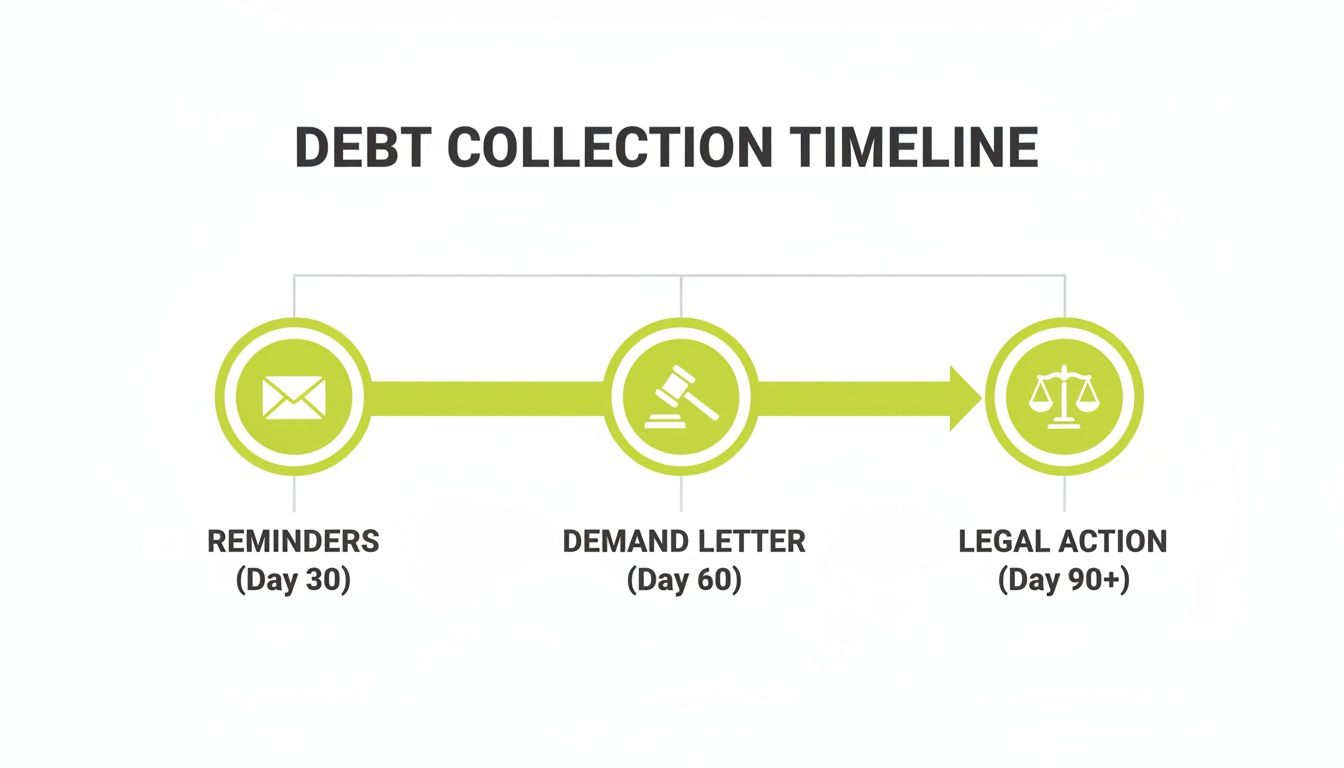
This step fits within a structured process, typically activated between 60 and 90 days past due, after standard collection efforts are exhausted.
Choosing the Right Delivery Method
The objective is to eliminate the "I never received it" excuse with undeniable proof of receipt.
- Certified Mail with Return Receipt: This is the standard for a reason. It provides a U.S. Postal Service-verified signature and delivery record, which is compelling evidence in court.
- Secure Digital Delivery: Platforms with read-receipts and digital signatures offer instant confirmation and a clean audit trail, integrating seamlessly with AR software for professional services.
For high-value accounts, use both methods. A certified letter reinforced by a tracked email creates a bulletproof physical and digital record.
Pinpointing the Optimal Timing
The timing of the letter is a strategic decision. Act with purpose, mindful of the statute of limitations that sets the legal deadline for filing a claim. The optimal window is typically 60 to 90 days past the invoice due date.
This timing demonstrates that you have exhausted standard channels—automated reminders, direct outreach—but are not willing to let the debt age further. Any earlier may seem overly aggressive; any later signals a lack of urgency.
A demand letter sent at the 90-day mark sends an unmistakable message: the account is moving from standard AR to a pre-litigation footing. It tells the debtor the window for informal resolution is closing.
Establishing an Unbreakable Follow-Up Protocol
Inaction after the deadline passes nullifies the letter’s authority. You have just demonstrated that your stated consequences are meaningless. A pre-defined protocol is essential.
Once the deadline passes without payment, your system must automatically trigger a pre-determined action:
- Final Executive Contact: A call from a Controller or CFO to their counterpart. This is not a negotiation but a final notification. The script is direct: "We sent a formal demand on [Date] with a deadline of [Date]. As payment has not been received, our next step is to engage legal counsel. Is there any reason we should not proceed?"
- Immediate Handoff to Counsel: For accounts with a history of broken promises, there should be no hesitation. The day after the deadline, the file is transferred to your attorney. This shows unwavering resolve.
Defining these next steps in advance removes emotion and hesitation. For more on systemizing collections, see our guide on effective procedures for accounts receivable. This operational discipline transforms a demand letter into a powerful tool that accelerates collections and improves cash flow.
Navigating Critical Legal and Jurisdictional Rules
A legal demand letter is a formal legal document, not just a sternly worded invoice. A single misstep can create new liabilities or render your claim unenforceable. Understanding the legal guardrails governing its content, tone, and delivery is a prerequisite to sending one.
For professional services firms, the primary risk lies in the complex web of state-specific consumer protection and fair debt collection laws. These statutes are designed to prevent deceptive or abusive practices and can sometimes extend to B2B transactions. Engaging counsel is a non-negotiable risk management step.
State-Specific Statutes and Their Impact
Each state has different rules. Some, like California's Unfair Competition Law (UCL) or Massachusetts' Chapter 93A, carry significant penalties, including triple damages and recovery of attorney's fees if a business is found to have acted unfairly.
A demand letter with an inflated claim, a threat you cannot legally execute, or a misrepresentation of the debt could invert the legal dynamic. Your collections effort could become a costly defense against a counterclaim.
The objective is a legally bulletproof demand. Every statement must be factually accurate, and every outlined consequence must be a legitimate, permissible next step. Your lawyer’s review serves as the final quality control.
The legal landscape is intensifying. Pre-suit demands, especially in U.S. privacy litigation, are rising, bundling consumer protection claims with demands for statutory damages. Certain California laws allow for damages up to $7,500 per violation. Under statutes like Chapter 93A, failure to respond correctly within a 30-day window can trigger severe penalties. You can read more about these surging pre-suit demand letters on pierceatwood.com.
Avoiding False or Unenforceable Threats
Making threats you cannot or will not execute destroys your credibility and exposes your firm to legal risk.
Common errors include:
- Threatening to report to credit bureaus. If your firm does not report to credit agencies, this is a false statement and a potential violation of the Fair Debt Collection Practices Act (FDCPA).
- Claiming you will "ruin their reputation." This is unprofessional and can be interpreted as harassment or defamation, inviting a counterclaim.
- Implying criminal action. Debt collection is a civil matter. Suggesting you will file criminal charges over a civil debt is a serious legal misstep.
Your demand letter must adhere strictly to the facts. It should only outline legitimate civil remedies, such as filing a lawsuit to recover the principal, plus any contractually agreed-upon interest and legal costs. For international business, understanding specific statutes like India's Cheque Bounce Act is critical when dealing with returned payments.
Working with your legal team ensures your demand letter strengthens your position for potential litigation rather than creating new liabilities.
Integrating Demand Letters into Your Automated AR Workflow
Manual accounts receivable processes create bottlenecks, introduce human error, and do not scale. This operational friction is what modern accounts receivable automation is designed to eliminate, particularly at the point of escalation to a legal demand letter.
An automated system converts your collections strategy into a predictable, repeatable process. It ensures the right actions occur at the right time, every time, without manual intervention.

Systematizing the Escalation Process
The core benefit of AI AR automation is operational discipline. You can build smart workflows that automatically trigger a demand letter based on pre-defined rules, moving a critical decision from an individual's to-do list to a system-driven event.
These triggers are tied directly to financial data within your ERP or accounting system.
- Invoice Age: Escalate any invoice that reaches 90 days past due without an active payment plan.
- Outstanding Balance: Define a materiality threshold (e.g., $10,000) that automatically initiates a formal collections path.
- Client Risk Score: Flag clients with a history of late payments for earlier, more assertive action.
- Broken Promises: The system logs payment commitments. After two missed commitments, the account is automatically escalated to the pre-legal stage.
This system removes inconsistency and ensures every high-risk account is managed with the same rigor, directly impacting your ability to reduce DSO and improve cash flow. For a deeper look, see our guide to accounts receivable automation software.
The Power of an Automated "Voice of a Lawyer"
An effective use of AI AR automation is deploying an authoritative "voice of a lawyer" communication at the precise moment it will have the most impact. This system-generated, legally reviewed communication carries significant weight without the immediate cost of outside counsel.
Automating this step ensures critical communications are not missed due to workload constraints. It bridges the gap between standard reminders and full legal action, applying calibrated pressure when it is most effective.
Data supports this approach. Legal demand letters resolve 65-80% of commercial disputes before litigation. Firms using automated demand letters have reduced write-offs by as much as 35%. Our pilots at Resolut show a 28% lift in payment rates within 7 days of an automated letter, recovering 22% more on invoices over 90 days past due.
This is not just another email. It is a data-driven message communicating that the window for informal resolution is closing, compelling the client to act.
The Measurable Outcomes of Automation
For finance leaders, technology is only valuable if it produces tangible results. Integrating dedicated AR software for professional services delivers measurable financial outcomes. Even for firms using general systems like QuickBooks AR automation, a specialized platform amplifies these gains.
The benefits are direct:
- Absolute Consistency: Every overdue account is treated according to firm policy, eliminating variance and neglect.
- Improved Accuracy: Automation pulls data directly from your financial systems, ensuring correct invoice numbers, dates, and amounts, which minimizes disputes.
- Scalable Collections: Manage a growing number of accounts without increasing headcount. The system handles the administrative load, freeing your team for strategic analysis.
By integrating the legal demand letter into an automated workflow, you convert a reactive, manual task into a proactive, strategic tool. It becomes a predictable and effective way to improve cash flow and protect your firm's financial health.
Your Questions, Answered
Here are practical answers for finance leaders in professional services firms. A demand letter is a tool you hope to never use, but must execute correctly when necessary.
Should the Demand Letter Come From Us or a Lawyer?
This depends on the required level of escalation.
An initial letter on your firm's letterhead, signed by the CFO or Controller, is a serious internal step. It keeps the dialogue direct but signals the matter has moved beyond routine collections. For many clients, this is a sufficient catalyst.
If that fails, a legal demand letter for payment from outside counsel fundamentally alters the dynamic. It communicates that you have engaged legal representation and are prepared for litigation. Some accounts receivable automation platforms can replicate this escalation, moving from a formal internal notice to a firmer, lawyer-like tone.
What is the Biggest Mistake Firms Make?
The most common and damaging mistake is allowing emotion to influence the content. A demand letter is not a venue for frustration, threats, or accusations.
The letter must be a dry, precise statement of fact: who owes the money, how much is owed, for what services, and the payment deadline. Nothing more.
Any subjective or threatening language can be used against you. At best, it provides an excuse for delay. At worst, it could form the basis of a counterclaim.
The most effective demand letters read like a financial ledger. They are stripped of emotion. Adhere to invoice numbers, dates, and contractual terms. Leave no room for interpretation.
The goal is not to win an argument, but to present an undeniable claim.
How Long Should We Wait for a Response Before Taking the Next Step?
Provide a reasonable but firm deadline. Typically, 10 to 30 days is standard, depending on the situation and jurisdiction.
The critical element is acting immediately when the deadline expires without payment or response.
Hesitation signals that your deadlines are negotiable, undermining the letter's authority. Your internal process, ideally managed by AR software for professional services, should automatically trigger the next step—a final call from the CFO or an immediate transfer to legal counsel. Consistency is essential to reduce DSO.
Can Sending a Demand Letter Hurt the Client Relationship?
Yes, which is why it is a tool of last resort.
A legal demand letter for payment is used when polite reminders and direct calls have failed. By the time you send one, the client’s non-payment has already damaged the relationship.
When drafted professionally—factually and without emotion—the letter does not create a new problem. It enforces the commercial terms you both agreed to. A well-designed AR process, particularly one driven by AI AR automation, is designed to resolve issues long before this stage, which is the best way to improve cash flow while preserving valuable client relationships.
--- Resolut automates AR for professional services—consistent, accurate, and human. Learn more.