A CFO's Guide to the Payment Request Letter Format
Discover the letter format for payment request that CFOs use to reduce DSO, improve cash flow, and maintain client relations. Templates and strategies inside.
Treating your letter format for payment request as a simple administrative task is a significant operational error. It’s a critical financial control. An imprecise format introduces friction that delays revenue and strains the client relationships you’ve worked to build.
A vague or inconsistent approach doesn't just look unprofessional; it directly impacts Days Sales Outstanding (DSO) and complicates cash flow forecasting.
The Financial Drag of a Flawed Payment Request Process
For a financial operator, a weak payment request process is a direct threat to predictable cash flow. This is not a minor paperwork issue—it’s a systemic vulnerability that introduces ambiguity into your accounts receivable cycle.
When your letters are inconsistent or omit key invoice details, you force your client's AP team to become detectives. That friction translates directly into higher DSO, tying up working capital that should be fueling growth.

Quantifying the Impact on Cash Flow
The financial drag from unpaid invoices is larger than most professional services firms estimate. Industry data reveals that roughly 1 in 10 invoices go unpaid, creating a significant administrative burden and revenue leakage.
Firms that implement a structured, systematic approach—with clear subject lines, invoice recaps, and direct payment links—report boosting recovery rates by 25-30%. You can explore the full payments report from McKinsey for a deeper analysis.
*Visual Idea 1: *A simple line graph showing two lines. Line 1 (blue) is labeled "Manual AR Process" and shows DSO flatlining at 45 days. Line 2 (green) is labeled "Automated AR Workflow" and shows DSO declining from 45 days to 30 days over six months.
Manual effort compounds this problem. Every hour your finance team spends chasing payments is an hour not spent on strategic analysis. For more on this, explore the true cost of AR inefficiency in professional services.
A flawed payment request is more than a communication breakdown; it's a cash flow bottleneck. It signals operational looseness that clients, consciously or not, deprioritize. Systemizing this touchpoint is a foundational step to improve cash flow.
Downstream Consequences
The impact extends beyond the balance sheet. An unstructured process creates compounding problems across the business:
- Eroded Client Trust: Unprofessional or confusing communication damages client relationships.
- Inaccurate Forecasting: Unpredictable payment timelines make revenue forecasting a guess, complicating strategic planning.
- Increased Delinquencies: Without a clear, escalating communication plan, overdue accounts age, increasing the risk of write-offs.
Standardizing your payment request letter is about regaining control. It transforms a reactive, manual task into a systematic financial process that accelerates payments.
This is where accounts receivable automation provides leverage. By implementing AI AR automation, firms can enforce this standard with perfect consistency. For those on common accounting platforms, QuickBooks AR automation can seamlessly integrate these structured communications, turning a point of friction into a driver of efficiency.
Anatomy of a High-Impact Payment Request Letter
An effective payment request is an exercise in precision, not a demand for money.
Its sole function is to remove friction from your client's accounts payable process, making it simple for them to pay you on time. This requires a standardized format that leaves zero room for ambiguity. Every communication must be professional and immediately actionable.
Think of it as providing a clear, easy-to-follow document that simplifies the workflow for your client’s AP team. This systematic approach is the foundation for lowering your DSO and securing your cash flow.

The Subject Line an AP Team Expects
The first component to optimize in any letter format for payment request is the subject line. It must be clear, professional, and instantly searchable. Vague subjects like "Invoice" are a ticket to being ignored.
An effective subject line includes three key data points:
- Your firm's name
- The specific invoice number
- A clear status indicator ("Payment Due")
Example: "[Your Firm Name] - Payment Due for Invoice #INV-7891". This structure allows the recipient to identify, categorize, and act on your request without opening the email.
Core Components for Clarity and Action
Inside the letter, every word must guide the recipient toward payment. Ambiguity is the enemy of prompt collections. Your letter must be direct, containing only the essential information needed to process payment.
A well-structured payment request anticipates the questions your client's AP team will ask and answers them upfront. This proactive clarity is the difference between an invoice paid on net 30 versus one that ages to net 60 or beyond.
This is where tools like accounts receivable automation excel. Platforms can auto-populate these fields with 100% accuracy, eliminating the human error that leads to payment delays.
A Breakdown of Essential Elements
To build a letter that gets results, include these non-negotiable components. Each one serves a distinct purpose: eliminate confusion and accelerate payment.
Key Components of an Effective Payment Request
Component | Purpose | Example Language |
|---|---|---|
Clear Opening | Immediately states the purpose of the communication without unnecessary preamble. | "This is a reminder that invoice #INV-7891 is due for payment." |
Invoice Details | Provides an at-a-glance summary of the key invoice data. | "Invoice Number: INV-7891<br>Amount Due: $15,250.00<br>Due Date: October 31, 2024" |
Direct Payment Link | Removes all barriers to payment by providing an immediate action path. | "You can securely pay this invoice online here: [Payment Portal Link]" |
Attached Invoice | Ensures the original invoice document is readily available for their records. | "For your reference, a PDF copy of the invoice is attached." |
Integrating this structure with tools like QuickBooks AR automation ensures consistency across all client communications.
The right AR software for professional services will make this structure the default for every outgoing request, enforcing financial discipline. Newer platforms using AI AR automation can adjust tone based on client payment history, but this core anatomy remains constant.
Calibrated Templates for Each Stage of the Collection Cycle
Using a single, generic payment request is a blunt instrument that ignores the critical variable in collections: time.
A sophisticated AR process requires different gears, adjusting tone and urgency as an invoice ages. An email sent five days before an invoice is due should feel completely different from one sent 30 days after.
This calibration protects client relationships while gently—and then firmly—escalating the pressure to pay.
*Visual Idea 2: *Cinematic, slightly desaturated close-up of a digital dashboard. In sharp focus is a single metric: "DSO: 28 Days," with a small green arrow pointing down. The background is blurred, suggesting a calm, controlled office environment.
Stage 1: The Proactive Reminder (Due Date -5 Days)
The first move in a modern AR cycle occurs before the invoice is due. This is a customer service touchpoint, not a collection attempt. You are simply ensuring the invoice is on their radar and queued for payment.
The tone is light, helpful, and assumes positive intent.
The goal is preventative. A proactive nudge like this can prevent up to 40% of late payments before they happen, which improves cash flow predictability.
Example Proactive Reminder Template
Subject: Reminder: [Your Firm Name] Invoice #INV-7891 Due [Due Date] >Hi [Client Contact Name], >This is a reminder that invoice #INV-7891 for [$Amount] is due for payment on [Due Date]. >A PDF of the invoice is attached. You can make a secure payment online here: [Payment Portal Link]. >Please let us know if you have any questions. >Best, >[Your Name/Finance Team]
This is intentionally concise. It provides everything they need—invoice number, amount, due date, payment link, and the document—without demanding language.
Stage 2: The Firm Past-Due Notice (Due Date +7 Days)
Once an invoice is officially late, the tone shifts. It remains professional but becomes more direct. The assumption of oversight gives way to a clear statement that an obligation has been missed.
The objective is to create mild urgency, moving this invoice from a routine task to a priority. This is also the time to reference payment terms. You can find ready-to-use structures in various payment request form templates to streamline this process.
Example Firm Past-Due Notice Template
Subject: Action Required: [Your Firm Name] Invoice #INV-7891 is Overdue >Hi [Client Contact Name], >Our records indicate that payment for invoice #INV-7891, due on [Due Date], has not yet been received. The outstanding balance is [$Amount]. >As per our service agreement, timely payment is required. Please prioritize this payment to bring your account current. >You can settle the balance immediately via our secure portal: [Payment Portal Link]. >If payment has been sent, please disregard this notice. Otherwise, please confirm your expected payment date. >Thank you, >[Your Name/Finance Team]
Note the shift in language. "Reminder" becomes "Action Required." "Is due" becomes "is Overdue." These tweaks signal a change in status without aggression.
Stage 3: The Final Demand (Due Date +45 Days)
When an account is seriously delinquent, the communication must convey finality. The tone is no longer suggestive; it is authoritative. This letter spells out the consequences of continued non-payment.
The strategy here is to clarify that the next step is escalation, whether to a collections agency or legal counsel. This communication serves as a final filter, prompting payment from clients who only respond to serious escalation.
Example Final Demand Letter Template
Subject: FINAL NOTICE: Immediate Payment Required for Overdue Invoice #INV-7891 >[Client Contact Name], >This letter serves as a final demand for payment on invoice #INV-7891, which is now [Number] days overdue. The outstanding balance is [$Amount]. >We have sent multiple reminders regarding this delinquent payment and have not received payment or a commitment to pay. >You have 10 business days from the date of this letter to settle the full balance. Failure to do so will result in this matter being escalated to our third-party collections partner, which may impact your company's credit standing. >To avoid this action, remit payment immediately: [Payment Portal Link]. >This is your final opportunity to resolve this matter directly. >Sincerely, >[Controller/CFO Name][Your Firm Name]
This message is unequivocal. It uses bolding for emphasis, sets a hard deadline, and states the consequences. When this methodical escalation is embedded within accounts receivable automation, you ensure every invoice is managed with precision.
Tying Letters Into an Automated AR Workflow
Manually sending every payment request is a low-value, high-volume task that is prone to human error and inconsistency. It consumes finance team hours that should be allocated to strategic analysis.
A perfectly crafted set of payment request letters becomes a true asset only when connected to an automated workflow. This is the shift from a manual, reactive chore to a proactive, systematic engine for cash collection.
The objective is to build a system where the right template goes to the right client at the right moment, triggered automatically by an invoice's age or client data. This ensures every communication is consistent, professional, and timed for maximum impact.
From Manual Tasks to Intelligent Triggers
The efficiency gain comes from workflow automation. Instead of a team member manually checking aged receivables, the system executes. This is the baseline for any modern accounts receivable automation software.
Workflows can be based on simple, powerful rules:
- Before Due Date: Automatically send the "Proactive Reminder" template five days before an invoice is due.
- Just Past Due: Trigger the "Firm Past-Due" notice exactly seven days after the due date.
- Escalation: Schedule the "Final Demand" to be sent at 45 days past due.
This programmatic approach removes the guesswork and hesitation from manual collections. It enforces your payment terms with perfect consistency, which conditions clients to pay more promptly over time.
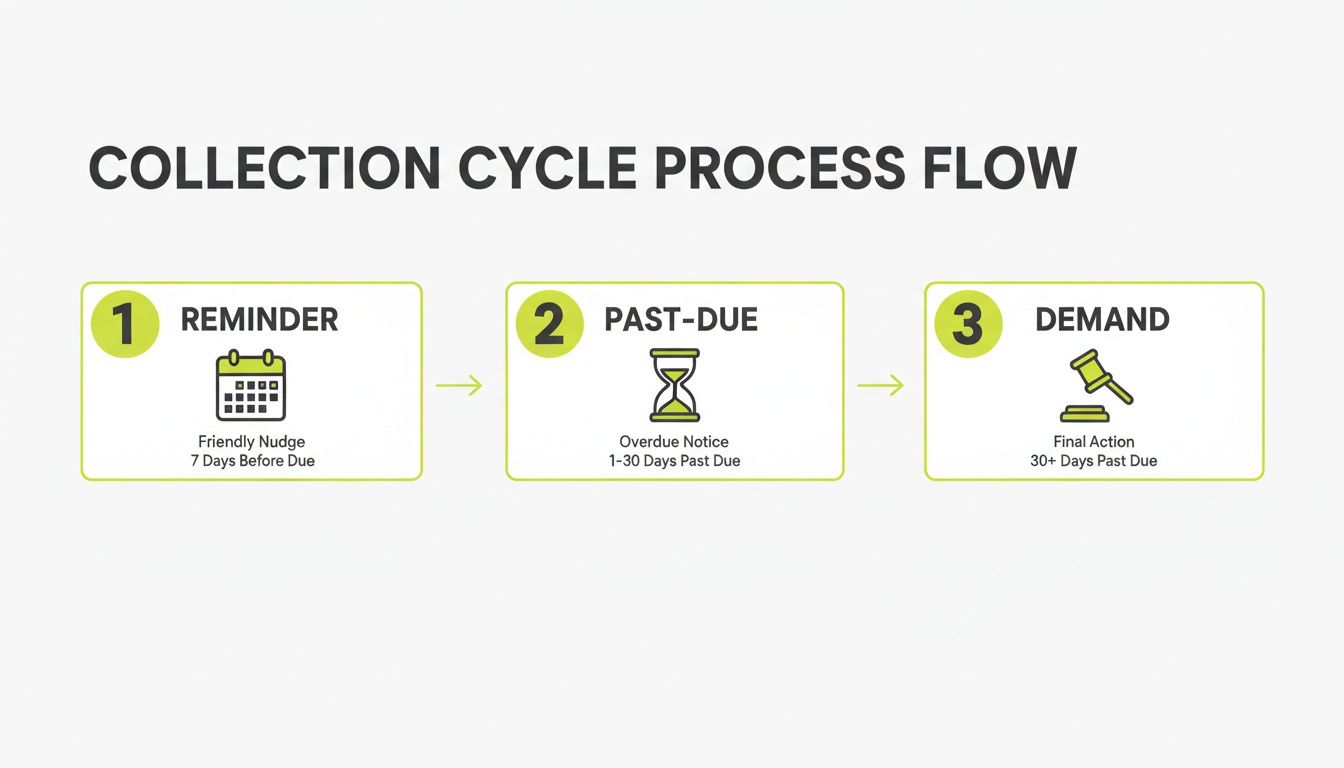
Automation creates a predictable, escalating cadence that eliminates the need for manual decision-making in most collection scenarios.
Personalization at Scale and Frictionless Payments
"Automation" does not have to mean "robotic." Effective AR software for professional services uses dynamic fields to pull in specific client and invoice details, ensuring every automated letter feels personal and relevant.
Embedding a direct payment link within each automated email is a game-changer. This single feature removes the largest point of friction. Instead of forcing a client to log into a portal, they can settle the invoice with a single click.
Integrating payment links into automated reminders has been shown to reduce DSO by an average of 5-8 days. It turns a simple notification into an immediate, actionable payment opportunity.
Platforms like Resolut take this further, with automated omnichannel letters that can cut manual AR work by 70% and slash DSO by 15 days on average.
The Power of AI in AR Automation
The most advanced platforms now layer in AI AR automation, which goes beyond simple, time-based triggers. This technology can analyze a client’s payment history to predict which accounts are at high risk of delinquency. It’s also worth seeing how AI helps personal injury lawyers draft powerful demand letters for a sense of how sophisticated these tools have become.
This allows the system to intelligently adjust its strategy, perhaps by sending reminders more frequently to a historically late client. For firms in the ecosystem, QuickBooks AR automation integrations are a seamless way to connect these smart workflows to existing financial data.
The goal is a system that handles routine collections and provides data for more effective receivable management services. Automating mundane work frees your finance team to focus on high-value exceptions and strategic cash flow decisions.
A Framework for Escalation When Letters Fail
Even the most effective payment request has its limits. A defined, internal escalation path is what separates firms that protect revenue from those that prematurely write off debt.
Your automated emails are the workhorse of your AR process. When they are ignored, it is a signal for human intervention, not a system failure.
The goal is to apply targeted pressure in a controlled, documented way, ensuring you systematically pursue every dollar while building a defensible collections history.
From Automated Letters to Direct Calls
The first step beyond ignored emails is a direct phone call from your finance team.
This transition should not be a manual decision. Your accounts receivable automation platform should trigger this step once an invoice hits a specific age, typically between 60 and 75 days past due.
This is not a cold call. Your team member enters the conversation with the full history of every email sent and opened. This context keeps them in control.
The call has a simple mission:
- Confirm receipt of invoices and reminders.
- Identify the reason for non-payment: oversight, cash flow problem, or dispute?
- Secure a firm payment date. Vague promises are insufficient.
A direct conversation uncovers issues emails cannot. It is a tactical intervention designed to break the cycle of silence.
A well-timed phone call moves the conversation from a passive email exchange to an active dialogue. It re-establishes a personal connection and signals that the invoice has become a priority that requires immediate attention.
The Pre-Collections Notice: A Final Internal Warning
If the phone call fails to produce payment, the final internal step is the ‘pre-collections notice.’
This is a formal, authoritative communication that clarifies the seriousness of the situation. Sent through your AR platform for documentation, this notice looks and feels different from previous communications.
It must state plainly that failure to pay by a final deadline (e.g., 10 business days) will result in the account being passed to a third-party collections agency. This step creates powerful urgency and a clean, documented hand-off. A clear notice of impending escalation can reclaim 10-20% of severely aged receivables. You can discover more insights about B2B payments on mckinsey.com.
This structured framework ensures you apply the right pressure at the right time. It’s a disciplined approach that helps reduce DSO and protects your firm's bottom line.
From Chasing Payments to Orchestrating Cash Flow
Mastering the letter format for payment request is more than an exercise in template design. It is a fundamental shift in managing your firm’s financial operations.
This is not about being a better bill collector. It is about moving from a reactive, manual task to a strategic, data-driven system.
When you standardize communication, you stop “collecting money” and start orchestrating your cash flow with precision. This proactive approach doesn't just lower your DSO; it frees your team from low-value follow-up. For a scaling firm, that is a core part of building a stable financial foundation. You can find more strategies in our guide on ways to increase cash flow.
A systematic approach to receivables strengthens client relationships. It replaces the ambiguity of manual follow-ups with professional, predictable communication.
When you pair this process with AI AR automation, you turn a manual bottleneck into a driver of predictable revenue. This is where technology helps you enforce discipline, not just send reminders.
Common Questions About Payment Requests
How Often Should I Send Payment Reminders?
The optimal cadence is persistent without being intrusive. A good rhythm starts with a reminder 3–5 days before the due date, followed by a notice on the due date itself.
Once past due, the cadence should be firm and predictable: follow up at 7, 15, and 30 days overdue. This demonstrates professional diligence.
Accounts receivable automation executes this cadence flawlessly, so your team can focus on exceptions.
What Is the Most Critical Part of a Payment Request Email?
The subject line. Clarity trumps cleverness. Your client’s finance team is managing a high volume of emails and prioritizes based on clarity.
Make their job easier. Always include your company name and the invoice number, such as: “[Your Company Name] - Invoice #12345 Due”. This makes the email instantly searchable and actionable.
When Should Late Fees Be Mentioned?
Introduce the concept of late fees in your first firm past-due notice, typically sent at 7 to 15 days overdue. This should be a reminder of the terms previously agreed to in your service contract.
More serious consequences, like escalation to collections, should be reserved for your final demand letter. This is typically sent after 60 days of non-payment and serves as the final opportunity for direct resolution.
This tiered approach protects the client relationship while enforcing payment terms. Embedding this logic into an AI AR automation platform ensures the correct level of urgency is applied at the right time, which is key to systematically improving your cash flow.
--- Resolut automates AR for professional services—consistent, accurate, and human. Learn more at resolutai.com.