
Outsourced Accounts Receivable: From Administrative Drain to Financial Control
Explore how outsourced accounts receivable helps professional services CFOs reduce DSO, improve cash flow, and gain financial control with AR automation.
For CFOs and controllers, accounts receivable isn't just an administrative function. It's the final, critical step in the cash conversion cycle.
When managed in-house, AR often becomes a source of operational drag. The process is manual, inconsistent, and pulls high-value finance talent into low-value tactical work.
The result is predictable: extended Days Sales Outstanding (DSO), strained working capital, and a lack of clear visibility into cash flow.
Outsourcing AR isn't about offloading tasks. It's about implementing a system designed for precision, predictability, and control.
Moving Beyond In-House Accounts Receivable
Traditional in-house AR management at professional services firms is inherently inefficient. The model itself creates friction.
Inconsistent client follow-up, manual cash application errors, and the high overhead of specialized staff all contribute to a slower cash cycle.
This isn't a critique of your team. It's a limitation of the manual systems they are forced to operate within. Each point of friction adds days to your DSO.
The Strategic Shift in Perspective
Viewing outsourced accounts receivable as a cost-cutting measure misses the primary benefit: transforming AR into a data-driven, predictable financial operation.
You aren't relinquishing control; you are gaining it through technology and specialized process management.
- Improved Consistency: An outsourced partner executes a systematic, repeatable process for invoicing, communication, and collections. The variability that plagues internal teams disappears.
- Access to Technology: Leading providers utilize accounts receivable automation and AI-driven platforms that predict payment behavior and streamline workflows, technology you wouldn't build in-house.
- Enhanced Focus: Freeing your finance team from daily collections allows them to concentrate on high-value activities: forecasting, FP&A, and strategic financial modeling.
Outsourcing converts AR from a reactive cost center into a predictable source of working capital. It's an acquisition of expertise and technology.
This strategic shift is reflected in the market. The global accounting outsourcing market is projected to grow from $54.79 billion in 2025 to $81.25 billion by 2030.
This growth indicates a clear move by financial operators to leverage specialization as a tool to improve cash flow.
Modern solutions integrate seamlessly with core financial systems. For firms running on platforms like QuickBooks, effective QuickBooks AR automation through a partner creates a unified system, ensuring data integrity and real-time visibility. Understanding modern receivable management services is the first step.
This reframing allows financial leaders to unlock working capital, reduce DSO, and achieve a reliable, real-time view of the firm’s financial position.
Calculating the True ROI of Outsourced AR
A genuine ROI calculation for outsourced AR extends beyond comparing a vendor fee to current payroll costs.
The analysis must connect the operational change to core financial metrics: working capital, DSO, and the strategic allocation of your finance team's time.
Direct cost savings—salaries, benefits, and licensing fees for AR software for professional services—are the most obvious component, but they represent a fraction of the total return.
The most significant gains come from operational efficiency and risk mitigation.
The Impact on Working Capital and DSO
Days Sales Outstanding (DSO) is the most critical lever in AR management. Each day reduced from your DSO directly unlocks working capital.
This is where specialized AR partners deliver measurable value. They apply a disciplined, consistent collections process that internal teams, managing competing priorities, cannot sustain.
Consider a professional services firm with $10 million in annual revenue and a DSO of 60 days. This ties up approximately $1.64 million in receivables.
- Before (60-day DSO): ($10,000,000 / 365) * 60 = $1,643,835 in receivables.
- After (50-day DSO): ($10,000,000 / 365) * 50 = $1,369,863 in receivables.
A 10-day DSO reduction—a conservative target for a focused AR partner—frees up over $270,000 in cash. This is a permanent improvement to the firm's liquidity. This single metric often justifies the entire business case.
This is a market-wide strategy. The accounting outsourcing market is projected to grow from $54.8 billion in 2025 to over $81.3 billion by 2030.
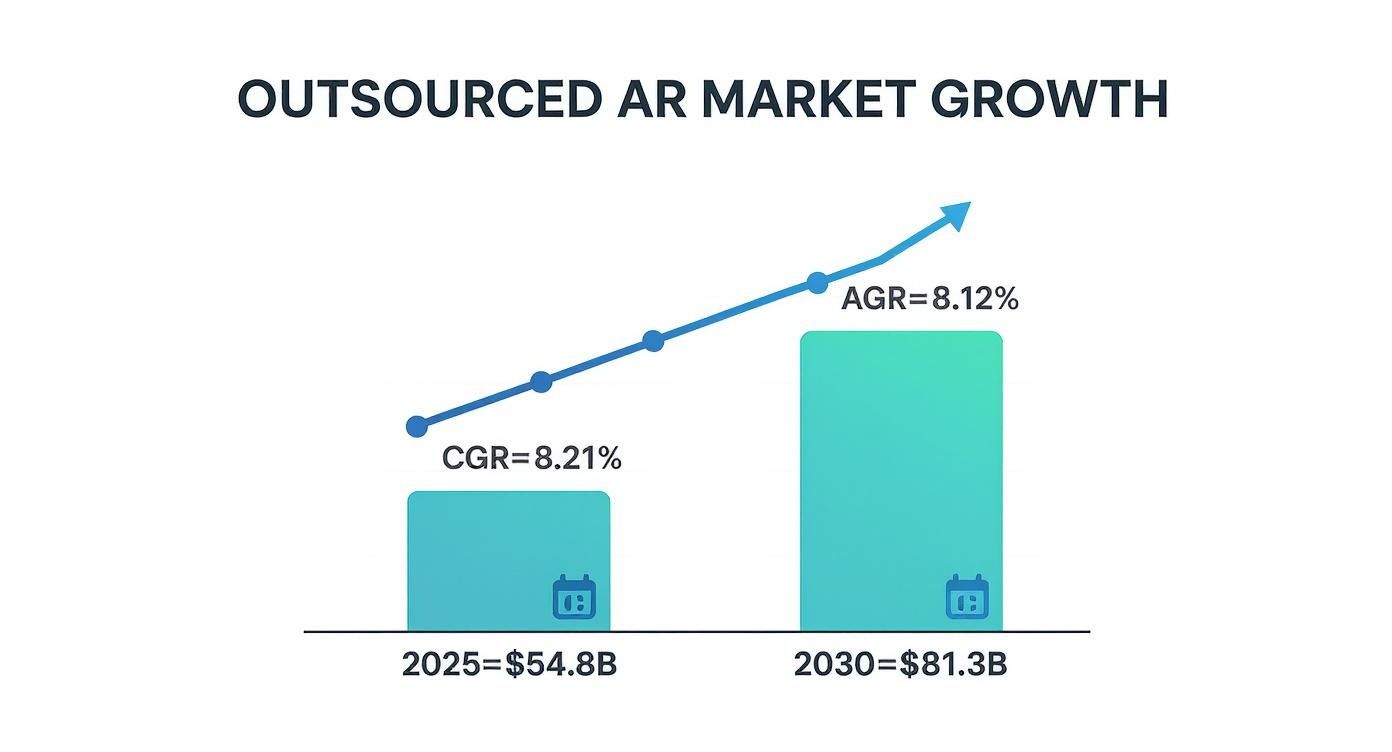
A compound annual growth rate of 8.21% reflects the increasing recognition among financial leaders that specialization is the most direct path to a stronger cash position.
A Quick Cost-Benefit Look
Mapping the direct and indirect financial implications provides clarity. The following table contrasts the two models.
Cost-Benefit Analysis of In-House vs Outsourced AR
Metric | In-House AR Operations | Outsourced AR Solution |
|---|---|---|
Direct Costs | Full-time salaries, benefits, payroll taxes, overhead (office space, equipment). | Predictable monthly or per-transaction fee. |
Software & Tools | Licensing fees for accounting software, AR automation tools, and payment portals. | Technology costs are typically included in the service fee. |
Working Capital | Higher DSO ties up significant cash in outstanding receivables. | Lower DSO frees up working capital for growth or operations. |
Bad Debt | Higher risk of write-offs due to inconsistent follow-up and lack of specialized resources. | Lower bad debt expense due to professional, systematic collection processes. |
Team Focus | Senior finance staff often pulled into tactical collection activities. | Finance team is free to focus on strategic analysis, forecasting, and planning. |
Scalability | Scaling requires hiring and training new staff, a slow and costly process. | Scales instantly with your business growth without additional hiring. |
The fixed, predictable cost of an outsourced solution often generates far greater value by improving core financial metrics and reallocating your most valuable internal resources to strategic work.
Quantifying Risk Reduction and Strategic Value
An accurate ROI model must also account for bad debt reduction and the strategic value of your finance team's reclaimed time.
Reducing revenue write-offs from 1.5% to 1% on a $10 million revenue base adds $50,000 directly to the bottom line.
The true value of outsourced AR lies in converting a reactive, administrative function into a predictable, data-driven financial asset. It’s about gaining control, not relinquishing it.
The most significant return, however, is the strategic output of your finance team. When a controller is no longer managing collections, they can focus on financial modeling, improving forecasting accuracy, and identifying operational efficiencies.
For more on this, our guide on ways to increase cash flow details complementary strategies.
The combination of direct savings, unlocked cash from a lower DSO, reduced bad debt, and the strategic lift from a refocused finance team creates a compelling ROI.
How AI and Automation Transform AR Management
Modern outsourced accounts receivable is a technology and data strategy, not just a labor arbitrage play.
The operational shift is from a reactive, manual AR process to a predictive, automated one. This provides a level of control and visibility unattainable with manual systems.
At the core is accounts receivable automation. An AI-driven platform executes follow-up with perfect consistency, eliminating the human error and variability that extend payment cycles.
Invoices are delivered on schedule. Payment reminders are sent based on predefined rules. Cash is applied accurately upon receipt.
For professional services firms with complex billing, this consistency alone provides a significant operational advantage.

From Reactive Collections to Predictive Insights
The primary value of AI AR automation is its predictive capability.
Traditional AR is reactive; action is taken only after an invoice is overdue. Modern systems use data to anticipate payment behavior.
Predictive analytics engines analyze payment histories, communication patterns, and invoice details to identify accounts likely to pay late. This enables a proactive, targeted approach.
- Early Risk Detection: AI identifies clients exhibiting late-payment indicators, allowing for early intervention before the due date.
- Smarter Communication: The system learns which communication channels and times yield the best response rates for each client.
- Focus Where It Matters: By flagging high-risk accounts, the technology directs human attention to complex disputes or high-value relationship management.
You shift from chasing debt to managing payment risk, actively shortening the cash conversion cycle.
What This Looks Like in a Professional Services Firm
For a CFO or Controller, this must translate into measurable outcomes.
For example, an AI-powered system can handle routine client inquiries about invoice details or payment options 24/7, freeing your team from low-value administrative tasks.
The data supports this model. Firms implementing AI in their AR processes report cost reductions up to 50% and significant DSO improvements. Using AI for routine inquiries can reduce support tickets by up to 60%.
When you engage a modern outsourced AR provider, you are acquiring a technology stack that delivers superior data, tighter control, and a measurable impact on your firm’s financial health.
This technology integrates directly with existing systems, providing QuickBooks AR automation that feels like a native extension of your workflow. Our guide to accounts receivable automation software provides a deeper analysis of the underlying technology.
This transforms AR from a cost center into a strategic asset that helps you improve cash flow, reduce DSO, and make more informed financial decisions.
How to Choose the Right AR Partner
Selecting an outsourced accounts receivable provider is a critical financial decision. You are entrusting a core component of your cash conversion cycle to a third party.
The right partner operates as a seamless extension of your finance department. The wrong one creates operational friction and can damage client relationships.
An effective evaluation process prioritizes expertise, technology, and process alignment over simple price comparisons. For a professional services firm, the partner must understand project-based billing and the importance of professional, client-centric communication.
Core Evaluation Criteria
Define your success criteria before reviewing proposals. A structured selection process should be built on three pillars: industry expertise, technology stack, and operational process.
A provider weak in any of these areas introduces unnecessary operational risk.
- Professional Services Expertise: Do they have demonstrable experience with firms in the $3M–$50M revenue range? They must understand your billing models. Request case studies and references from comparable firms.
- Technology and Integration: How seamlessly does their accounts receivable automation software integrate with your GL, particularly QuickBooks? Insist on a live demo of their QuickBooks AR automation to verify it is a true integration, not a manual workaround.
- Client Communication Process: How will they represent your firm? Request detailed documentation of their communication workflows. The tone must be professional and aligned with your brand.
Critical Questions for Potential Partners
Once you have a shortlist, your objective is to pressure-test their operational capabilities. Vague answers to specific process questions are a significant red flag.
A potential partner’s response to detailed operational questions reveals their level of sophistication. If they cannot clearly explain their dispute resolution workflow or data security protocols, they lack the required operational discipline.
Drill down into the specifics. As you build your evaluation framework, it can be helpful to understand general best practices for [choosing the best Business Process Outsourcing (BPO) providers](https://lathire.com/business-process- outsourcing-providers/).
*Visual Idea 1: *Chart showing vendor evaluation criteria. X-axis: Expertise, Technology, Process, Security. Y-axis: Score (1-10). Plot hypothetical scores for Vendor A vs. Vendor B, showing a clear data-driven choice.
Due Diligence Checklist
Use this checklist to cover non-negotiable operational areas during your evaluation:
- Dispute Resolution Workflow: Request a step-by-step map of their process for handling a disputed invoice. Define the point of contact, escalation path, and reporting mechanism.
- Data Security and Compliance: How is your financial and client data secured? Inquire specifically about their SOC 2 compliance and other relevant certifications. This is non-negotiable.
- Team Experience: Who will manage your account? Ask about the operational experience of the team members, not just the sales representatives. What is their background in finance for professional services?
- Reporting and KPIs: What metrics define their success, and how are they reported to you? Expect a dashboard with real-time access to DSO, Collection Effectiveness Index (CEI), and an aging summary.
*Visual Idea 2: *Cinematic image of a CFO and Controller in a modern, minimalist office, looking at a large screen displaying a clean, data-rich AR dashboard. The feeling is one of calm, information-driven control.
A structured evaluation framework shifts the decision from one based on price to one based on capability. This discipline ensures you select a partner who will reliably improve cash flow and function as a strategic asset.
Implementing Your Outsourced AR Solution
Transitioning to an outsourced accounts receivable partner is a managed process, not an event.
A well-executed implementation is seamless. A poorly managed one disrupts cash flow and creates internal friction. For CFOs and Controllers, precision in this handoff is critical.
A structured 90-day roadmap provides a clear, shared plan that breaks the project into manageable phases, establishing trust and accountability from the start.
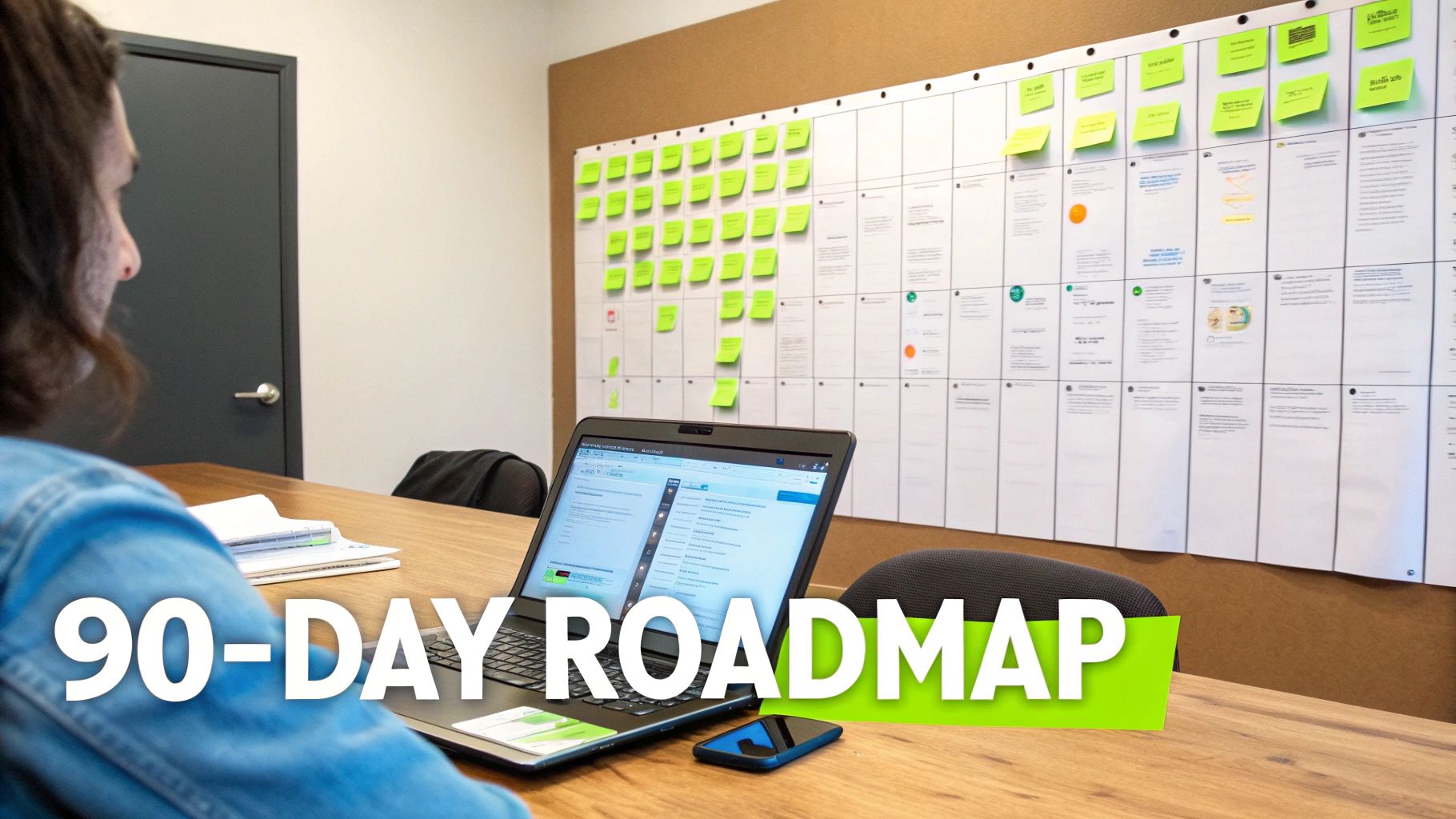
Days 1-30: Discovery and Integration
The first 30 days are dedicated to system and process alignment. Your partner must integrate with your financial operations, systems, and client communication standards.
- System Integration: The technical connection is established between their platform and your accounting software. For QuickBooks users, this phase ensures flawless QuickBooks AR automation.
- Data Migration: Historical AR data, client contacts, and open invoices are securely migrated. Data integrity is the sole focus.
- Scope and Process Mapping: You and your partner collaboratively define the rules of engagement. Every step of the AR workflow is mapped to eliminate ambiguity.
Days 31-60: Parallel Operations and Refinement
The second month involves running the outsourced process in parallel with your existing one. This phase acts as a safety net and validation period.
It allows you to stress-test the new workflow with live data, compare performance directly, and identify any process gaps before the full cutover. This is the time to refine communication templates and follow-up cadences.
A parallel run is not a sign of hesitation; it is a mark of operational discipline. It provides the data to confirm performance and builds internal confidence before the final transition.
Days 61-90: Full Transition and Performance Monitoring
In the final month, your AR partner assumes full ownership of the defined workflows. Your internal team’s role shifts from execution to oversight.
The focus moves to monitoring KPIs and continuous improvement.
- Establish Baseline KPIs: Document the starting metrics: Days Sales Outstanding (DSO), Collection Effectiveness Index (CEI), and the percentage of past-due receivables.
- Weekly Performance Reviews: Conduct brief, data-driven check-ins to review progress against baseline metrics and address any emerging issues.
- Refine Communication Protocols: Solidify the communication loop between your partner, your finance team, and your client-facing teams.
A structured 90-day plan transforms a potentially disruptive change into a controlled, predictable upgrade to your finance operation, positioning your outsourced accounts receivable solution to improve cash flow consistently.
Key Performance Indicators for Monitoring AR Success
Engaging an outsourced partner is the beginning of the process, not the end. Effective oversight is required.
Success is measured by objective data. The right key performance indicators (KPIs) provide the financial dashboard needed to ensure accountability and quantify the impact on your firm's financial health.
A sophisticated approach involves tracking a select group of metrics that together provide a comprehensive view of your cash conversion cycle. Relying solely on Days Sales Outstanding (DSO) is insufficient.
Beyond DSO: The Metrics That Really Matter
DSO is a lagging indicator. To gain a real-time, nuanced view of performance, you must track metrics like the Collection Effectiveness Index (CEI) and Average Days Delinquent (ADD).
Effective monitoring relies on clear data analytics in financial services. Your partner must provide a transparent dashboard with these KPIs clearly displayed.
The essential metrics for monitoring include:
- Days Sales Outstanding (DSO): The baseline metric for the average number of days to collect payment. The goal is a steady, downward trend.
- Collection Effectiveness Index (CEI): Measures the percentage of collectible receivables that were actually collected during a period. A CEI near 100% indicates a highly efficient collections process.
- Average Days Delinquent (ADD): Focuses specifically on overdue invoices, showing the average number of days they are past due. This is a precise indicator of delinquent account management.
- AR Aging Report: A critical snapshot of receivable distribution across aging buckets (e.g., 31-60 days). The objective is to maintain the vast majority of AR in the "current" category.
Your KPI dashboard is your control panel. It allows you to move beyond subjective assessments and objectively prove that your outsourced AR strategy is working to improve cash flow and financial stability.
Setting Benchmarks That Make Sense
Knowing what "good" looks like is as important as tracking the metrics themselves. While benchmarks vary, you must establish clear targets to ensure accountability.
A high-performing AR function should target the following:
- Reduce DSO: A realistic initial goal is a 15-20% reduction within six months.
- Target CEI: Aim for a CEI of 90% or higher.
- Minimize ADD: Your Average Days Delinquent should be consistently below 15 days.
- Aging Distribution: Keep over 85% of your total accounts receivable in the "current" (0-30 days) bucket.
By tracking these KPIs, you create an objective system of accountability, providing clear evidence of a more efficient and predictable cash conversion cycle.
The Tough Questions About Outsourcing AR
Certain operational questions consistently arise when considering outsourcing a function as critical as accounts receivable.
They are practical concerns related to control, integration, and financial impact. Let's address them directly.
Will We Lose Control Over Our Client Relationships?
This is the primary concern. The fear is that an outside party will damage hard-won client relationships through aggressive collection tactics.
This is a misunderstanding of modern outsourced AR. A quality partner operates as a seamless extension of your firm, using your brand voice. You define the communication protocols: the tone, the frequency, and the escalation path.
The objective is consistent, professional communication, not aggressive collection. Accounts receivable automation for reminders provides clients with clarity and predictability, which often enhances the relationship.
How Does This Bolt Onto Our Existing Systems?
A new system that creates manual reconciliation work is a non-starter.
Seamless integration is a core requirement, not a feature. A qualified provider will offer robust QuickBooks AR automation and connectors for other primary accounting systems. The implementation process maps their platform to yours, ensuring data flows between systems automatically.
The result is a single source of truth for AR data, visible within your existing financial environment.
The right partner doesn’t replace your systems; they enhance them. AI AR automation should feel like a powerful upgrade to your existing software, providing data and control you previously lacked.
What’s the Real Impact on Cash Flow?
The most significant financial lever is Days Sales Outstanding (DSO).
Through consistent, professional follow-up and simplified payment processes, firms typically reduce DSO by 15-25%.
This metric translates directly into working capital. Cash is unlocked from aged receivables and returned to your balance sheet. Cash flow becomes a more predictable asset, improving your ability to forecast accurately and fund strategic initiatives.
Resolut automates AR for professional services—consistent, accurate, and human.