A Guide to the Payment Text Message for Faster Cash Flow
A guide for finance leaders on using the payment text message to reduce DSO, accelerate cash flow, and maintain compliance in professional services.
A payment text message is an SMS containing invoice details, a due date, and a link to a secure payment portal. For a professional services firm, this single message can reduce Days Sales Outstanding (DSO) and improve cash flow.
This is a tool for financial control, not just a notification.
Why Payment Texts Are A Strategic AR Tool
Cash flow is the operational lifeblood of a professional services firm. Yet many firms rely on email invoices that are easily lost in cluttered inboxes. Low open rates delay payment, increasing DSO and tying up working capital.
Client communication has shifted. Texts are read almost instantly. This accelerated response time translates directly into measurable outcomes for the finance team, such as a 3-7 day reduction in DSO.
Driving Urgency And Action
A tap-to-pay link in a text removes friction from the payment process. Consider the data:
- 90%+ of texts are opened, compared to 20-30% for emails.
- Response times for texts average under 5 minutes.
- Click-through rates for SMS links often exceed 30%, versus 2-5% for email.
This means a client can receive a notification, review their balance, and remit payment without logging into a desktop or searching for an invoice. The process is self-contained and immediate.
Integrating SMS Into AR Automation
A standalone text is useful, but its true value emerges within a complete accounts receivable automation workflow, integrated with systems like QuickBooks. This enables precise, trigger-based messaging:
- Five days before a due date as a professional courtesy.
- One day after an invoice becomes past due.
- Custom triggers based on client payment history or invoice value.
This disciplined approach transforms receivables from a reactive task into a predictable, low-touch system.
“For a finance operator, this isn't about sending texts. It's about engineering a reliable collections engine to reduce DSO and improve cash flow.”
By layering automated emails, texts, and calls in a logical sequence, you maintain a professional tone while systematically closing open invoices. You can explore additional tactics by reviewing ways to increase cash flow.
Below is a data-driven comparison of email versus automated SMS in a professional services collections workflow.
Email vs Payment Text Message for AR Collections
Metric | Traditional Email Outreach | Automated SMS Outreach |
|---|---|---|
Open Rate | 20–30% | 90%+ |
Response Time | 24–48 hours | < 5 minutes |
Click-Through Rate | 2–5% | 30–40% |
Average DSO Impact | +5–10 days | −3–7 days |
User Convenience | Login required, desktop-centric | One-tap mobile payment link |
The data indicates that SMS accelerates every stage of the payment cycle, making the process more efficient for both the firm and the client.
Staying Compliant with B2B Payment Texts
For any finance team, risk management is as critical as cash flow management. Implementing payment text messages introduces a new communication channel governed by specific regulations. Non-compliance carries significant financial penalties.
The primary regulation is the Telephone Consumer Protection Act (TCPA). While often associated with consumer marketing, its rules on automated messaging apply directly to B2B communications, including payment reminders.
The Cornerstone: Express Written Consent
The TCPA requires express written consent from a client before you send automated text messages.
In a B2B context, "written consent" does not require a separate physical document. It can be integrated into existing client agreements and onboarding processes.
The language must be unambiguous and conspicuous. It should state that the client agrees to receive automated texts regarding their account and payments at the number provided. Ambiguity creates unnecessary legal and financial risk.
How to Obtain Consent in Practice
Consent language should be embedded into documents clients already review and sign. The objective is to make consent a standard, documented part of the client intake process.
Optimal locations for this language include:
- Master Service Agreements (MSAs): Add a clause outlining communication preferences, including consent for automated billing texts.
- Client Onboarding Forms: Include a clear checkbox and disclosure where clients provide contact information.
- Online Payment Portals: Integrate consent into the terms of service that clients must accept before making a payment.
Here is an example of compliant language to be reviewed with legal counsel:
By providing your mobile number, you consent to receive automated text messages from [Your Firm Name] regarding your account, including invoice notifications and payment reminders. Message and data rates may apply. Reply STOP to opt out.
This language is direct. It informs the client why you are texting and provides a simple opt-out mechanism—both are essential for TCPA compliance.
Managing Opt-Outs and Maintaining Records
Obtaining consent is only the first step. You must also honor opt-out requests instantly and without fail.
When a client replies "STOP," your system must automatically remove their number from all future SMS campaigns. A failure to process an opt-out is a compliance violation that erodes client trust.
This is where accounts receivable automation platforms like Resolut provide critical infrastructure. They manage opt-outs automatically and maintain a clean, auditable record of both initial consent and any subsequent opt-out requests.
This documentation serves as proof of a disciplined, compliant process, allowing you to reduce DSO and improve cash flow from a position of control.
How to Structure Messages for Maximum Financial Impact
In accounts receivable, communication must be precise. An ambiguous text is ignored, delaying payment. A clear message prompts immediate action.
The structure of a payment text message directly correlates to its financial outcome. This is financial process control, not marketing. The goal is to be understood instantly and acted upon quickly.
Every character must guide the client from notification to payment with minimal friction.
The Core Components of a High-Impact Message
Every payment text message must include four critical elements. Omitting one undermines your accounts receivable automation efforts.
- Clear Identification: State your firm's name at the beginning.
- Specific Invoice Details: Reference the invoice number and total amount due.
- Direct Call-to-Action (CTA): Use unambiguous phrases like "Remit payment" or "View and pay your invoice."
- Secure Payment Link: Include a direct link to a secure payment portal.
A text that requires a client to log into a separate portal or search for an invoice has failed. The objective is to make payment the path of least resistance.
This structure respects your client's time and reinforces your firm's professionalism. It projects confidence and control, turning a collections touchpoint into an efficient transaction.
Tailoring Messages to the AR Lifecycle
The message content must adapt to the invoice's status. A pre-due date reminder differs from a past-due notice.
Using AR software for professional services automates these nuances. Having clear invoice payment terms from the outset establishes the foundation for these communications.
Scenario 1: Upcoming Due Date Reminder
This is a professional courtesy to prevent delinquency. The tone is informative.
- Objective: Preempt a late payment and improve cash flow predictability.
- Timing: 3-5 days before the due date.
- Example:
[Firm Name]: Reminder: Invoice #1045 for $7,500 is due 09/15/2024. Pay securely here: [link]
Scenario 2: Day-of-Payment Notification
This message is a direct, action-oriented prompt.
- Objective: Capture on-time payment from punctual but busy clients.
- Timing: Morning of the due date.
- Example:
[Firm Name]: Your payment for Invoice #1045 ($7,500) is due today. Please remit payment: [link]
Scenario 3: Initial Past-Due Follow-Up
This first follow-up must be firm yet professional, assuming an unintentional oversight.
- Objective: Secure payment immediately after a missed deadline without escalating tension.
- Timing: 1-3 days after the due date.
- Example:
[Firm Name]: Our records show Invoice #1045 ($7,500) is past due. To keep your account current, please make a payment: [link]
These templated messages are central to an effective AI AR automation strategy. When using a system like QuickBooks AR automation, dynamic fields for invoice numbers and amounts are populated automatically, eliminating human error and ensuring accuracy.
Building an Automated and Scalable SMS Workflow
Manual execution of payment texts does not scale. The objective is an automated workflow that manages routine follow-ups, freeing your team to handle high-value exceptions. This requires a disciplined approach to triggers, timing, and segmentation.
The process starts by defining time-based triggers within your accounts receivable automation platform.
Establishing a Controlled Cadence
A three-touchpoint workflow is effective for most firms.
- Pre-Due Reminder: A text sent 3-5 days before the due date as a professional courtesy.
- Day-After Alert: A follow-up 1 day after the due date. The tone becomes more direct.
- First Escalation: At 15 days past-due, a message signals the account requires attention to remain in good standing.
This visual illustrates how these triggers fit into the AR cycle.
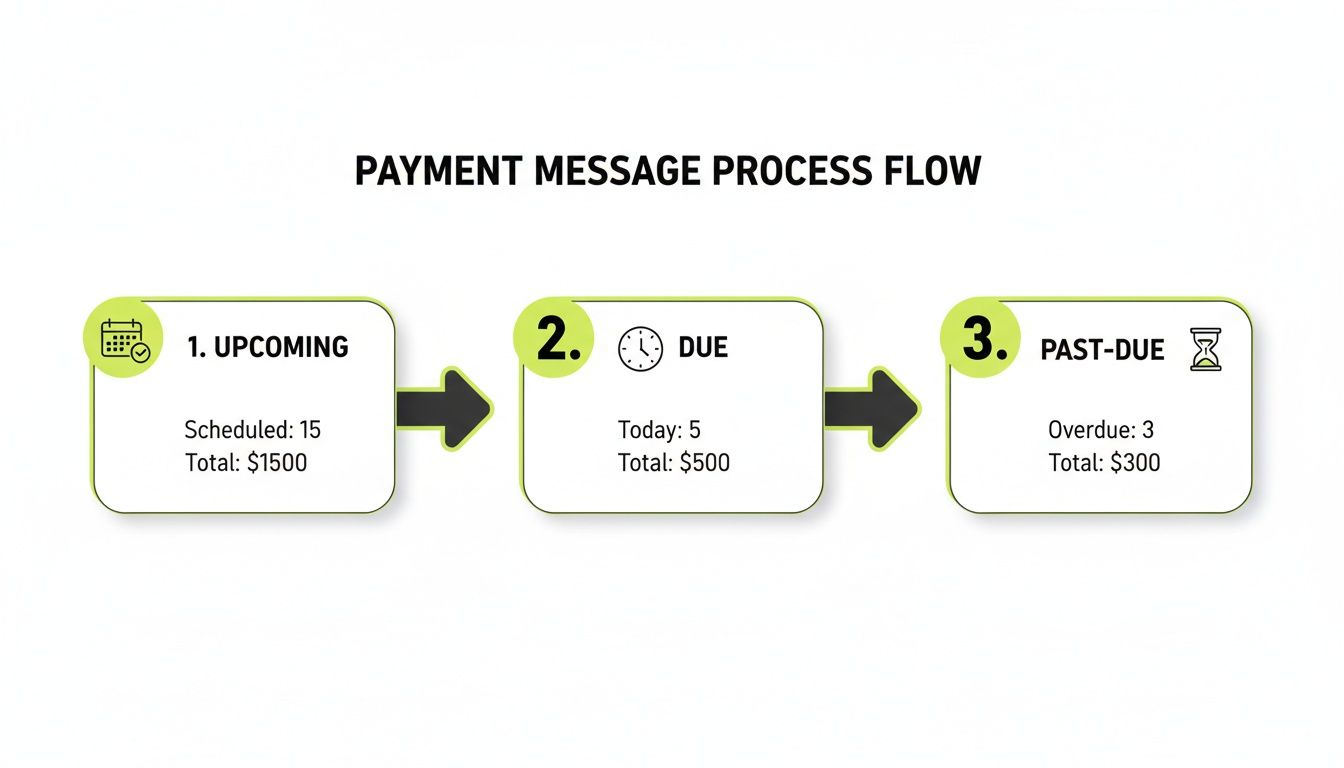
This automated flow manages the AR lifecycle without manual intervention.
Segmenting for Financial Impact
A one-size-fits-all strategy is inefficient. High-value clients with a perfect payment history should not receive the same automated sequence as a new client or one who consistently pays late. Effective AI AR automation enables intelligent segmentation.
For example, a "strategic client" segment for your top 10% of accounts might use fewer automated texts and more personalized outreach. Conversely, high-volume, low-dollar invoices can be managed with a more aggressive, fully automated sequence to reduce DSO efficiently. Part of this is scheduling text messages to arrive during business hours for maximum impact.
By segmenting your AR portfolio, you align collection efforts with financial risk and client value. This deploys resources where they have the greatest impact on cash flow.
Integrating SMS into a Multi-Channel Strategy
SMS is most effective as part of an integrated communication strategy. The goal is a persistent, professional presence across multiple channels.
An effective sequence might look like this:
- Email: Initial invoice delivery.
- SMS: First past-due notification for immediate attention.
- Automated Call: A follow-up at 7 days past due with a professional, pre-recorded message.
- Email Escalation: A formal email at 15 days past due, potentially copying the client's account manager.
This multi-channel approach increases engagement while maintaining a controlled, documented process. Our complete guide to accounts receivable automation software provides further detail on building a cohesive strategy.
This mobile-first approach is critical. With over 70% of e-commerce purchases projected to occur on mobile devices by 2025, an automated SMS workflow aligns your firm’s AR process with modern payment behavior.
Measuring Performance to Optimize Your Cash Flow
Sending a payment text message without measuring its financial impact is an exercise in futility. A disciplined approach to tracking performance allows you to systematically refine your process and improve cash flow.
Your goal is to turn AR data into a set of levers to accelerate payments.

Key Financial Metrics to Track
Focus on financial outcomes, not activity metrics. These three KPIs provide a clear picture of the impact on working capital.
- Reduction in Days Sales Outstanding (DSO): Track overall DSO before and after implementing automated texts. Segment DSO by client tier to identify where the strategy is most effective. A sustained 3-5 day reduction in DSO within 90 days is a valuable and achievable target.
- Payment Velocity: Measure the time from when a text is sent to when payment is completed. A low payment velocity—for example, an average of four hours from message to payment—indicates an efficient process.
- AR Collected via SMS Channel: Quantify the cash collected directly from SMS payment links. If 15-20% of total monthly collections are attributable to this channel, it is a core component of your accounts receivable automation strategy.
A collections process without rigorous KPI tracking is merely a series of disconnected actions. Focusing on DSO, payment velocity, and channel-specific collections transforms AR into a data-driven operation that strengthens the firm's cash position.
Using A/B Testing for Continuous Improvement
Once you have a baseline, use methodical A/B testing to optimize. Modern AR software for professional services often includes this functionality. Start by testing variables with the highest potential influence on client behavior.
Message Timing
When a message is sent can significantly impact response time.
- Hypothesis: Sending a past-due reminder mid-morning generates a faster response than an end-of-day message.
- Group A: Receives the message at 10:00 AM Tuesday.
- Group B: Receives the same message at 4:00 PM Thursday.
- Measurement: Compare the average payment velocity for both groups over 30 days.
A 10% increase in payment velocity, when scaled, provides a material benefit.
Message Copy
The words you use also affect outcomes.
- Hypothesis: A message framing payment as a way to "keep your account current" will perform better than a simple demand.
- Message A:
[Firm Name]: Invoice #1045 ($7,500) is past due. Please make a payment here: [link] - Message B:
[Firm Name]: To keep your account current, please remit payment for Invoice #1045 ($7,500) here: [link] - Measurement: Track the click-through rate on the payment link for each version.
These controlled experiments, whether through QuickBooks AR automation or another system, provide the data needed to refine your strategy and remove guesswork from collections.
Conclusion
Integrating text messages into your AR process is a strategic decision to reduce DSO and improve cash flow. It provides a direct communication channel that cuts through email clutter.
Success requires an integrated approach built on three pillars: ironclad compliance, precise messaging, and smart accounts receivable automation. Without this foundation, you are simply sending texts, not operating a controlled, scalable system.
For finance leaders, managing receivables requires a balance of financial discipline and client relationships. Control and satisfaction must coexist.
True integration uses AI AR automation to orchestrate a multi-channel workflow. It weaves text, email, and other touchpoints into a cohesive strategy that accelerates payments without alienating clients. Building out a robust strategy is a core component of modern receivable management services.
A modern AR platform provides the necessary efficiency and control.
Resolut automates AR for professional services—consistent, accurate, and human.
Your Top Questions About Payment Texts, Answered
CFOs and Controllers consistently raise the same practical questions when considering SMS for their AR strategy. Here are direct answers for leaders at professional services firms.
Is This Secure for My Clients?
Yes, provided you use a reputable platform.
The text message is a notification vehicle. The secure payment link directs the client to a PCI-compliant portal, the same standard used for all online credit card transactions. No sensitive financial data is transmitted or stored in the text message itself.
The text is the envelope, not the check. This separation is a non-negotiable feature of any modern AR software for professional services.
How Will My Clients React to a Payment Text Message?
In a B2B context, the reaction is positive when implemented correctly.
Your clients are busy professionals who value efficiency. A text with a one-tap payment link is faster than searching emails and logging into a portal. It should be positioned as a convenient service, not a demand.
Firms that were initially skeptical about client perception have been convinced by the results. A tangible reduction in DSO and positive client feedback demonstrate that this channel is viewed as helpful, not intrusive.
What is the ROI on Implementing This System?
The return is measured in improved cash flow and operational efficiency.
The financial case is built on two key metrics:
- DSO Reduction: A 3-day reduction in DSO for a firm with $10M in annual revenue frees up over $82,000 in working capital.
- Labor Cost Savings: Automating reminders can save a controller 10 hours per week, translating to annual savings that can exceed $15,000.
These direct financial gains create a clear business case for accounts receivable automation.
Is This Difficult to Integrate with QuickBooks?
No. Modern AR platforms are designed for seamless integration.
A system built for QuickBooks AR automation will connect directly, pulling invoice data, due dates, and client contacts automatically. This ensures every payment reminder is accurate without manual data entry.
The integration handles the data synchronization, allowing your team to manage the entire AR process from a single platform.
***
Resolut automates AR for professional services—consistent, accurate, and human.