Proforma Invoice Meaning: A Guide for Finance Operators
Unlock the proforma invoice meaning for your firm. Learn how to leverage them to improve cash flow, reduce DSO, and streamline AR automation. A guide for CFOs.
A proforma invoice is not a bill. It is not a demand for payment, and it has no impact on your general ledger.
Think of it as a formal commitment captured on paper—a preliminary agreement that outlines project scope, costs, and terms before work begins.
This document aligns your firm and your client, enabling them to secure budget approvals. It establishes a tone of control and predictability from the start.
What a Proforma Invoice Means for Your Firm's Financial Control
For a CFO or Controller in a professional services firm, the distinction between a proforma and a commercial invoice is non-negotiable.
A proforma invoice is a planning tool. It never enters your accounts receivable ledger. Its function is to align stakeholders on engagement details before the project is formally initiated.
This pre-billing step is a cornerstone of sound financial operations. By issuing a proforma, you create a good-faith agreement that mitigates future disputes over scope creep or unexpected costs. It is the first step in a controlled, predictable transaction.
Clarifying Terms Before the Transaction
A proforma invoice converts a verbal agreement or a basic quote into a concrete document.
Your client uses this to generate a purchase order or formally allocate funds. This simple action removes significant friction that often causes payment delays.
In international trade, where misalignments are costly, proformas provide the clarity needed for smooth cross-border transactions, preventing disputes that can freeze payments and damage client relationships.
The Strategic Impact on Cash Flow
Using proforma invoices is a strategic decision to protect your cash flow. By confirming every detail upfront—from project scope to the precise legal entity for billing—you eliminate common errors that delay final invoice issuance and payment.
A disciplined proforma process creates a clear audit trail and secures commitment. It transforms a preliminary document into a powerful tool for accelerating your cash conversion cycle. It is a foundational element of effective accounts receivable automation.
This process directly translates into more predictable revenue and a lower Days Sales Outstanding (DSO). Firms that master this see measurable improvements in their financial stability. For a deeper dive, this guide offers the pro forma invoice meaning explained in more detail.
Proforma Invoice vs. Quote vs. Commercial Invoice
In B2B transactions, confusing a quote, a proforma invoice, and a commercial invoice creates operational friction. It can delay payments and strain client relationships.
Each document serves a distinct and non-interchangeable role in the revenue cycle. Understanding their specific functions is fundamental to financial control.
Think of it as a progression:
- A quote is an initial, non-binding estimate.
- A proforma invoice is a formal, good-faith agreement on scope and price.
- A commercial invoice is the official, legally binding request for payment.
Using the wrong document at the wrong time disrupts your client's procurement process and your own cash flow.
Distinguishing The Documents By Purpose
A quote is exploratory. It provides a ballpark figure to gauge interest and initiate a discussion. It is flexible and non-committal.
A proforma invoice follows a verbal agreement. Its primary function is to formalize the terms so the client can secure internal approvals, like a budget or purchase order. This solidifies the proforma invoice meaning as a critical bridge between negotiation and execution.
The commercial invoice is the final step. It is the official request for payment after services are rendered or a milestone is met. This is the only document of the three that officially enters your accounting system as a receivable.
The progression from quote to proforma to commercial invoice reflects a growing commitment. This workflow—from informal discussion to firm agreement to financial transaction—is a process every professional services firm must control.
To make the distinctions clear, here is a breakdown of how these documents compare.
Document Comparison: Proforma Invoice vs. Quote vs. Commercial Invoice
Attribute | Quotation | Proforma Invoice | Commercial Invoice |
|---|---|---|---|
Purpose | Initial price estimate; opens negotiation | Confirms agreed-upon details for buyer's internal processes (e.g., PO) | Official demand for payment after goods/services are delivered |
Timing | Beginning of the sales cycle | After a verbal agreement, before the final invoice | After delivery of goods/services |
Legal Status | Not legally binding | Not legally binding | Legally binding contract for payment |
Accounting Impact | None. Not recorded in ledgers. | None. Not recorded as revenue or a receivable. | Recorded as a sale and an account receivable. |
Commitment Level | Low; an invitation to negotiate | Medium; a good-faith agreement | High; a formal claim for payment |
Each document has a distinct and non-overlapping function in a well-managed financial workflow.
Legal and Accounting Implications
The differences are critical for accurate reporting. A quote has no legal or accounting significance. It is for discussion purposes only.
A proforma invoice, despite its formal appearance, is also not legally binding and must never be recorded as revenue or an account receivable. For firms using accounting software like QuickBooks, a proforma should be created as an "Estimate" to keep it separate from the general ledger. This distinction is vital.
This infographic summarizes how a proforma aligns scope and budget before a deal is finalized.
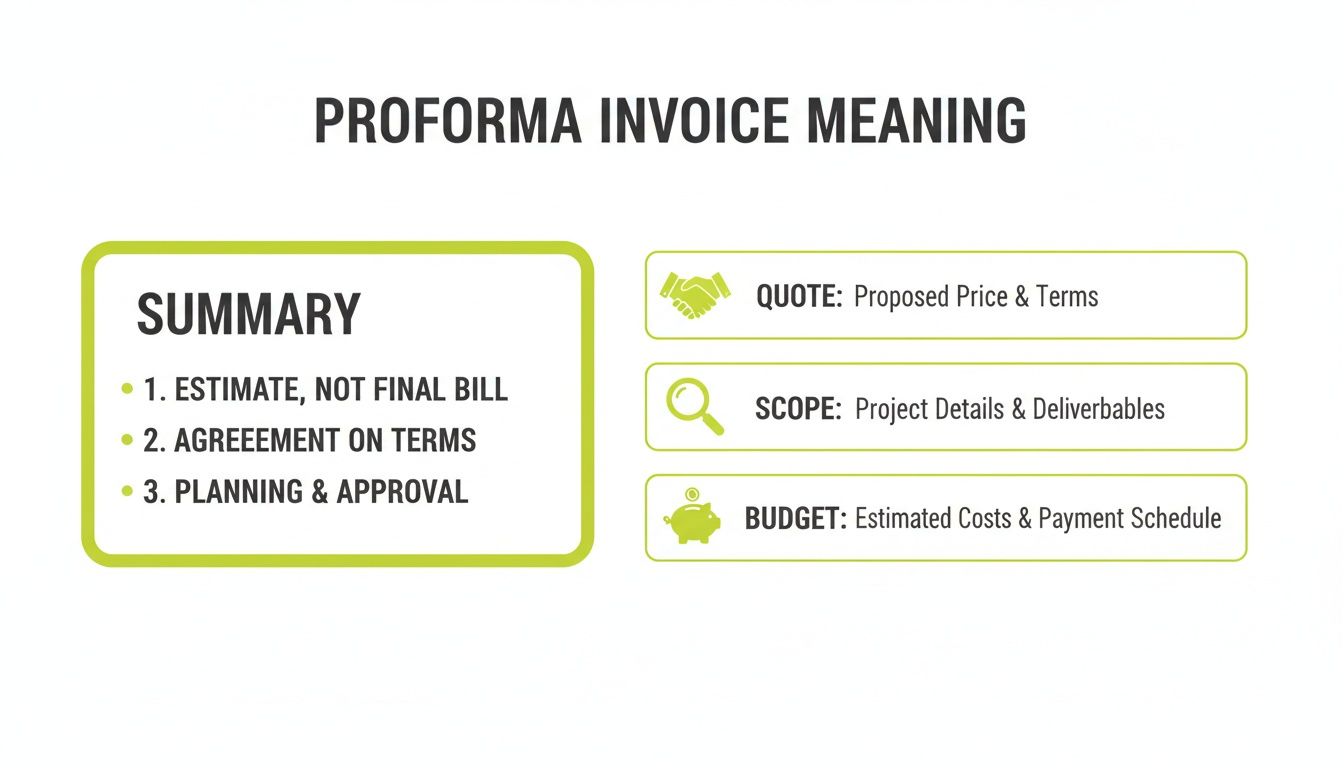
Only the commercial invoice stands as a legal document. It represents your formal claim for payment and triggers all collections activities. This is the document that initiates automated follow-ups in an AR platform to reduce DSO and improve cash flow.
Maintaining this separation creates a clean audit trail and ensures financial reports are accurate. For firms using an AR platform like Resolut, this discipline ensures workflows are triggered by the correct document, making the collections process consistent and predictable.
How Professional Services Firms Use Proforma Invoices
Moving beyond definitions, leading professional services firms use proforma invoices as a tactical tool to secure revenue and de-risk projects.
This is where the proforma evolves from a procedural document into a key component of your financial strategy.
Securing Deposits and Managing Scope
One of the most effective uses of a proforma is to collect an upfront payment. For a large consulting project, you might issue a proforma for 50% of the total fee before work begins.
This secures immediate cash flow and, more importantly, confirms the client's commitment to the engagement.
The document gives your client a tangible artifact for their own finance department, normalizing the deposit request within their process. It provides a clear, documented basis for them to issue payment.
By requiring a client to approve a proforma invoice before you allocate resources, you convert a potential project into a committed one. This single step significantly reduces the risk of last-minute cancellations or scope creep.
Consider it an early financial checkpoint. A client's hesitation to approve the proforma or pay the deposit is a critical red flag regarding their commitment or ability to pay.
Streamlining Client Procurement
For firms working with large enterprises, procurement departments are gatekeepers. A proforma invoice provides the exact details they require to generate a Purchase Order (PO).
It itemizes services, costs, project codes, and vendor information in a format their systems can process.
Firms that standardize this workflow see a measurable reduction in payment delays. An invoice rejected for a missing PO number can reset payment terms by 30-60 days. A proforma prevents this.
This proactive step ensures your final invoice moves seamlessly through their payment system. You align your billing process with their internal controls from day one—a fundamental practice for lowering Days Sales Outstanding (DSO).
Integrating Proforma Invoices with AR Automation
Manual invoicing is a source of operational chaos. It involves chasing information across emails and project notes, a process prone to errors that delay cash flow.
AI AR automation provides the solution. For a professional services firm, automation supports your finance experts by handling repetitive, low-value tasks. An AR platform can generate, send, and track proforma invoices, creating a single source of truth for every project.
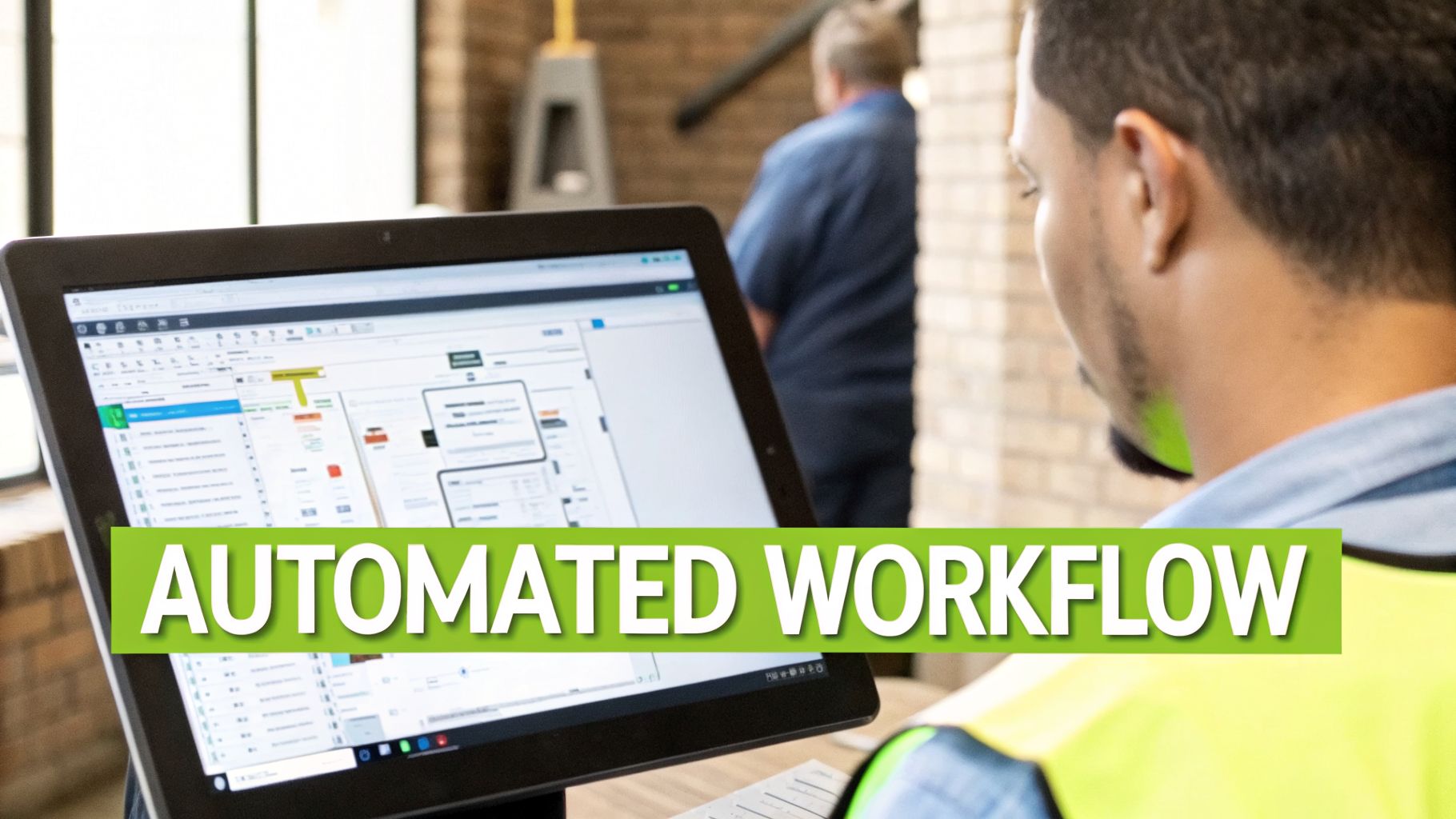
From Agreement to Invoice, Automatically
Imagine this workflow: a deal is marked "won" in your CRM, and the system automatically drafts a proforma invoice from the agreed-upon terms. It sends this document to the client via a secure portal for review and approval.
Once a milestone is met, the platform automatically converts that approved proforma into a commercial invoice and initiates the collections process. This closes the loop between sales, delivery, and finance, eliminating the disconnects that cause billing delays.
For a CFO or Controller, this provides an unprecedented level of control. You gain a complete audit trail from proforma to payment. The system can leverage proforma data to generate more accurate cash flow forecasts, transforming a simple document into a powerful financial planning tool.
The result is faster, more predictable payment. You build a disciplined financial process that also creates a seamless, professional experience for your clients.
Measurable Outcomes of Automation
Firms are moving away from manual invoicing for a reason. The invoice processing software market is projected to reach $94.12 billion by 2030, signaling that manual methods are no longer viable. read the full research on the invoice processing software market.
For finance leaders, the impact is direct. The right technology can reduce DSO by 30-50%, often because the AI can flag at-risk proformas long before they become overdue invoices.
Integrating your proforma process with dedicated AR software for professional services like Resolut gives you command over your revenue cycle. When a platform offers QuickBooks AR automation, the moment a proforma is converted, the final invoice is guaranteed to be accurate, and the collections clock starts immediately. This is how you systematically shorten your cash cycle.
Proformas and E-Invoicing Mandates
For firms with international clients, mandatory e-invoicing is a present-day reality. Governments globally are implementing clearance models that change how you bill for services.
Under these regulations, invoices must be digitally registered with a government tax platform before being sent to the client. Once an e-invoice is issued, it cannot be easily altered.
This makes your proforma invoice more critical than ever. It is your final checkpoint before the transaction is locked into a government system.
The Proforma as Your Final Check
Use the proforma as your last opportunity to perfect every detail before it becomes immutable. This is where you and your client confirm correct PO numbers, legal entity names, tax IDs, and service descriptions.
An error on the final e-invoice will cause a rejection from the tax authority, initiating a complex correction process and halting your payment cycle.
The transition to e-invoicing is accelerating. By 2026, over 90 jurisdictions are expected to mandate structured e-invoices. This shift is driving adoption of AI-powered networks that can cut invoice processing costs by up to 80%. You can discover more insights about e-invoicing trends for 2026 to understand the scope of this change.
For finance leaders, the proforma is no longer just for client approval. It is now your firm’s primary tool for ensuring regulatory resilience in an increasingly automated and scrutinized global billing environment.
Building Proformas into Your Compliance Workflow
Your accounts receivable software must adapt. Proformas must be the official first step in a regulated e-invoicing process. This is the domain of modern AI AR automation.
An intelligent system should:
- Validate Data: Automatically check proforma details against client records to catch errors before an e-invoice is created.
- Create a Clear Audit Trail: Maintain a permanent link between the approved proforma and the final, government-cleared e-invoice.
- Protect Cash Flow: Ensure accuracy from the start to prevent rejections and corrections that disrupt cash flow.
By making proforma management a core function of your QuickBooks AR automation or ERP setup, you turn a compliance burden into a competitive advantage. If you are new to the topic, you can learn more about what e-invoicing is in our article.
Best Practices to Reduce DSO with Proforma Invoices
A proforma invoice is a primary tool for tightening your cash conversion cycle and reducing Days Sales Outstanding (DSO).
A key tactic is requiring a deposit upon proforma approval. Securing 25-50% upfront, particularly on large projects, provides an immediate cash injection and filters for committed clients.
It fundamentally changes the engagement dynamic from the outset, establishing the value of your services.
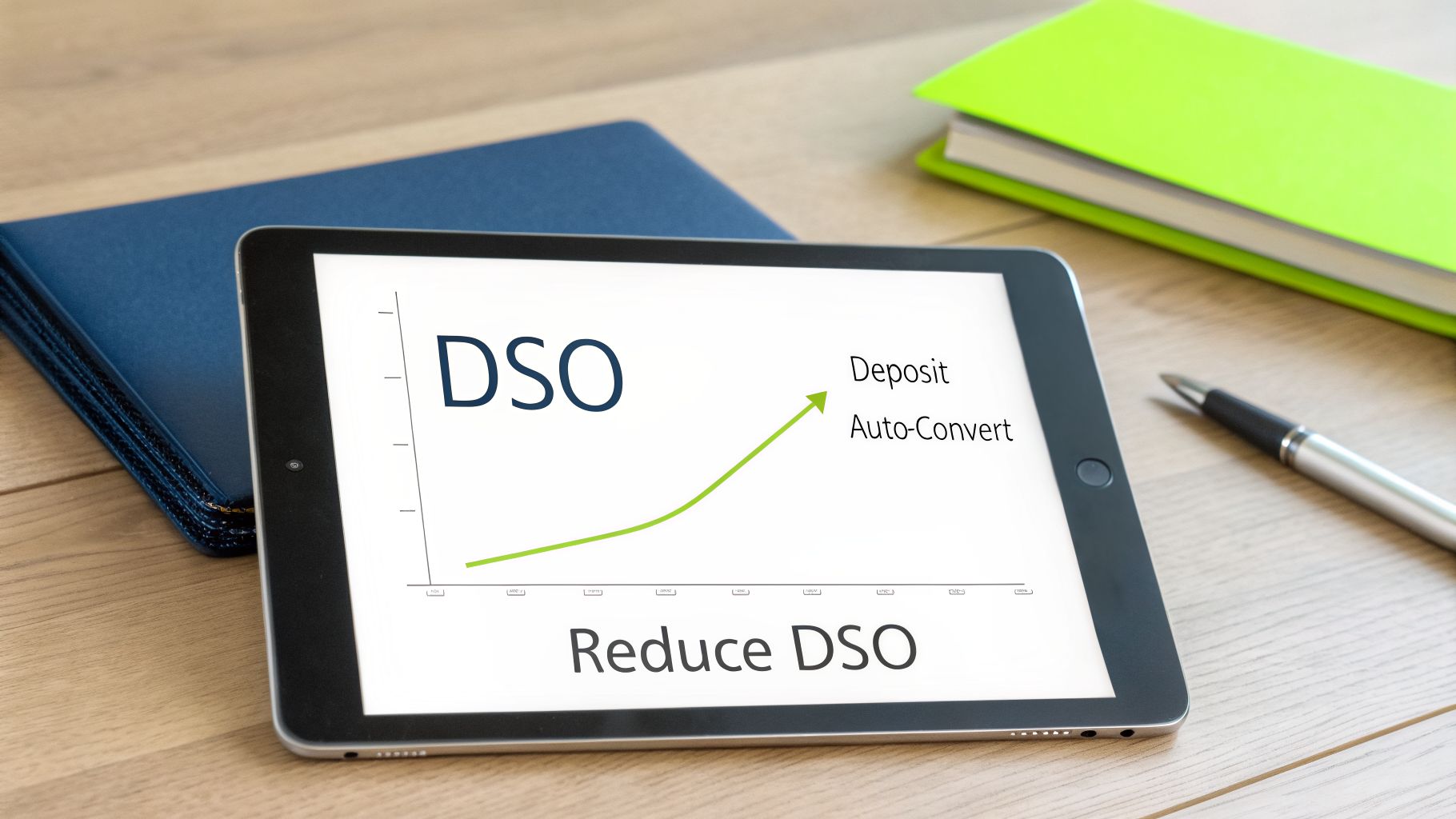
Lock in Accuracy Upfront
The proforma is your opportunity to resolve all administrative details before a commercial invoice is generated.
Use it to confirm the client's legal entity name, billing address, and any required purchase order numbers.
This simple discipline is highly effective at preventing invoice rejections and payment delays. For finance leaders, it is a core strategy to reduce DSO and strengthen your firm's financial position.
By treating the proforma as the definitive pre-billing document, you eliminate friction in the payment cycle. This step alone can reduce DSO by ensuring the final invoice passes through the client's AP process without issue.
Automation is the final component. Your AR software for professional services should instantly convert an approved proforma into a live commercial invoice the moment a deposit is paid or a milestone is reached. This removes manual error and starts the payment clock immediately.
If your team is still building invoices by hand, our guide on how to make an invoice that gets you paid faster may be useful.
Frequently Asked Questions About Proforma Invoices
Here are answers to common operational questions finance teams face when implementing a proforma invoice workflow.
How Do I Handle a Proforma Invoice in QuickBooks or My ERP?
You do not book a proforma invoice as revenue. It must never impact your accounts receivable ledger, as it is not a formal claim for payment.
Recording a proforma as revenue inflates sales and receivables, creating an inaccurate view of your firm's financial position.
In a system like QuickBooks, the correct procedure is to create an "Estimate." This keeps the document out of your general ledger. Once approved, you convert the estimate into a sales invoice, which correctly posts revenue and creates a receivable. This discipline is central to any effective QuickBooks AR automation strategy.
Is a Proforma Invoice a Legally Binding Document?
No, it is not. A proforma invoice is a good-faith agreement. It outlines mutually agreed-upon terms, but the buyer has no legal obligation to pay based on the proforma alone.
Its value lies in setting clear expectations for scope and price before a binding commitment is made. The legally binding document is the commercial invoice that follows.
Can I Use a Proforma Invoice for Collections?
No. Attempting to use a proforma for collections is incorrect and unprofessional. Since it is not a legal demand for payment, it has no standing in a formal collections process. This is a common misunderstanding of the true proforma invoice meaning.
The correct workflow: you issue a commercial invoice when payment is due. If that invoice becomes delinquent, the commercial invoice is the only document used for collections activities, from automated reminders sent by your AR software for professional services to any potential legal action.
When Should I Issue a Proforma Instead of a Quote?
Use a quote during the early, exploratory stages of negotiation. Terms are flexible, and commitment is low.
Issue a proforma invoice after you have a firm verbal agreement on scope, deliverables, and price. The proforma formalizes that agreement and is often the document the client needs to secure internal budget approval, signaling a strong intent to proceed.
--- Resolut automates AR for professional services—consistent, accurate, and human.