Mastering Cash Flow with Receivable Management Systems
Discover how receivable management systems use AR automation to cut DSO, improve cash flow, and give finance leaders strategic control. Your guide to modern AR.
For CFOs and Controllers at professional services firms, there comes a point when manual accounts receivable becomes a strategic liability.
Spreadsheets and reactive collection calls aren't just inefficient—they're a drag on growth.
The shift to an effective receivable management system isn’t about new software. It’s about reclaiming control and creating predictable cash flow to scale with confidence.
Moving Beyond Manual Accounts Receivable

Relying on manual follow-ups and a patchwork of spreadsheets is a direct path to high Days Sales Outstanding (DSO) and volatile cash flow.
It buries your finance team in low-value administrative work, pulling them away from the strategic analysis where they create the most impact. This operational drag is a hidden tax on your firm’s potential.
A modern system brings discipline and predictability. Instead of sporadic collection calls, it establishes a systematic, automated communication cadence that is both persistent and professional. This is the core of effective accounts receivable automation—it turns a manual task into a reliable operational asset.
The True Cost of Inefficiency
The real cost isn't just a late payment. It's the operational friction and lack of visibility.
When your Controller spends their morning manually reconciling payments, they lose hours that could have been spent on forecasting or financial modeling. This inefficiency directly kneecaps your ability to improve cash flow and make informed capital decisions.
The core job of a receivable management system is to convert a firm's invoices into cash in the shortest time possible, with the least amount of manual effort. It’s about operational leverage, not just collections.
The global market for accounts receivable automation is projected to hit $8.6 billion by 2035. This signals a clear trend: manual financial operations are not sustainable for growth-oriented firms. For a broader view on this shift, a guide on document workflow automation shows the wider context of streamlining operations.
A Strategic Upgrade for Financial Control
This technology is a fundamental upgrade for your financial controls, not just another software purchase.
For firms using QuickBooks, a dedicated system adds a necessary layer of sophistication. This is what effective QuickBooks AR automation looks like in practice.
By implementing a dedicated system, you gain:
- Predictable Revenue Cycles: Smooth out the peaks and valleys of cash collection.
- Reduced DSO: Systematically shorten the time it takes to get paid. For example, a 10% reduction in a 60-day DSO cycle for a $10M firm unlocks over $160,000 in working capital.
- Strategic Team Focus: Free up your best financial minds for high-value analysis.
This is how an operator reclaims control over the firm's most critical asset: cash.
How Modern Receivable Management Systems Work
A modern receivable management system is an engine built to turn outstanding invoices into cash with minimal friction.
Its value is measured in tangible outcomes: a lower DSO, predictable cash flow, and a finance team focused on analysis, not administration.
The system orchestrates a series of automated, personalized workflows. It injects logic and intelligence into the collections process, going far beyond basic accounting software. The key workflow automation benefits illustrate how these modern systems deliver operational leverage.
Automated Invoicing and Delivery
The process starts with accurate, confirmed invoice delivery.
A receivable management system ensures every bill is generated with correct project codes and client details, then delivered through the client’s preferred channel on schedule.
This provides confirmation of receipt, eliminating the "we never received it" excuse—a common issue that can delay payment by weeks for firms with complex, milestone-based billing.
Intelligent and Systematic Collections
This is where accounts receivable automation provides the biggest operational lift.
Instead of relying on manual reminders, the system executes a predefined communication strategy. It sends a sequence of professional, non-confrontational reminders that escalate based on invoice age and client payment history.
This systematic approach turns collections from a reactive task into a predictable, data-driven process. The goal is to be persistent without being a nuisance, protecting the client relationship while ensuring timely payment.
For finance operators, the true power of AI AR automation lies in its ability to manage hundreds of client communications simultaneously, with a consistency no manual team can replicate. It ensures no invoice is forgotten and every client interaction is recorded.
Automated Cash Application
Closing the loop is just as critical. Manually matching payments to invoices is a known bottleneck for teams, even those using standard QuickBooks AR automation.
A dedicated system automates this. Using AI, it matches incoming payments—ACH, wire, credit card—to the correct open invoices, even with incomplete remittance data.
This real-time reconciliation gives you an accurate, up-to-the-minute view of your cash position. The need to automate this is driving rapid adoption; 60-70% of payments once required manual matching, a process that is now being streamlined.
Real-Time Reporting and Analytics
Finally, a modern system provides immediate visibility into key metrics.
Instead of waiting for month-end reports, a Controller can pull up a real-time dashboard showing current DSO, cash flow forecasts, and aging receivables. You can explore a deeper comparison of platforms versus in-house teams in our article on receivable management services.
This clarity lets you spot negative trends early and adjust strategy before they become problems. It turns historical data into actionable intelligence, enabling effective working capital management and helping to improve cash flow with confidence.
Manual AR vs Automated Receivable Management
The contrast between the old way and the new standard highlights the shift from reactive tasks to proactive financial management.
Process | Manual Approach (The Old Way) | Automated System (The New Standard) |
|---|---|---|
Invoicing | Manual creation, prone to data entry errors. | Automated, template-driven generation with verified data; error-free. |
Delivery | Sent via email with no delivery confirmation. | Delivered via preferred channel with tracking and read receipts. |
Collections | Ad-hoc emails and calls based on memory or spreadsheets. | Pre-defined, personalized communication sequences that run automatically. |
Cash Application | Hours spent manually matching payments to invoices. | AI-powered matching of payments to invoices in real-time. |
Reporting | Static, month-end reports that are immediately outdated. | Live dashboards with real-time DSO, aging, and cash flow forecasts. |
Team Focus | Administrative tasks: chasing, data entry, reconciling. | Strategic work: analysis, forecasting, process improvement. |
One approach is reactive and creates friction; the other is proactive and builds predictability. For a finance leader focused on working capital, the choice is a necessity.
The Financial Impact of AR Automation
For a finance leader, the only question is the return. A receivable management system delivers measurable financial wins that impact working capital, cash flow, and operational costs.
These are quantifiable improvements to your firm's financial health.
This is how accounts receivable shifts from a reactive cost center to a strategic asset. The primary lever is the ability to systematically reduce DSO (Days Sales Outstanding), unlocking cash currently stuck in the collections cycle.
Unlocking Working Capital by Reducing DSO
The first impact of accounts receivable automation is a drop in DSO. For a professional services firm, even a small improvement has a significant effect.
Consider a firm with $10 million in annual revenue and a typical DSO of 60 days. That's $1.64 million tied up in outstanding receivables.
A well-implemented system can reduce that DSO by 15%, or 9 days. The math is straightforward:
- Annual Revenue: $10,000,000
- Daily Revenue: $10,000,000 / 365 = $27,397
- DSO Reduction: 9 days
- Working Capital Unlocked: $27,397 x 9 = $246,573
This is a permanent boost to your firm's liquidity, freeing up capital to reinvest in growth, talent, or technology.
Improving Cash Flow Predictability
Beyond the initial cash injection, automation delivers consistency. Manual collections are dependent on an individual's workload, memory, and comfort level.
This creates unpredictable revenue cycles and makes accurate forecasting difficult.
An automated system enforces discipline. It establishes a systematic, data-driven cadence for every invoice, smoothing out the collections cycle. This turns your cash flow from a volatile unknown into a predictable metric. You can find more details in our guide on the core accounts receivable automation benefits.
The purpose of a modern receivable management system is to create a reliable financial rhythm. When collections are predictable, so are cash reserves—the foundation of stability and strategic agility.
Quantifying Operational Cost Savings
The final piece of the ROI is reclaiming your team’s time. Every hour spent manually chasing invoices or matching payments is an hour not spent on high-value analysis.
This is where efficiency gains are most apparent.
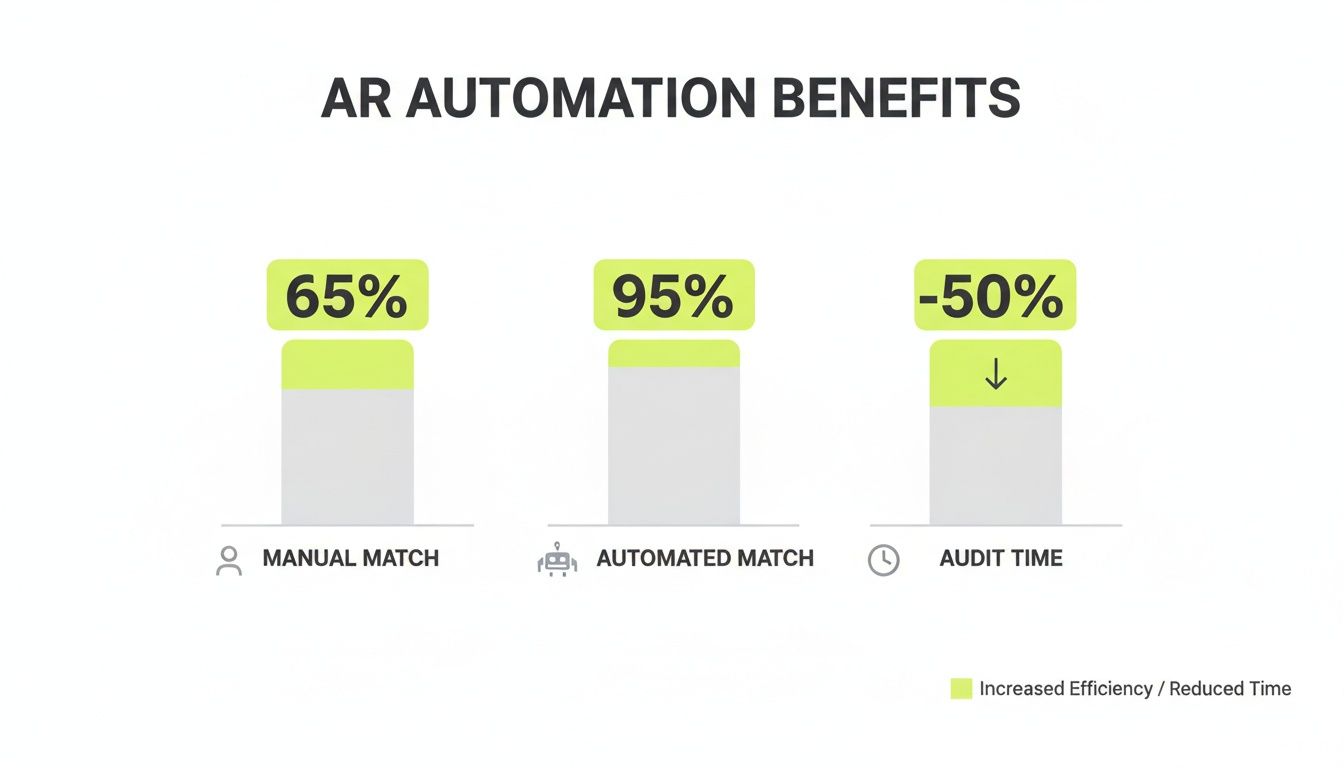
The data tells the story: automated systems achieve a 95% cash application match rate compared to 65% manually and can cut audit prep time in half.
For firms using tools like QuickBooks AR automation, adding a dedicated platform eliminates the tedious task of manual cash application. AI AR automation can instantly match payments to invoices with near-perfect accuracy—a job that consumes dozens of hours per month for a Controller or staff accountant.
By reallocating that time, your finance team can focus on forecasting, financial modeling, and providing the strategic counsel that guides the firm’s growth.
Choosing the Right AR Software for Your Firm
Not all receivable management systems are created equal, especially for professional services firms.
A generic tool fails when faced with project-based billing or complex client hierarchies, creating more manual workarounds. The goal is a system that provides control, not another piece of software requiring constant oversight.
Selecting the right AR software for professional services is about a disciplined evaluation of what solves your firm's unique operational challenges.
Non-Negotiable Integration Capabilities
First, the system must integrate deeply with your accounting software. For most firms in the $3M to $50M range, this means a robust, two-way integration with QuickBooks.
A superficial connection that requires manual data transfer is not automation; it’s a dealbreaker.
True QuickBooks AR automation means the system syncs all invoice data, payment statuses, and customer information in real time. This creates a single source of truth, ensuring clean financial reporting and saving your controller from reconciliation nightmares.
Built for a Service-Based Revenue Model
Beyond integration, the software must understand how your firm generates revenue. This is what separates generic platforms from specialized tools.
A system designed for professional services must handle:
- Project-Based and Milestone Billing: Tying invoices to project phases, retainers, or specific deliverables.
- Complex Client Structures: Managing invoicing for a parent company with multiple departments or subsidiaries.
- Dispute and Adjustment Workflows: Pausing collections on a disputed line item while pursuing the undisputed balance.
The right receivable management system understands that a professional service firm’s revenue is tied to relationships and project outcomes. Its features must support that reality.
The Quality of Automated Communications
Automation is worthless if it damages client relationships. The quality and flexibility of the system's communication engine are critical.
You need the ability to send automated reminders that feel professional, helpful, and human—not like a cold demand for payment.
Look for a platform that allows deep personalization. You should be able to set different communication cadences for different client tiers, tweak the tone as an invoice ages, and intervene manually when a situation requires a personal touch. This balance of automation and human control is the essence of effective AI AR automation.
Analytics That Drive Strategic Decisions
Finally, the system must provide analytics that are meaningful to a service-based business. For a complete checklist, our guide on how to choose AR automation software that works for professional services firms breaks it all down.
Your system should let you track DSO trends by client, by project type, or by the partner managing the account. This granular data turns AR from a back-office function into a source of strategic intelligence. It helps identify your best-paying clients and spot the systemic issues quietly impacting cash flow.
A Practical Plan for Implementation
Bringing a new receivable management system online should be a controlled process, not a disruptive event.
A smooth rollout is about disciplined planning and clear objectives.
Here is a straightforward, operator-focused plan to get it right.
Defining Your Objectives from Day One
Before anything else, define what success looks like in numbers. Without clear goals, you are just installing software, not solving a business problem.
Your objectives should be concrete, with a deadline. For example:
- Objective 1: Reduce Days Sales Outstanding (DSO) by 15% within six months.
- Objective 2: Automate 90% of routine payment reminders by the end of the first month.
- Objective 3: Reclaim 20 hours per week of team time by reducing manual cash application within 60 days.
These targets become the anchor for every decision during setup and launch.
Data Preparation and Migration
A new system is only as good as its data. The most common point of failure in any software implementation is a messy data migration.
This means a thorough review of your current AR aging report. Correct known errors, reconcile accounts, and standardize customer contact information. A clean dataset ensures a smooth migration and prevents old problems from corrupting your new system.
Data cleanup is not a technical task to delegate. It is a critical financial control function. Investing time here prevents costly issues later and ensures the system operates with reliable information from day one.
Configuring Workflows and Logic
This is where your firm's collection strategy is translated into automated action. Modern receivable management systems allow for specific configuration of communication workflows and escalation logic.
Map out the entire communication sequence for a typical invoice:
- Initial Invoicing: Define the template and delivery method.
- Pre-Due Date Reminder: Send a helpful nudge 3-5 days before the due date.
- Day of Due Date: A professional notification that payment is now due.
- Post-Due Date Escalation: A series of increasingly firm reminders at specific intervals (e.g., 7, 15, and 30 days past due).
With AI AR automation, you can refine this logic based on a client’s payment history, invoice size, or risk profile. This strategic setup ensures the system handles the bulk of communications, freeing your team to manage exceptions.
Effective team training is non-negotiable. Your staff needs to understand not just how to use the software but why the workflows are designed as they are. Set up performance dashboards to track progress against your objectives, ensuring the system delivers on its promise to improve cash flow and reduce DSO.
Getting to True Financial Control and Predictability
A modern receivable management system isn't about fixing an operational headache. It’s about gaining strategic control. It gives a professional services firm the consistency it needs to grow without stumbling over its own cash flow.
This is how you turn a reactive, administrative chore into a predictable, strategic asset.
Moving from manual spreadsheets to accounts receivable automation strengthens the firm. A systematic approach doesn't just protect cash reserves; it improves client relationships by making every communication professional and data-driven.
From Chasing Payments to Strategic Foresight
This newfound stability allows for confident decision-making.
When you can reliably predict cash arrivals, you can manage expenses with precision and invest from a position of strength. You stop reacting to economic shifts and start navigating them with financial clarity.
The real goal of AI AR automation is to create a financial model where cash flow is a known quantity. For any finance leader, predictability is the ultimate form of control.
This systematic approach allows you to analyze payment behaviors, spot at-risk accounts, and adjust credit policies based on real-world data.
* **Visual Idea 1: A calm, focused finance leader looking at a clean AR dashboard on a large monitor. The data visualizations are clear, showing a downward trend for DSO and a stable cash flow forecast, symbolizing control and foresight. ***
A Foundation Built for Growth
For a professional services firm, growth puts immense pressure on back-office functions. A manual AR process that is a minor issue at $5M in revenue becomes a breaking point at $15M.
An automated system is built to handle that volume without requiring a larger team or introducing more errors.
It ensures that as your firm wins more business, your ability to convert that revenue into cash keeps pace. This is the difference between growing and scaling. The objective is to build a financial backbone that supports your ambitions.
* **Visual Idea 2: A split-screen visual. On the left, a cluttered desk with paper invoices and spreadsheets, labeled "Reactive AR." On the right, a clean office with one person calmly managing a streamlined digital workflow on a tablet, labeled "Predictable Cash Flow." ***
Frequently Asked Questions About Receivable Management
As a leader in a professional services firm, you need direct answers. Here are the most common questions from controllers, partners, and owners evaluating modern receivable management systems.
How Long Does Implementation Take?
Weeks, not months. For a professional services firm, getting a modern cloud platform online is fast.
The process involves connecting to your accounting software (like QuickBooks), customizing communication templates, and importing your existing AR data. A focused project can be live in under a month. The key factors are clean data and clear goals from the start.
Will Automating Collections Damage Client Relationships?
No. In fact, it strengthens them. A well-designed system replaces awkward, inconsistent manual follow-ups with professional, timely, and helpful reminders.
It adds a layer of polish and consistency that manual efforts cannot match. By ensuring accuracy, providing easy payment options, and keeping communications respectful, you remove friction and create a smoother financial experience for clients.
Is Our Firm Too Small for AR Automation?
The decision to automate is not about firm size; it's about the cost of inefficiency. We see a clear ROI for firms well within the $3M–$50M revenue range.
The test is simple: calculate the hours your team spends weekly on manual invoicing, payment chasing, and cash application. If that time represents a strategic bottleneck or a significant operational cost, your firm is ready. The goal is leverage, not just new tech.
How Is This Different from Our Accounting Software?
Your accounting software, like QuickBooks, is the financial ledger—the book of record. It was never designed to be a collections engine.
Dedicated receivable management systems are specialists. They add a critical layer of intelligence on top of your ledger.
Your accounting software is the ledger, but an AR platform is the operating system for turning those ledger entries into cash. It manages the entire communication workflow, from pre-due date nudges to complex escalations.
This specialized focus provides advanced AR analytics, dispute management tools, and AI-powered cash application—capabilities not found in a general accounting platform. Integrating the two creates a complete financial stack that doesn’t just record revenue, but collects it with precision.
***
Here are a few more common questions from finance leaders.
Question | Short Answer |
|---|---|
How does the system handle disputes or partial payments? | Modern platforms have dedicated workflows. They let you tag invoices in dispute, assign them to a team member, and pause automated reminders until the issue is resolved, keeping everything organized and out of spreadsheets. |
Can we customize the reminder emails and cadence? | Absolutely. Customization is key. You can tailor the tone, timing, and frequency of all communications to match your firm's brand and your relationship with a specific client. It ensures the "human touch" isn't lost. |
What kind of reporting and analytics can we expect? | You get a real-time dashboard showing your most important AR metrics: DSO, an aging summary, and cash flow forecasts. The best systems also help you identify trends, like which clients consistently pay late, so you can address the root cause. |
Is our financial data secure in a cloud-based platform? | Yes. Reputable providers use bank-level security, data encryption, and regular third-party audits (like SOC 2 compliance) to ensure your sensitive financial data is protected. It's often more secure than an on-premise server or local spreadsheet. |
These answers should provide a clearer picture of how these systems work and where they add value. The right platform should feel like a natural extension of your team.
--- Resolut automates AR for professional services—consistent, accurate, and human.