
Mastering the Receivable Turnover Ratio to Control Cash Flow
A complete guide for CFOs on using the receivable turnover ratio to improve cash flow. Learn how to calculate the ratio, reduce DSO, and leverage AR automation.
As a finance leader in a professional services firm, you focus on revenue and profit. But operational control comes from mastering cash flow.
The receivable turnover ratio is the clearest measure of how efficiently your firm converts billable work into cash.
It’s not an abstract accounting metric. It’s a diagnostic tool that reveals the health of your entire invoice-to-cash cycle.
Why the Receivable Turnover Ratio Matters for Professional Services
A high ratio signals a lean, cash-efficient operation. A low one indicates friction—a drag on working capital that erodes financial control.
For firms managing project-based billing and critical client relationships, this metric is fundamental. It answers one question: how effectively are we collecting payment for our work?
Ignoring this ratio means operating blind. You can hit revenue targets but still rely on a line of credit to make payroll. That is not a predictable or scalable model.
A Diagnostic Tool for Financial Health
Think of your receivable turnover ratio as a stethoscope for your firm's financial core. It helps you identify small issues before they become systemic problems.
- It measures operational efficiency. It’s a direct grade on your invoice-to-cash process. No ambiguity.
- It reflects client health. Consistently slow payments can be a red flag about a client's stability or satisfaction with your service.
- It pinpoints trapped cash. A low ratio proves you are effectively providing clients an interest-free loan with your working capital.
For a firm with $5M in annual revenue, accelerating collections by just 10 days frees up over $135,000 in cash. This is not an accounting exercise. It is capital you can deploy.
From Data to Action
When you monitor your receivable turnover, you gain control. You can spot negative trends, like a gradual increase in payment times across your client base, before they impact operations.
This early warning allows you to react. You can adjust your collections strategy, perhaps implementing accounts receivable automation to ensure follow-ups are consistent and professional, without overburdening your team.
This guide moves from calculation to operational application. The goal is to turn this ratio from a reported number into a lever you can pull to improve cash flow and strengthen your firm's financial position.
--- Resolut automates AR for professional services—consistent, accurate, and human.
Calculating Your Receivable Turnover Ratio Step By Step
The receivable turnover ratio provides an objective look at your collections efficiency. The formula is simple, but precision in its inputs is critical for professional services firms.
The core formula is Net Credit Sales / Average Accounts Receivable.
This figure tells you how many times per year your firm collects its average outstanding receivables. A higher number indicates a tighter, more efficient cash conversion cycle.
Defining Net Credit Sales for Your Firm
For a services firm, "Net Credit Sales" is not top-line revenue. It is the revenue billed on credit terms during a specific period.
You must exclude any cash payments, upfront retainers, or sales taxes collected.
Further adjustments are necessary:
- Credit Memos: Subtract any credits issued to clients for billing adjustments or service issues.
- Write-offs: Deduct the value of any services written off as bad debt during the period.
The resulting Net Credit Sales figure represents the clean, collectible revenue that feeds your accounts receivable.
Calculating Average Accounts Receivable
Next, calculate your Average Accounts Receivable for the same period. Using an average prevents one-time events, like a large client payment, from skewing the data.
The calculation is direct:
- Take your Beginning Accounts Receivable balance (e.g., January 1st).
- Add your Ending Accounts Receivable balance (e.g., December 31st).
- Divide the sum by two.
(Beginning AR + Ending AR) / 2 = Average Accounts Receivable >This method smooths out volatility, providing a more reliable baseline. QuickBooks AR automation or other dedicated AR software can often generate this data directly.
A Practical Example: A $10M Consulting Firm
Consider a $10M consulting firm analyzing its annual performance.
- Total Revenue: $10,500,000
- Upfront Retainers & Cash Projects: $500,000
- Credit Memos & Write-offs: $200,000
- Beginning AR (Jan 1): $1,100,000
- Ending AR (Dec 31): $1,400,000
First, calculate Net Credit Sales: $10,500,000 (Total) - $500,000 (Cash) - $200,000 (Adjustments) = $9,800,000
Next, calculate Average Accounts Receivable: ($1,100,000 + $1,400,000) / 2 = $1,250,000
Finally, apply the formula: $9,800,000 / $1,250,000 = 7.84
This is a snapshot of the journey from rendered service to collected cash—the exact cycle this ratio measures.
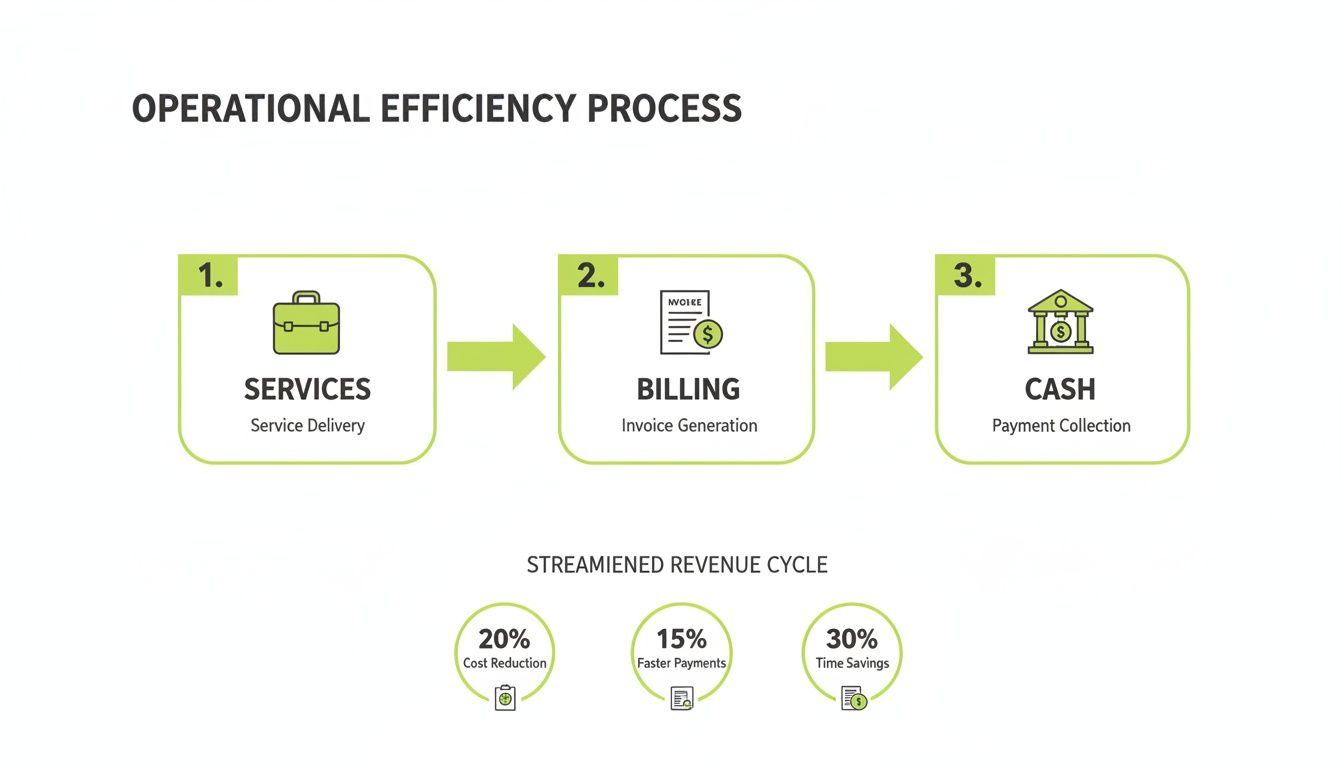
The firm's ratio of 7.84 means it collects its average accounts receivable nearly eight times per year. For our consulting firm, this number becomes a crucial internal benchmark, providing a clear target as they work to reduce DSO and optimize operations.
Translating Your Ratio Into Days Sales Outstanding

The receivable turnover ratio is a strong indicator of efficiency, but it remains an abstract number.
To make it tangible, we translate it into a metric everyone understands: time.
Days Sales Outstanding (DSO) measures, on average, how many days it takes to convert billings into cash. It shifts the focus from "how many times" to "how long." That clarity is actionable.
The calculation is a simple conversion.
365 Days / Receivable Turnover Ratio = Days Sales Outstanding (DSO) >This formula converts an efficiency score into a timeline, creating a clear target for operational improvement.
Applying The DSO Formula
Return to our $10M consulting firm with a receivable turnover ratio of 7.84.
Now, convert it to DSO:
365 / 7.84 = 46.5 days
The metric is now grounded in reality. On average, this firm waits over 46 days to get paid.
This is no longer an accounting exercise. It is a precise measure of the operational drag on your business. Every one of those days represents working capital held by your clients instead of your firm.
Why DSO Is The Operator’s Metric
A ratio is for analysis; DSO is for action. It provides a clear view of the collection timeline. As J.P. Morgan highlights, this focus on days is critical for navigating economic shifts.
This focus on time makes DSO a key leadership metric. When you set a goal to reduce DSO, you create a clear objective for your entire team.
Improving DSO is one of the most direct ways to strengthen your balance sheet. The strategy is straightforward:
- Clarify Invoice Terms: Remove ambiguity. State payment due dates and methods clearly.
- Implement a Follow-Up Cadence: A structured, automated reminder process ensures consistency. It is about persistence, not pressure.
- Use the Right AR Software: Tools from QuickBooks AR automation to more advanced AI AR automation platforms execute this process flawlessly.
Reducing DSO directly accelerates cash flow. This is about building a more resilient, predictable financial engine for your firm.
Resolut automates AR for professional services—consistent, accurate, and human.
What’s a “Good” Ratio for Professional Services?
A universal "good" receivable turnover ratio does not exist. Comparing a professional services firm to a retailer is irrelevant; their business models and cash cycles are fundamentally different.
The only meaningful benchmark is one that reflects the realities of your industry.
Several factors inherent to professional services suppress the ratio:
- Project-Based Billing: Billings against complex milestones or retainers are less predictable than simple transactions.
- Negotiated Payment Terms: Net 30, Net 60, or Net 90 terms are standard with large corporate clients.
- The Relationship Factor: Collections must be managed with care to preserve long-term client partnerships.
Your goal is not an impossibly high number. It is a stable, predictable ratio that improves over time.
Hitting the Sweet Spot
What is a realistic target?
For most consulting, legal, and marketing firms, a healthy receivable turnover ratio falls between 6 and 8. This translates to a Days Sales Outstanding (DSO) of roughly 45 to 60 days.
This range is efficient enough to maintain healthy cash flow without alienating clients. A ratio below 6 is a warning sign that your collections process is too loose.
A ratio consistently above 8 indicates a highly efficient collections process. However, an excessively high ratio might signal that your credit terms are too restrictive, potentially deterring desirable clients. Balance is key.
To put this in context, B2B services operate on a completely different timeline than B2C industries.
Receivable Turnover Ratio Benchmarks by Industry
Industry | Typical Turnover Ratio | Average Collection Period (DSO) |
|---|---|---|
Professional & Business Services | 6.0 - 8.0 | 45 - 61 days |
Software & Tech Services | 5.5 - 7.5 | 49 - 66 days |
Construction | 5.0 - 7.0 | 52 - 73 days |
Wholesale Trade | 8.0 - 10.0 | 37 - 46 days |
Retail (High Volume) | 50.0 - 100.0+ | 3 - 7 days |
Manufacturing | 7.0 - 9.0 | 41 - 52 days |
Utilities | 10.0 - 12.0 | 30 - 37 days |
These figures, sourced from industry analyses like those from csimarket.com, show that collecting within 60 days is a strong benchmark for B2B services.
Why the Trend Is More Important Than the Number
A single data point is useful. The actionable insight is in the trend. A declining ratio is an early warning of a developing cash flow problem.
If your ratio moves from 7.5 in Q1 to 7.1 in Q2 and 6.6 in Q3, the trend indicates that your collections efficiency is deteriorating. It is a signal to diagnose the root cause before it becomes a crisis.
A downward trend often points to:
- A new, large client with long payment terms skewing the average.
- An overloaded team unable to maintain consistent follow-ups.
- Unclear invoices causing payment delays.
Monitoring the trend allows you to take corrective action. This is where accounts receivable automation provides leverage. An AR software for professional services standardizes your follow-up cadence, ensuring every invoice is managed with discipline.
A platform like Resolut, which offers QuickBooks AR automation, transforms a reactive manual process into a predictable system that stabilizes and improves cash flow.
The Hidden Costs of a Low Turnover Ratio
A low receivable turnover ratio is more than a metric. It is a drag on your firm’s momentum, representing earned revenue that is not available for use.
The most immediate impact is on working capital. Every dollar tied up in aged receivables is a dollar unavailable for payroll, investment, or supplier payments. This forces reliance on credit lines, incurring interest costs that erode profitability.
The Operational Burden of Slow Collections
Beyond the financial cost, a low turnover ratio creates significant operational drag. It diverts your finance team from high-value strategic work to low-value collections activity. Manual invoice follow-up is an inefficient use of skilled personnel.
This constant pursuit can also damage client relationships. A disorganized collections process appears unprofessional and creates friction. The goal is persistence, not pressure.
For a professional services firm with $5M in annual revenue, reducing its Days Sales Outstanding (DSO) by just 10 days can free up over $135,000 in cash. This is a high-ROI operational improvement that directly funds growth.
Slow collections also increase bad debt risk. The older an invoice, the lower the probability of collection. A low turnover ratio is a leading indicator of at-risk accounts that may require write-offs.
The True Cost of Inefficiency
The burden of manual AR management compounds with growth. As invoice volume increases, a manual process becomes unsustainable, forcing a choice between hiring more staff for collections or accepting slower cash conversion. You can explore the true cost of AR inefficiency in professional services to quantify these hidden expenses.
The solution is to replace a reactive, manual system with a proactive, disciplined one. This is where accounts receivable automation becomes a strategic necessity. By using AR software for professional services, you implement a consistent, professional follow-up process without increasing headcount.
An intelligent system automates routine reminders, allowing your team to focus on the small number of accounts that require direct intervention. This accelerates collections and improves your receivable turnover ratio while protecting client relationships.
Resolut automates AR for professional services—consistent, accurate, and human.
How to Improve Your Ratio With AR Automation
Improving your receivable turnover ratio is not about aggressive collections. It is about building a precise, disciplined process that removes friction from the invoice-to-cash cycle.
Systematic improvement requires technology that executes that process flawlessly.

A high-performing AR function is built on core operational tactics that demand consistency. Automation provides this consistency at scale, becoming a true operational lever.
Establishing a Disciplined Collections Framework
Before technology can be effective, you must define your process. A strong framework is built on clarity and consistency for both your team and your clients.
Key pillars include:
- Clarifying Invoice Terms: Every invoice must clearly state payment terms (e.g., Net 30), due dates, and payment methods. Ambiguity causes delays.
- Offering Flexible Payment Options: Accepting credit cards, ACH, and digital payments removes common friction points.
- Defining a Follow-Up Cadence: A structured sequence of communications ensures no invoice is overlooked.
A low receivable turnover ratio is often a symptom of an inconsistent process. Automation ensures every invoice is managed with the same discipline, regardless of who is managing the account.
Manual execution of this framework does not scale. As your firm grows, manual collections become unsustainable, leading to errors and a deteriorating turnover ratio.
Moving Beyond Simple Reminders with AI AR Automation
Modern accounts receivable automation is more than basic email reminders. True AI AR automation orchestrates intelligent, multi-channel outreach that adapts to client behavior with a human-like touch.
This is critical for professional services firms, where relationships are paramount. The goal is persistent follow-up that never feels robotic. An intelligent system personalizes its approach using data.
An AI AR automation platform can:
- Adapt Tone and Timing: It learns from past interactions, sending a gentle nudge to a reliable client and a more formal reminder to an account with a history of late payments.
- Use Multiple Channels: It can send an email, a text message, or flag an account for a personal call based on the invoice size and age.
- Integrate Seamlessly: Platforms with QuickBooks AR automation capabilities pull data directly from your accounting system, ensuring accuracy and eliminating manual data entry.
Effective invoicing is a cornerstone of solid AR; implementing smarter invoicing strategies is the first step. Combining this with an automated collections workflow creates a powerful system for accelerating cash flow.
The Measurable Impact on Your Receivable Turnover Ratio
Implementing AR software for professional services produces a measurable financial outcome. The objective is to systematically increase your receivable turnover ratio and reduce DSO.
Consider a $15M consulting firm with a DSO of 60 days (a turnover ratio of ~6.0). By implementing AR automation, they establish a consistent follow-up cadence.
The system ensures:
- Invoices are acknowledged by the client's AP contact.
- A reminder is sent five days before the due date.
- A professional follow-up is sent the day an invoice becomes overdue.
- Escalations are automated when an invoice hits 30 days past due.
This disciplined process can reduce DSO by 10 days, bringing it to 50 days. This improves their receivable turnover ratio from 6.0 to 7.3 (365 / 50). More importantly, it unlocks over $410,000 in working capital. For more context, understanding professional receivable management services can help structure these strategies.
By automating the process, you directly improve cash flow and build a more resilient financial foundation.
Resolut automates AR for professional services—consistent, accurate, and human.
Building a Healthier Cash Flow Cycle
Your firm’s receivable turnover ratio is not just a metric. It is a leading indicator of your operational control.
Mastering this number requires building a precise, professional, and predictable process for converting work into cash. A high-performing ratio reflects a system that runs with discipline—clear invoices, consistent follow-up, and simple payment options.
This is the result of a deliberate strategy, not manual effort. In a growing firm, achieving this consistency without adding headcount is critical.
From Metric to Action
The path to a better turnover ratio begins with a commitment to process—a shift from reactive chasing to proactive management.
This operational discipline has a direct, measurable impact on your firm’s financial health. Technology makes this strategy scalable. Modern accounts receivable automation provides the engine, ensuring every invoice receives the right attention without straining client relationships.
A healthy receivable turnover ratio is a direct reflection of a healthy business. It signals operational excellence and a resilient cash flow cycle that can fund your firm's future.
Tools like AI AR automation move beyond simple reminders to orchestrate a sophisticated collections process that feels human. An intelligent system adapts its tone and timing, ensuring persistence never compromises professionalism.
Your goal is a financial operation as reliable as the services you deliver. By focusing on your receivable turnover ratio, you are not just improving a number; you are fortifying the foundation of your business. This focus provides the stability to explore other ways to increase cash flow and drive sustainable growth.
--- Resolut automates AR for professional services—consistent, accurate, and human.