A CFO's Guide to Payment Reminder Systems That Work
Transform your reminder for payment process. Learn to leverage sequencing, automation, and critical KPIs to reduce DSO and unlock cash flow for your firm.
Sending a reminder for payment isn't an administrative task. It's a key control in your cash conversion cycle.
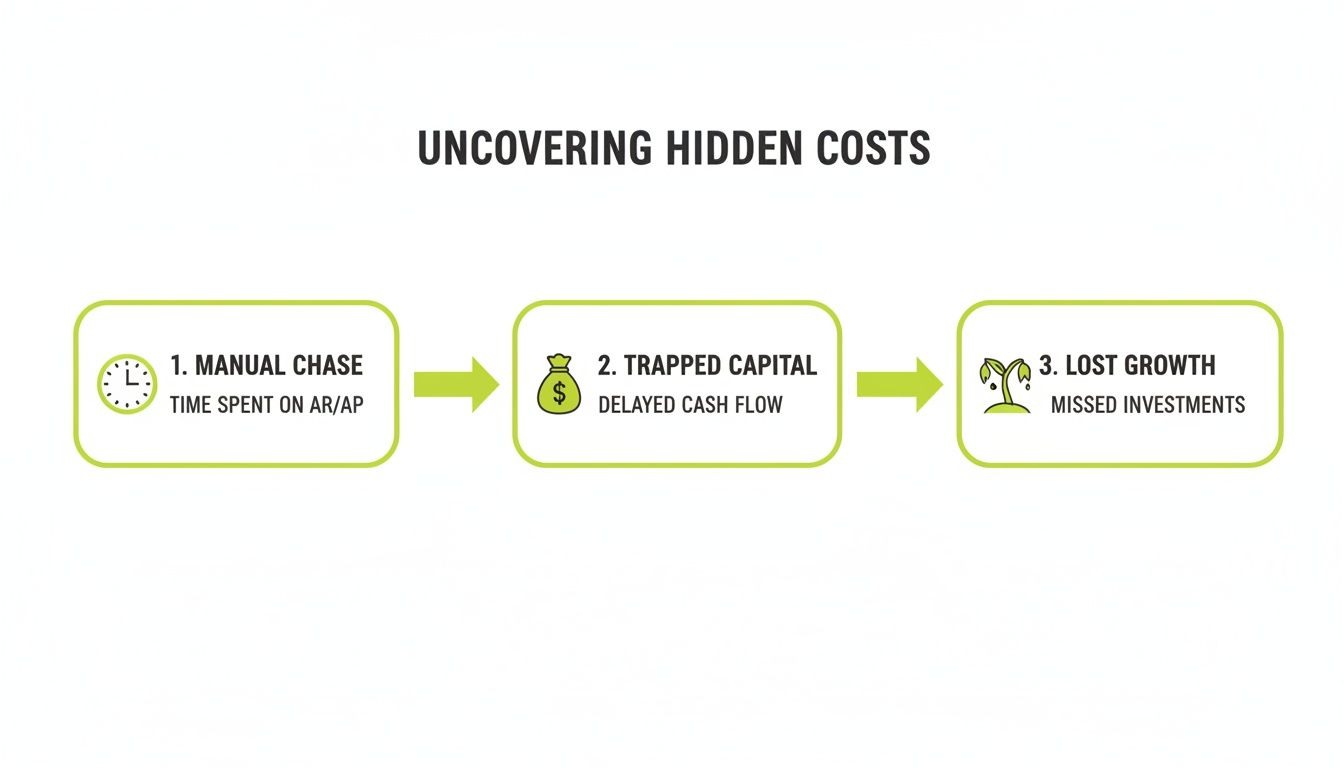
Every manual follow-up introduces operational drag. The true cost isn't just the delayed cash—it's the friction and lost growth opportunities that compound with each overdue invoice.
The Hidden Costs of Manual Payment Reminders
For a finance operator, a manual payment reminder process is more than an inconvenience; it’s a systemic weakness. The issue isn't just late payments, but the trapped working capital and eroded client relationships from inconsistent follow-up.
This isn't a collections problem. It's a cash flow bottleneck that directly impedes strategic growth.
An outdated accounts receivable process creates significant inefficiency. The time your team spends tracking invoices, drafting emails, and making calls is time not spent on forecasting or strategic financial analysis. This administrative burden scales with growth, creating a cycle where success increases operational drag.
Quantifying the Operational Drag
Consider a professional services firm with $10 million in annual revenue and a Days Sales Outstanding (DSO) of 60 days.
This means approximately $1.64 million is tied up in accounts receivable at any given time.
By reducing DSO by just ten days—from 60 to 50—the firm unlocks over $270,000 in working capital. That is cash available for reinvestment, debt reduction, or operational reserves. Understanding how to improve cash flow is a critical capability for any finance leader.
This is the exact financial friction that modern accounts receivable automation is designed to eliminate.
You shift from reactively chasing payments to proactively managing cash flow. The AR function transforms from a cost center into a strategic asset. The objective is a system where every reminder for payment is consistent and data-driven, not dependent on manual effort.
Designing a Disciplined Payment Reminder Cadence
Chasing late payments strains client relationships and consumes valuable team resources. It's an inefficient, high-friction activity.
An effective reminder strategy isn't about chasing—it's about controlled, systematic communication. A predictable cadence moves from a professional nudge to a firm directive, preserving the client relationship while enforcing payment terms.
The goal is to improve cash flow with less manual intervention.
A multi-stage approach is essential. The tone for a client who is three days late should not be the same as for one 30 days past due. A structured follow-up sequence maintains professionalism and escalates with clarity only when necessary.
This methodical process replaces ad-hoc follow-ups that drain your team and trap your cash. When capital is locked in receivables, it directly stalls growth.
Here is a practical framework for building a reminder sequence that delivers results.
The Proactive Nudge (Pre-Due Date)
The most impactful reminder is sent before an invoice is due.
An automated email sent 7 days before the due date is not a collection attempt. It is a helpful administrative prompt that prevents late payments caused by simple oversight.
The tone should be professional and courteous. The message is direct: "As a reminder, invoice [#] is due on [date]. For your convenience, a payment link is included." This simple step establishes a professional process and makes it easy for clients to pay on time.
For high-value clients, AI AR automation can add a personal touch, such as a brief project acknowledgment, maintaining a high-touch feel without manual effort. This is a core function of modern accounts receivable automation.
The First Follow-Up (Early Post-Due Date)
Once an invoice is past due, the tone shifts from helpful to direct.
The first post-due reminder should be sent 3 to 5 days after the due date. This timing provides a grace period for processing delays while signaling that you actively monitor payment terms.
The message must be professional and unambiguous.
- Subject: Action Required: Invoice [#] is Overdue
- Body: This is a notification that Invoice [#] for [Amount], due on [Date], is now past due. Please remit payment via the link below or inform us of any issues.
A common error is waiting 15 or 30 days to send the first notice. This delay implicitly signals that payment terms are flexible, which is a direct cause of DSO expansion. This early intervention is critical.
Mid-Stage Escalation (Increasing Urgency)
If an invoice remains unpaid 15 days after the due date, communication must escalate. The tone becomes firmer, and the message introduces the consequences of non-payment. This is a non-negotiable step in any effective reminder for payment sequence.
At this stage, introducing a second channel is a sound tactic. If initial reminders were email-based, a follow-up call from an account manager or an automated SMS from your AR software for professional services can cut through the noise.
Messaging should be concise and action-oriented. For example: "Invoice [#] is now 15 days past due. To avoid late fees as outlined in our terms, please remit payment within 48 hours." This is where QuickBooks AR automation becomes invaluable, triggering escalations based on real-time data.
Sample Multi-Stage Reminder for Payment Sequence
Stage | Timing (Relative to Due Date) | Primary Channel | Tone of Voice | Core Message |
|---|---|---|---|---|
Proactive Nudge | 7 days before due date | Professional & Helpful | "Reminder: Invoice [#] is due soon. A payment link is included." | |
Gentle Reminder | 3-5 days after due date | Professional & Direct | "Invoice [#] is now past due. Please submit payment or contact us." | |
Firm Follow-Up | 15 days after due date | Email + Phone Call | Firm & Urgent | "Invoice is 15 days overdue. Payment required to avoid late fees." |
Final Notice | 30 days after due date | Email + Phone Call | Serious & Consequential | "Account is seriously delinquent. Immediate payment required." |
Pre-Collections | 45-60 days after due date | Certified Mail / Legal | Formal & Procedural | "Final attempt to collect before this matter is escalated." |
This sequence ensures communication is appropriate for the situation, protecting client relationships while safeguarding your cash flow. It is programmatic, not aggressive.
Choosing the Right Channel for Each Reminder
An effective payment reminder is not just about what you say, but how and where you deliver the message.
Channel selection is a tactical decision that directly impacts payment velocity. A multi-channel approach demonstrates control and improves outcomes.
Not all channels are equal. Email serves as the standard for formal documentation. SMS and phone calls provide immediacy for urgent communication. The key is to match the channel to the objective of each reminder.

Aligning Channel with Intent
For professional services firms, the communication method must reflect the message's gravity. A pre-due date nudge is ideal for email. A seriously delinquent account requires a human conversation.
- Email: The default for formal communication. Use it for initial invoices, statements, and early-stage reminders. Email provides a clear audit trail and allows for detailed information and direct payment links.
- SMS: Reserve text messages for high-immediacy, low-detail alerts. A simple message like, "Reminder: Payment for invoice #5678 is due tomorrow," is effective because it is short and has a high open rate. Use it sparingly to avoid being intrusive.
- Phone Call: A direct call from an account manager is your most resource-intensive tool. Reserve it for high-value invoices or accounts that are 30+ days overdue. A direct conversation can resolve issues an email chain cannot.
Implementing an Omnichannel AR Strategy
An intelligent omnichannel strategy builds a logical escalation path.
For example, an automated workflow can start with several email reminders. If the invoice is still unpaid after 15 days, the system can trigger a task for a team member to initiate a phone call.
This is where AI AR automation excels. An intelligent system can analyze a client's payment history to select the optimal channel for outreach, scaling a personalized approach across your client base.
This orchestration maintains a professional tone while systematically improving collections. A well-designed system doesn't just reduce DSO; it reinforces the client relationship by providing clear, consistent communication. You can explore this further in our guide on how modern AR automation protects client relationships.
Automating Reminders with Intelligence, Not Intrusion
Effective automation is not about sending robotic demands. It’s about executing your collections strategy with precise timing and a human touch, at a scale no manual team can match.
Modern AR platforms act as an extension of your finance team, applying business rules with perfect consistency. This frees your staff from routine follow-ups to focus on high-value exceptions and client relationships.

What a Smart Workflow Looks Like
An intelligent system orchestrates a communication sequence based on context, not just a generic reminder for payment.
- Client Segmentation: The system automatically segments clients. A strategic partner with a perfect payment history receives a different message—more consultative—than a newer client with a history of late payments.
- Adaptive Tone: As an invoice ages, the messaging tone shifts from a professional nudge to a firm directive. The system manages these tonal shifts automatically based on predefined rules.
- Intelligent Halts: This is critical. The moment a client pays an invoice or replies to an email, the automation instantly pauses all further reminders for that invoice. This prevents sending an erroneous demand after payment has been made.
The Critical Role of Data Integrity
The intelligence of this process depends on seamless integration. For firms using QuickBooks, QuickBooks AR automation is the operational backbone.
The AR platform must pull invoice data and payment statuses in real time. When a payment is recorded in QuickBooks, the automation engine must know immediately. Without this direct link, you risk sending inaccurate reminders that erode client trust.
This connection ensures every reminder is accurate and relevant. For more on using this technology for client communication, see these insights on automating customer service with AI strategies.
Modern AI AR automation is more than a reminder tool; it's a central system for managing your firm's financial relationships. The goal is to create a predictable and controlled collections process. We have seen firms implement an intelligent AR system and reduce their DSO by 15-25% within six months by replacing manual chasing with a systematic, data-driven approach.
Learn more about this methodology in our guide to receivable management services.
Measuring Success with Key AR Performance Indicators
You cannot manage what you do not measure.
An intelligent payment reminder system is a financial tool designed to produce measurable outcomes. Focus on the key performance indicators (KPIs) that directly reflect the health of your cash conversion cycle.
Tracking the right AR metrics provides an objective view of your collections process. It helps identify systemic issues, validate strategies, and demonstrate ROI to stakeholders.
Days Sales Outstanding (DSO)
DSO is the foundational metric for AR performance. It is the average number of days it takes to collect payment after a sale. It is a direct indicator of liquidity and operational efficiency.
A high or rising DSO signals that cash is trapped in receivables.
The calculation is:
- (Total Accounts Receivable / Total Credit Sales) x Number of Days in Period
For professional services firms, a DSO below 45 days is healthy. Top-performing firms often operate closer to 30 days. Reducing this number is the primary objective of investing in accounts receivable automation.
Collection Effectiveness Index (CEI)
While DSO tracks speed, CEI measures how much of your collectible revenue you actually collect. It offers a nuanced view of your team's performance in securing owed funds.
The formula provides a percentage of effectiveness:
- ((Beginning Receivables + Monthly Credit Sales) - Ending Total Receivables) / ((Beginning Receivables + Monthly Credit Sales) - Ending Current Receivables) x 100
A CEI of 80% or higher is a strong benchmark. A lower score suggests a significant portion of receivables is aging, increasing write-off risk and straining your cash flow. Note that essential metrics of customer service often correlate with collection success, as satisfied clients tend to pay on time.
Effective AR software for professional services should present these KPIs on a real-time dashboard. This visibility allows for a shift from reactive problem-solving to proactive financial management.
From Manual Effort to Strategic Oversight
A smart payment reminder strategy is not about aggressive collection tactics. It is about systematic, data-driven communication that preserves client relationships while enforcing financial discipline.
Constantly chasing payments is a symptom of a broken process.
Real control comes from an intelligent system that operates with automation's precision but communicates with the nuance of your best account manager. This transforms accounts receivable from a reactive cost center into a strategic asset. When you can predict and accelerate your cash conversion cycle, you unlock working capital.
![Visual Idea: Cinematic shot of a CFO looking out over a city skyline at dusk, conveying foresight and strategic control. The reflection in the glass shows a clean AR dashboard with a downward trending DSO line.]
The New Standard for Financial Control
This level of control is achievable. We consistently see firms that implement an intelligent AR system cut their DSO by 15-25% within six months. They replace inconsistent manual follow-ups with an orchestrated, scalable communication strategy.
The future of finance leadership is not about hiring more collectors. It is about using technology to create calm control, ensuring every invoice is managed with consistency and intelligence.
Complete command over accounts receivable is the new standard for high-performing professional services firms. The right system brings clarity, improves cash flow, and strengthens your firm's financial foundation.
Resolut automates AR for professional services—consistent, accurate, and human.
Frequently Asked Questions About Payment Reminders
For CFOs and Controllers considering modernizing their collections process, several key questions often arise.
When is the right time to automate payment reminders?
The trigger is the cost of manual effort. If your team spends more than a few hours per week on follow-ups, or if inconsistencies are causing client confusion, it is time to consider automation. For most professional services firms, this threshold is met quickly. Effective accounts receivable automation is about bringing consistency and control to a critical financial process.
Will automation damage our client relationships?
No, when implemented correctly, it improves them. A smart system sends polite, professional, and timely reminders that feel consistently human—a reliable nudge, not an awkward phone call. Clients prefer predictable communication and simple payment options. The key is configuring the system to be an extension of your firm's professional standards.
How does automation integrate with QuickBooks?
Seamlessly. Modern AR software for professional services is built for direct integration with platforms like QuickBooks. The systems sync invoice data, payment statuses, and client information in real-time. This ensures every reminder for payment is based on up-to-the-minute data. That direct QuickBooks AR automation link eliminates errors and provides the clean data needed for an intelligent collections strategy.
--- Resolut automates AR for professional services—consistent, accurate, and human.