8 Sample Letters for Payment Request to Systemize Collections
Unlock better cash flow with these 8 expert-crafted sample letters for payment request. Designed for CFOs to reduce DSO and automate AR. Download now.
For CFOs and Controllers at professional services firms, the gap between invoiced work and collected cash is a persistent operational drag. Standard accounts receivable processes, often reliant on manual reminders, introduce variability that directly impacts cash flow and inflates Days Sales Outstanding (DSO).
The challenge is not a lack of effort but the absence of a systematic, data-driven collections process. When nearly 1 in 10 B2B invoices become overdue, the administrative costs become a significant drain. Transitioning to a structured AR strategy is about reclaiming control over working capital.
This article provides a framework for that transition. We will analyze eight distinct sample letters for payment request, providing proven templates for various scenarios. Each is a strategic tool designed for a specific stage of the collections cycle.
We will analyze the operational logic behind each letter, from the initial invoice to the final notice. The goal is to build a scalable collections engine that protects client relationships while predictably accelerating cash flow. Leveraging accounts receivable automation and tools like QuickBooks AR automation can transform these communications from administrative tasks into strategic financial instruments.
1. The Foundational Template: Professional Invoice Payment Request
Every accounts receivable process needs a reliable, professional, and clear starting point. This foundational template is the cornerstone of your collection efforts. It sets a professional tone and ensures all necessary information is immediately available to the client’s accounts payable department.
The goal is not just to send an invoice; it's to facilitate prompt, frictionless payment. This initial communication must be unambiguous and easy to act upon. It preempts common payment delays caused by missing information, such as a PO number or unclear payment instructions.
Core Components and Example
A strong foundational request is built on clarity and completeness. It removes potential friction for the client's AP team.
Subject: Invoice [Invoice Number] from [Your Company Name]
Body:
Hi [Client Contact Name],
Attached is invoice [Invoice Number] for the amount of [Invoice Amount], due on [Due Date]. This is for [brief, specific description of services/products provided].
You can make a payment via [list accepted payment methods, e.g., ACH, credit card link, wire transfer]. Please let us know if you need any additional information, such as a PO number, to process this.
Thank you.
Best regards,
[Your Name] [Your Title/Company]
Strategic Analysis
- Clarity is Key: The subject line immediately identifies the invoice number and sender, making it easily searchable.
- Essential Data Upfront: The body provides the four critical pieces of information: invoice number, amount, due date, and a brief description of services.
- Proactive Problem-Solving: By asking if a PO number is needed, you proactively address common processing roadblocks. This small step can reduce DSO.
- Multiple Payment Options: Offering clear and varied payment methods simplifies the process for the client, removing another layer of potential friction.
This initial, professional approach is a critical component of effective receivable management services. For a deeper look into structuring these systems, you can learn more about how comprehensive receivable management services operate. By starting with this foundational sample letter for payment request, you establish a system of control and predictability from day one.
2. Past Due Payment Reminder Letter
Once an invoice passes its due date, your approach must shift from notification to a proactive reminder. This first follow-up is a critical touchpoint. Sent 7-15 days after the due date, it serves as a polite but firm nudge, assuming the delay is an oversight.
The tone is crucial; it must convey urgency without being accusatory. This communication is a key component of any effective collections strategy, directly impacting your DSO by re-engaging clients who may have missed the initial payment deadline.

Core Components and Example
A successful past due reminder is direct, helpful, and provides an immediate path to resolution. It re-attaches the original invoice for convenience.
Subject: Action Required: Payment Now Due for Invoice [Invoice Number]
Body:
Hi [Client Contact Name],
This is a follow-up regarding invoice [Invoice Number] for [Invoice Amount], which was due on [Original Due Date]. The payment is now [Number of Days] days past due.
I have re-attached the invoice for your convenience. You can settle the outstanding amount via [list accepted payment methods, e.g., ACH, credit card link].
If you have already made the payment, please disregard this notice. If there are any issues preventing payment, please let us know so we can assist.
Thank you,
[Your Name] [Your Title/Company]
Strategic Analysis
- Urgent Subject Line: "Action Required" creates a clear call to action that stands out in a crowded inbox.
- Re-attaching the Invoice: This simple step removes a common friction point. The client's AP team does not need to search for the original email.
- Statement of Fact: The letter avoids accusatory language by simply stating the facts: invoice number, amount, and days overdue.
- Opening Dialogue: By asking if there are any issues, you create an opportunity to uncover and resolve problems before they escalate.
This type of sample letter for payment request is a fundamental tool for managing accounts receivable. A systematic, automated follow-up cadence for past due invoices is a hallmark of efficient cash flow management.
3. Urgent Payment Due Letter
When an account becomes significantly delinquent (typically 30-60 days past due), the communication must escalate. The Urgent Payment Due Letter shifts the tone from a reminder to a firm demand for immediate action. This is a critical step before considering collections.
The objective is to convey the seriousness of the situation without severing the client relationship. It signals that standard procedure has failed and the account requires executive-level attention. This letter formalizes the debt and creates a clear paper trail.
Core Components and Example
This sample letter for payment request is direct and leaves no room for misinterpretation. It clearly outlines consequences while offering a final path to resolution.
Subject: URGENT: Final Notice for Overdue Invoice [Invoice Number] - Action Required
Body:
Dear [Client Contact Name],
This letter is a final notice regarding the outstanding balance on invoice [Invoice Number], due on [Due Date]. The amount of [Invoice Amount] remains unpaid.
Per the terms of our agreement, payments more than [Number] days overdue may be subject to late fees. If we do not receive payment in full by [Final Deadline, e.g., 5-7 business days], we will place this account with our collections agency.
The original invoice is attached. To avoid further action, please remit payment immediately. If you wish to discuss a payment arrangement, you must contact me directly at [Your Phone Number] before the deadline.
Sincerely,
[Your Name] [Your Title/Company]
Strategic Analysis
- Urgent Subject Line: Using "URGENT" and "Final Notice" ensures the email is prioritized.
- Clear Consequences: The letter explicitly states the next steps: late fees and the engagement of a collections agency. This removes ambiguity.
- Reference to Agreement: Citing the contract terms reinforces the legal basis of your claim and reminds the client of their obligations.
- Defined Deadline: Providing a specific deadline ([Final Deadline]) creates a strong call to action and prevents further delays.
4. Payment Plan Negotiation Letter
When a client communicates they cannot meet the original deadline, the conversation shifts to collaboration. This template proposes a structured payment plan, balancing the immediate need for cash flow with the long-term value of the client relationship.
Instead of writing off the debt, offering a payment plan shows flexibility. This approach turns a potential conflict into a manageable financial arrangement, preserving the partnership while ensuring you receive full payment.

Core Components and Example
A successful payment plan proposal is clear and firm. It outlines specific terms, dates, and amounts, leaving no room for ambiguity.
Subject: Payment Plan Proposal for Invoice [Invoice Number]
Body:
Hi [Client Contact Name],
Thank you for discussing the outstanding balance of [Invoice Amount] for invoice [Invoice Number]. We value your business and propose a [e.g., 3-month] payment plan.
The proposed schedule is:
- Payment 1: [Installment Amount] due on [Date 1]
- Payment 2: [Installment Amount] due on [Date 2]
- Payment 3: [Installment Amount] due on [Date 3]
Please reply to this email to confirm your agreement. Once confirmed, we will consider this arrangement formally in place.
Best regards,
[Your Name] [Your Title/Company]
Strategic Analysis
- Relationship Preservation: The letter opens with an understanding tone, framing the interaction as a partnership.
- Structured Clarity: A bulleted schedule of payments removes confusion. It defines exact amounts and due dates.
- Action-Oriented Request: The call to action is simple: “reply to confirm.” This creates a written record of the agreement.
- Proactive Negotiation: Inviting discussion maintains control while showing flexibility. Managing these sensitive communications is vital, and you can learn more about how modern AR automation protects client relationships during these processes.
This sample letter for payment request helps convert a non-paying account into a performing asset, securing future cash flow.
5. The Late Payment Consequence Notification Letter
Shifting from reminders to firm communication requires a clear, legally-grounded step. This letter outlines the specific financial penalties that will accrue due to non-payment. It serves as a serious escalation, making the cost of further delay tangible.
This communication moves from a simple request to a contractual obligation. It is most effective when the terms (late fees, interest) were clearly stated in the original agreement. Its purpose is to show that continued non-payment has direct financial consequences.
Core Components and Example
A strong consequence notification is built on precision and references your legal right to impose penalties.
Subject: Action Required: Overdue Invoice [Invoice Number] and Accrual of Late Fees
Body:
Dear [Client Contact Name],
This letter is a formal notification regarding invoice [Invoice Number] for [Invoice Amount], now [Number of Days] days overdue.
As per our signed agreement dated [Date of Agreement], section [Contract Section Number], all invoices not paid within terms are subject to a late fee.
Effective [Date Fees Begin], a late fee of [e.g., 1.5% per month] will be applied to the outstanding balance. For invoice [Invoice Number], this is an initial charge of [Calculated Fee Amount, e.g., $150]. This fee will continue to accrue monthly.
Please remit payment for the new total of [Original Amount + Fee] immediately. You can make a payment via [list accepted payment methods].
Sincerely,
[Your Name] [Your Title/Company]
Strategic Analysis
- Cites Authority: Referencing the specific contract section grounds your claim in a legally binding agreement.
- Mathematical Clarity: Stating the exact fee percentage and the calculated dollar amount makes the consequence real.
- Establishes a Timeline: Specifying the exact date fees begin to accrue creates urgency and a clear deadline.
- Professional and Firm Tone: The language is formal and direct. This sample letter for payment request signals a necessary escalation.
Implementing this step systematically ensures clients understand the financial impact of their delays, protecting your cash flow.
6. Early Payment Incentive Request Letter
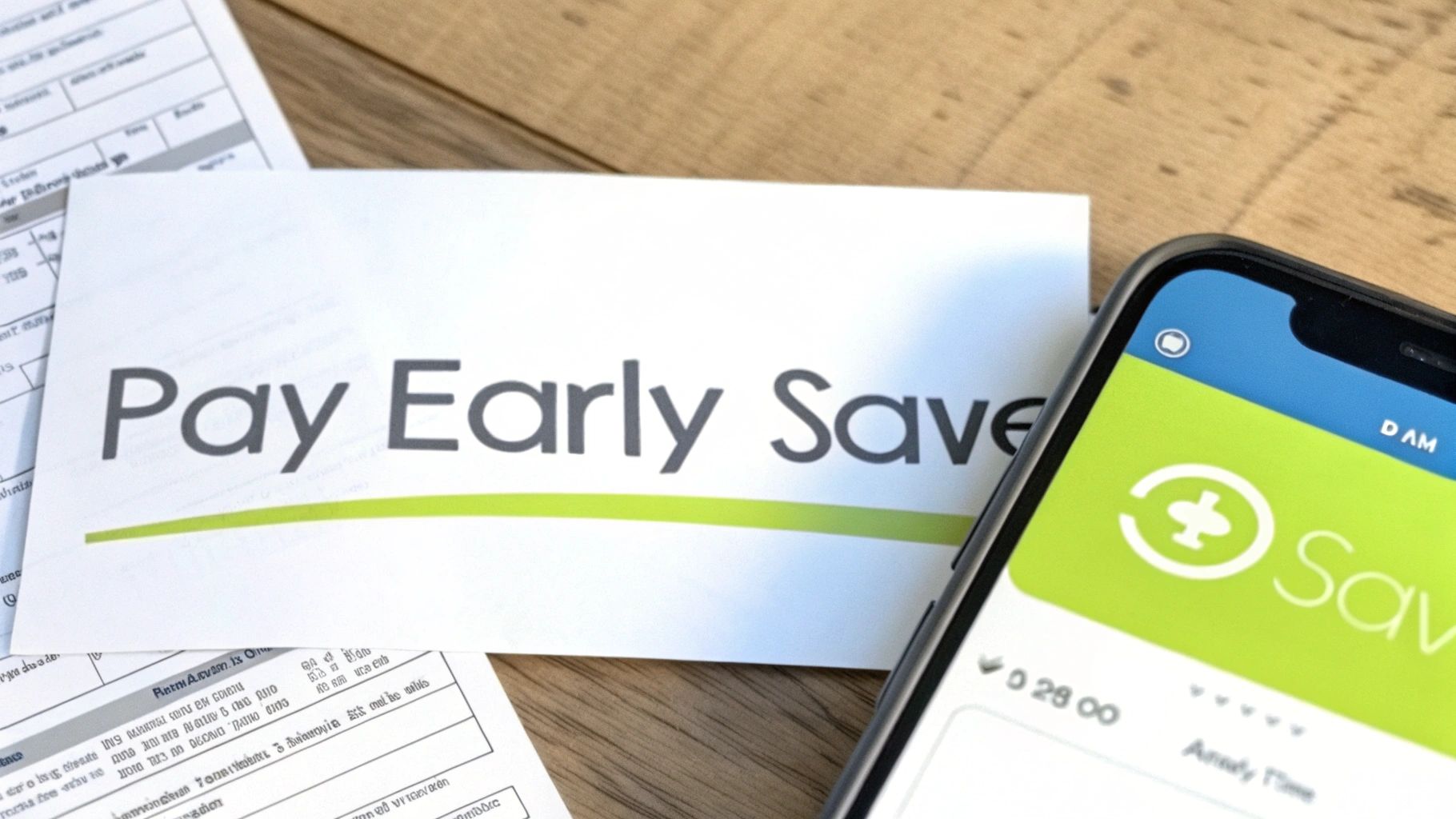
Proactive cash management involves strategically accelerating cash inflow. The early payment incentive letter is a powerful tool for this. By offering a small discount for paying before the due date, you provide a compelling reason for clients to prioritize your invoice.
This approach transforms a standard transaction into a mutually beneficial opportunity. For a minimal cost, you gain immediate liquidity, reduce DSO, and minimize risk. It’s a calculated move that strengthens your balance sheet.
Core Components and Example
The effectiveness of this sample letter for payment request hinges on making the offer clear, attractive, and simple to act upon.
Subject: Save [Discount Percentage]% on Invoice [Invoice Number] - Pay by [Early Payment Date]
Body:
Hi [Client Contact Name],
Attached is invoice [Invoice Number] for [Invoice Amount], with a standard due date of [Due Date].
As a valued partner, we offer a [Discount Percentage]% discount if you complete payment by [Early Payment Date]. By paying early, you can save [Exact Dollar Savings] and reduce the total to [New Discounted Amount].
Payment can be made easily via [list frictionless payment methods, e.g., online portal, credit card link]. The discount will be applied automatically.
We appreciate your prompt attention.
Best regards,
[Your Name] [Your Title/Company]
Strategic Analysis
- Benefit-Led Subject Line: The subject line immediately communicates the core value proposition: a clear, quantifiable saving.
- Quantified Savings: The body explicitly states the dollar amount saved and the new total. This tangible number is more persuasive.
- Frictionless Redemption: Stating that the discount is applied automatically is crucial. This eliminates procedural hurdles.
- Strategic Deployment: This tactic is most effective for clients with a consistent payment history. For a deeper dive into optimizing your finances, you can explore various ways to increase cash flow.
7. Collection Agency Referral Notification Letter
This is the final internal communication before escalating to a third-party collections agency. This letter serves as a formal warning, providing one last opportunity to settle the debt directly and avoid consequences like credit score damage.
The goal is to compel immediate payment and create a legally defensible record. Sending this notice via certified mail establishes a paper trail, proving you acted in good faith before escalating. It is a critical step in a structured collections process.
Core Components and Example
This letter must be firm, formal, and unambiguous. It must clearly state consequences and the final deadline.
Subject: FINAL NOTICE: Account #[Account Number] - Referral to Collections
Body:
Dear [Client Contact Name],
This letter is a final notice regarding invoice [Invoice Number] for [Invoice Amount], due on [Due Date]. The outstanding balance remains unpaid.
If full payment of [Total Amount Due, including fees] is not received by [Final Deadline Date, 10 days from letter date], your account will be referred to [Collection Agency Name] on [Date of Referral].
Referral to a collection agency may negatively impact your business credit rating. We are required to report this delinquency to major credit bureaus.
To prevent this action, please remit payment immediately via [list accepted payment methods]. This is your final opportunity to resolve this matter directly with [Your Company Name].
Sincerely,
[Your Name] [Your Title/Company]
Strategic Analysis
- Creates Urgency: The explicit threat of referral to a named agency on a specific date creates powerful, time-sensitive urgency.
- Documents Compliance: Referencing credit reporting demonstrates procedural rigor. Sending via certified mail provides proof of delivery.
- Clear Consequences: The letter explicitly states negative outcomes: third-party involvement and credit bureau reporting.
- Final Off-Ramp: Providing a direct contact gives the client one last path to avoid escalation, which can salvage payment without agency fees.
8. Project/Contract-Specific Milestone Payment Request Letter
For project-based professional services firms, invoicing is often event-driven. This specialized payment request is triggered by the completion of a specific deliverable or milestone, linking payment directly to tangible progress.
Using this sample letter for payment request ensures both parties are aligned on what has been completed and what is now due. It formalizes the transition from one project phase to the next, converting completed work into cash without ambiguity.
Core Components and Example
A strong milestone request provides proof of completion and references the governing contract, leaving no room for confusion.
Subject: Invoice [Invoice Number] for Completion of [Milestone Name] - [Project Name]
Body:
Hi [Client Contact Name],
We are pleased to confirm completion of the "[Milestone Name]" for [Project Name] as of [Completion Date]. This milestone, as defined in section [Contract Section Number] of our agreement, included [brief, specific list of deliverables].
Attached is invoice [Invoice Number] for [Invoice Amount], payable upon completion of this milestone. Payment is due by [Due Date].
You can make a payment via [list accepted payment methods]. Please find attached [e.g., link to the final deliverable, signed-off acceptance form] as confirmation of completion.
We appreciate our continued partnership.
Best regards,
[Your Name] [Your Title/Company]
Strategic Analysis
- Proof of Performance: Directly linking the invoice to a completed milestone makes the payment obligation clear.
- Contractual Reinforcement: Referencing the specific contract section adds authority and reminds the client of their obligations.
- Forward-Looking Communication: Mentioning the next milestone maintains project momentum and encourages prompt settlement to avoid project delays.
- Clarity and Context: The subject line and opening sentence immediately provide context, helping the client's finance team process the invoice.
Comparison of 8 Payment Request Letter Samples
Letter Type | 🔄 Implementation Complexity | ⚡ Resource Requirements | 📊 Expected Outcomes | 💡 Ideal Use Cases | ⭐ Key Advantages |
|---|---|---|---|---|---|
Professional Invoice Payment Request Letter | Low — standard template, easy to customize | Low — invoice data, letterhead, basic billing system | Baseline payment initiation; sets clear expectations 📊 | Standard B2B invoices, SaaS renewals, consulting billing | Universally accepted format; quick to deploy ⭐ |
Past Due Payment Reminder Letter | Medium — requires timing/sequencing of reminders 🔄 | Moderate — aging reports, automation recommended | Increased response rates (typical +30–40%) 📊 | Follow-ups at 7–15 days past due; early collections | Boosts payments while preserving relationships ⭐ |
Urgent Payment Due Letter | High — legal wording and escalation thresholds 🔄 | High — legal review, senior approvals, documented evidence | Often triggers immediate payment; supports litigation if needed 📊 | 30+ days past due or critical operational impact | Strong leverage for recovery; creates legal record ⭐ |
Payment Plan Negotiation Letter | Medium — negotiation and agreement documentation 🔄 | Moderate — account management, installment tracking | Recoveries over extended period; preserves client goodwill 📊 | Customers unable to pay in full; maintain long-term clients | Recovers funds that might be written off; preserves relationships ⭐ |
Late Payment Consequence Notification Letter | Medium–High — compliance and precise fee calculations 🔄 | Moderate — finance/legal for rates and disclosures | Clarifies costs, deters late payment, reduces fee disputes 📊 | Attach to invoices or send when late fees/interest apply | Legal protection for fees; prevents future disputes ⭐ |
Early Payment Incentive Request Letter | Low–Medium — configure discounts and messaging 🔄 | Moderate — billing adjustments, ROI tracking | Accelerates cash receipt; can reduce DSO by 10–30% 📊 | Improve cash flow; target reliable or strategic customers | Encourages faster payment without aggressive collections ⭐ |
Collection Agency Referral Notification Letter | High — strict compliance and final-notice protocols 🔄 | High — certified mail, legal coordination, collection partner | Often prompts last-chance payments; escalates irrecoverable accounts 📊 | Final notice before third‑party collection referral | Creates legal proof of escalation; maximizes final recovery chances ⭐ |
Project/Contract-Specific Milestone Payment Request Letter | Medium–High — requires evidence of deliverables and sign-offs 🔄 | Moderate — project tracking, acceptance documents | Reduces disputes; ties payments directly to delivered work 📊 | Project-based billing (construction, software, agencies) | Clear linkage between deliverables and payment; aids accounting ⭐ |
From Templates to an Automated System
The eight sample letters for payment request provide the tactical tools for effective accounts receivable management. Mastering their application, tone, and timing is a foundational step toward improving cash flow.
However, relying solely on manual execution introduces operational friction. Inconsistency and delays are inevitable when AR teams are stretched thin. The objective for a finance leader is not just to have better letters; it’s to build a system that executes the collections strategy flawlessly.
Shifting from Manual Execution to Systemic Control
The true value of these templates is unlocked when integrated into accounts receivable automation. Manual processes are inherently reactive and resource-intensive. An automated approach transforms AR from a cost center into a predictable, strategic driver of working capital. This is where AI AR automation platforms become indispensable for professional services firms.
- Data-Driven Decisions: AI-driven systems analyze payment histories and communication patterns to deploy the right message at the right time.
- Dynamic Personalization: Automation allows personalization at scale, inserting specific invoice details without manual entry, reducing errors and increasing effectiveness.
- Optimized Cadence: The system can automatically escalate communications based on pre-set rules, ensuring no invoice falls through the cracks. An invoice 15 days past due might trigger a polite email, while one at 60 days automatically initiates a firm letter and alerts the account manager.
This systemic approach ensures every invoice is managed with operational precision. It also provides finance leaders with clear visibility into AR performance. To achieve predictable cash flow, finance leaders should also explore automating your company's approval workflows, as this streamlines internal financial controls.
The Strategic Value of AR Automation for Professional Services
For CFOs and Controllers at growing firms, the benefits extend beyond faster payment. Automating collections frees up your finance team's time for high-value activities like financial planning, cash flow forecasting, and strategic analysis.
This shift directly impacts the bottom line by:
- Reducing Days Sales Outstanding (DSO): Consistent, timely follow-ups systematically reduce the time to collect. Firms using AR automation often see a 10-25% reduction in DSO within six months.
- Improving Cash Flow Predictability: An automated system provides a more reliable forecast of cash inflows, enabling better capital allocation.
- Scaling Operations Efficiently: As your firm grows, an AR software for professional services handles increased invoice volume without a proportional increase in headcount, protecting margins.
Ultimately, integrating these sample letters for payment request into a robust AR software solution is not about replacing human judgment but augmenting it. It’s about building a reliable, data-driven engine that protects your firm's financial health and empowers your team to drive strategic growth.
Resolut automates AR for professional services—consistent, accurate, and human.