Straight Through Processing: A Guide for Finance Leaders
Explore how straight through processing stp transforms AR workflows, reduces DSO, and boosts cash flow with AI-powered AR automation.
Straight Through Processing (STP) replaces slow, manual financial workflows with a fully automated, “no-touch” pipeline from invoice to cash application.
It's an operating model built for pure efficiency. Transactions move through your system without requiring manual intervention, giving you greater control over your financial operations.
Defining Straight Through Processing in Accounts Receivable
For most professional services firms, the accounts receivable process is a sequence of high-touch, manual tasks.
Every step—drafting an invoice, chasing payment, and applying cash—demands direct attention. This drains your team's capacity and actively delays cash flow.
Straight through processing overhauls this workflow. It is not simple automation, like setting up templated email reminders.
True STP is a state where a transaction moves from start to finish electronically, with zero manual touchpoints. For AR, an invoice is created, delivered, paid, and reconciled in your books without a single person intervening.
The entire philosophy behind straight through processing stp is the total removal of manual work. If a human has to open a file, type in data, or manually match a payment to an invoice, the process is broken from an STP standpoint. The absolute goal is a 100% "no-touch" rate for all standard transactions.

The Anatomy of a No-Touch AR Process
Achieving a "no-touch" state requires a connected ecosystem where different functions work together seamlessly.
- Automated Invoice Generation and Delivery: Invoices are generated directly from your ERP or accounting system, like QuickBooks. They are automatically sent to clients through their preferred channel, with no one manually exporting PDFs or attaching files. This includes modern formats like what is e-invoicing.
- Intelligent Collections Outreach: The system initiates a smart, personalized communication sequence using email or SMS, based on the invoice's real-time status and the client's payment history.
- Client Self-Service Portals: Clients receive a direct link to a secure portal. There, they can view all outstanding invoices, submit questions, and pay immediately using their preferred method, whether it's ACH, credit card, or a digital wallet.
- Automated Cash Application and Reconciliation: Once a payment is received, AI-powered tools instantly match the cash to the correct open invoice(s) and automatically close out the receivable in your financial system.
This approach changes the role of an AR team. Instead of spending 80% of their time on repetitive admin, your finance experts can focus on managing exceptions, analyzing payment trends, and performing high-value strategic work.
Visual Idea: A split-screen visual. On the left, a cluttered desk with papers, sticky notes, and a stressed finance professional on the phone ("Manual Chaos"). On the right, a clean, modern desk with a single screen showing a dashboard, and a calm, focused finance operator ("STP Control").
The data supports this shift. STP can reduce processing time by over 80% and deliver significant cuts in operational costs. The table below breaks down the transition from a manual model to an STP framework.
AR Process Stage | Manual High-Touch Approach | STP No-Touch Approach |
|---|---|---|
Invoice Creation | Manually created, often from a template. Prone to data entry errors. | Automatically generated from system data (ERP, accounting software). |
Invoice Delivery | Emailed as a PDF attachment one by one. No delivery confirmation. | Sent automatically via client's preferred channel (email, portal, e-invoice). |
Collections | Manual follow-ups via email/phone based on a calendar or memory. | Automated, personalized reminders sent based on invoice aging and rules. |
Payment | Client mails a check or calls to provide credit card info. | Client pays through a self-service portal with multiple digital options (ACH, Card). |
Cash Application | Manually matching bank statement lines to open invoices. | AI automatically matches payments to invoices and reconciles in the ledger. |
Reporting | Time-consuming process of pulling data into spreadsheets for analysis. | Real-time dashboards provide instant visibility into DSO, aging, and cash flow. |
This comparison clarifies that STP creates a more accurate, reliable, and scalable financial operation.
From Manual Chaos to Controlled Flow
Consider a $10M consulting firm sending 200 invoices a month. A manual process involves data entry, creating PDFs, attaching them to emails, making follow-up calls, and matching bank deposits to invoices.
Each step introduces risk—a typo, a forgotten follow-up, a misapplied payment. Each one increases your Days Sales Outstanding (DSO) and can frustrate clients.
With an STP framework, the moment a project milestone is hit, the system generates and delivers a perfect invoice. The AI AR automation platform handles all follow-ups politely and persistently.
The client clicks a link, pays in a portal, and the cash is applied in QuickBooks automatically. Your finance operator intervenes only to review a dashboard of rare exceptions, not to manage every transaction.
The Financial Impact of a No-Touch AR Process
For any finance leader, technology adoption is about measurable results. A straight-through processing (STP) model delivers direct, quantifiable improvements to cash flow, cost structure, and financial control.
The business case for a hands-off accounts receivable process is built on three pillars: a dramatic cut in Days Sales Outstanding (DSO), better cash flow predictability, and a real drop in operational costs.
Radically Reduce Days Sales Outstanding
Every day an invoice goes unpaid, your firm's earned revenue is not working for you. Manual AR is slow by nature, with delays at every step. Each human touchpoint adds friction and extends your collection cycle.
Accounts receivable automation, the engine of STP, targets these delays. Automating cash application—matching bank deposits to open invoices in QuickBooks—can immediately shave 5-10 days off your DSO.
Payments are reconciled almost instantly, not left in a queue for manual processing.
For a professional services firm with $10 million in annual revenue, cutting DSO by just 10 days frees up approximately $274,000 in cash ($10M / 365 days * 10 days). That capital moves from "outstanding" into your bank account.
This effect compounds at every stage of the process, helping you reduce DSO.
Enhance Cash Flow Predictability
Guesswork is the enemy of a sound financial strategy. For many firms, cash forecasting is a reactive chore based on historical data and estimates.
An STP model transforms forecasting. By creating a closed loop of invoice status, client engagement, and payment data, you gain real-time visibility.
This stream of information lets you build sharp, data-driven cash forecasts. Instead of relying on a gut-feel DSO number, your forecast is built on the live status of every receivable. Your finance function shifts from reactive to proactive, enabling you to improve cash flow with confidence.
Cut Operational Costs and Reallocate Talent
The largest hidden cost in manual AR is the time your skilled finance team wastes on low-value, repetitive work. An STP framework automates these burdens.
Consider the direct cost savings:
- Reduced Labor: Automating routine collection tasks can cut the time your team spends on this by up to 80%.
- Error Elimination: Manual data entry is prone to errors that cost time and money to fix. STP virtually eliminates these.
- Scalability: An automated system processes 1,000 invoices with the same effort as 100, allowing you to grow without expanding AR headcount.
By implementing AI AR automation, you free up your finance experts to focus on strategic analysis and complex financial problem-solving—the work that drives growth. Your finance department is transformed from a cost center into a strategic asset.
The Technology That Enables True STP
Achieving genuine straight-through processing is about building an ecosystem where technologies work in concert. Understanding this tech stack is key to gaining operational control.

At the heart of this ecosystem is a modern AI AR automation platform. This platform acts as the central nervous system, connecting your ERP, accounting software, and payment processors to operate as one intelligent machine.
Core Components of an STP Tech Stack
To build a "no-touch" AR process, four key technologies must work together. A piecemeal approach creates new data silos and defeats the purpose of STP.
- Automated Invoice Generation and Delivery: It starts in your accounting system. For many professional services firms, this means QuickBooks AR automation. An STP platform integrates directly, grabbing new invoices and delivering them via the client's preferred channel.
- Intelligent Omnichannel Collections: This is more than generic reminders. AI AR automation initiates a smart collections sequence. The system analyzes client history and invoice data to personalize the timing and tone across email and SMS for optimal results.
- Client Self-Service Payment Portals: A secure, branded online portal allows clients to view invoices, ask questions, and pay immediately with ACH or credit cards. This removes friction and accelerates payment.
- AI-Powered Cash Application: When payment arrives, AI algorithms instantly match funds to the correct open invoice(s). The system then automatically posts the payment and closes the receivable in your ledger, saving hours of manual work.
The goal of this integrated stack is to ensure data flows without interruption. From invoice creation in QuickBooks to cash application, the process should be electronic and instant. If any step requires manual data transfer, you have not achieved true straight through processing stp.
The Unifying Role of an AI Platform
An AI platform turns a collection of tools into a true STP engine. The AI acts as the brain, making dynamic decisions with perfect consistency and at scale. This is similar to how sales process automation can be used to design automated financial workflows.
The platform decides:
- Which client gets a gentle nudge versus a direct follow-up.
- When to escalate a non-responsive account to a team member.
- How to correctly apply a partial payment or a single payment covering multiple invoices.
This decision-making capability is what separates world-class AR software for professional services from a basic collections tool. The numbers show that STP can reduce processing time by 82% and cut operational costs by 80%.
Visual Idea: A cinematic shot of a digital "control room" for finance. Multiple screens show real-time cash flow, DSO trends, and automated workflows. A single, calm operator observes the system, symbolizing control and oversight rather than manual work.
Without this central intelligence, you are left with isolated "islands of automation." This forces your team back into manual reconciliation, breaking the STP chain and hindering efforts to improve cash flow and reduce DSO. Our guide on accounts receivable automation software is a good resource for exploring specific tools.
Implementing STP and Avoiding Common Pitfalls
Implementing straight through processing stp is a strategic operational shift, not just an IT project. The goal is to steer the transition with minimal disruption while focusing on measurable results from day one.
This is not about flipping a switch. It is a phased rollout that starts with a clear diagnosis of your current AR bottlenecks. Automating inconsistent or messy workflows will only automate chaos.
Begin with Diagnosis and Standardization
First, map your entire AR process, from invoice creation to cash application. Pinpoint every manual touchpoint, delay, and common error. Where is your team’s time really going?
Often, the biggest hurdle is not technology but the lack of standardized processes. Inconsistent invoice templates or collection follow-ups will cause automation to fail. The system requires clear, repeatable rules.
Before you can automate, you must simplify and standardize. Many firms invest in sophisticated AR software for professional services expecting it to fix a broken process. The software is a tool; it cannot organize a fundamentally disorganized operation.
Establish firm-wide standards for key areas:
- Client Master Data: Ensure client records are clean, complete, and consistent.
- Invoice Generation: Standardize the format and data fields on every invoice.
- Collections Workflow: Define a clear playbook for reminders and escalations.
Address Critical Implementation Pitfalls
Even with a standardized foundation, common pitfalls can derail implementation. Knowing them ahead of time is critical.
A major risk is choosing a solution that does not properly integrate with your core financial systems. If your new AI AR automation platform cannot sync with your general ledger, as in QuickBooks AR automation, you have created a new manual task.
Another oversight is underestimating the human element. Your team may see automation as a threat. It is critical to frame the project as a way to eliminate tedious tasks, freeing them for high-value strategic work.
This table outlines common stumbling blocks and how a finance operator can address them.
STP Implementation Pitfalls and Operator-Led Solutions
Common Pitfall | The Typical Problem | The CFO's Strategic Solution |
|---|---|---|
Poor Data Hygiene | Inaccurate or incomplete client data causes invoice bounces and payment mismatches, breaking the automation chain. | Mandate a one-time data cleanup project before implementation. Establish clear, ongoing data governance rules to keep it clean. |
Weak System Integration | The new AR platform doesn't have a deep, real-time sync with your accounting system, forcing manual data entry. | Prioritize solutions with proven, bi-directional integrations. Ask for case studies and references for your specific ERP or ledger. |
Neglecting Change Management | The finance team resists the new system, fearing job loss, and creates manual workarounds that sabotage the project. | Communicate a clear vision for how automation elevates roles from data entry to strategic analysis. Involve the team in the selection and rollout process. |
By turning these potential roadblocks into part of your strategy, you ensure a smoother adoption.
Secure Quick Wins to Build Momentum
A "big bang" implementation is risky and disruptive. A smarter approach is to start small with a high-impact area to score a measurable win quickly.
For most professional services firms, the most time-consuming part of AR is cash application. Automating the matching of incoming payments to open invoices delivers an immediate and significant reduction in DSO.
Piloting an STP solution on this single function can show a concrete ROI in weeks. That early success builds credibility and secures buy-in for a full-scale rollout. This focused approach proves the value of accounts receivable automation and helps you improve cash flow across the firm.
A Practical Example of Straight Through Processing in AR
The theory of straight through processing is one thing; how it works in practice is what matters to a finance leader. Let's ground this in the daily workflow of a professional services firm.
Think about the lifecycle of an invoice. Your team completes a project, and an invoice is generated in QuickBooks. With an AI platform, this is where automation takes over.
The platform sees the new invoice the instant it is created. Without human touch, it logs the receivable and initiates a personalized outreach campaign based on client data, choosing the best channel and timing.
From Invoice Creation to Cash Applied
The initial communication guides the client to a secure, self-service payment portal. There, they can see invoice details and pay immediately using ACH, credit card, or a digital wallet. This is similar to how AI-driven conversational customer service manages interactions from start to finish.
Once payment is made, the platform's AI performs automated cash application. It instantly matches the payment to the correct open invoice(s), even with partial payments or single payments for multiple invoices. The receivable is then automatically closed in your ERP. The entire process is completed with zero manual effort.
Getting this right requires a clear, step-by-step plan.
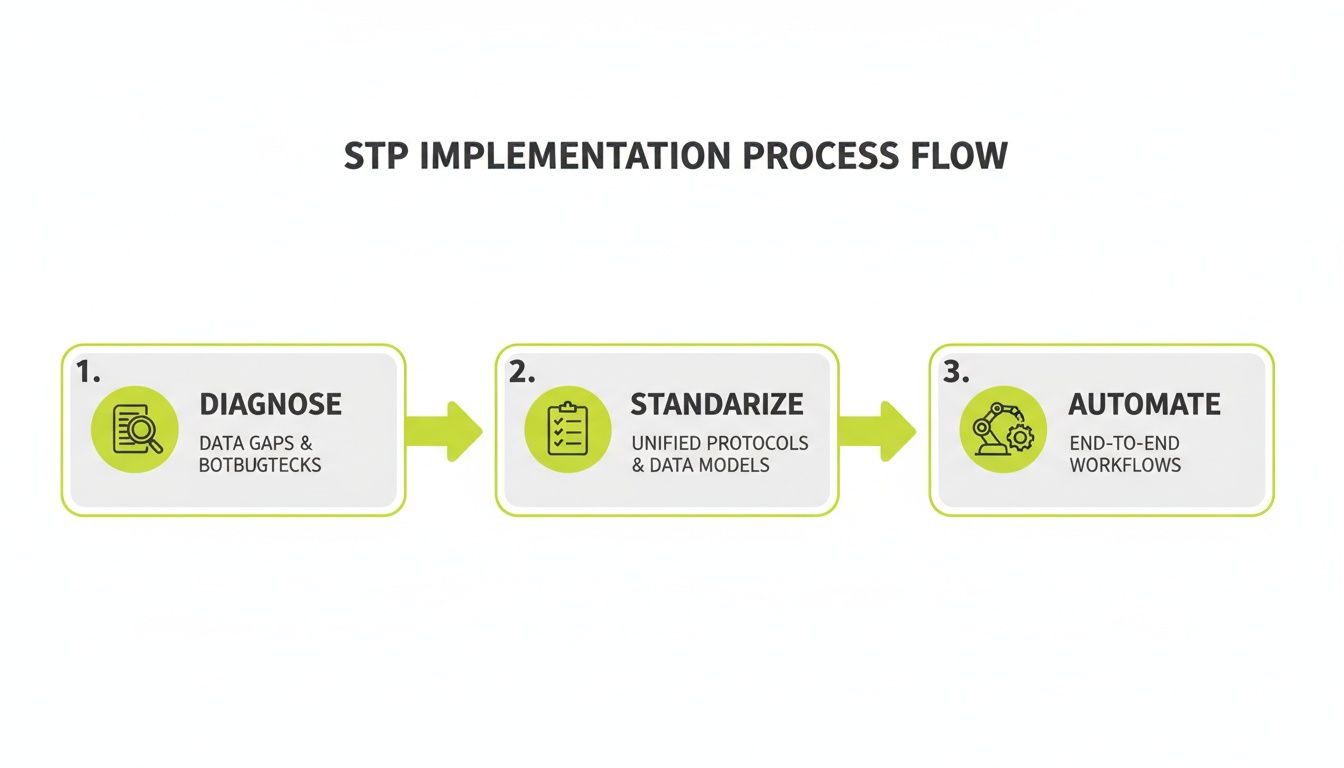
A successful rollout starts with diagnosing process breakdowns and standardizing workflows. Only then can automation deliver its full promise.
Autopilot vs. Co-pilot Modes
Genuine straight through processing runs in "Autopilot" mode. The system handles 100% of the workflow for standard transactions without human supervision. This is the goal for the vast majority of your receivables, resulting in a major reduction in DSO and more predictable cash flow.
Of course, not every transaction is standard. Complex disputes or unique billing agreements require human judgment. This is where "Co-pilot" mode is engaged.
The objective of modern AR software for professional services is not to replace people. It is to free them from repetitive tasks so they can focus their expertise where it makes a difference.
In Co-pilot mode, the AI platform does the heavy lifting but flags specific exceptions for human review. It provides all necessary context—communication history, payment patterns, invoice details—so your finance operator can make a fast, informed decision.
For example, the system might automatically send reminders for an invoice up to 60 days past due. If it remains unpaid, the platform escalates the account to a specialist, complete with a summary and suggested next steps. This ensures nothing is missed while saving your team from chasing every late payment.
This dual-mode capability is what makes today’s AI AR automation effective. You get the efficiency of a no-touch process for the bulk of your receivables while retaining strategic control over exceptions.
Measuring the ROI of Your STP Initiative
When proposing an operational investment like Straight Through Processing, the first question is, "What's the ROI?" You need an answer grounded in data.
To get buy-in and prove success, you must build a dashboard with hard, data-driven metrics. This is how you demonstrate the financial return of your accounts receivable automation initiative.
Core Metrics for Your STP Dashboard
Focus on a few core KPIs that tell a clear story of financial improvement.
- STP Rate: The percentage of invoices processed from creation to cash application with zero human touch. A rising STP rate is your north star metric.
- Cost Per Invoice: Calculate the total cost to process an invoice (labor, software, fees). As you automate, this number should drop dramatically.
- Cash Application Auto-Match Rate: This measures how many incoming payments the system automatically matches to the correct invoice without intervention. It is a direct measure of system intelligence.
- Average Collection Cycle Time: This tracks the average time from invoice sent to payment applied. It shows exactly how much faster you are getting paid.
A firm processing 1,000 invoices per month might have a manual cost of $12 per invoice. With an effective STP system, that can drop to under $3. That represents over $100,000 in annual savings.
Calculating and Benchmarking Your KPIs
Tracking these metrics is one thing; knowing what "good" looks like is another.
1. STP Rate
- Calculation: (Number of Invoices Processed with Zero Manual Touch / Total Invoices Processed) x 100
- Benchmark: Best-in-class teams often achieve an 80-90% STP rate for standard invoices.
2. Cost Per Invoice
- Calculation: (Total Monthly AR Operational Costs) / Total Invoices Processed in Month
- Benchmark: Manual processing can cost $10-$25 per invoice. With solid AI AR automation, this can be pushed down to $2-$5.
3. Cash Application Auto-Match Rate
- Calculation: (Payments Automatically Matched / Total Payments Received) x 100
- Benchmark: Manual matching may achieve a 40-50% rate. A good AI system, especially one integrated with QuickBooks AR automation, can clear 95% or more.
4. Average Collection Cycle Time
- Calculation: Sum of (Date of Payment Application - Date of Invoice Sent) for all paid invoices / Number of Paid Invoices
- Benchmark: Aim for a 15-20% reduction in this cycle time within the first year. This is a strong, achievable target that directly impacts your DSO.
When you chart these KPIs, the story of your progress tells itself. You will have an undeniable visual of your progress. For more on the financial wins, see our guide on the benefits of accounts receivable automation.
Ultimately, measuring the ROI of Straight Through Processing is about demonstrating control. It proves you have built a financial operation that is more predictable, cost-effective, and scalable.
Visual Idea: A simple, elegant line chart showing "Cost Per Invoice" on the Y-axis and "Time" on the X-axis. A steep downward trend is shown post-STP implementation, with a clear label: "Operational Cost Reduction."
Your Top Questions About STP in AR, Answered
For CFOs and controllers considering a move to straight through processing (STP), a few questions consistently arise around control, risk, and team impact. Here are straightforward answers.
Does STP Eliminate the Need for an AR Team?
No. It changes the nature of their work for the better, shifting their focus from tactical to strategic.
STP automates the repetitive, manual tasks that consume their day. This frees your skilled finance professionals to tackle work that requires human intellect—strategic analysis, nurturing complex client relationships, and resolving difficult exceptions.
Your team stops chasing paperwork and starts driving financial performance.
- Before STP: Your team spends 80% of its time on tedious, administrative tasks.
- After STP: The ratio flips. They now spend 80% of their time on high-impact financial management.
Can STP Work if Our Clients Have Unique Invoicing Requirements?
Yes. Modern AI AR automation platforms are built for flexibility, not rigidity.
They can be configured to manage a client’s specific invoicing rules, communication preferences, or payment portals. The system learns standard patterns and handles them autonomously, flagging only true anomalies for human review.
This provides maximum efficiency without sacrificing the high-touch service your clients expect.
What Is the First Step to Take Toward Implementing STP?
Start with a clear-eyed analysis of your current AR process. Pinpoint the single biggest bottleneck—where you lose the most time and where errors are most common. For most professional services firms, this is cash application and reconciliation.
The most effective strategy is a focused pilot project in that high-impact area. This allows you to prove a clear, measurable ROI quickly, such as a noticeable drop in DSO. This quick win is crucial for building momentum and securing firm-wide buy-in for a wider rollout.
A successful pilot takes accounts receivable automation from an abstract idea to a proven victory. It is the smartest way to minimize risk and build the confidence needed to transform your AR function.
Resolut automates AR for professional services—consistent, accurate, and human.