
What Is Net 30 and How Does It Impact Cash Flow?
Understand what is net 30 and its impact on your cash flow. Learn how to manage payment terms, reduce DSO, and use AR automation to improve financial stability.
For financial leaders at professional services firms, Net 30 isn't just an invoice term. It's a key lever for managing working capital and controlling the firm's cash conversion cycle.
Understanding and optimizing these payment terms is fundamental to financial stability. It directly impacts your Days Sales Outstanding (DSO), cash flow predictability, and client relationships.
What Net 30 Means for a Professional Services Firm
Net 30 stipulates that the full invoice amount is due within 30 calendar days of the invoice date. This includes weekends and holidays. An invoice dated April 1st is due by April 30th.
For a services firm, Net 30 is a standard trade credit practice. It provides clients a reasonable window to process payment while giving your firm a predictable timeline for cash receipts.
This isn’t just an accounting detail; it’s a core component of your financial operations. Effective management of these terms is the first step toward reducing DSO and improving cash flow.
The Core Components of Net 30
Net 30 terms are built on three non-negotiable data points that directly impact your firm's financial reporting and client communications.
- Invoice Date: The start of the 30-day payment cycle. Accuracy here prevents downstream disputes and delays.
- Due Date: The end of the payment cycle, 30 calendar days from the invoice date. This date anchors all cash flow forecasting.
- Payment Obligation: The total amount due. To manage this effectively, it's essential to understand the crucial difference between gross and net figures in your financials.
Here is how these components translate into operational reality for a financial leader.
Net 30 Core Components
Component | Operational Significance for a CFO/Controller |
|---|---|
Invoice Date | Triggers the cash conversion cycle for earned revenue. Precision is required for accurate DSO calculation. |
Due Date | The anchor for cash flow forecasting and the trigger for automated collections workflows. |
Payment Obligation | The gross revenue earned. Managing this balance is central to maintaining liquidity and working capital. |
Mastering these fundamentals enables the implementation of more advanced strategies, such as accounts receivable automation and a structured, non-confrontational collections process.
* **Visual Idea: A clean, cinematic shot of a calendar on a desk. The 1st of the month is circled (Invoice Date), and an arrow gracefully sweeps across the days to the 30th, which is also circled (Due Date). The visual communicates precision and control. ***
The Real Impact of Net 30 on DSO and Cash Flow
Offering Net 30 terms is a strategic decision that directly shapes your firm's cash position. Every outstanding invoice represents earned revenue that is not yet available as working capital.
This gap between billing and collection is measured by Days Sales Outstanding (DSO).
DSO calculates the average number of days it takes to collect payment after a sale. A low DSO indicates high AR efficiency. A high DSO signals that working capital is trapped in unpaid invoices. Before addressing this, clarity on understanding the crucial difference between accounts payable and accounts receivable is essential.
The formula is a standard financial metric:
DSO = (Total Accounts Receivable / Total Credit Sales) x Number of Days in Period
This is not just an accounting calculation; it is a real-time indicator of your AR process's effectiveness. The most direct way to reduce DSO is to systematically manage your Net 30 terms.
The Financial Drag of a High DSO
For a professional services firm, even a marginal increase in DSO can have a significant impact on working capital.
Consider a $10M firm with a standard 30-day DSO. This means approximately $822,000 is tied up in accounts receivable at any given time. If collections processes are lax and DSO slips to 45 days, that figure increases to over $1.23M.
That represents an additional $408,000 in cash unavailable for payroll, strategic investments, or operational expenses.
Net 30 is designed to manage this cycle.
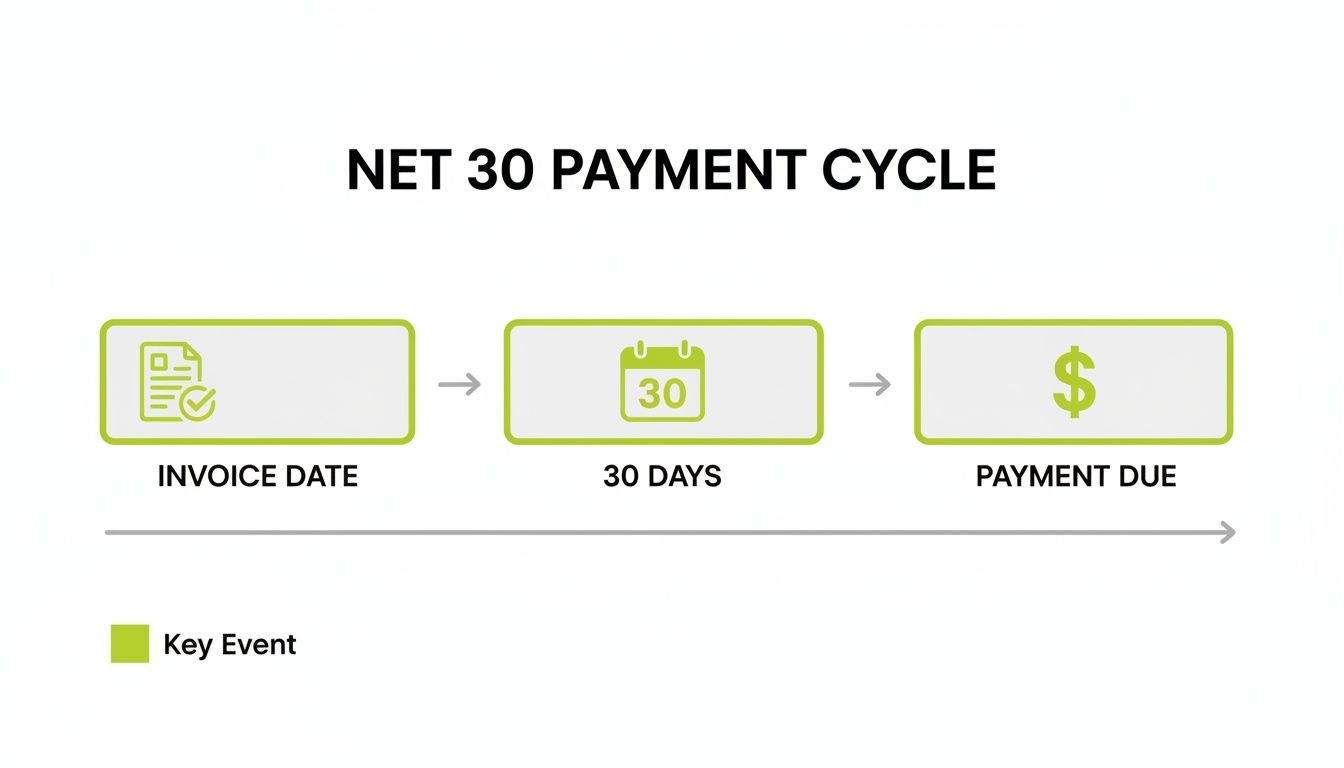
While the process appears linear, operational friction often leads to delays, extending the 30-day term far beyond its intended scope.
When Net 30 Becomes Net 52
While "Net 30" is the contractual term, late payments are common. Data shows 40% of B2B invoices are paid late, pushing the average DSO to 52 days in many sectors—a material drag on cash flow.
Managing this variance requires a proactive strategy, not reactive follow-ups. Firms can implement tactical ways to increase cash flow by tightening their AR procedures.
This is where AR software for professional services becomes a critical operational tool. Effective enforcement is not about aggressive calls; it's about systemizing reminders to keep invoices top-of-mind without damaging the client relationship.
While native tools like QuickBooks AR automation offer basic functionality, a dedicated platform provides superior control. It transforms accounts receivable from a manual, reactive function into a predictable system that directly controls the firm’s liquidity.
Using Incentives to Accelerate Cash Flow
Standard Net 30 terms are passive. They set a deadline, and you wait.
A more effective approach is to actively shape client payment behavior. The objective is not just to collect payment, but to make early payment a logical financial decision for your clients.
While late fees are a reactive penalty that can strain relationships, early payment discounts are a positive incentive. This aligns your objective (faster cash) with their objective (cost savings).
The Power of 2/10 Net 30
One of the most effective incentives is 2/10 Net 30. The terms are simple: the client can take a 2% discount if they pay within 10 days. Otherwise, the full amount is due in 30 days.
This small change has a measurable impact. Ramp reports that 35% of vendors using this structure see payment speeds increase by 15 days on average. QuickBooks data shows firms using it collect on 92% of receivables within terms, versus 78% for standard Net 30. You can review more data on how payment terms affect collections.
The Math That Drives Early Payment
A 2% discount is a powerful incentive for a sophisticated finance department.
By paying 20 days early (the delta between day 10 and day 30), they earn a 2% return on that capital.
Annualized, this represents an effective interest rate of over 36%. No competent CFO or controller would ignore a risk-free 36% return.
This reframes the interaction. You are no longer asking for a favor; you are offering a high-yield financial opportunity. This single strategy directly accelerates cash flow and can significantly reduce your DSO.
The choice between Net 30 and its variations depends on your firm's specific cash flow needs and client base.
Let's compare the most common terms from an operator's perspective.
Comparing Common Payment Term Strategies
An analysis of payment terms and their effect on cash flow and client dynamics.
Payment Term | Impact on Vendor Cash Flow | Client Perception | Optimal Use Case |
|---|---|---|---|
Due on Receipt | Immediate. Minimizes DSO. | Demanding. May be impractical for clients with established AP cycles. | Small, one-off projects or new clients with no established credit history. |
Net 15 | Accelerated. A strong middle-ground to maintain a tight cash conversion cycle. | Moderate. Signals a need for prompt payment but is achievable for most clients. | Short-duration projects or firms with minimal working capital float. |
Net 30 | Standard. Predictable but can be slow, exposing the firm to payment delays. | High. The industry standard, offering ample time for invoice processing. | Established client relationships with a reliable payment history. |
2/10 Net 30 | Excellent. Incentivizes early payment, improving cash flow and predictability. | Very High. The discount offers a clear financial benefit, making it a compelling choice. | Firms with sufficient margins to absorb the discount in exchange for accelerated and more predictable cash. |
Net 60 | Slow. Ties up significant working capital and increases credit risk. | Extremely High. Favored by large enterprise clients with rigid AP processes. | Large, long-term contracts with enterprise clients, provided the firm has the cash reserves to finance the extended term. |
Ultimately, the optimal terms depend on your business model, client profile, and risk tolerance. A dynamic term like 2/10 Net 30 often provides the best balance of flexibility and speed.
Putting Early Payment Incentives to Work
Simply adding "2/10 Net 30" to an invoice is insufficient. Effective execution requires a systematic process.
- Make It Obvious on the Invoice: State the terms clearly. More importantly, show the math: include the exact discount amount and the early payment due date.
- Send Smart Reminders: Use accounts receivable automation to send a notification a few days before the 10-day discount window closes. This is a helpful prompt, not a collection notice.
- Make Paying Easy: The client payment portal must make it simple to apply the discount and execute payment. Any friction will lead them to default to the 30-day term.
For firms using platforms like QuickBooks AR automation, these workflows can be built in. However, dedicated AR software for professional services offers greater control and customization.
How Automation Solves the Net 30 Problem
Managing receivables manually is inefficient and directly impedes cash flow. Human error, inconsistent follow-up, and administrative delays are the primary drivers of high Days Sales Outstanding (DSO).
For a CFO or controller, this manual process represents a significant opportunity cost. Time spent on administrative collection tasks is time not spent on strategic financial planning.

The solution is to replace reactive, manual processes with a proactive, automated system. Accounts receivable automation provides this control, transforming AR from a cost center into a strategic asset.
From Manual Collections to an Automated System
Effective AI AR automation augments your finance team, providing a system that executes the collections process flawlessly and consistently. This trains clients to pay on time.
A standard automated workflow includes:
- Instant Invoice Delivery: The invoice is sent automatically upon creation, eliminating manual delays.
- Pre-Due Date Reminder: A professional reminder is sent 7 days before the due date.
- Due Date Notification: A clear communication is sent on the day payment is due.
- Systematic Escalations: A sequenced series of communications begins the day an invoice becomes overdue, with increasing urgency.
This systematic approach removes the inconsistency and emotional friction from collections. Firms using robust AI AR automation typically see their DSO decrease by 25-35%. For a $10M firm, that can free up over $200,000 in cash. For more on this, see our guide on receivable management services.
AR Software: A Strategic Investment, Not an Expense
Modern AR software for professional services is more than an email scheduler. It directly addresses a CFO's primary objectives: cash flow predictability and risk mitigation.
An automated system can identify at-risk accounts based on payment history and invoice aging—before they become critical. This allows your team to intervene strategically rather than reactively.
While basic integration with QuickBooks AR automation is a start, a dedicated system provides deeper control, client-facing payment portals, and a unified dashboard for complete visibility. This positions AR automation as a direct investment in the firm's operational health.
Unifying Your AR Process for Total Control
Simple automation sends emails. An advanced system orchestrates the entire accounts receivable lifecycle.
Most AR processes are fragmented. Credit, billing, collections, and cash application operate in silos, creating friction that delays cash flow. True control comes from integrating these functions into a single, intelligent system. This is AR orchestration.
It moves beyond scheduling messages to delivering the right communication to the right person at the right time, through the preferred channel. An orchestrated system learns client payment behaviors, making every interaction feel responsive and human.

Beyond Automation to Orchestration
Orchestration provides an operating system for receivables. Instead of simply automating tasks, it connects disparate data points to build a cohesive strategy designed to reduce DSO.
A unified platform integrates:
- Intelligent Workflows: The system customizes outreach based on payment history, invoice value, and client risk profile, ensuring high-value accounts receive appropriate attention.
- Unified Data: By integrating with the general ledger (e.g., QuickBooks), the platform eliminates data silos between billing and collections, creating a single source of truth for the entire AR cycle.
- Improved Client Experience: Clients gain access to a self-service portal to view, manage, and pay invoices. Removing friction is one of the fastest ways to accelerate payment.
The primary benefit of this unified approach is predictive insight. The system flags at-risk accounts before they become a problem, enabling a strategic, proactive response from your finance team. This is one of the key benefits of accounts receivable automation that directly impacts cash flow.
This level of control transforms accounts receivable from a tactical necessity into a strategic driver of financial stability.
* **Visual Idea: A high-end data visualization chart showing DSO (Days Sales Outstanding) on a sharp downward trend over six months. Key milestones on the timeline are marked: "AR Automation Implemented," "2/10 Net 30 Introduced," and "Predictive Analytics Activated." This visual directly links actions to measurable outcomes. ***
Common Questions About Net 30 from Financial Leaders
Even for experienced finance professionals, nuances in applying Net 30 terms can create challenges. Here are answers to common questions from CFOs and controllers.
When does the 30-day period begin?
The 30-day countdown begins on the invoice date, not the date of receipt by the client or the date work was completed.
An invoice dated May 1 is due May 31, including all calendar days. Accounts receivable automation locks in this date, creating an indisputable starting point for the payment cycle. This clarity is fundamental to improving cash flow.
Is it better to offer a discount or enforce late fees?
This depends on your strategic objective. A discount like 2/10 Net 30 is a proactive incentive designed to accelerate cash flow and reduce DSO. Late fees are a reactive penalty for non-compliance.
Most firms find proactive incentives more effective. They encourage the desired behavior and preserve the client relationship. However, a clear, contractual late fee policy remains a necessary tool for managing habitually delinquent accounts.
How can we transition from Net 60 to Net 30 without losing clients?
This transition requires clear, proactive communication. Announce the change in terms well in advance, explaining the business rationale for standardization.
For key clients, consider a phased approach, such as a temporary "Net 45" term for one quarter. A direct conversation from a partner or senior executive can frame the change as a mutually beneficial move toward greater predictability.
What invoice language is critical for enforcing Net 30?
Clarity is essential for control. The invoice is a contractual document and must prominently state "Net 30" terms.
It must also clearly specify:
- A distinct invoice date.
- A calculated due date (e.g., "Due by: May 31, 2024").
- Accepted payment methods.
- The consequences of late payment (e.g., "1.5% monthly interest on overdue balances").
This precise language prevents disputes and empowers your finance team to enforce policy. Effective AR software for professional services standardizes this language across all invoices, ensuring consistency and compliance.
Resolut automates AR for professional services—consistent, accurate, and human.