What Is Net 30 Terms And How It Impacts Your Firm's Cash Flow
A guide for CFOs on what is Net 30 terms. Learn how this common payment term impacts DSO, working capital, and how to improve cash flow with AR automation.
"Net 30" on an invoice means the client has 30 calendar days from the invoice date to remit full payment. For finance leaders at professional services firms, these terms are a key lever for managing cash flow and client relationships.
Understanding and controlling your payment terms is fundamental to financial operations. It is a strategic choice that directly impacts working capital.
Decoding Net 30 Terms for Financial Operators
In professional services, Net 30 is a standard convention—often a requirement for securing enterprise clients. Functionally, it is a 30-day, interest-free loan to your customer.
This creates a deliberate gap in your cash conversion cycle. Every day an invoice remains outstanding, your firm's cash is locked in accounts receivable.
Effective finance operators view these terms not as a static default but as a component of financial strategy. Managing them separates firms with disciplined financial controls from those with unpredictable cash flow.
Net 30 Terms At A Glance
Component | Definition for Finance Leaders |
|---|---|
Invoice Date | Day zero. The 30-day term begins from this date, not the service completion date or when the client receives the invoice. |
Due Date | The final day payment must be received. Ambiguity here invites payment delays. Precision is critical. |
Payment Method | Your specified payment instructions. Clear options like ACH, wire, or a payment portal remove operational friction. |
These components should align with the master terms outlined in your firm's Terms of Service (TOS). Consistency between legal agreements and operational documents is essential.
The Real-World Impact on Your Cash
The financial leverage in managing payment terms is significant.
For a $10M firm with an average Days Sales Outstanding (DSO) of 45 days, shortening the collection cycle by just five days can unlock over $135,000 in working capital.
Managing Net 30 is about maintaining precise control over accounts receivable. It is the foundation to improve cash flow, reduce DSO, and build a resilient financial operation.
--- Visual idea: A cinematic shot from above of a large, polished boardroom table. At one end sits a lone laptop displaying a cash flow forecast dashboard. The rest of the table is empty, symbolizing quiet control and data-driven decision-making.
The Real Financial Impact of Offering Net 30 Terms
Offering Net 30 terms is standard practice in professional services. It builds client trust and accommodates the procurement cycles of larger organizations.
From a financial operator's perspective, however, every Net 30 invoice is an interest-free loan that creates a measurable gap in working capital.
While your team delivers services, your cash is tied up in accounts receivable. This forces your firm to fund payroll and operating expenses from its reserves while awaiting payment. Managing this portfolio of receivables is a core financial function.
Quantifying the Cash Flow Gap with DSO
Days Sales Outstanding (DSO) measures the impact of your payment terms. It calculates the average number of days it takes to collect payment after a sale. A lower DSO indicates an efficient collections process and stronger cash flow.
The formula is:
DSO = (Total Accounts Receivable / Total Credit Sales) x Number of Days in Period
For a firm with $1.2M in accounts receivable and $10M in annual revenue, the DSO is 43.8 days. This means it takes, on average, nearly 44 days to convert services into cash, despite official Net 30 terms. That metric is a critical health indicator for your revenue cycle.
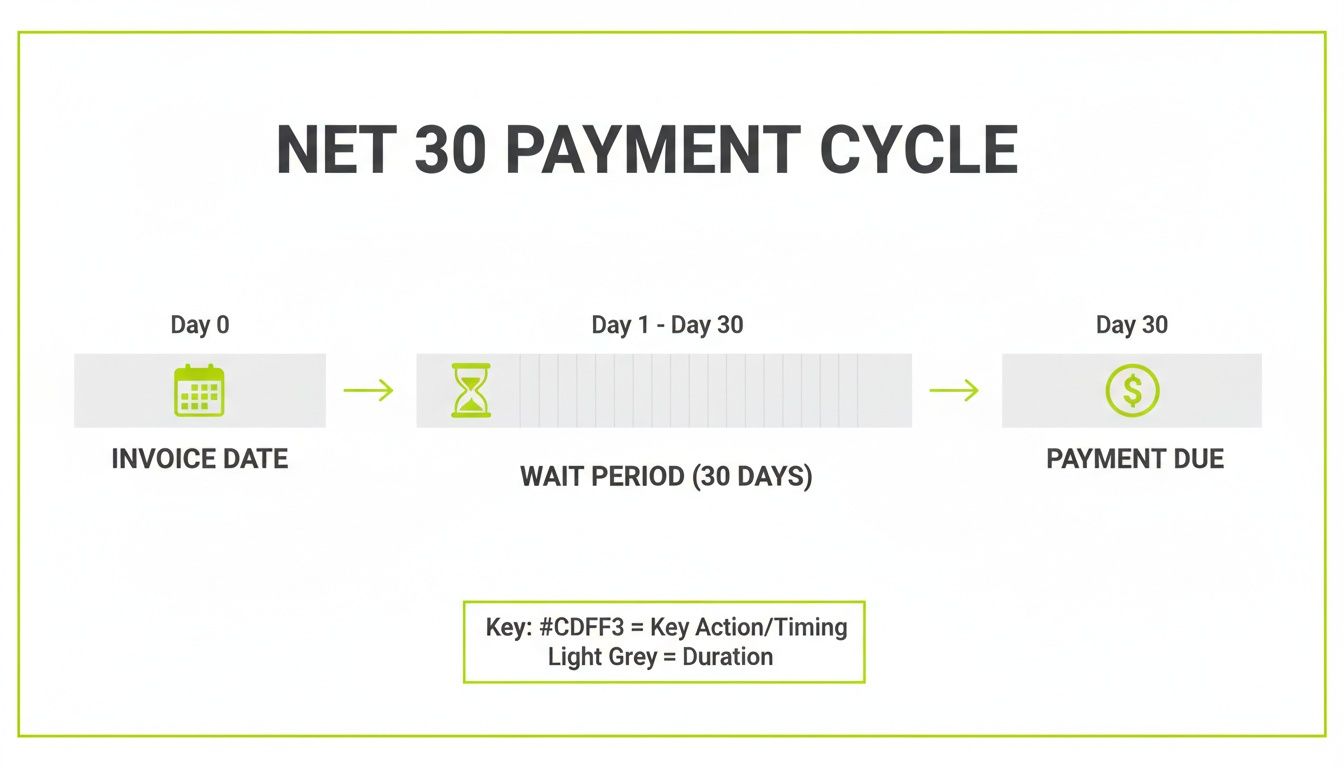
This 30-day period represents a planned delay between service delivery and cash receipt, directly impacting your firm's liquidity.
The True Cost of a Single Invoice
Consider a $50,000 invoice issued on Net 30 terms. For the next month, that capital is inaccessible. It cannot be used for payroll, reinvestment, or operating expenses. If the client pays on day 35, the cash gap widens.
Multiplying this across hundreds of clients reveals the immense pressure a manual AR process places on the business. The issue isn't just the 30-day term; it's the operational drag and lack of financial visibility that accompanies it. For more context, review these cash flow management tips.
Addressing this requires a system, not just increased effort. The objective is to reduce DSO and make cash flow predictable. This demands a strategic approach to collections and client communication, where accounts receivable automation provides significant leverage. You can dive deeper into planning for this in our guide on https://www.resolutai.com/blog/what-is-cash-flow-forecasting.
How to Craft Invoices That Actually Get Paid on Time
In accounts receivable, clarity is a prerequisite for control. An ambiguous invoice invites payment delays, creating unnecessary friction and straining cash flow.
Applying "Net 30" is insufficient. Your invoice must contain precise, professional language that serves as the first line of defense against late payments.

Each invoice must be a clear set of instructions for your client's accounts payable department, leaving no room for interpretation. This operational discipline prevents delays and ensures invoices are processed, not deferred.
Must-Have Invoice Details for Fast Payments
To shorten DSO and accelerate cash collection, every invoice must include these details:
- Invoice Issue Date: The start date. Clearly label it "Invoice Date" to eliminate ambiguity about when the 30-day term begins.
- Calculated Due Date: Do not make clients calculate the due date. Stating "Payment Due: [Date]" is direct and effective.
- Unique Invoice Number: A distinct identifier is critical for your client's AP process and your own record-keeping.
- Accepted Payment Methods: Provide clear instructions for ACH, wire transfer, or a link to a secure payment portal. Reducing friction accelerates payment.
These elements transform an invoice from a passive request into an active tool to improve cash flow. Explore more phrasing options in our guide on invoice payment terms examples.
Using Early Payment Discounts to Your Advantage
Offering an early payment discount, such as "2/10, Net 30," can accelerate collections. This provides clients a 2% discount for payment within 10 days; otherwise, the full amount is due in 30 days.
While 2% seems small, the financial mechanics are powerful. A client accepting the offer pays 20 days earlier for a nominal discount.
Annualized, a 2/10, Net 30 offer is equivalent to a 36% APR on the early-received capital. It is a self-funding mechanism to improve liquidity.
The challenge is manual execution. Tracking discount deadlines and sending reminders is operationally intensive. This is where accounts receivable automation excels, automatically prompting clients to secure the discount, thereby accelerating your cash conversion cycle.
The Hidden Costs of Managing Net 30 Manually
The obvious cost of Net 30 terms is the 30-day wait for cash. The deeper costs, however, are the operational friction and revenue leakage from manual AR processes.
Manual AR is a collection of inefficient, error-prone tasks. The "soft costs"—hours spent on follow-ups, payment matching, and reporting—represent a significant opportunity cost. This is time that could be allocated to high-value financial analysis.
Quantifying the Operational Drag
Manual AR processes inhibit scale. Each new client adds administrative burden, from tracking statuses in spreadsheets to composing reminder emails. This friction not only delays payments but consumes your finance team's capacity.
Data highlights the inefficiency: small businesses offering Net 30 terms often see their DSO extend to 38 days. A staggering 22% of invoices on these terms are paid late. For finance leaders, the ROI of automation becomes clear. Insights from J.P. Morgan on net payment terms confirm these benefits.
Manual AR processes are a direct tax on your firm’s growth. They create a system where your team's effort is spent chasing cash that is already earned, rather than fueling future revenue generation.
From Manual Effort to Automated Control
Implementing an automated system is a fundamental shift in financial control. An AI AR automation platform transforms collections from a reactive, manual task into a predictable, data-driven operation.
- Systematic Outreach: An automated system sends personalized, timely follow-ups to every client according to a predefined schedule.
- Fewer Errors: Manual data entry is a primary source of error. Effective QuickBooks AR automation eliminates these mistakes.
- Healthier Cash Flow: The ultimate goal is a measurable ability to reduce DSO and stabilize working capital.
This transition frees your finance team to operate with precision. They can shift from chasing payments to using real-time data for risk management and cash forecasting.
--- Visual idea: A clean, minimalist chart showing DSO trending downward over six months. A clear annotation marks the point where "AR Automation Implemented," correlating the technology with the positive financial outcome.
Using AR Automation to Master Net 30 Collections
The operational drag of manual collections is a strategic liability. Managing AR with spreadsheets and calendar reminders inevitably leads to missed follow-ups and delayed payments.
The solution is not more effort, but a better system. Accounts receivable automation executes your collections strategy at scale, ensuring every client receives the right communication at the right time, consistently. This discipline is the key to lowering DSO.
From Reactive Chasing to Proactive Orchestration
An AI AR automation platform shifts your team from a reactive to a proactive stance. The system methodically engages clients throughout the payment cycle, converting chaotic collections into a predictable operation.
The process becomes deliberate:
- Intelligent Reminders: Automated reminders are sent before, on, and after the due date. The system can adapt tone and messaging based on client payment history or invoice size.
- Self-Service Client Portals: A secure portal allows clients to view invoices and make immediate payments via ACH or card. This removes friction and common payment obstacles.
- Automated Cash Application: The system automatically matches inbound payments from lockbox, ACH, or wire to the correct open invoices. For firms using QuickBooks AR automation, this eliminates hours of manual reconciliation.
By making outreach systematic, AR automation ensures no invoice is forgotten. It improves the client experience while shrinking your cash conversion cycle, leading to a measurable ability to reduce DSO.
The Measurable Outcomes of Automation
Implementing AR software for professional services produces tangible financial results. Firms gain real-time visibility into their financial health, enabling them to improve cash flow with precision. For more detail, read about accounts receivable automation benefits.
The outcomes are measurable:
- A significant reduction in DSO, often by 10-20% or more.
- Elimination of manual reconciliation errors, leading to trusted financial data.
- A finance team freed from administrative tasks to focus on strategic analysis.
This transition converts your AR function from a cost center into a strategic asset. Your team gains the capacity and data to make better decisions on credit policy, client risk, and cash forecasting.
Net 30 FAQs: Your Questions Answered
Direct answers for finance leaders managing Net 30 payment terms.
When Does The Net 30 Clock Actually Start?
The 30-day countdown begins on the invoice issue date. It does not start from the service completion date or when the client opens the email.
To prevent disputes, your invoice must clearly state the "Invoice Date" and the corresponding "Payment Due Date." Ambiguity invites payment delays.
Should We Offer An Early Payment Discount Like 2/10 Net 30?
Offering a 2% discount for payment within 10 days can accelerate cash flow. The annualized return on this early-collected cash exceeds 36%.
However, this strategy is only viable if gross margins can absorb the discount. You must also assess if clients' internal AP processes can accommodate a 10-day payment turnaround.
The primary challenge with early payment discounts is execution. Manual AR teams often fail to track deadlines and remind clients. Accounts receivable automation solves this by sending timely notifications that drive adoption of the discount.
How Should We Handle Clients Who Consistently Pay Late?
Manual collection efforts for chronically late clients are inefficient and can damage relationships. A systematic approach is required.
A structured, automated follow-up sequence is the solution. It begins with polite reminders and escalates in tone as the invoice ages. Beyond a certain point, the system should flag the account for a personal call. This removes emotion and ensures consistent policy enforcement.
For high-risk accounts, consider modifying terms to Net 15 or requiring deposits for future work. An AI AR automation platform can identify these clients proactively, allowing you to mitigate risk before it impacts cash flow.
--- Resolut automates AR for professional services—consistent, accurate, and human. Learn more at https://www.resolutai.com.