What Is Net Realizable Value? A Guide for Financial Operators
Understand what is net realizable value and how it impacts your firm's cash flow and AR. A practical guide for CFOs on calculating and improving NRV.
Net Realizable Value (NRV) is a number that tells the truth.
On paper, your accounts receivable is an impressive figure—the sum of all billed work. But NRV cuts through that optimism to ask a more critical question: "How much of that cash are we actually going to collect?"
It’s the real-world value of your receivables after you account for invoices that, for various reasons, will never be paid. It's the cash you can confidently expect to hit your bank account.
The Difference Between Potential and Reality
Think of your gross accounts receivable as potential. It’s the best-case scenario. Net Realizable Value is reality. It’s your gross AR minus an allowance for doubtful accounts—a sober, data-driven estimate of uncollectible revenue.
This isn’t just an academic exercise; it's a core principle of sound financial management. Overstating AR creates a false sense of security, leading to spending and investment decisions based on cash that will never arrive.
NRV forces a disciplined look at your real financial health. It shifts the focus from "what we've billed" to "what we will actually collect."
A Foundational Accounting Principle
This isn’t a niche metric. It’s a core requirement under both U.S. GAAP and IFRS, designed to prevent asset overstatement.
If your firm has $500,000 in gross billings but historical data shows that 3% ($15,000) typically goes uncollected, your NRV is $485,000. Recording this adjusted figure ensures your balance sheet is accurate and reliable.
Net Realizable Value acts as a financial reality check. It forces a disciplined assessment of your client base and collection effectiveness, shifting the focus from "what we've billed" to "what we will collect."
As your firm grows, so does the complexity of your receivables. You might even find yourself dealing with new asset classes. For instance, as more businesses explore digital currencies, it's worth understanding the implications of crypto payments adoption and how to value these new forms of payment.
Ultimately, an accurate NRV is the first step toward predictable cash flow. It highlights friction in your collections process and gives you the data needed to implement targeted fixes, like AR software for professional services, to accelerate cash conversion.
How to Calculate NRV for Accounts Receivable
Calculating the Net Realizable Value of your accounts receivable isn’t an abstract accounting drill. It’s a core business discipline that requires a systematic approach to identifying collection risk.
While a simple percentage-of-sales method exists, the AR aging method delivers the precision needed for effective cash flow management.
This approach is built on a simple truth: the older an invoice, the higher the probability of non-payment. By applying escalating risk percentages to older invoices, you build a defensible, risk-adjusted allowance for doubtful accounts. This is the key to a realistic NRV.
The AR Aging Method in Practice
The process is straightforward. First, segment your total Accounts Receivable into aging buckets based on invoice issue date—typically Current (0-30 days), 31-60 days, 61-90 days, and 90+ days. This is a standard report in most accounting platforms, including those with QuickBooks AR automation.
Next, assign an estimated non-collection percentage to each bucket based on your firm’s historical payment data. New companies can start with industry averages, but after a few quarters, your own collection metrics will provide a far more accurate baseline.
The goal is to move from a generic guess to a data-backed forecast. An accurate NRV is built on the reality of your past collections performance, not on industry hypothetically.
This diagram shows how Gross AR, your calculated allowance, and the final NRV all fit together.
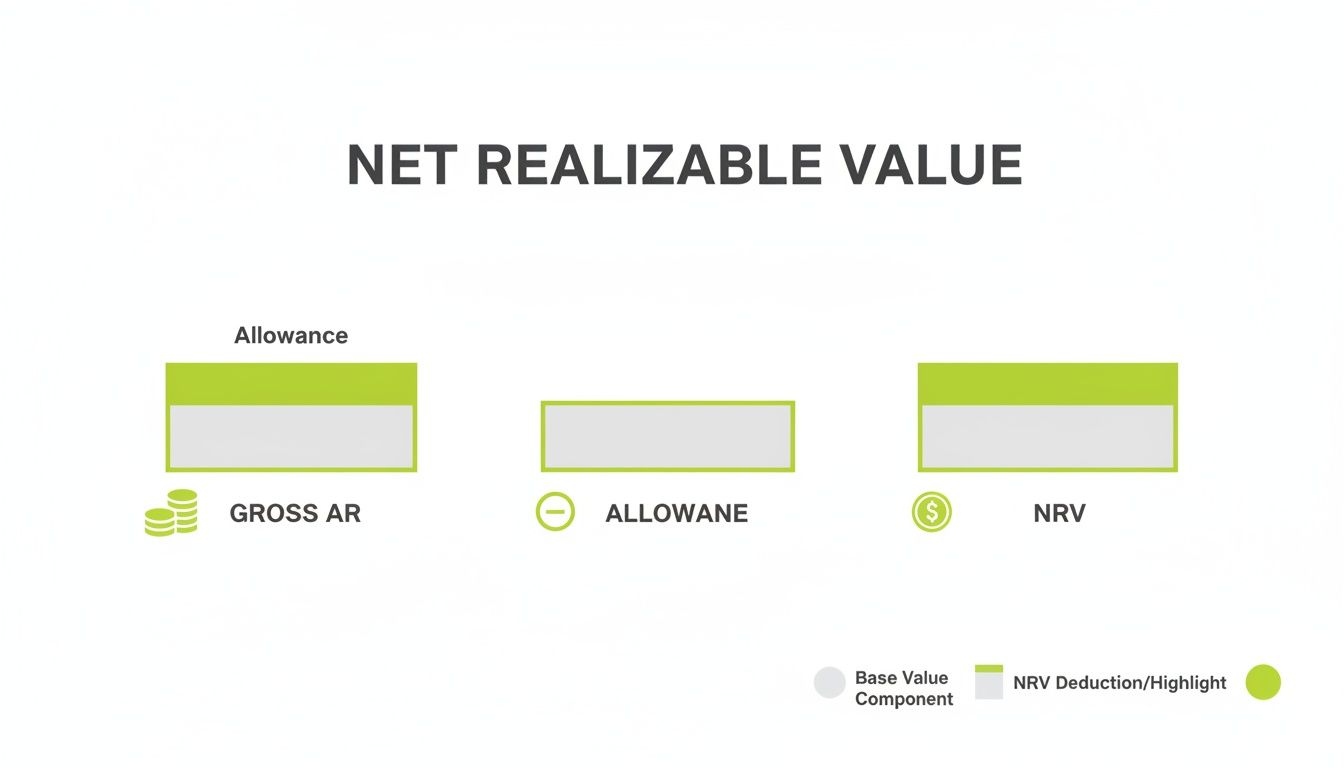
The visual makes it clear that NRV isn't about finding new money. It’s about a disciplined reduction of your gross receivables to reflect what you can actually expect to collect.
A Worked Example for a Services Firm
Let's walk through an example for a mid-sized consulting firm with $2.5 million in gross accounts receivable. Based on its payment history, it has assigned the following risk percentages to its aging buckets.
Here’s a quick table to show how the math works out.
AR Aging Method for NRV Calculation Example
Aging Bucket | Amount Receivable | Estimated Uncollectible % | Required Allowance |
|---|---|---|---|
Current (0-30 days) | $1,500,000 | 1% | $15,000 |
31-60 days | $600,000 | 5% | $30,000 |
61-90 days | $300,000 | 15% | $45,000 |
90+ days | $100,000 | 50% | $50,000 |
Totals | $2,500,000 | $140,000 |
By summing the allowance for each bucket, the firm arrives at a total Allowance for Doubtful Accounts of $140,000.
With that figure, the final NRV calculation is simple:
- Gross AR: $2,500,000
- Less: Allowance: ($140,000)
- Net Realizable Value (NRV): $2,360,000
That final number—$2,360,000—is what matters for strategic planning. It represents the cash the firm can confidently expect to collect, providing a solid foundation for decisions about payroll, new investments, and growth.
Using accounts receivable automation can make these percentages more accurate by providing cleaner, more accessible historical data, sharpening your NRV forecast month after month.
How NRV Impacts Your Financials and Cash Flow
Net Realizable Value isn't just a compliance number. It's a direct reflection of your firm’s financial integrity. How you account for it sends clear signals through your financial statements, telling a story about both stability and operational efficiency.
On the balance sheet, the Allowance for Doubtful Accounts acts as a contra-asset account. It sits directly below your gross accounts receivable and reduces it, presenting an honest picture of your firm’s actual liquidity. This is about making decisions based on the cash you will actually collect.
Simultaneously, the other side of this entry hits your income statement as Bad Debt Expense. This directly reduces net income, making it a critical measure of profitability. A consistently high bad debt expense is a clear indicator that something in your client intake or collections process is broken.
From Accounting Entry to Operational Reality
The line between this accounting principle and your day-to-day cash flow is direct. A poorly managed NRV calculation—often resulting in a bloated allowance—is a lagging indicator of a weak collections process. The operational impact is measurable.
For example, a 5% increase in your bad debt provision can easily drive a 10-15 day spike in your Days Sales Outstanding (DSO). That means cash that should be funding operations is trapped in your receivables, weakening your working capital. Understanding this link is critical; it shows how accounting discipline directly impacts your ability to improve cash flow and fund growth.
An inflated AR balance creates a false sense of security. The discipline of calculating NRV forces a realistic conversation about client creditworthiness and the effectiveness of your collections engine.
The Real Price of Getting NRV Wrong
When NRV isn’t managed with precision, the consequences extend beyond a reporting error. The ripple effects are damaging:
- Misguided Capital Allocation: Overstated assets might lead you to fund new initiatives with cash you don’t actually have.
- Strained Banking Relationships: Lenders and creditors rely on accurate financials to assess risk. Inflated AR erodes that trust and can compromise your access to capital.
- Lower Firm Valuation: During due diligence for a sale or merger, a high bad debt expense or a sudden, large write-off signals operational weakness. That will directly and negatively impact your firm's valuation.
Ultimately, a precise NRV supported by a data-driven allowance is a sign of financial control. It proves you have a firm grasp on the entire client-to-cash cycle. This is where tools like AI AR automation provide the real-time data needed to maintain accuracy and turn NRV from a quarterly chore into a dynamic measure of your firm's health.
Common Pitfalls in Managing Receivable NRV

Getting receivable NRV right isn't just an accounting exercise—it's a measure of operational discipline. When handled correctly, it provides a clear, defensible picture of your firm's most liquid assets.
However, a few common blind spots can destroy that accuracy, leading to skewed financials and poor capital decisions. These aren't minor errors; they are strategic failures that obscure the true health of your cash flow.
Overly Optimistic Assumptions
The easiest trap is basing your allowance for doubtful accounts on hope instead of historical data. Assuming a client will pay simply because they always have ignores changing economic realities. That optimism directly inflates your NRV and, in turn, your total assets.
Imagine a marketing agency that kept a client’s $150,000 balance as "current," even after hearing of layoffs at the client’s company. Three months later, the client declared bankruptcy. The agency was forced into a sudden, painful write-off that cratered its Q3 profits and put its credit line negotiations at risk.
An accurate NRV is built on skepticism and evidence, not just relationships or past performance. It demands an honest look at the collection risk for every single dollar you're owed.
Inconsistent Allowance Methods
Another common mistake is changing how you calculate your allowance. One quarter, you might use a simple percentage of sales; the next, a detailed aging analysis—often to smooth earnings numbers. This creates volatile, unreliable reports that mask underlying collection problems.
That inconsistency erodes trust with lenders and investors, who rely on predictable data. A consistent, well-defined method, preferably based on AR aging, demonstrates control. For a deeper dive, review these essential accounts receivable best practices for professional services firms to build a stronger foundation.
Delayed Write-Offs
Finally, there's the reluctance to write off a debt that is clearly uncollectible. Some leaders see write-offs as admitting failure, letting dead invoices linger on the books for months or even years. This habit artificially inflates your accounts receivable balance and skews key metrics like DSO.
The delay doesn’t just distort your balance sheet; it wastes your team’s time chasing ghosts. A clear, time-based write-off policy—for example, writing off any invoice over 180 days with no active payment plan—keeps your AR clean and your data trustworthy. This is precisely where AI-powered AR automation can offer data-driven recommendations, removing emotion from the equation and helping to systematically reduce DSO.
Improving NRV with AR Automation

Calculating Net Realizable Value manually often relies on gut feelings, historical averages, and spreadsheets that are difficult to maintain.
This guesswork creates a quiet but persistent drag on your firm's finances. It obscures the true health of your accounts receivable and makes real liquidity a moving target. In short, it’s a necessary evil that’s no longer necessary.
Modern accounts receivable automation replaces subjective guesswork with data-driven clarity. It provides the operational control needed to calculate NRV accurately and consistently, turning an accounting chore into a strategic advantage.
Moving from Guesswork to Precision
AI-powered AR automation analyzes thousands of data points in real time—individual payment histories, communication patterns, and even broader industry payment trends.
The result is a dynamic, living risk model for your entire AR portfolio.
Instead of applying a flat 5% provision to every invoice in the 31-60 day bucket, the system gets specific. It might flag one client in that same bucket as a 25% risk because they have suddenly stopped responding after a history of prompt payments.
The core function of AR automation in NRV management is to replace lagging indicators with leading indicators. It shifts the focus from reacting to payment delays to proactively identifying which accounts pose the greatest risk before they become seriously delinquent.
This predictive power transforms the NRV calculation from a backward-looking accounting exercise into a forward-looking financial strategy. For a closer look at the mechanics, our guide on receivable management services offers valuable context.
The Measurable Outcomes of Automation
This precision delivers tangible benefits that extend far beyond a cleaner balance sheet.
- Improved Cash Flow Forecasting: An accurate NRV makes cash flow projections reliable. That enables smarter decisions about hiring, investment, and growth.
- Systematic DSO Reduction: By spotting at-risk accounts sooner, your team can intervene with the right collection strategy at the right time. This proactive management helps reduce DSO.
- Enhanced Financial Reporting Integrity: A consistent, data-backed NRV gives auditors, lenders, and investors confidence. It demonstrates a firm handle on your assets and financial controls.
Better automation also helps on the recovery side. Automated systems can manage disputed funds with advanced representment strategies, improving recovery rates and, by extension, your NRV. AR software built for professional services, especially with integrations like QuickBooks AR automation, provides the data backbone for superior financial control.
What This All Really Means for Your Business
Net Realizable Value is more than a box you check for accounting compliance. It's a gut check. It’s an honest look at how well your firm is running and how disciplined your finances really are.
A sharp, accurate NRV tells a story about your liquidity, but it also reveals the health of your entire process, from the first proposal to the final payment. It’s a direct measure of your operational pulse.
When you nail down your NRV, you send a clear signal to lenders, investors, and partners. It shows you’re operating with a real map—one based on the cash you can actually collect, not the vanity numbers on gross invoices. That kind of predictable financial footing is what sustainable growth is built on.
This is where accounts receivable automation becomes a strategic tool. It pulls you out of subjective estimates and replaces them with a living, data-driven model. The goal is an NRV that is always accurate.
With the right AI AR automation, you can sharpen forecasts, improve cash flow, and gain the control needed to plan your firm's future with confidence.
Common Questions About NRV
How Often Should We Adjust Our Allowance for Doubtful Accounts?
For most professional services firms, you should review and adjust your allowance at the end of every monthly close. Anything less frequent creates unnecessary risk.
This isn't just about accounting hygiene. Monthly adjustments provide a real-time, accurate picture of your working capital and ability to improve cash flow. A quarterly review is the bare minimum and often leads to large, surprising write-offs that could have been managed sooner.
What’s a Healthy Percentage for Bad Debt Expense?
It will always vary based on your client base, but a healthy bad debt expense for a professional services firm should hover between 1% and 3% of total revenue.
If your firm consistently creeps above that range, it’s a red flag. It points to friction in your process—perhaps in client screening, invoicing, or collections. Using AR software for professional services can make a real difference, helping you spot at-risk accounts before they become write-offs.
A disciplined NRV process signals financial maturity. It tells investors and lenders that you operate with a clear-eyed view of your assets and have strong internal controls.
Can Improving Our NRV Estimation Actually Impact Firm Valuation?
Absolutely. It’s one of the most underrated drivers of value.
When potential investors or acquirers see a consistent, well-documented process for calculating Net Realizable Value, it signals that your financials are solid. It gives them confidence that your reported assets aren't just wishful thinking.
A lower, more stable bad debt expense flows directly to your bottom line, improving metrics like EBITDA that are central to valuation. Disciplined NRV management proves you have reliable cash flow and operational control—two things every investor wants to see. The precision from accounts receivable automation makes this process both defensible and repeatable.
--- Resolut automates AR for professional services—consistent, accurate, and human. Learn more at https://www.resolutai.com.