
Unlocking Predictable Cash Flow Through Your Accounts Receivable Process
Transform your AR process with a superior digital customer experience. This guide for finance leaders explains how to reduce DSO and improve cash flow.
For finance leaders, the phrase “digital customer experience” isn’t marketing fluff—it’s a direct lever for financial control. Every point of friction in your accounts receivable process is a roadblock delaying cash in the bank.
A smooth, clear AR experience is a measurable strategy for improving cash flow. It systematically reduces Days Sales Outstanding (DSO) and strengthens your financial position.
Connecting the Client Payment Experience to Your Bottom Line
The term "digital customer experience" often brings to mind retail or marketing. For a CFO or Controller at a professional services firm, this view is incomplete. It overlooks the most critical financial touchpoint: the invoice and payment cycle.
From the moment an invoice is sent until payment is reconciled, your client is having a direct financial experience with your firm. This experience directly impacts your balance sheet.
A confusing invoice, a difficult payment process, or inconsistent follow-up all create friction. Each point of friction adds days to your Days Sales Outstanding (DSO), ties up working capital, and requires manual intervention from your team. This isn't a "soft" metric; it's a hard operational drag.
The Financial Cost of a Poor AR Process
A disjointed AR process has tangible costs. When clients must spend time deciphering a complex invoice or navigating a clunky payment system, they often defer payment.
This delay forces your finance team into a reactive cycle of manual reminders and chasing payments. Their time is diverted from high-value analysis to administrative clean-up.
This operational inefficiency is a growing risk. By 2026, customer frustration has driven 77% of customers to report a product or service issue in the past 12 months. This sentiment impacts B2B payment timeliness, making a seamless financial experience critical.
The table below contrasts a traditional AR approach with a modern, client-centric one. The difference in financial outcomes is clear.
Metric | Traditional AR Process | Client-Centric AR Process |
|---|---|---|
Primary Focus | Internal collections; "getting paid" | Client convenience; "making it easy to pay" |
Client Interaction | Reactive, manual chasing | Proactive, automated, professional reminders |
Payment Process | Limited options (check, bank transfer) | Multiple, convenient options (credit card, ACH) |
Days Sales Outstanding (DSO) | High and unpredictable | Lower and more predictable |
Team Workload | High-touch, administrative, focused on collections | Low-touch, strategic, focused on exceptions |
Cash Flow | Constrained and inconsistent | Optimized and reliable |
Shifting focus from internal collections to the external client payment experience fundamentally improves financial results. It moves AR from a reactive chore to a proactive cash flow strategy.
Redefining the Goal: Efficiency Is the Outcome
The objective is not to "delight" clients with over-engineered portals. The goal is to build a financial process so efficient and clear it becomes invisible.
An effective digital customer experience in AR means:
- Clients receive invoices they understand instantly.
- They can pay in seconds using their preferred method.
- They receive professional, automated reminders that feel helpful, not nagging.
- Payments are reconciled automatically, closing the loop without error.
For a deeper dive into the core principles, this guide on Mastering Digital Customer Experience is a useful resource.
This controlled, predictable process translates directly to a lower DSO and healthier cash flow. It is about taking command of your financial operations by viewing collections through your client's eyes.
Resolut automates AR for professional services—consistent, accurate, and human.
The Four Pillars of a High-Performing Financial Experience
To turn the concept of digital customer experience into a tangible asset, we must get practical. For a finance leader, this is about engineering a system for control, accuracy, and predictable cash flow.
Let's break it down into four operational pillars. Each pillar targets a specific point of friction in the accounts receivable cycle, systematically reducing delays and manual follow-up.
The connection between these pillars and your firm’s financial health is direct and measurable. Improving one stage of your client's financial journey creates a positive ripple effect, boosting cash flow and shrinking your Days Sales Outstanding (DSO).
This diagram illustrates how a better client experience forms the base supporting your most important financial goals.
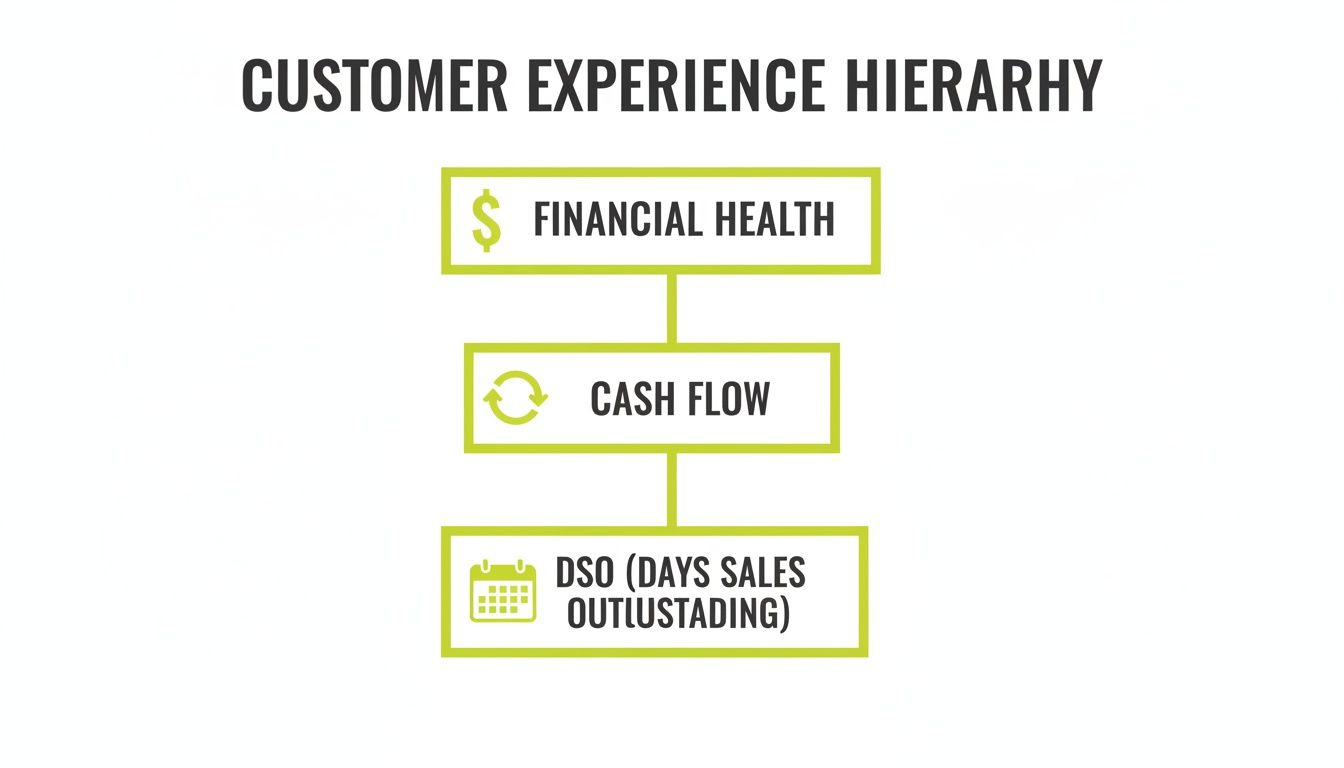
As you can see, a positive experience is the foundation. It enables a lower DSO, which in turn leads to stronger cash flow and better overall financial health.
Pillar 1: Dynamic Billing
First is Dynamic Billing. The traditional process involves sending a static PDF invoice. This often creates more questions than it answers, with vague line items or missing context forcing the client's AP team to pause payment and investigate. This adds days or weeks to your DSO.
Dynamic billing transforms the invoice from a static document into an interactive, self-service portal. Clients can click for more detail, view the original statement of work, or ask a question directly from the invoice. This clarity prevents disputes before they start.
Pillar 2: Omnichannel Outreach
The second pillar is systematic Omnichannel Outreach. In a manual AR world, follow-up is inconsistent. The tone varies, and communication is often limited to a single channel that may not be your client’s preference.
This pillar is about creating a disciplined, automated communication strategy. By 2026, 61% of customers will prefer digital channels like messaging. An AI AR automation platform that sends intelligent follow-ups across email, SMS, and client portals meets clients where they are, making it easier for them to act.
Pillar 3: A Seamless Payment Portal
Once a client is ready to pay, any friction is another opportunity for delay. This makes a Seamless Payment Portal critical. Forcing clients to mail a check or use a clunky bank transfer process is an unnecessary hurdle.
A modern payment portal should offer consumer-grade options: credit card, ACH, and digital wallets. Providing flexible, one-click payment methods removes the final barrier between your client's intent to pay and cash in your bank account.
Pillar 4: Automated Reconciliation
The final pillar is Automated Reconciliation. The collections cycle ends not when a payment is received, but when the cash is correctly applied and your books are closed. Manually applying cash is slow, error-prone, and creates a lag in your cash position visibility.
Automated reconciliation is the lynchpin of the financial experience. It closes the loop instantly by matching payments to invoices and updating your general ledger in real time, resulting in an accurate, up-to-the-minute view of cash.
This immediate reconciliation eliminates administrative work and ensures your financial reports are based on current, reliable data. For more on this, our guide on managing customer communication can help maintain a professional AR process.
How AI AR Automation Delivers Measurable Results

Implementing the four pillars without overburdening your team is the primary challenge. This is where AI AR automation becomes a practical tool for improving cash flow. It's about making your existing AR process more intelligent, not just adding another piece of software.
True AI AR automation is about intelligent orchestration. It adapts its approach based on live data and client behavior, acting as a disciplined, digital extension of your finance team that executes your collections playbook with perfect consistency.
The outcome is a more professional digital customer experience that directly improves your bottom line. The system handles repetitive, manual work, freeing your team to focus on high-value exceptions and financial strategy.
From Manual Effort to Intelligent Orchestration
Basic automation is rigid, following simple rules like sending reminders at 7, 14, and 30 days. This one-size-fits-all approach misses critical context, such as a client’s payment history or invoice amount.
Intelligent orchestration, powered by AI AR automation, is more sophisticated. It analyzes patterns to determine the optimal action for each situation.
- Personalized Outreach: The AI may note a high-value client always pays on the 15th. Instead of sending multiple reminders, it sends a single, professional reminder on the 14th. For a new client, it might initiate a more structured communication sequence.
- Predictive Risk Analysis: AI models can flag invoices likely to become delinquent before they are late. It might identify a client who usually pays in 10 days but hasn't opened the invoice email after a week, allowing your team to intervene proactively.
Achieving this level of nuance manually is impossible at scale. Our guide to accounts receivable automation software provides a deeper look.
Autopilot vs. Co-Pilot Control
Adopting an automated system does not mean relinquishing control. Modern platforms support your firm's unique processes by offering different levels of engagement. The technology should serve your team.
Consider it in two modes:
Autopilot Mode: The system runs autonomously based on your predefined rules. It handles the entire collections process—sending invoices, dispatching personalized reminders, and applying cash. This is ideal for standard, low-risk accounts, freeing up 90% or more of your team's time spent on manual follow-up.
Co-pilot Mode: For sensitive accounts or complex issues, your team remains in control. The system acts as a guide, providing smart suggestions, flagging at-risk invoices, and queuing up communications for human review. Your team can edit, approve, or discard any action, ensuring high-touch relationships receive careful oversight.
This dual-mode approach delivers the efficiency of automation for routine tasks and the precision of human judgment for exceptions. It’s a framework for scaling collections without scaling headcount.
AI AR automation is a tool that executes your financial strategy with perfect consistency. It connects dynamic billing, omnichannel outreach, seamless payments, and automated reconciliation into a unified engine to reduce DSO and improve cash flow.
Resolut automates AR for professional services—consistent, accurate, and human.
Measuring the ROI of Your AR Investment
As a finance leader, you operate on hard numbers. When investing in your firm's digital customer experience, you are making a direct investment in your balance sheet. Justifying that investment requires showing precisely how it will pay off.
Days Sales Outstanding (DSO) is the primary metric, but a richer view of collections efficiency comes from tracking other key performance indicators.
Looking Beyond DSO
A low DSO is the goal, but how you achieve it matters. Two other metrics provide a clearer picture of performance: the Collection Effectiveness Index (CEI) and Average Days Delinquent (ADD).
- Collection Effectiveness Index (CEI): This measures how much cash you collected against the total amount available to collect during a period. A CEI of 100% means you collected every dollar that was due.
- Formula:
(Beginning Receivables + Credit Sales - Ending Total Receivables) / (Beginning Receivables + Credit Sales - Ending Current Receivables) x 100
- Formula:
- Average Days Delinquent (ADD): This metric isolates problem accounts by showing the average number of days invoices are past due. Unlike DSO, which can be skewed by payment terms, ADD clearly signals when collections are slipping.
- Formula:
Days Sales Outstanding (DSO) - Best Possible DSO
- Formula:
Tracking these metrics provides a precise, multi-dimensional view of your AR health. Our guide on understanding DSO in depth offers more context.
Modeling the Financial Impact
Let's translate these metrics into tangible results. Consider a professional services firm with $10 million in annual revenue.
With Net 30 terms, a DSO of 45 days means the firm has roughly $1.23 million tied up in accounts receivable at any given time ($10M / 365 days * 45 days). This is earned cash that cannot be used.
Now, assume the firm implements AI AR automation. By improving invoice clarity, payment options, and reminder consistency, they reduce their DSO by just five days, from 45 to 40.
The amount tied up in receivables drops to $1.09 million ($10M / 365 days * 40 days). That five-day improvement unlocks $140,000 in working capital—real cash available for payroll, investment, or reserves.
This data-driven approach proves that improving the financial customer experience is a direct line to a healthier cash position. It transforms AR from a cost center into a strategic lever for financial control.
Market data supports this. Research shows that 59% of high-growth organizations see significant business results from their digital CX efforts, while 64% of customers spend more after a positive experience. A professional and seamless AR process leads to faster payments. Find more customer experience statistics that matter in this report.
Modern AR software for professional services, including platforms with QuickBooks AR automation, provides this data through intuitive dashboards. You can monitor DSO, CEI, and ADD in real time, enabling smart decisions that directly improve cash flow.
Resolut automates AR for professional services—consistent, accurate, and human.
A Pragmatic Implementation Roadmap for Your Finance Team

Implementing a new system in the finance department requires precision and control. This roadmap breaks down how to adopt accounts receivable automation in four manageable phases, ensuring a smooth transition that delivers predictable results.
This is a controlled operational upgrade, not a massive tech overhaul. Each phase builds on the last, giving your team complete visibility and control while systematically improving your digital customer experience and cash flow.
Phase 1: Assessment and Goal Setting
The first step is a clear analysis of your current AR process. Map the entire workflow, from invoice creation to cash application, to identify friction points. Quantify where delays occur and how much time your team spends on manual follow-ups.
With a clear baseline, set specific, measurable goals. Vague targets like "improve cash flow" are insufficient. Aim for concrete outcomes, such as:
- Reduce DSO by 7 days (e.g., from 45 to 38) within 90 days.
- Cut time spent on manual collections follow-up by 75%.
- Decrease invoices over 60 days past due by 50%.
These hard targets will guide implementation and measure success.
Phase 2: System Integration and Configuration
With clear goals, the next step is system integration. Modern AR software for professional services is built for seamless connection with accounting systems. A platform offering robust QuickBooks AR automation should provide a straightforward, two-way sync.
This integration is non-negotiable. It ensures all invoice, client, and payment data flows automatically, eliminating manual data entry and creating a single source of truth for receivables data.
During this phase, you will also configure the automation rules. This translates your firm’s collections strategy into an automated workflow, setting the timing and tone for reminders, defining escalation paths, and customizing the payment portal.
Phase 3: Controlled Go-Live and Pilot Program
A "big bang" rollout introduces unnecessary risk. A controlled go-live, starting with a small pilot group of clients, is a more prudent approach. This allows you to test the system in a real-world environment without disrupting your entire client base.
Select a representative sample for the pilot: a mix of prompt payers, consistently late clients, and one or two large accounts. This provides a comprehensive test of the system's workflows.
During the pilot, your team acts as "co-pilot," monitoring automated communications, observing client interactions with the new payment portal, and gathering feedback. This controlled test validates system performance and builds team confidence before a firm-wide launch.
Any issues discovered can be resolved with minimal impact. This methodical approach ensures a smooth transition for both your team and your clients.
Phase 4: Monitoring and Continuous Optimization
Once the system is fully live, the final phase begins: ongoing monitoring and optimization. Your AI AR automation platform provides a wealth of operational data. The analytics dashboard offers a real-time pulse on key metrics like DSO and CEI.
Use this data to fine-tune your strategy. You may find that one client segment responds better to SMS reminders or that a specific payment option accelerates collections. This data-driven feedback loop enables continuous adjustments that further reduce DSO and strengthen financial outcomes.
This four-phase roadmap transforms AR automation implementation into a structured, manageable process. It puts you in control, minimizes risk, and ensures the technology serves its ultimate purpose: to build a more resilient and predictable cash flow engine for your firm.
Resolut automates AR for professional services—consistent, accurate, and human.
***
Your Path to Consistent and Human AR
For finance leaders, digital customer experience is about disciplined financial operations. It’s an operational strategy designed to gain tighter control over cash flow, reduce administrative waste, and strengthen client relationships through sheer professionalism.
The focus must be on measurable results. We are not aiming for abstract "delight," but for predictable performance that improves the balance sheet. Every improvement—from clearer invoices to simpler payment methods—is a direct lever to reduce DSO and improve cash flow.
A superior digital experience in AR is ultimately about financial control. It translates client convenience into predictable cash flow, giving you a more resilient financial foundation. This is how you move from reactive collections to proactive financial management.
When your collections process becomes consistent, accurate, and human, you build a stronger firm. This disciplined approach transforms a frustrating, manual task into an operational strength.
The end result is less time spent chasing payments and more capital available to fund strategic growth.
Resolut automates AR for professional services—consistent, accurate, and human.
Frequently Asked Questions
For any finance leader, adopting new technology is a decision that requires balancing risk and reward. Here, we address common questions from CFOs and Controllers considering how AR automation can redefine their firm's financial health and digital customer experience.
Will AR Automation Feel Robotic and Damage Our Client Relationships?
This is a common concern, especially in relationship-driven professional services. The fear is replacing a human touch with cold, robotic reminders. The correct way to view this is as disciplined orchestration, not just automation.
A well-designed AI AR automation system creates smart, personalized workflows that adapt based on client history. An early reminder can be a helpful nudge, while a notice for a seriously overdue invoice can adopt a more formal tone.
The best AR software for professional services acts as a co-pilot. It allows a human to review, approve, or intervene before communication is sent, preserving the personal connection where it matters most. The goal is to make collections more consistent and professional, which builds client trust.
How Does This Software Connect With Our System, Like QuickBooks?
Modern accounts receivable automation platforms are built for seamless integration with accounting systems like QuickBooks, Xero, and NetSuite. This is not a massive IT project; connecting the systems is a straightforward part of the initial setup.
Once linked, the platform automatically syncs all invoice and customer data, eliminating manual entry and errors. When a client pays via the portal, the payment is automatically recorded and reconciled in your accounting software, creating a single source of truth for your cash position. For many firms, a solid QuickBooks AR automation integration is essential.
What’s the Real ROI, and How Fast Will We See It?
The return on investment is measurable in three key areas:
- Direct Financial Gains: The most immediate impact is a reduction in DSO. Even a small decrease frees up significant working capital previously tied up on your balance sheet.
- Operational Savings: Quantify the hours your team spends chasing payments and manually reconciling accounts. Automation significantly reduces this administrative burden, freeing staff for more strategic analysis.
- Strategic Benefits: Predictable cash flow allows for more confident financial forecasting and strategic investment.
Most firms see a noticeable reduction in DSO within the first 60-90 days. The full impact, including operational cost savings and improved cash stability, becomes clear within six months as the system optimizes its collection workflows. It is a direct investment in your firm's financial resilience.
--- Resolut automates AR for professional services—consistent, accurate, and human. Learn more at Resolut.