
Mastering DSO in Accounting to Improve Cash Flow
A finance leader's guide to DSO in accounting. Learn to calculate, benchmark, and reduce your DSO to improve cash flow and operational efficiency.
On the surface, Days Sales Outstanding (DSO) is just the average number of days it takes to get paid after you complete your work. For a CFO, Controller, or firm owner, it's a direct measure of financial control and the rhythm of your cash flow.
A high DSO means your firm’s cash is tied up funding your clients' operations instead of your own. Every day an invoice goes unpaid is a day you can't use that capital for hiring, growth, or operational expenses.
Why DSO Is Your Firm’s Most Critical Financial Metric
In professional services, DSO isn't just a metric—it's an indicator of your firm's financial stability and operational discipline. A high DSO is a drag on your entire organization.
It erodes working capital, forces your finance team into low-value collection activities, and increases the risk of bad debt. The older an invoice gets, the less likely it is to be collected.
- It Drags Down Your Cash Flow: Revenue on the books is not cash in the bank. A high DSO starves your business of the liquidity it needs to operate effectively.
- It Creates Operational Friction: Instead of focusing on strategic financial planning, your finance team is forced to spend hours chasing payments—a costly, morale-draining distraction.
- It Increases Financial Risk: The story is always the same: the older an invoice gets, the higher the probability of a write-off. That risk cuts directly into your profit margin.
The Widening Gap in Collections
This isn't a theoretical problem. Collection cycles are lengthening across the board, squeezing working capital for firms in every sector. Recent data shows global DSO creeping up to 50–54 days.
What’s more alarming is that 44% of organizations now report a DSO over 60 days, and 21% are waiting more than 90 days to get paid. For a professional services firm, these numbers are unsustainable.
The goal must shift from simply tracking DSO to actively managing it. Once you understand the drivers behind your number, you can implement systematic changes to improve cash flow. If you're looking to dive deeper, we've put together a complete guide on what DSO is and why it's a vital metric for your firm.
A low DSO is the mark of a disciplined financial operation. It reflects efficient processes, clear payment terms, and strong client relationships—giving you the predictability needed for confident strategic decisions.
How to Calculate and Interpret Your DSO
Calculating your Days Sales Outstanding is straightforward. The real value comes from interpreting what that number means for your firm's financial health.
DSO = (Total Accounts Receivable / Total Credit Sales) x Number of Days in Period
Consider a professional services firm with $2M in accounts receivable at the end of a 90-day quarter, during which it recognized $7.5M in credit sales. Its DSO would be 24 days (($2,000,000 / $7,500,000) x 90).
This isn't just an accounting figure. It's a direct measure of your cash conversion cycle and an indicator of your clients' payment behavior.
Moving From Calculation to Interpretation
Knowing your DSO is step one. Understanding what it's telling you is step two. A high DSO means your capital is sitting on your clients' balance sheets instead of in your bank account.
This is not a minor issue; payment delays are a significant operational drag for firms of all sizes.
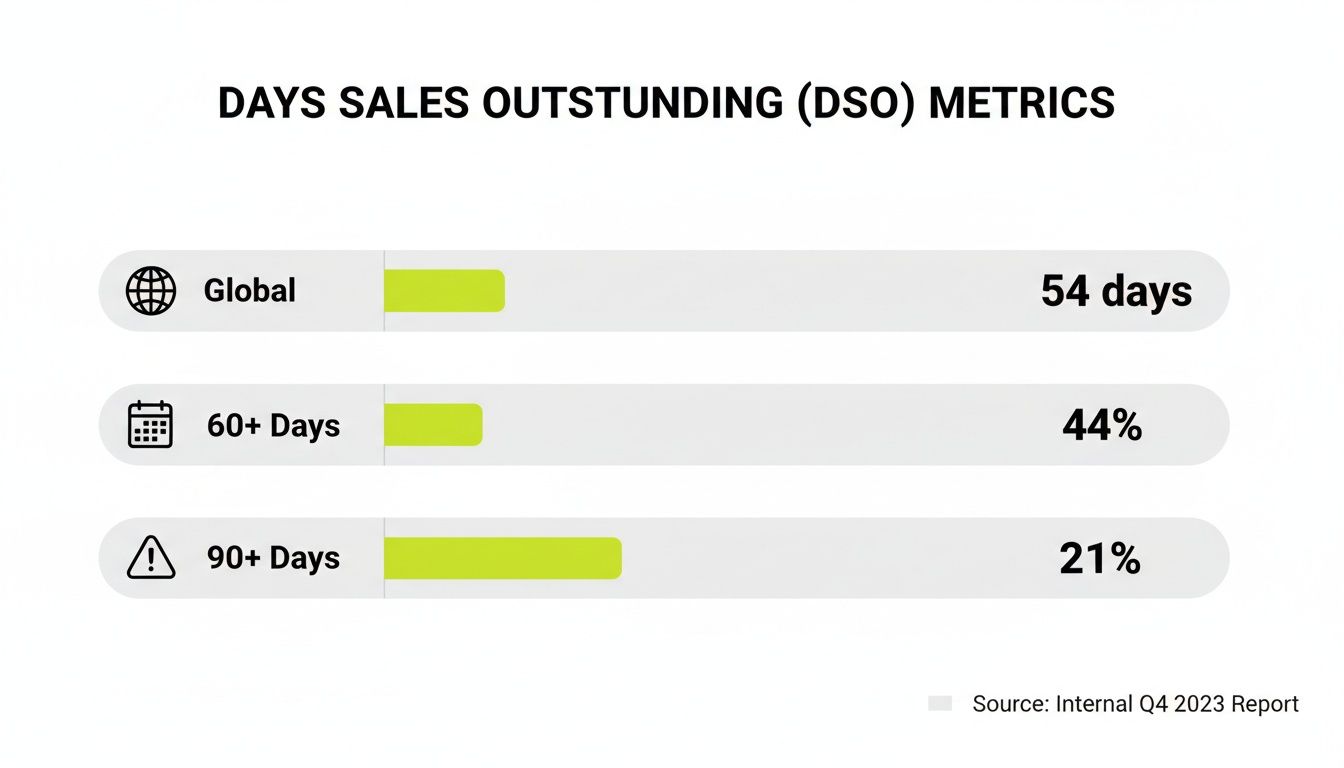
With nearly half of all businesses seeing their DSO climb past 60 days, a passive approach is a liability. For a professional services firm, a DSO creeping over 60 is a serious red flag. Conversely, a DSO under 30 days is considered best-in-class.
Benchmarking Your DSO
DSO is a key performance indicator, but "good" varies by industry. To get an accurate sense of your performance, you need to compare your DSO against relevant benchmarks.
Here’s a look at how professional services firms compare to other sectors.
Segment | Typical DSO Range (Days) |
|---|---|
Professional Services (Small/Mid-Sized) | 40 - 65 |
Professional Services (Large Enterprise) | 50 - 75 |
Manufacturing | 55 - 85 |
Construction | 60 - 90+ |
SaaS/Technology | 25 - 50 |
Retail (B2C) | 5 - 20 |
Industries with long project cycles and complex billing, like construction and professional services, naturally face longer collection times. Use this data as a starting point to evaluate your firm's position.
What Your DSO Is Telling You
Your DSO is a diagnostic tool. Think of it as a financial health check revealing the condition of your accounts receivable process. Here’s how to read the results:
- Under 30 Days: Excellent. This indicates a highly efficient AR process, clear payment terms, and prompt-paying clients. Your liquidity is strong.
- 30–45 Days: A healthy, common range for most professional services firms. There’s room for improvement, but your operations are in a good position.
- 46–60 Days: A warning zone. A DSO in this range suggests friction in your collections process. It’s time to analyze your invoicing, follow-up cadence, and payment options.
- Over 60 Days: A major drag on your operations. A DSO this high is tying up significant working capital and requires immediate attention to reduce DSO.
To get the full picture, analyze DSO alongside related metrics like the Accounts Receivable Turnover Ratio, which provides another view of collection effectiveness. For a deeper dive into the calculation, you can explore our detailed guide on the DSO formula.
The Real-World Costs of a High DSO
A high DSO is not just an accounting metric; it is a direct drag on your firm's financial health. It acts as a silent tax on profitability and a brake on your ability to operate with agility.
When earned revenue is tied up in accounts receivable, it creates tangible costs across your entire business. You may be forced to draw on a line of credit to make payroll, with interest payments eating directly into your profit margins.
Quantifying the Opportunity Cost
The true cost is best understood by quantifying what that locked-up cash could be doing for you instead. A high DSO means you are essentially providing your clients with an interest-free loan.
A professional services firm with $10M in annual revenue and a 65-day DSO is effectively floating its clients an interest-free loan of nearly $1.8M. That is capital that could be used for hiring, technology investments, or shareholder distributions.
This simple calculation re-frames the issue. It's no longer just a collections problem—it's a balance sheet problem. The objective becomes clear: reduce DSO and repatriate that capital from your clients' books back to your own.
Visual Idea: A cinematic shot of a sleek, modern office. A transparent screen in the foreground displays a line chart showing a decreasing DSO over time, with the freed-up cash flow being redirected into visible growth areas like new hires and technology upgrades.
The Operational and Relational Drain
Beyond the financial impact, a high DSO creates significant operational friction. The consequences extend to your team's morale and can strain client relationships.
- Administrative Burden: Your finance team's time is a valuable asset. When they are stuck chasing payments—sending reminders and reconciling accounts—they are not performing the strategic work you hired them for.
- Strained Client Relationships: No one enjoys making collection calls, and clients do not enjoy receiving them. An ad-hoc process can feel unprofessional and damage the goodwill you have worked to build.
- Flawed Forecasting: Inaccurate cash flow forecasting forces conservative—and often suboptimal—decisions about hiring, expansion, and investment. A high DSO creates this uncertainty.
At its core, a high DSO signals a lack of control over a fundamental business process. Taking back that control starts by recognizing these costs and implementing a systematic solution.
Three Levers for Systematically Reducing Your DSO
A high DSO is not a fact of life; it is a direct result of your firm's policies, processes, and technology. Improving your DSO in accounting is not about making more calls. It's about systematically managing these three core areas.

Think of these as the control dials for your cash flow. Adjusting each one builds a more predictable and financially healthy operation without simply increasing your team's workload.
Lever 1: Policy
Clarity starts here. Your internal policies set the terms of engagement for every client. Vague or inconsistent rules guarantee payment delays. Firm, clear policies create predictability for both your team and your clients, laying the groundwork to reduce DSO.
Consider these foundational policies:
- Standardized Payment Terms: Establish a firm-wide standard, such as Net-30, and apply it consistently. Avoid negotiating terms on a case-by-case basis.
- Credit Reviews for New Clients: A simple credit review before a major engagement can prevent a significant future write-off.
- Defined Escalation Paths: Document the exact steps for handling invoices at 15, 30, and 60 days past due. This removes guesswork and ensures consistent treatment.
Lever 2: Process
With solid policies in place, the focus shifts to execution. Your invoice-to-cash process brings these policies to life. The goal is simple: make it as easy as possible for clients to pay you.
This means optimizing the entire workflow, from invoice creation to cash application.
The moment a project milestone is met or work is completed, the invoice must be sent. Any delay at this stage adds days to your DSO before the payment clock even starts.
From there, a well-defined follow-up cadence is essential. A measured mix of automated reminders and timely, personal outreach keeps your invoices top-of-mind. This is how you improve cash flow without straining client relationships.
Lever 3: Technology
Technology makes your policies and processes scalable and effective. For professional services firms in the $3M–$50M revenue range, this is where accounts receivable automation becomes a core operational tool.
Manual follow-up is inconsistent, time-consuming, and prone to error. AR software for professional services, including platforms that provide QuickBooks AR automation, executes your collections strategy with precision. It delivers the right message at the right time.
Modern AI AR automation can also flag at-risk invoices before they become seriously delinquent, allowing your finance team to intervene strategically. This transforms AR from a reactive chore into a proactive, data-driven function.
Resolut automates AR for professional services—consistent, accurate, and human.
Using AR Automation to Improve Cash Flow
Even the best collections policies are ineffective without consistent execution. For professional services firms managing a high volume of invoices, accounts receivable automation is the bridge between strategy and actual cash flow.
An AI AR automation platform puts your policies into practice with precision. Instead of your controller manually reviewing aging reports and sending one-off emails, the system executes the workflow automatically. This ensures every invoice is managed according to your firm's standards.

Executing with Precision and Control
At its core, AR software for professional services is designed to eliminate the operational friction that inflates your DSO in accounting. It addresses the three biggest bottlenecks in the collections process: communication, payment, and reconciliation.
Here’s how it works:
- Systematic Outreach: The platform automates your entire communication cadence based on invoice due dates—from a pre-due date reminder to more direct follow-ups. It can use tools like **ringless voicemail** to leave discreet reminders.
- Frictionless Payments: Effective QuickBooks AR automation includes integrated payment portals. This gives clients a simple, one-click way to pay online via credit card or ACH, eliminating "check is in the mail" delays.
- Automated Cash Application: Once a payment is made, the system instantly matches it to the correct open invoice and reconciles your books. This saves hours of manual data entry and provides a real-time view of your cash position.
From Reactive Chasing to Proactive Management
The impact on your team is immediate. Instead of spending all their time chasing late payments, your finance professionals are elevated to a role of strategic oversight. The repetitive work is handled.
A controller’s attention shifts from manually pulling aging reports to analyzing at-risk accounts flagged by the system. The platform might identify a key client whose payment behavior is deteriorating, enabling a proactive conversation long before the account becomes a serious problem.
This is how you build predictable cash flow. By removing manual effort and human inconsistency, you not only improve cash flow but also professionalize a vital business function, giving you true control over your firm's financial health.
Achieving Predictability and Control Over Your AR
Lowering your DSO in accounting is not just about an internal metric. It's about gaining predictable control over your firm's cash flow and, by extension, its financial destiny. It's the difference between being reactive and being strategic.
A disciplined and consistent collections process has external benefits. Clients experience more professional communication and easier payment methods, which strengthens the relationship.
Specialized AR software for professional services offloads the repetitive, manual tasks that drain your finance team’s capacity. This frees them to stop chasing payments and start focusing on strategic financial management.
From Reactive Collections to Strategic Oversight
This shift in focus changes the function of your finance team. Instead of making collection calls, your controller manages a system that executes flawlessly. Their expertise is applied where it matters most.
- Human-in-the-loop control: Your team can step in to negotiate a payment plan or resolve a complex dispute, while the system handles routine follow-ups.
- Predictable cash flow: Automation makes incoming cash far more reliable. This stability enables better forecasting and confident investment decisions. One study showed 99% of companies using AI-powered AR successfully reduced their DSO.
- Scalable growth: For any professional services firm planning to grow, a modern AI AR automation system is a necessity. It provides the financial backbone to support growth without scaling headcount in the collections department.
The goal is to transform accounts receivable from an administrative function into a strategic asset. By mastering your collections process, you gain the financial predictability needed to drive sustainable growth.
This level of control is an operational reality made possible by modern technology. You can build a system that delivers consistency and frees your most valuable people to make a greater impact.
Resolut automates AR for professional services—consistent, accurate, and human.
Frequently Asked Questions About DSO
Here are answers to common questions from finance leaders about Days Sales Outstanding and managing cash flow.
What Is a Good DSO for a Professional Services Firm?
A "good" DSO for a professional services firm should consistently be below 45 days. Best-in-class performance is typically under 30 days.
The primary red flag is a DSO that trends over 60 days. This is a clear indicator that your collections process is tying up critical cash reserves and requires immediate review.
How Can We Reduce DSO Without Harming Client Relationships?
This is a common concern, but it's based on a false premise. The key is to shift from inconsistent, manual follow-ups to a professional and predictable system. Accounts receivable automation allows you to implement a firm, respectful communication cadence.
Instead of damaging relationships, a well-implemented system improves them. The process becomes transparent, professional, and hassle-free for the client, which removes friction. A respectful, automated reminder is often received better than an ad-hoc phone call.
Visual Idea: A split-screen chart. On the left, a jagged, unpredictable line labeled "Manual Collections" shows high DSO. On the right, a smooth, downward-sloping line labeled "Automated AR" shows a low, stable DSO. An icon for "Client Satisfaction" is higher on the right side.
At What Firm Size Does AR Automation Become Critical?
While managing DSO is always important, automation becomes critical for firms in the $3M to $50M revenue range. At this scale, invoice volume becomes too large to manage manually, yet the firm may not have a dedicated collections team.
This is the inflection point where implementing AR software for professional services is most impactful. It allows you to build scalable financial processes before receivables become unmanageable and turns AR into a strategic tool to improve cash flow.
Can AI AR Automation Replace My Finance Team?
No. It is a force multiplier, not a replacement. AI AR automation handles the 80% of collections work that is repetitive—sending reminders, logging activity, and applying cash. This is particularly true for platforms offering QuickBooks AR automation.
This frees your finance professionals to focus on the 20% of work that requires human judgment: negotiating payment plans, resolving complex disputes, and managing key client relationships. The system acts as a co-pilot, handling routine tasks while keeping your team in full control.
--- Resolut automates AR for professional services—consistent, accurate, and human.