
Days Sales Uncollected Formula: A Guide for Financial Control
Discover days sales uncollected formula to reduce DSO, speed collections, and strengthen your cash flow.
The Days Sales Uncollected (DSU) formula tells a simple but critical story: how many days, on average, does it take your firm to get paid after completing the work? For a professional services firm, this isn't an accounting exercise. It’s a direct measure of financial efficiency and a key indicator of cash flow health.
A low DSU indicates strong financial discipline and healthy cash flow. A high DSU means your cash is trapped in unpaid invoices instead of being put to work growing your business.
What Is The Days Sales Uncollected Formula?
Days Sales Uncollected (DSU), often used interchangeably with Days Sales Outstanding (DSO), quantifies the length of your cash conversion cycle—the time from rendering a service to having cash in the bank.
Before calculating DSU, a firm grasp of your Accounts Receivable is essential. This is the total amount of money your clients owe you for services already delivered.

The Core Calculation
The standard formula to calculate Days Sales Uncollected is:
DSU = (Accounts Receivable / Net Credit Sales) x Number of Days in Period
Let's break down the components. For a professional services firm, each part tells a piece of the story about your financial operations and client relationships.
Core Components of the Days Sales Uncollected Formula
Component | Definition for Professional Services | Why It Matters to CFOs |
|---|---|---|
Accounts Receivable | The total outstanding balance of all client invoices. This is money earned but not yet collected. | A high balance signals potential cash flow bottlenecks and increased credit risk. |
Net Credit Sales | Your firm's total revenue from services delivered on credit (invoiced), minus any credits or write-offs. | This figure represents your actual earned revenue, providing the baseline for measuring collection efficiency. |
Number of Days | The total number of days in the period you are measuring (e.g., 90 for a quarter, 365 for a year). | This standardizes the calculation, allowing for consistent tracking and comparison over time. |
Understanding these individual parts is the first step. Now, let's apply them to a practical scenario.
A Practical Example
Imagine a consulting firm has $400,000 in outstanding invoices (Accounts Receivable) and generated $3,600,000 in annual revenue (Net Credit Sales).
Using the formula, their DSU is 41 days: [($400,000 / $3,600,000) × 365]. This means it takes them, on average, 41 days to collect payment after invoicing a client. For a deeper look at similar calculations, see our guide on how to compute the average collection period.
A DSU that creeps above 45-60 days is often a red flag. It suggests that cash—the lifeblood of your firm—is unnecessarily held up, limiting your ability to invest in growth.
Why DSU Is Critical for Professional Services
Unlike a company selling physical goods, your firm's inventory is its expertise and time. DSU makes the value of these intangible assets tangible, showing how effectively you convert billable hours into cash.
For a firm with $10 million in annual revenue, every single day added to your DSU locks up approximately $27,400 in working capital. Ten extra days? That's over a quarter-million dollars sitting in your clients' bank accounts instead of yours.
This metric helps answer strategic questions:
- Is our invoicing process causing delays?
- Are our collections efforts effective against our payment terms?
- Do certain clients consistently pay late, draining our resources?
Mastering your DSU is about taking control of your firm's financial destiny. The goal isn't just to calculate it, but to use that insight to drive operational improvements.
Calculating and Interpreting Your Firm's DSU
The Days' Sales Uncollected (DSU) formula is a powerful diagnostic tool. Let's walk through how to calculate it accurately and interpret the story it tells about your firm’s financial health.
First, pull two key numbers from your accounting system, whether it’s QuickBooks or a larger ERP: your total Accounts Receivable and your Net Credit Sales for a specific period.
Sourcing Your Data for the DSU Formula
The quality of your DSU calculation is only as good as the data you feed it.
- Accounts Receivable (AR): This is your total outstanding invoice balance on the final day of the period. For a Q3 calculation, you need the AR balance as of September 30th.
- Net Credit Sales: This is the total revenue you billed (not collected) during the same period. Use the net figure, which subtracts credit notes, discounts, or write-offs. Learn more about how to calculate net credit sales to ensure precision.
The period you choose—a month, quarter, or year—frames the story. A monthly DSU offers tactical oversight, a quarterly view spots trends, and an annual DSU provides a high-level benchmark for year-over-year comparison.
A Step-by-Step Calculation Example
Let's ground this in a real-world scenario for a mid-sized consulting firm.
- Firm: A $10M consulting practice.
- Period: Quarter 3 (91 days).
- Accounts Receivable (as of Sept 30): $1,300,000.
- Net Credit Sales (for Q3): $2,500,000.
Here’s how the DSU formula plays out:
DSU = ($1,300,000 / $2,500,000) x 91 days = 47.3 days
This tells us it takes this firm, on average, just over 47 days to convert its invoices into cash.
From Calculation to Interpretation
A DSU of 47.3 days reflects operational reality. If the firm's standard payment terms are Net 30, this result immediately flags a serious disconnect between policy and reality.
Your DSU reveals the gap between your stated payment policy and your collections reality. A DSU of 47 against Net 30 terms means cash arrives, on average, 17 days later than promised.
That 17-day delay has a real cost. For our $10M firm, those extra days hold over $465,000 in working capital hostage ($10M / 365 days * 17 days). That’s cash that could fund a key hire or technology upgrades like accounts receivable automation.
Analyzing Trends Over Time
The real power of DSU comes from consistent tracking. A single calculation is a snapshot; tracking it over time provides a full-motion picture of your AR health.
- A sudden spike could point to a delayed milestone payment.
- A gradual creep upward might signal that collections efforts are losing effectiveness.
- A steady decline is a sign that process improvements, like implementing AR software for professional services, are paying off.
*Visual Idea 1: Line Graph*
A clean line graph titled 'DSU Trend Analysis: Q1-Q4' shows a firm's DSU fluctuating quarterly. Annotations point out a spike ('Q2: Major project milestone billing delay') and a dip ('Q4: Implemented QuickBooks AR automation'), demonstrating DSU as a dynamic tool.
Watching these trends empowers proactive decisions, shifting your finance function from reactive fire-fighting to strategic financial management.
Benchmarking DSU in Professional Services
You’ve calculated your DSU. Without context, that number is just floating in space. A DSU of 45 days might feel high, but if the industry average is 55, you're actually ahead of the curve.
Benchmarking against your peers provides an objective scorecard for your collections process. It also delivers the data needed to justify investments in better systems, like adopting accounts receivable automation.
Why Professional Services Are Different
Professional services firms play by a different set of cash flow rules. Your "inventory" is the time and expertise of your people, which almost always means longer payment cycles.
While a DSU under 30 days is rare, a "good" DSU is typically 1.25x to 1.5x your standard payment terms. If you bill on Net 30, a DSU between 37 and 45 days suggests a healthy collections machine.
Current DSU Benchmarks
Economic conditions have a direct impact on when you get paid. When the market is uncertain, clients hold onto their cash longer, pushing DSU up for everyone.
Payment cycles ebb and flow. In the 1990s, the average DSO for U.S. manufacturing was 55 days. By 2010, ERP systems helped bring that down to 48 days. Recent economic headwinds pushed it back toward 52 days. You can find more insights about DSU benchmarks and historical trends to see how your firm compares.
In the professional services world, recent surveys paint a tougher picture: agencies see an average DSU near 50 days. More alarmingly, 1 in 5 invoices now ages past 90 days, eroding margins by as much as 8%.
This infographic walks through the process of calculating and using your DSU, from getting the data to making sense of the result.
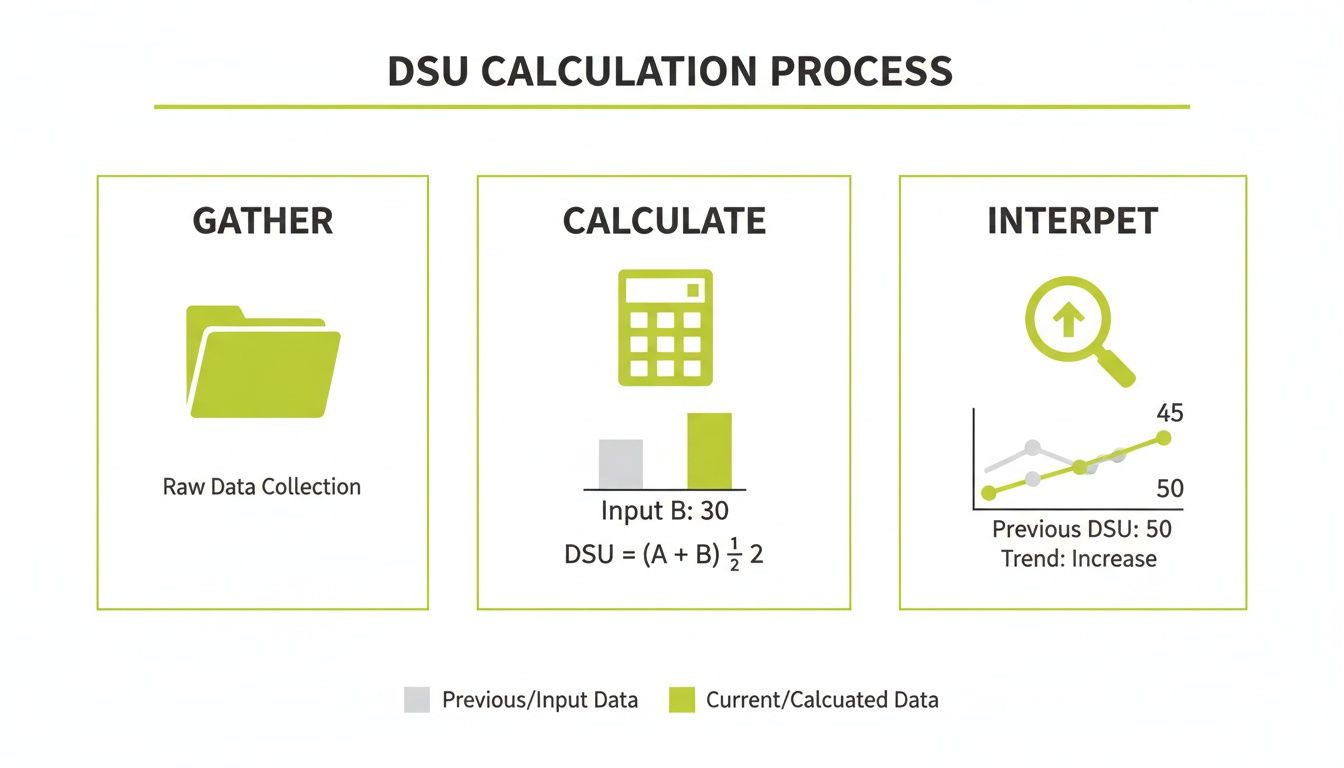
As you can see, calculating your DSU is a straightforward, repeatable exercise that is fundamental to good financial hygiene.
Don't Just Benchmark—Beat Your Own Score
Benchmarks show where you stand, but your real competition is your performance last quarter. The goal is to consistently chip away at your own historical numbers.
Your firm's DSU isn't a static grade; it's a live indicator of operational health. The goal isn't just to hit an industry average, but to build a system that consistently shrinks your cash conversion cycle.
Here’s a practical framework:
- Establish a Baseline: Use past DSU figures to set your internal benchmark.
- Set Achievable Goals: Target a steady, incremental reduction. A goal to reduce DSO by 5% each quarter is sustainable.
- Connect Cause and Effect: When you implement a change, like new AR software for professional services, track its direct effect on your DSU to prove ROI.
Focusing on internal improvement builds a more resilient and cash-rich firm, regardless of competitor performance. This is how you go from measuring your DSU to mastering it.
The Financial Drag of a High DSU
A high Days Sales Uncollected (DSU) figure is a real and active drain on your firm’s lifeblood. It's a hidden tax on your profitability and growth, measured in lost opportunities and operational friction.
The most immediate pain is opportunity cost. Every dollar stuck in an unpaid invoice is working capital you can't use. When DSU creeps up, you are essentially giving clients a zero-interest loan with money that should be funding your own goals.
Calculating the Cost of Trapped Cash
Let's quantify this. For a $15M professional services firm, daily revenue is about $41,096 ($15M / 365 days). If your DSU slips by just 10 days, that’s over $410,000 of your cash locked up in accounts receivable.
That capital could have been put to work. For example, $410,000 could fund:
- Strategic Hires: Salaries for two senior consultants to build a new service line.
- Technology Upgrades: An investment in AR software for professional services to improve finance function efficiency.
- Market Expansion: The budget for a new branch office or a major marketing campaign.
A high DSU quietly starves your company of the fuel it needs to grow, limiting your financial agility.
*Visual Idea 2: Cinematic Imagery*
A powerful, stylized image of a large, industrial dam holding back a vast reservoir. An overlay text reads: "Every extra day in your DSU is another dollar locked away from your business." This visual metaphor powerfully communicates the concept of trapped working capital.
The Hidden Costs That Erode Margins
Beyond opportunity cost, a high DSU creates secondary problems that chip away at operations and profits.
A high DSU is a flashing red light for process inefficiency. It means the finance team is spending too much time on low-value administrative churn instead of high-impact financial strategy.
First, there’s the administrative weight on your finance team. Every overdue invoice means more follow-up emails, phone calls, and manual tracking. This pulls your team from strategic activities like forecasting and analysis, a drag that tools like QuickBooks AR automation are designed to eliminate.
Then there’s the growing risk of bad debt. The longer an invoice goes unpaid, the less likely it is to be collected. An invoice 90 days past due has a frighteningly low chance of being collected in full, forcing write-offs that directly hit your bottom line.
Finally, unpredictable cash flow often forces reliance on lines of credit to cover operating expenses. The interest on that debt is a direct cost you pay because you can't collect your own cash fast enough. You can explore more insights on how DSU impacts corporate health to see the real-world consequences.
How AR Automation Reduces Your DSU
Once you see the real-world cost of a high DSU, the next question is how to bring that number down. The answer is not working harder, but smarter. This is where accounts receivable automation becomes a critical part of a modern financial strategy.
The best AR platforms, especially those using AI, systematically attack the root causes of a high DSU. Forget a list of features—let's look at the real-world results these systems deliver to improve cash flow.

From Manual Drudgery to Automated Precision
By far, the biggest drain on your collections process is the manual work involved. Your team spends countless hours chasing due dates and writing follow-up emails. It’s repetitive, error-prone work.
AR automation acts as a tireless collections assistant, working 24/7 to ensure no invoice is overlooked. This consistent follow-up directly chips away at your days sales uncollected formula by closing the gap between invoice send and first reminder.
Firms can reallocate an estimated 15-20 hours per week of their finance team's time after automating routine collections. They stop chasing payments and start focusing on high-impact financial analysis.
A human team cannot match the scale and consistency of an automated system. It ensures every client gets a polite, professional reminder at the right time, turning collections into a predictable machine. See our guide on how to automate accounts receivable for more detail.
Using AI to Predict and Prevent Late Payments
Standard automation is good, but AI AR automation is where things get truly strategic. Instead of just reacting to overdue invoices, it helps you get ahead of them.
AI-driven platforms analyze payment histories, communication records, and invoice data to flag clients who are statistically likely to pay late. This gives your team an intelligent "watch list," letting them step in with a personal touch before an invoice becomes a problem.
This predictive power delivers clear advantages:
- Smarter Workflows: The system automatically highlights high-risk accounts, directing human effort where it matters most.
- Proactive Outreach: Your team can make a friendly call to a client showing early warning signs, resolving issues before they escalate.
- Less Bad Debt: By catching problems early, AI significantly lowers the risk of invoices aging into the "uncollectible" category.
This is how you truly reduce DSO—by preventing late payments, not just chasing them faster.
Manual vs. Automated AR: The Impact on DSU
The contrast between manual and automated AR processes highlights exactly why automation is so effective at lowering DSU.
AR Process | Manual Approach (High DSU) | Automated Approach (Low DSU) |
|---|---|---|
Invoice Reminders | Sporadic, manual emails. Prone to being forgotten or inconsistent. | Automated, scheduled reminders sent at optimal intervals (e.g., 3 days before due, on due date, 7 days past due). |
Collections Prioritization | Based on the "squeaky wheel" or oldest invoice. Often inefficient. | AI-driven risk scoring flags accounts most likely to be late, directing human effort where it's needed most. |
Payment Processing | Relies on mailed checks or manual bank transfers, adding days of float time. | Integrated client portal with one-click payment options (ACH, credit card), enabling instant payment. |
Dispute Resolution | Handled via long, confusing email chains. Easy for issues to get lost. | Centralized communication hub where disputes are tracked, assigned, and resolved quickly. |
Reporting & Analysis | Manual spreadsheet data entry. Time-consuming and often out-of-date. | Real-time dashboards showing DSU, aging reports, and cash flow forecasts automatically. |
As the table shows, automation systematically removes the friction and delays inherent in manual processes, leading directly to faster collections and a healthier DSU.
Make It Effortless for Clients to Pay You
Sometimes, an invoice goes unpaid simply because you’ve made it difficult for your client to pay. Forcing them to mail a paper check or navigate a clunky payment site adds friction.
Modern AR software for professional services solves this with clean, user-friendly client portals. Clients can log in, see all their outstanding invoices, and pay immediately with a credit card or ACH transfer. It couldn't be simpler.
By making it easy for clients to pay, you dramatically shorten the payment cycle. Businesses have cut their DSU by 10-15% from this feature alone. Combining automated reminders, predictive intelligence, and a frictionless payment experience provides a clear path to reducing your DSU.
Answering Your Questions About DSU
You have the formula. But the real questions start once the calculator is put away. As a financial leader, your job is to use metrics to make smarter decisions.
Let's tackle the questions we hear most from CFOs and Controllers. These are the answers that help you move from theory to a real-world strategy for improving your firm’s financial health.
What Is a Good DSU for a Professional Services Firm?
A DSU under 30 days is rare in professional services due to project milestones and client-side approvals.
A more realistic benchmark is 1.25x your standard payment terms. If you bill on Net 30 terms, a DSU between 37 and 45 days signals a well-managed collections process. Anything consistently over 60 days is a major red flag that requires attention.
*Visual Idea 3: Cinematic Imagery*
A close-up shot of a chess board, with a hand moving a queen into a checkmate position. The text overlay reads: "Your DSU isn't just a number. It's your next strategic move." This visual connects DSU to high-level strategy and control.
How Is DSU Different from Accounts Receivable Turnover?
They are two sides of the same coin, but DSU is a more practical management metric.
- Accounts Receivable Turnover tells you how many times you collect your average receivables in a given year.
- Days Sales Uncollected (DSU) translates that ratio into the average number of days it takes to get paid.
An AR turnover of 8 equals a DSU of about 46 days (365 / 8). Most leaders prefer DSU because "46 days" is tangible. It's easier to rally a team around the goal, "Let's shave 5 days off our DSU."
Can I Calculate DSU for a Specific Client?
Yes, and you absolutely should. A firm-wide DSU can hide serious issues, like one or two slow-paying whales dragging down an otherwise healthy average.
Calculating DSU on a client-by-client basis uncovers the real story. It shows you exactly which accounts are straining your cash flow, so you can focus your team’s energy where it matters most.
This is where modern AR software for professional services becomes invaluable. Instead of manual number-crunching in spreadsheets, a platform can flag high-risk accounts automatically. For firms on QuickBooks, this kind of QuickBooks AR automation is a game-changer.
How Can We Reduce DSU Without Damaging Client Relationships?
This is the classic balancing act. The answer isn't to chase harder; it's to build a better, more professional process with accounts receivable automation.
A smart AI AR automation system like Resolut isn’t about blasting clients with demanding emails. It creates a system of polite, personalized reminders on a predictable schedule and gives clients an easy-to-use portal to view and pay invoices instantly.
This approach improves the client experience by giving them clarity and control. You become professionally persistent, not personally aggressive, strengthening relationships while steadily bringing your DSU down.
--- Resolut automates AR for professional services—consistent, accurate, and human.