Dunning Letter Meaning: A Tool for Financial Control
Unlock the true dunning letter meaning. Go beyond reminders to build a strategic collections process that protects cash flow and client relationships.
A dunning letter is more than a late payment notice. It's a formal, systematic communication sent to a client when their invoice is overdue. For financial leaders, it is a critical tool for maintaining cash flow control and operational discipline.
This process is not about confrontation. It’s the first step in a deliberate sequence designed to accelerate payment while preserving client relationships. It signals that your firm operates a professional, organized system for managing accounts receivable.
The Strategic Purpose of a Dunning Process

A disciplined dunning process is a fundamental system for managing working capital. The objective is not merely to collect funds but to build a predictable, controlled process that directly strengthens the firm's financial position.
The primary function is to accelerate cash collection and methodically reduce Days Sales Outstanding (DSO). For every day an invoice remains unpaid, the probability of collecting the full amount decreases. A structured dunning sequence tightens the payment cycle, which directly improves cash flow.
Second, it brings required consistency to client communications. Inconsistent, manual follow-ups lead to varied messaging and tone, which can damage client relationships. A defined dunning cadence ensures every client receives professional, predictable, and fair notifications.
A Proactive Risk Management System
Data on overdue receivables highlights the need for this system. In some professional services sectors, it's common to see over 22% of receivables slip into the 91+ days overdue category. These figures represent significant cash flow blockages. You can analyze more industry data on these late payment trends.
A dunning process creates a clear, documented audit trail. This documentation is invaluable if an account requires escalation, providing a defensible record of every attempt made to collect payment.
Ultimately, this process shifts collections from a reactive, often chaotic task into a proactive risk management function. This is where tools offering AI AR automation and QuickBooks AR automation deliver measurable value by ensuring each step is handled with precision.
Building a Structured Dunning Cadence
Effective dunning is not a single, aggressive letter. It is a carefully planned communication sequence that escalates methodically over time. A predictable cadence removes emotion and guesswork, replacing them with a structured process that protects both cash flow and client relationships.
*Visual Idea 1: A cinematic shot of a well-organized, modern office. A controller calmly reviews a dashboard showing DSO trends decreasing over a 90-day period, a subtle smile indicating control and success.*
To execute this, you need documented standard operating procedures. This ensures every client receives the same professional treatment, which is vital for maintaining long-term partnerships.
The clock is always ticking on unpaid invoices. This visual shows just how quickly your chances of getting paid drop as an invoice ages.
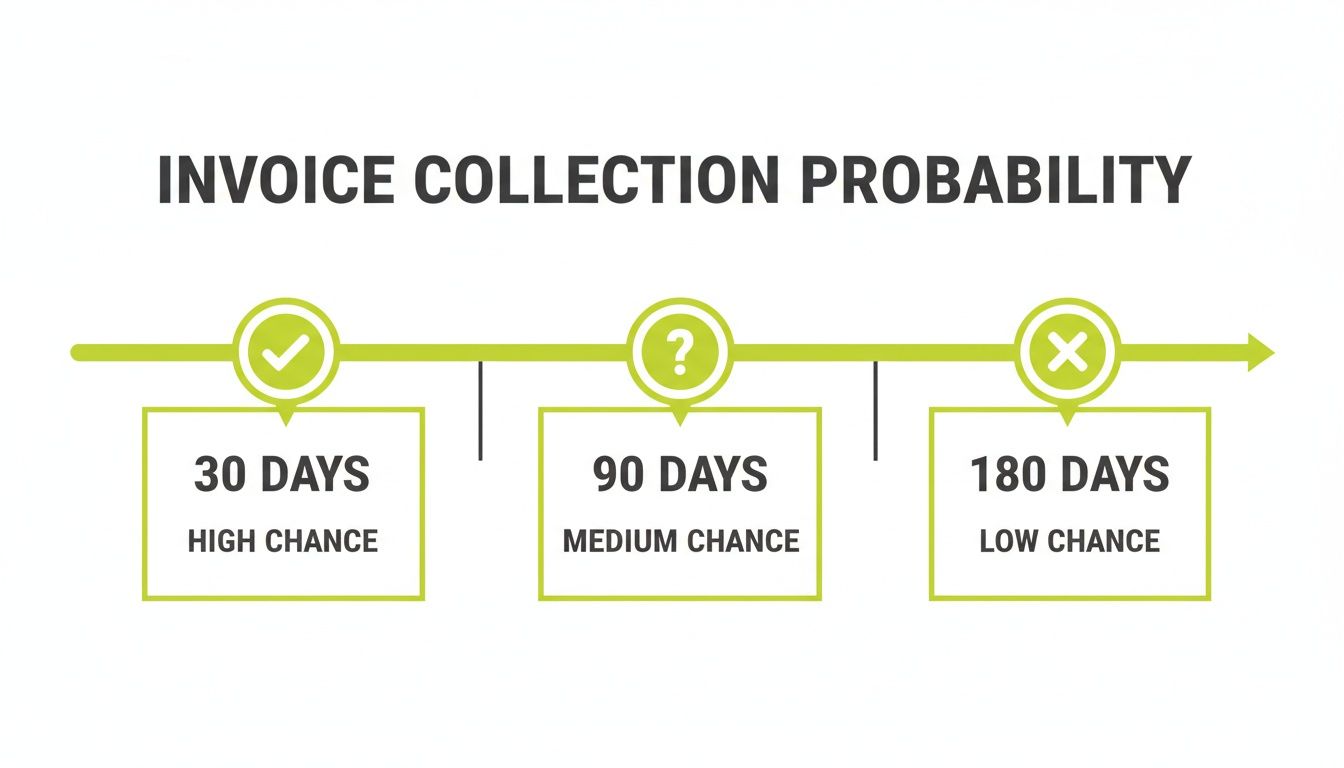
The data is clear: the probability of collection plummets after the 90-day mark. A prompt, consistent follow-up process is non-negotiable for any firm serious about its financial health.
A Standard Dunning Communication Cadence
A typical escalation path for a professional services firm should be clear and progressive. This methodical approach demonstrates control while maintaining professionalism.
Here is a common timeline:
Stage | Timing | Tone | Primary Objective |
|---|---|---|---|
Pre-Due Reminder | 3-5 days pre-due | Helpful, courteous | Prevent accidental delinquency; professional courtesy |
Initial Overdue Notice | 1-3 days past due | Professional, direct | Immediate notification and request for payment status |
Second Notice | 15 days past due | Firm, concerned | Reinforce urgency; identify payment obstacles |
Final Demand | 30-45 days past due | Serious, authoritative | Clearly state consequences of continued non-payment |
This structured follow-up is the core of effective accounts receivable automation. Implementing AR software for professional services ensures this cadence runs without fail, freeing your team from manual tracking. When you send a reminder for payment, a proven framework makes all the difference.
Navigating Legal and Compliance Guardrails
Dunning communications operate within a defined legal framework. Missteps can damage client relationships and expose your firm to legal risk.
While most of your invoices are B2B, best practices are derived from consumer protection laws. Adopting their principles is not just about compliance; it's about building a collections process that is fair, defensible, and protects your firm's reputation.
The foundational law is the Fair Debt Collection Practices Act (FDCPA). While it applies directly to third-party collectors of consumer debts, its core principles serve as a "gold standard" framework for any professional collections activity.
The FDCPA as a B2B Framework
Adopting FDCPA principles helps you avoid legal issues and demonstrates operational integrity. A dunning process built on fairness and accuracy is simply more effective.
These non-negotiable principles should be built into your process:
- Absolute Accuracy: The stated amount due must be 100% correct. An error here immediately undermines your credibility and can create legal complications.
- Professional Language: Your tone should be firm but never cross into harassing, abusive, or threatening language. The objective is collection, not intimidation.
- Defined Contact Hours: Adhere to standard business hours for all communications. This is a professional courtesy that maintains respect.
The point of these guardrails is to ensure the dunning letter meaning is always a professional business communication, never a personal attack. This distinction is critical to getting paid while retaining the client.
This is where accounts receivable automation provides significant value. Instead of relying on manual adherence, you can build these guardrails directly into your workflow. Platforms like Resolut use AI AR automation to ensure every communication is compliant, accurate, and aligned with your firm's policies.
How Automation Drives Dunning Effectiveness
Manual dunning is an administrative burden. It relies on calendar reminders and manual tracking, leading to inconsistency, human error, and an inability to scale.
The correct approach is to treat dunning as a strategic financial function. Accounts receivable automation transforms this process from a manual chore into a data-driven operation. It brings systematic consistency to client communications, ensuring the right message is delivered at the right time.
When the administrative load is removed, your finance team can stop chasing invoices and start analyzing performance, focusing on high-value exceptions and strategic financial management.

Driving Measurable Financial Outcomes
Modern AR software for professional services does more than send reminders. It analyzes client payment history and risk profiles to customize the dunning approach—applying more pressure on a chronically late payer while maintaining a lighter touch with a reliable one.
The financial impact is significant. Firms using AI AR automation see an average 10-16x ROI and achieve 70-85% recovery rates on overdue invoices, a marked improvement over manual efforts. You can review these dunning effectiveness benchmarks for further detail.
*Visual Idea 2: A simple, clean line chart showing two lines. One, labeled "Manual Collections," is erratic and trends high. The other, labeled "Automated Collections," is smooth, stable, and trends consistently downward, clearly illustrating the reduction in DSO.*
By integrating tools like QuickBooks AR automation, firms can dramatically reduce DSO and improve cash flow predictability. Our guide on how to automate accounts receivable details the implementation process.
Implementing a Controlled Collections System
Understanding the strategic dunning letter meaning is the foundation of a disciplined AR process. The goal is to move from reactive invoice chasing to a predictable, controlled system. This is about protecting cash flow while maintaining client relationships.
A structured dunning process brings predictability to your finances. It is a core component of managing accounts payable and receivable that directly strengthens your firm’s financial health.
The real value of a dunning system is not in collecting a single late invoice. It's establishing a process that consistently reduces DSO and improves cash flow predictability quarter after quarter.
By taking a systematic approach, you eliminate last-minute cash flow surprises and create a clear, documented paper trail for every invoice. It is a fundamental part of building a resilient financial operation.
Common Questions from Financial Leaders
Here are answers to common questions from controllers and CFOs when refining a dunning process.
When Should the Dunning Process Begin?
The most effective systems begin before an invoice is due. An automated reminder sent 3-5 days before the due date acts as a professional courtesy and prevents a significant percentage of late payments.
The formal dunning sequence should trigger immediately after the due date, often the next business day. This consistency establishes a clear and fair payment expectation for all clients.
Will Dunning Letters Damage Client Relationships?
They can, if the tone is incorrect. The key is to remain professional and helpful, especially in early communications. Frame initial messages as reminders or offers of assistance, not demands.
When the process is automated, fair, and consistent, clients recognize it as a standard business practice, not a personal conflict. Being firm and predictable removes awkwardness and protects the relationship.
Is It Better to Automate Dunning or Handle It Manually?
For a professional services firm, automation of the core dunning sequence is the superior operational choice. While manual intervention may be needed for complex accounts, accounts receivable automation provides a level of consistency that manual efforts cannot match.
Automation eliminates human error, frees up significant administrative hours, and creates a perfect, auditable trail of every communication. It allows your team to focus on strategic analysis, not routine follow-up.
This systematic approach is the most direct path to reducing DSO and improving cash flow. AI AR automation and QuickBooks AR automation tools integrate with existing systems, while dedicated AR software for professional services provides a complete solution.
--- Resolut automates AR for professional services—consistent, accurate, and human. Learn more at https://www.resolutai.com.