The CFO's Guide to Hosted Payment Gateways for Professional Services
Learn how a hosted payment gateway can reduce PCI scope, improve cash flow, and integrate with AR automation. A strategic guide for CFOs and Controllers.
For a professional services firm, accounts receivable is more than a line item. It is the operational fuel for the business. A hosted payment gateway is a core component of a modern financial stack, designed to improve cash flow by streamlining this critical process.
Its function is to offload the complex and high-risk task of payment processing from your firm's servers to a specialized third-party provider. This secures cash flow and reduces operational risk.
The Strategic Role of a Hosted Payment Gateway

As a financial leader, your focus is on capital efficiency and risk mitigation. A hosted payment gateway is not an IT decision; it is a financial control. It directly addresses the security and compliance burdens of processing client payments.
By redirecting clients to a secure, third-party page to enter payment information, you ensure that sensitive data never touches your company's servers.
This single architectural choice dramatically reduces your PCI DSS compliance scope. Instead of a complex, technical audit, compliance becomes a simple annual questionnaire.
Financial and Operational Impact
The data supports this strategic shift. A market analysis shows that hosted gateways enable firms to launch payment processing capabilities with up to 80% less setup time compared to self-hosted systems.
More importantly, this approach mitigates the significant costs of PCI DSS compliance. Firms processing payments on-site can face annual costs ranging from $50,000 to $150,000 to maintain the highest levels of certification.
By offloading this function, you redirect capital and team resources from complex security protocols back to core business operations. The outcomes are measurable and immediate:
- Reduce DSO: Firms that embed a secure payment link directly into invoices and reminders see an average 15-20% reduction in Days Sales Outstanding (DSO).
- Improve Cash Flow: Faster payment cycles mean working capital is available, not trapped in accounts receivable.
- Lower Operational Costs: Eliminates the need for specialized IT security infrastructure and expensive annual compliance audits.
Connecting Payments to AR Automation
A hosted payment gateway is a critical component, but its full value is realized when integrated into a comprehensive accounts receivable automation strategy. The gateway becomes the final step in a systematic process designed to accelerate payment.
When your AI AR automation platform sends a reminder, it includes a direct link to the secure payment page. This removes friction from the collections process. Learn more about how you can integrate payments directly into text message reminders.
This integration is foundational to modern QuickBooks AR automation. It creates a closed loop from invoice issuance to cash application, providing a precise, real-time view of your firm's financial position without manual intervention.
How Hosted Gateways Secure Payments and Simplify Compliance
As a financial leader, you are the ultimate owner of risk. Understanding the security mechanics of a hosted payment gateway is therefore essential. The moment a client clicks ‘Pay Now,’ a simple but powerful handoff occurs: they are redirected from your environment to one managed entirely by the payment provider.
This redirect ensures that sensitive cardholder data—Primary Account Number (PAN), CVV, and expiration date—never transits or is stored on your systems. In technical terms, this reduces your PCI DSS scope. In business terms, it means less risk, lower cost, and fewer compliance-related distractions.
It is analogous to a bank's secure deposit box. You provide the client with the key (the payment link), but the bank’s vault and security infrastructure are responsible for protecting the assets. Your firm is removed from the chain of custody.
Radically Simplified PCI DSS Compliance
This clear data segregation is the primary driver for adopting a hosted gateway. For a professional services firm, achieving and maintaining full PCI DSS compliance independently is a major operational drain, involving quarterly vulnerability scans, annual penetration testing, and extensive logging.
With a hosted solution, your compliance obligation is reduced to completing the Self-Assessment Questionnaire A (SAQ-A). This is an annual form with fewer than 25 questions confirming you do not store, process, or transmit cardholder data.
- Self-Hosted: Requires complex technical controls, constant monitoring, and can exceed six figures annually in audit and remediation costs.
- Hosted Gateway: Requires a simple questionnaire, offloading the technical security burden to your vendor.
This shift liberates significant capital and internal resources. Instead of funding defensive compliance tasks, that capital can be deployed to functions that improve cash flow and drive growth.
The Mechanics of a Secure Transaction
The process is engineered for security without compromising the client experience. The workflow insulates your firm from liability at every step.
- Client Initiates Payment: The client clicks a payment link provided by your AR software for professional services.
- Secure Handoff: Their browser is redirected to the payment gateway's secure, PCI-compliant domain.
- Data Entry: The client enters payment details directly into the provider's form. Your systems have no visibility into this data.
- Authorization: The gateway encrypts the data and routes it through payment networks (e.g., Visa, Mastercard) for approval.
- Confirmation: The gateway returns a simple "success" or "fail" token to your system. No sensitive data is exchanged, only the transaction outcome.
This architecture significantly reduces the risk of a data breach. A PCI DSS compliance checklist can help align your internal processes with the security provided by your gateway, creating a defensible payment environment. You manage the client relationship; the gateway manages the risk.
Integrating Your Gateway with AR Automation
A standalone hosted payment gateway is a secure collection point. Its strategic value is unlocked when it becomes the integrated final step in an automated accounts receivable workflow. This reframes payment processing from a discrete transaction into the logical conclusion of a systematic collections strategy.
Connecting a hosted gateway to an accounts receivable automation platform creates a complete, closed-loop system. This is the core of modern AR management—using technology to manage the entire cycle, from invoice to cash application, eliminating manual gaps.
Creating a Seamless AR-to-Cash Cycle
The objective is to build an automated engine that moves cash from your client's bank to yours with minimal friction. This process begins long before the client decides to pay, using intelligent, automated communications that guide them toward payment.
This is the role of an AI AR automation platform. The system manages all communications, sending personalized reminders and escalations based on invoice age and client payment history. The payment link is the clear call-to-action in every communication.
A standalone gateway is a cash register in a store with no staff. An integrated gateway is the final, frictionless step in a guided customer journey, presented at precisely the right moment.
For AR teams and controllers, this integration is critical. It enables instant reconciliation and supports multiple payment methods—cards, ACH, and digital wallets—all of which can significantly reduce DSO. Large enterprises, which constitute 56% of the payment gateway market, build their processes around these integrations to manage high transaction volumes. You can see more data on how firms handle payment challenges on grandviewresearch.com.
The Technical Pillars of Integration
Two key technologies enable this automated loop: tokenization and webhooks. Understanding their function is key to appreciating the security and efficiency gains.
1. Tokenization for Secure Recurring Billing For firms with retainer-based services, tokenization automates recurring payments securely. On the first payment, the hosted payment gateway captures the card details and returns a non-sensitive "token."
This token is a random alphanumeric string that represents the card. You can safely store this token to initiate future retainer payments without ever storing the actual card number, keeping your systems out of PCI scope and mitigating significant risk.
2. Webhooks for Automated Cash Application A webhook is a real-time message sent from one application to another. When a client's payment is successfully processed by your gateway, a webhook instantly notifies your AR software for professional services.
That single, automated signal triggers a sequence of events:
- The corresponding invoice is marked as paid.
- The payment is applied in your accounting system.
- All automated collection reminders for that invoice cease.
This is how a client payment on a secure page translates directly to an up-to-date cash position in your ledger.
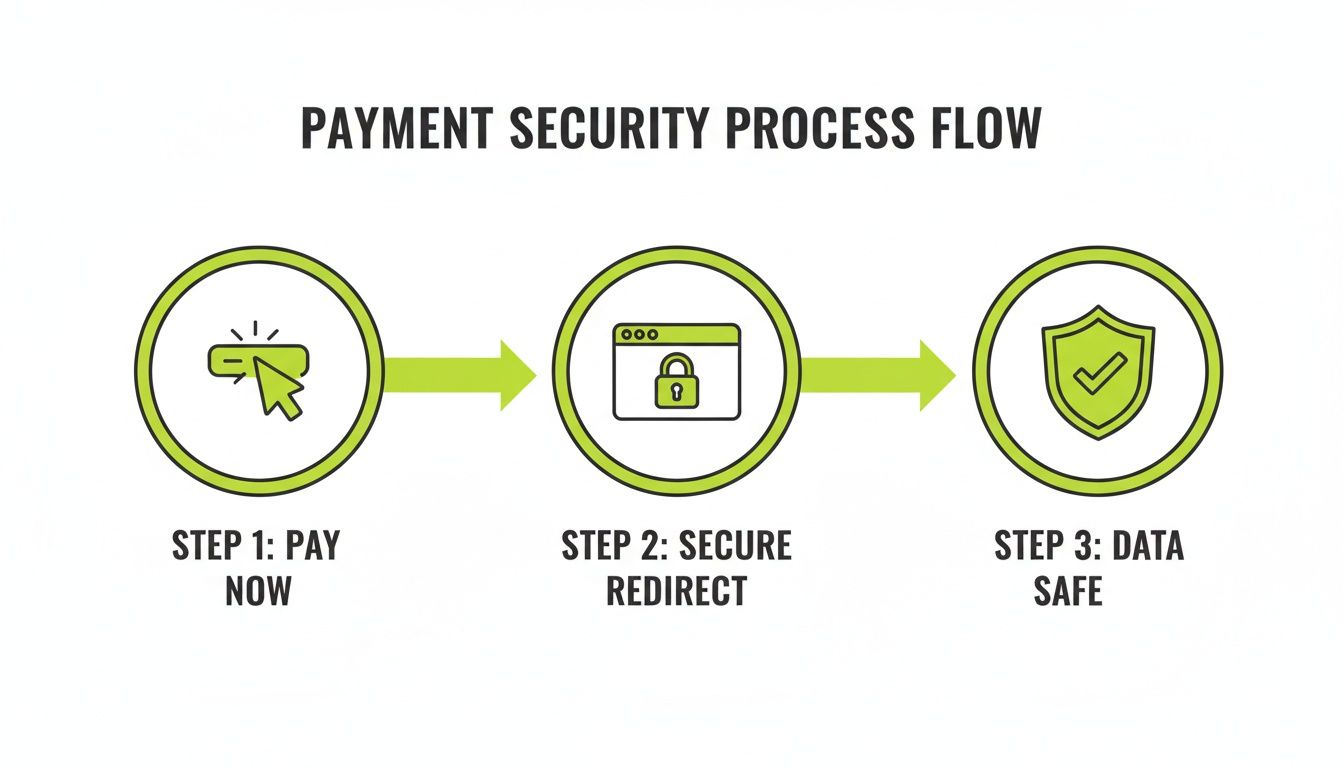
This diagram shows the critical handoff. By redirecting the client, you transfer the risk and compliance burden. Your systems are left to do what they do best: reporting and reconciliation.
This eliminates manual cash application, a process known for human error and inefficiency. The result is an accurate, real-time ledger within your QuickBooks AR automation software, providing a clear view of your firm’s financial health.
Choosing the Right Gateway Vendor for Your Firm

Selecting a hosted payment gateway is a financial partnership decision. It requires the same diligence as any major capital allocation. The evaluation must go beyond marketing to assess operational and financial suitability.
A methodical, data-driven approach is essential. The right partner accelerates financial operations. The wrong one introduces hidden fees, reconciliation challenges, and unnecessary risk. The goal is to find a provider that aligns with your transaction patterns and helps you improve cash flow.
Deconstructing Pricing Models
The advertised rate is rarely the total cost. A proper cost-benefit analysis requires understanding the two primary pricing models.
- Flat-Rate Pricing: A set percentage plus a small fixed fee on every transaction (e.g., 2.9% + $0.30). This model is predictable and suitable for firms with inconsistent volume or smaller average invoice sizes.
- Interchange-Plus Pricing: This transparent model passes the direct interchange fee from the card network (e.g., Visa) to you, plus a fixed markup. For firms processing over $25,000 per month, this is typically more cost-effective.
Base your decision on data. Pull 12 months of transaction history, analyzing volume, average ticket size, and card type mix. Model the costs for both pricing structures. A vendor unwilling to assist with this analysis is a red flag.
Evaluating Non-Financial Criteria
Operational performance is as important as fees. These factors directly impact team efficiency, risk profile, and scalability.
Uptime and Reliability If your payment gateway is down, your cash flow stops. Look for a Service Level Agreement (SLA) that guarantees at least 99.9% uptime. Anything less is unacceptable for a mission-critical financial tool.
Reconciliation and Reporting How easily can your team match payments to open invoices? A quality vendor provides detailed reporting that enables efficient reconciliation, chargeback management, and a faster monthly close. Seamless integration with tools like QuickBooks AR automation is non-negotiable.
Support for B2B Payments For professional services, ACH is the preferred method for large invoices due to its low, flat fees. Ensure any considered gateway offers native, easy-to-use ACH processing with clear settlement times. This feature alone can yield significant savings.
How Resolut Turns a Payment Gateway into a Cash Flow Engine
A hosted payment gateway is a tool for secure payment collection. It is the final step in the accounts receivable process. True financial control comes from a system that guides clients to that final step efficiently.
Resolut is an accounts receivable automation platform designed to manage the entire AR lifecycle. We don't just provide a payment link; we create the conditions that ensure timely payment, turning a manual follow-up process into a systematic and measurable operation.
From Invoice to Cash, Without the Friction
For most professional services firms, late payments result from process friction, not client intent. An AI AR automation platform like Resolut addresses these root causes directly.
We integrate with your existing systems, including your QuickBooks AR automation workflow and chosen hosted gateway. This creates a unified engine that delivers the right message at the right time. Our platform manages client communications with a professional, human touch that preserves relationships.
A gateway provides the secure door for payment. Resolut is the clear, well-lit path that guides your client to it, removing obstacles and making the next step obvious. That coordination is what allows you to reduce DSO.
By automating outreach and embedding a frictionless payment experience within a branded client portal, we solve the core issues that cause payment delays. The result is an accelerated cash conversion cycle.
The Resolut Difference: A Human-Centric Approach
Our platform automates the administrative burden of AR without sacrificing the personal touch that defines professional services. Resolut ensures every communication is persistent but professional, reflecting your firm’s standards.
This intelligent integration of outreach and secure payment processing delivers measurable results:
- Improved Cash Flow: By systematically closing open invoices faster and more predictably.
- Reduced Administrative Costs: Freeing your team from manual follow-ups. Our guide on what is payment reconciliation details how automation transforms this function.
- Stronger Client Relationships: By replacing collection calls with helpful, professional reminders.
A hosted gateway is a tool. Resolut provides the strategy and execution to make that tool effective, ensuring your firm gets paid faster and more consistently.
Frequently Asked Questions
As a financial leader, thorough diligence is required when vetting new financial technology. Here are answers to common questions about implementing a hosted payment gateway.
Does a Hosted Gateway Eliminate All PCI Responsibilities?
No, but it dramatically reduces and simplifies them. Your obligation shifts from managing complex technical security controls to simple procedural validation.
You are no longer responsible for the infrastructure that stores card data. Instead, you will complete an annual Self-Assessment Questionnaire (SAQ A), a short form confirming that your firm does not store, process, or transmit cardholder data on its systems. Your role becomes one of vendor oversight, not direct compliance management.
How Does a Hosted Gateway Impact the Client Experience?
Modern hosted gateways offer a seamless experience. While older versions redirected clients to a generic provider page, today’s solutions offer two superior options.
First is branding customization, allowing you to match the payment page to your firm’s visual identity. The second, an iFrame, embeds the payment form directly into your website or client portal. The client never leaves your domain, yet the data remains isolated within the provider's secure environment, combining a seamless user experience with minimal PCI scope.
Can I Use a Hosted Gateway for Recurring Retainer Billing?
Yes. This is a primary function and a key method to improve cash flow from retainer clients. The process is enabled by a technology called tokenization.
When a client pays their first invoice, the gateway captures their card details and returns a non-sensitive "token" to your AR software for professional services. You can use that token to initiate future retainer payments automatically without storing the actual card number, automating recurring billing while keeping your firm out of PCI scope.
--- Resolut automates AR for professional services—consistent, accurate, and human. Learn more at https://www.resolutai.com.