When an Invoice Past Due Threatens Your Firm’s Cash Flow
A guide for CFOs on how to handle an invoice past due. Learn to reduce DSO, improve cash flow, and use AR automation to regain financial control.
A past-due invoice is more than a number on an aging report. It is a slow leak in your firm’s financial engine—a quiet but constant drain on the cash flow required to operate and grow.
This single entry ties up working capital that should be funding new hires, strategic projects, or technology upgrades. For finance operators, it represents a direct threat to predictability and control.
The Hidden Costs of a Single Invoice Past Due
For any CFO or Controller, the true cost of an invoice past due extends far beyond the face value of the document. Every late payment triggers a chain reaction of hidden expenses and operational drag that erodes profitability.
When an invoice slips past its due date, your finance team must pivot from high-value strategic work to tactical collections. This pivot represents a significant opportunity cost.
Every hour spent on follow-up emails, calls, and manual tracking is an hour not spent on financial modeling, cash flow forecasting, or optimizing the firm’s capital structure.

The Ripple Effect On Your Firm’s Finances
The fallout from a late payment is rarely contained. It sends ripples across the organization, often forcing difficult decisions that stifle growth.
This is not a niche problem. According to the Intuit QuickBooks Small Business Late Payments Report, nearly 1 in 10 invoices is not paid on time, placing immense pressure on liquidity.
This constant strain leads to measurable consequences:
- Increased Reliance on Credit: To cover payroll and operational expenses, firms must often draw on expensive lines of credit. This transfers potential profit to lenders as interest payments.
- Delayed Strategic Initiatives: Growth plans—expanding service offerings, investing in new technology, or making key hires—are shelved. Unpredictable cash flow makes it nearly impossible to commit capital.
- Strained Client Relationships: Persistent collections, no matter how polite, introduce friction into client partnerships and can jeopardize future revenue.
A past-due invoice is not a static problem. It is an active liability that consumes resources, degrades financial stability, and restricts a firm’s ability to execute its strategic vision. The real cost is measured in lost opportunities.
To quantify these costs, let's break down the impact.
Operational Impact of a Past Due Invoice
The table below illustrates the tangible and intangible costs of a single $25,000 invoice becoming 60 days past due. It provides a clear model of how the financial drag extends beyond the invoiced amount.
Impact Area | Description | Estimated Financial Impact |
|---|---|---|
AR Team Labor | Time spent on manual follow-up (emails, calls, internal meetings). Assumes 6 hours over 60 days at a blended rate of $50/hour. | $300 |
Opportunity Cost | Strategic work the finance team could have performed instead. Estimated at 2x the direct labor cost. | $600 |
Cost of Capital | Interest on a line of credit to cover the cash flow gap. Assumes 8% APR on $25,000 for 60 days. | $333 |
Bad Debt Provision | Increased risk of non-payment. A standard 2% provision on the invoice amount. | $500 |
Total Estimated Cost | The combined direct and indirect financial drain from a single overdue invoice. | $1,733 |
A $25,000 invoice that is 60 days late can cost the firm over $1,700 in lost time, interest, and risk provisioning. That is nearly 7% of the invoice's value erased.
A manual accounts receivable process keeps your firm in a perpetually reactive state. To genuinely improve cash flow and reduce DSO, you need a system that delivers control and predictability.
For professional services firms, a proactive AR approach with a platform like Resolut is essential for achieving consistent, scalable growth.
Finding the Real Reason Payments Are Late
When an invoice past due appears on an aging report, it is rarely a singular event. It is a symptom. Chasing the debt after the fact is a reactive process that burns out your finance team.
A more effective approach is to diagnose the root cause of the delay.
By understanding precisely why payments are held up, you can fix the underlying problems—whether a broken internal process or a communication gap with a client. This is how you systematically improve your cash flow.
Late payment reasons typically fall into two categories: issues originating within your firm or challenges on your client’s end.
Are You Accidentally Causing Your Own Late Payments?
Frequently, payment delays originate from internal process failures. These are the issues you have the most direct control over and can fix most efficiently. A simple error or delay in invoice submission can halt a client’s payment process.
For example, an invoice with a vague line item like "professional services rendered" or a missing project code cannot be verified by the client's accounts payable team. That invoice is set aside, your payment is held up, and your team is left to investigate.
Common internal failure points include:
- Invoicing Errors: Mistyped purchase order numbers, incorrect line items, or amounts that don't match the Master Service Agreement (MSA) cause delays. A $1 error can hold up a $100,000 payment for weeks.
- Sending Invoices Late: Batch-invoicing at month-end gives clients additional time to pay. Work completed on the 2nd of the month should be invoiced promptly, not on the 30th.
- Unclear Payment Terms: Vague terms like "Due upon receipt" lack urgency. Clear terms like "Net 30" leave no room for interpretation and establish a firm deadline.
The surest way to accelerate payment is to make your invoices impossible to misunderstand and simple for your client to process. Every error on your part is a legitimate reason for them to delay payment.
When the Problem Is on the Client’s Side
Even with a flawless invoicing process, a past due invoice can result from issues on your client’s side. While you cannot control these directly, understanding them helps you anticipate risks and adjust your collections strategy.
A common example in professional services is a multi-step approval workflow. An invoice may require sign-off from a project manager, their director, and then finance. If one person is out of the office, the chain breaks, and your payment is stuck.
Other significant client-side hurdles include:
- Client Cash Flow Problems: Your client may be waiting on their own customers to pay them. This domino effect is a common, though rarely admitted, reason for payment delays.
- Disputes Over Work: If a client is dissatisfied with a deliverable, they may withhold payment as leverage.
- A Disorganized AP Department: In some organizations, your invoice may be lost in an email inbox or physically buried on a desk.
Diagnosing these root causes is the first step toward building an effective accounts receivable process. Once you know why an invoice past due is happening, you can implement targeted solutions—from refining your invoicing with QuickBooks AR automation to deploying more advanced AI AR automation.
By addressing the source of the problem, you transition from being a debt manager to the architect of predictable cash flow.
Building a Modern AR Collections Workflow
Chasing down a past-due invoice often feels like a constant, reactive scramble. This approach not only hurts cash flow but also strains the client relationships you have worked hard to build.
The solution is not to chase harder, but to build a modern, systematic collections workflow that brings predictability to your accounts receivable.
A well-designed collections process is both firm and fair. It moves beyond chasing individual invoices to create a clear, multi-stage path that applies consistent logic. This system begins working before an invoice is due, handling each step with calm, measured confidence.
The Foundation of a Predictable Collections System
The best collections systems are built on one principle: make it easy for good clients to pay on time and impossible for any invoice to get lost. This requires a documented, staged process that removes guesswork and emotion.
The process can get derailed by simple internal mistakes.
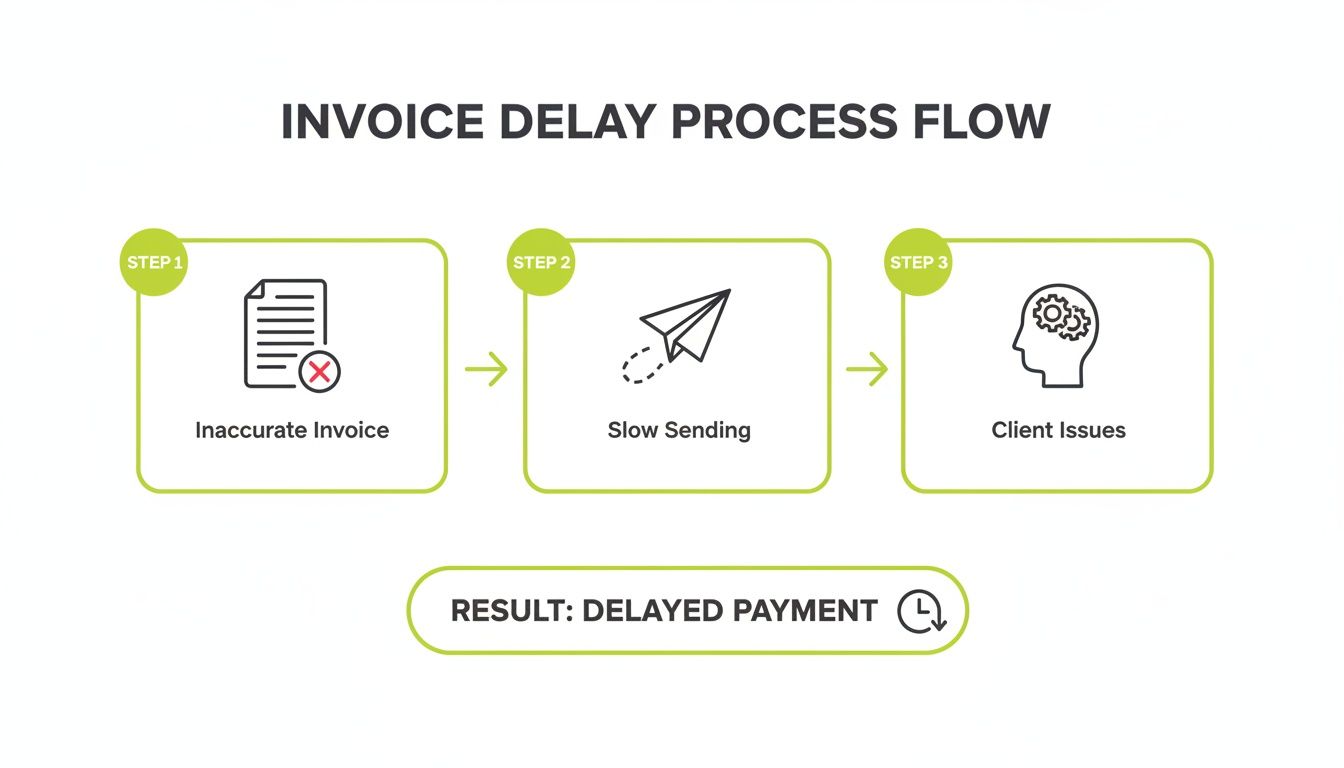
As illustrated, simple friction points—an error on a line item or a delay in sending the invoice—create significant payment roadblocks. Correcting these internal weak spots is the first step in building a resilient collections process.
Designing the Escalation Cadence
A structured follow-up schedule ensures timely communication without alienating clients. Each step needs a clear trigger, a specific communication method, and a singular goal.
For a professional services firm, a robust escalation path could be:
- The Pre-Reminder (Day -3): An automated email is sent three days before the due date as a helpful heads-up, including a payment link.
- The First Nudge (Day +1): The day after the due date, another automated email goes out. The tone is light, acknowledging that items can be missed.
- The Firm Reminder (Day +7): After one week, the message becomes more direct but remains professional. The original invoice is re-attached with the outstanding amount clearly stated.
- The Personal Call (Day +15): At 15 days past due, a human touch is required. An AR specialist or account manager should make a personal call to understand the delay.
- The Final Demand (Day +30): At 30 days past due, a formal demand letter is issued. This communication should reference the service agreement and outline next steps.
The power of a modern collections workflow is its consistency. Every invoice receives the same methodical follow-up, ensuring nothing is missed and freeing your team from deciding how and when to act.
This systematic approach is the core of accounts receivable automation. An automation builder allows you to design and execute these multi-stage follow-ups automatically. The result is a significant reduction in manual work and a measurable improvement in cash flow.
With AI AR automation, you can further tailor the tone and timing of communications based on a client's payment history or risk profile. Platforms with strong QuickBooks AR automation can sync with your accounting software, initiating workflows the moment an invoice status changes.
This is how you shift from managing debt to orchestrating your firm’s financial health with precision.
Using Metrics to Predict and Prevent Late Payments
Reacting to late payments means you are already behind. True control over your firm’s cash flow comes from a strategic shift: viewing accounts receivable not as a collections list, but as a source of valuable operational data.
Instead of relying on gut feelings, top finance operators use key performance indicators (KPIs) to assess collections health. These metrics help you anticipate problems, identify at-risk accounts, and pinpoint process weaknesses before they impact cash flow.

Analyzing Days Sales Outstanding (DSO)
Days Sales Outstanding (DSO) is the single most important metric for measuring collections efficiency. It tells you, on average, how many days it takes to convert an invoice into cash. A rising DSO is a clear warning sign of a potential cash flow crunch.
The formula is straightforward:
DSO = (Total Accounts Receivable / Total Credit Sales) x Number of Days in Period
If your firm had $800,000 in receivables against $2.4 million in credit sales over a 90-day quarter, your DSO would be 30 days. A lower number is always the objective. For a deeper analysis, see our guide on the Days Sales Uncollected formula.
This is a predictive metric. For context, a 2026 report on global payment trends found that businesses waited an average of 51 days for payment on 32-day terms. Those 19 days of delay represent a significant drain on working capital.
Dissecting the Accounts Receivable Aging Report
While DSO provides a high-level view, the AR Aging Report is your tactical map. This report sorts unpaid invoices into time-based buckets (e.g., 1-30 days, 31-60, 61-90, 90+), showing exactly where to focus your team’s efforts.
The real insights emerge when you segment the data to find patterns:
- By Client: Do specific clients consistently appear in the 60+ day column? This may signal a need to adjust their credit terms or initiate a direct conversation.
- By Service Line: Are invoices for a particular service consistently paid late? The scope of work might be unclear, leading to disputes that delay payment.
- By Project Manager: Does one PM’s portfolio have a higher AR balance? This could point to a gap in their project close-out process.
Your AR Aging report is more than a list of debtors; it is a diagnostic tool. Segmenting the data reveals the why behind the numbers, transforming a reactive list into a proactive roadmap for process improvement.
To be effective, this data must be current. When you automate reports, you gain the real-time visibility needed to make informed decisions and prevent an invoice past due situation from escalating.
This is where modern AR software for professional services provides a distinct advantage. An AI AR automation platform like Resolut syncs directly with QuickBooks, delivering live dashboards that track these KPIs. This level of QuickBooks AR automation gives you the power to reduce DSO and improve cash flow.
The Role of AI and Automation in Accounts Receivable
As a professional services firm scales from $3M to $50M, manual AR processes begin to break down. Ad-hoc emails and spreadsheets become an operational drag, tying up cash and consuming valuable team resources.
This is a systemic problem. A few years ago, 62% of small businesses reported struggles with overdue invoices, turning predictable revenue into a guessing game. These late payments cost small and mid-sized firms millions of hours in wasted productivity chasing earned revenue. As these findings on late invoice impacts show, the cost of inaction is substantial.
This is why finance leaders are moving past manual processes to embrace accounts receivable automation. This is about installing a proper AR operating system that brings intelligence, consistency, and predictability to your entire collections cycle.
Moving Beyond Simple Reminders
Basic accounting software often includes generic, automated reminders. While better than nothing, this is far from the smart orchestration needed to truly improve cash flow and lower Days Sales Outstanding (DSO).
True AI AR automation builds a dynamic, responsive collections engine. Instead of following a rigid schedule, these platforms learn. They analyze client payment history, invoice risk factors, and even communication engagement to adapt the collections strategy in real time. This is AR orchestration.
A basic reminder is an alarm clock—it makes a noise at a preset time. AR orchestration is a logistics system—it optimizes routes, anticipates delays, and ensures every payment arrives on time.
The Core Capabilities of an AI-Powered AR Platform
An intelligent AR platform transforms collections from a tactical chore into a strategic, automated function.
Here’s what that looks like in practice:
- Unified Omnichannel Outreach: The system automatically communicates via channels clients use, like email and SMS. The messaging is personalized with specific invoice details while maintaining your firm's professional tone.
- Intelligent Risk Identification: The AI constantly scans your receivables portfolio to flag high-risk invoices before they become a major problem. It identifies patterns, allowing you to get ahead of issues.
- Automated Cash Application: Modern AR systems connect to your bank feeds, parse remittance data, and automatically apply cash. This reconciles accounts in seconds, freeing up your team for higher-value work.
The goal of modern AR automation is to get your team out of the weeds. By eliminating repetitive, low-value tasks, you empower your finance experts to focus on strategic cash flow management and high-level financial analysis.
For professional services firms, a seamless QuickBooks AR automation integration means your AR system and general ledger are always perfectly in sync. This creates a single source of truth for your receivables. You can learn more in our guide on how to fully automate your accounts receivable process in our detailed guide.
The Measurable Outcomes of AR Orchestration
Moving from manual work to AI-driven orchestration delivers clear, bottom-line results. Firms that adopt this level of AR software for professional services see immediate and tangible improvements.
The primary outcome is a significant reduction of DSO. By ensuring every invoice past due receives consistent, timely follow-up, automation naturally accelerates the payment cycle. For a firm with $10M in annual revenue, cutting DSO from 45 to 35 days unlocks over $270,000 in cash flow.
Manual AR vs. Automated AR Orchestration
This table highlights the operational difference between a manual and an automated system.
AR Function | Manual Process (The Old Way) | AI-Driven Automation (The New Way) |
|---|---|---|
Collections Outreach | Ad-hoc emails and calls; inconsistent timing and tone. | Personalized, automated sequences across email and SMS. |
Risk Management | Reactive; problems identified only when an invoice is 60+ days late. | Proactive; AI flags at-risk accounts based on payment behavior. |
Cash Application | Manual matching of payments to invoices; prone to error. | Automated reconciliation; payments are applied instantly and accurately. |
Reporting | Static, outdated reports pulled manually from spreadsheets. | Real-time dashboards with live DSO and aging analysis. |
By automating tactical work, you elevate the entire finance function. Your team is no longer buried in administrative tasks. Instead, they are armed with the data and time to become strategic partners to the business, focused on driving financial performance.
Regaining Control Over Your Firm's Cash Flow
Dealing with an invoice past due can feel like a constant battle. However, it is not an unavoidable cost of doing business—it is an operational challenge that can be solved.
The key is to shift from reactively chasing late payments to proactively managing your receivables. This is how finance leaders trade chaos for control, turning AR into a predictable source of cash.
A calm, consistent, and data-backed approach to collections is the foundation of this control. It allows you to protect your firm’s financial health without damaging client relationships.
From Reactive to Proactive Control
Real change occurs when you stop managing individual debts and start orchestrating your entire cash flow. This requires a system: predictable collections cadences, close tracking of metrics, and automation to handle repetitive work.
Embracing modern accounts receivable automation means you are no longer just collecting money. You are installing an intelligent operating system for your firm’s most critical asset: its cash.
With a systemic approach, no invoice gets lost. Your team is freed from chasing paperwork to focus on high-value financial strategy that drives growth. You are building a resilient financial function that can scale with your business.
*Visual Idea 1: *A cinematic image showing a CFO calmly looking at a clean dashboard on a large screen. The dashboard displays a downward trendline for DSO and a healthy AR aging chart, symbolizing clarity and control.
The Power of Intelligent Systems
Control comes from having the right tools. For firms in the $3M–$50M range, platforms offering AI AR automation and seamless QuickBooks AR automation are essential infrastructure.
These systems provide the visibility and efficiency needed to consistently reduce DSO and improve cash flow. They are the engine that powers a modern, proactive AR process.
*Visual Idea 2: *A split-screen visual. On the left, a cluttered desk with piles of paper invoices and sticky notes, representing manual AR. On the right, a clean, modern desk with a single tablet showing a clear, automated workflow, representing control.
Resolut automates AR for professional services—consistent, accurate, and human.
Your Top Questions About Past Due Invoices, Answered
As a leader in a professional services firm, you have likely spent time thinking about outstanding invoices. Here are direct answers to the questions we hear most often from finance operators.
When Should We Actually Consider Legal Action for an Unpaid Invoice?
Legal action is a last resort. This step should only be considered when an account is seriously delinquent—typically 90-120 days past due—and the client has ceased all communication.
Before engaging legal counsel, your team must have a solid, documented history of every collection attempt. This includes a time-stamped log of every email, call, and formal letter. This documentation is critical evidence.
Some modern AR software for professional services offers an intermediate step: a "voice of a lawyer" service. A formal notice is sent on legal letterhead without initiating a full lawsuit. This tactic often elicits an immediate response, saving significant costs.
How Does AR Automation Actually Talk to QuickBooks?
Effective AR automation software integrates directly with your accounting system, not creating another data silo. For tools like QuickBooks, this connection is made via an API, a secure, two-way data bridge.
This QuickBooks AR automation ensures both systems have identical information in real time:
- Customer Information: Contact updates in one system are synced to the other.
- Invoice Data: New invoices—with amounts, numbers, and due dates—are synced instantly.
- Payment Status: The moment a payment is logged in QuickBooks, the AR system is notified, immediately halting further collections for that invoice.
This seamless sync eliminates manual data entry and prevents chasing clients for invoices they have already paid. It establishes a single source of truth for your receivables, which is essential to improve cash flow.
Can We Chase Payments Without Ruining Client Relationships?
Yes. When implemented correctly, thoughtful automation can strengthen client relationships. The goal is to replace inconsistent manual follow-ups with a system that is professional, predictable, and helpful.
Automation is not about being robotic; it is about being reliable. It ensures every client receives the right message at the right time. It systematizes respect.
For example, you can configure gentle reminders for your best clients and a more direct cadence for those with a history of late payments. By providing a simple payment portal, you make it easy for clients to pay. A better experience for them helps you reduce DSO and get cash in the bank faster.
--- Resolut automates AR for professional services—consistent, accurate, and human.