Crucial Guide: mo statute of limitations debt for CFOs
CFO guide to mo statute of limitations debt and AR compliance: protect cash flow, reduce risk, and optimize receivables within Missouri timelines.
As a CFO, you know that every dollar tied up in aging accounts receivable is a direct threat to cash flow and your company's financial stability. The Missouri statute of limitations on debt isn't some dusty legal footnote; it's a hard deadline that dictates your window for legal recourse. Miss that window, and you're essentially writing off earned revenue for good.
The CFO's Playbook for Missouri's Debt Statute of Limitations

A high-performing finance team manages accounts receivable with precision. Once an invoice blows past the 90 or 120-day mark, it’s a potential liability on your balance sheet. In Missouri, the legal timelines for collecting that debt are firm, making a proactive AR strategy essential.
Think of the statute of limitations as a ticking clock on your right to sue for payment. Once that clock runs out, your leverage is gone. For a professional services firm with revenues between $3M and $50M, a handful of uncollected five-figure invoices can materially impact quarterly results and working capital.
This is why you must move beyond just chasing the oldest invoices. The focus is on building an intelligent process that respects these legal deadlines while protecting your firm’s bottom line, ultimately helping to reduce DSO.
Why Timeframes Dictate Your AR Strategy
The real challenge for finance leaders isn't just seeing what's overdue; it's knowing how long you have to legally collect it. The mo statute of limitations debt rules create a hard stop, turning a potential asset into a permanent write-off. Your entire AR workflow needs to be built around this reality.
For example, an invoice tied to a detailed written contract has a much longer legal lifespan than one based on a verbal agreement. Your AR team must know the difference to prioritize their efforts effectively. AI AR automation can systematically categorize these for you.
A disciplined AR process isn't about being aggressive; it's about preserving the value of the revenue you've already earned. Knowing your legal time limits is the bedrock of that discipline.
This concept of a legal collection deadline isn't unique to Missouri. Across the U.S., statutes of limitations vary widely, typically falling between 3 to 10 years depending on the state and the type of debt. You'll find that 10 states have a very short 3-year window, while others grant a full decade. This variance highlights how critical state-specific knowledge is.
Missouri Debt Statute of Limitations at a Glance
To make this practical, here’s a quick-reference table outlining the specific time limits your team needs to know for Missouri. This data should inform how your AR software for professional services prioritizes outreach.
Debt Type | Statute of Limitations (Years) |
|---|---|
Written Contract | 10 Years |
Oral Contract | 5 Years |
Promissory Note | 10 Years |
Open Account | 5 Years |
Judgment | 10 Years |
This table should be the starting point for your AR strategy, helping your team quickly classify and prioritize overdue accounts based on their legal viability.
From Legal Rulebook to Operational Control
The goal here is to turn these legal statutes into a system that protects your cash flow. This means going beyond standard aging reports and implementing a process that gives you clear visibility into every account's collection timeline.
Here’s what that looks like in practice:
- Rock-Solid Documentation: Your first line of defense is a clear, organized paper trail. This includes every contract, service agreement, change order, and invoice.
- Critical Date Tracking: The clock often starts ticking from the date of the last payment or activity on an account. Your system must track this meticulously for every single client.
- Compliant Communications: All your outreach to clients about overdue payments must follow legal standards. The last thing you want is to inadvertently restart the clock or create a new legal headache.
Building out this kind of robust system is a key part of strategic corporate compliance, which helps you navigate today's complex regulatory environment. It ensures your AR process isn't just effective, but also legally sound.
Ultimately, getting a handle on the mo statute of limitations debt is about taking control of your financials. It’s about making sure your firm has every possible opportunity to collect the money it has rightfully earned and improve cash flow.
Understanding Missouri's Key Debt Categories
In Missouri, not all debt is created equal. The clock for collecting what you're owed starts ticking at different speeds depending on one crucial factor: the type of agreement you have with your client.
The difference between a signed Master Service Agreement and a quick verbal "yes" to a project extension isn't a minor detail. It’s the difference between having 10 years to pursue a debt and having only 5. Getting this right is a core function for your AR team.
Written Contracts: The 10-Year Rule
When a debt is backed by a written contract, Missouri law gives you a generous 10-year statute of limitations. The clock usually starts running the moment a breach occurs—the day an invoice goes past its due date and remains unpaid.
For a professional services firm, a "written contract" is any formal document that both you and your client have signed. Think of things like Master Service Agreements (MSAs), signed project scopes (SOWs), or formal retainer agreements.
Meticulous record-keeping is non-negotiable. These signed documents are the bedrock of your legal claim. An invoice from seven years ago with a signed SOW is in a much stronger position than an unpaid bill from two years ago based on a handshake.
Promissory Notes: Another 10-Year Lifeline
A promissory note also gets the benefit of that 10-year mo statute of limitations debt rule. A promissory note is exactly what it sounds like: a formal, written promise to pay a specific amount of money by a certain time.
While not for day-to-day work, they are an effective tool for managing large, overdue balances. For a $50,000 delinquent account, you could structure a payment plan and formalize it with a signed promissory note, creating a new, legally solid agreement with its own 10-year window.
A promissory note transforms a delinquent account into a new, legally fortified agreement. It effectively resets the collection framework, providing a clear path to recovery with a decade-long enforcement period.
This converts a messy collections problem into a clearly defined financial asset with strong legal standing, a measurable outcome for your balance sheet.
Oral Agreements and Open Accounts: The 5-Year Deadline
Here’s where the timeline shrinks dramatically. For both oral agreements and debts on an open account, Missouri law imposes a much shorter 5-year statute of limitations. This is a significant risk for firms that sometimes operate on trust and verbal approvals.
An "open account" is a common business scenario with ongoing services and a running balance, like a monthly retainer without an overarching written contract. Each transaction falls under this tight 5-year rule.
An oral contract is a verbal deal. When a client asks for "a few extra hours of work" and you agree without a signed change order, you've created an oral contract. It's valid, but your window to sue for non-payment has just been cut in half.
This 5-year deadline is a powerful argument for documenting everything. Turning verbal requests into simple, signed documents is the best way to convert a high-risk, 5-year receivable into a secure, 10-year asset.
When the Collections Clock Starts, Stops, and Resets
Think of the statute of limitations less like a simple countdown and more like a stopwatch. Certain actions can start it, pause it, or even reset it back to zero. Understanding these triggers is key to compliant collections and revenue protection.
One of the most powerful—and often misunderstood—events is what the law calls an acknowledgment. This is when a debtor does something that essentially admits the debt is real and valid. That single action can restart the entire statutory clock.
On the other hand, some events can pause the clock, a legal pause called tolling. Knowing what stops the timer versus what resets it is critical. Getting it wrong can lead to wasting resources chasing a debt a court can no longer enforce.
Acknowledgment: The Action That Resets the Clock
In Missouri, if a debtor acknowledges a debt, the statute of limitations starts all over again from that day. This can be a significant advantage for your collections strategy, but it’s a concept your team needs to understand to manage properly.
So, what counts as an acknowledgment? It’s often simpler than you’d think.
- A Partial Payment: This is the most common example. When a client makes any payment on an overdue invoice, they implicitly confirm they owe the remaining balance. The clock resets on the date you receive that payment.
- A Written Promise to Pay: An email from a client saying, "I know we're behind, but we'll get that paid by the end of the month," is enough to restart the statute. This is why keeping detailed records of all client communications is non-negotiable.
A partial payment on a four-year-old invoice under a five-year statute doesn't just lower the balance. It resets the timer, giving your firm a fresh five-year window to collect the remainder.
This principle is what fueled the "zombie debt" market. Collectors buy old, written-off debts, then try to coax a small payment or promise out of the debtor just to make the debt legally enforceable again. You can get a better sense of the compliance minefield by reading more about time-barred debt collection practices.
Tolling: Events That Pause the Clock
While an acknowledgment hits the reset button, tolling events just press pause. During a tolling period, the statute of limitations simply stops running. Once the event is over, the clock picks up right where it left off.
Common situations that pause the clock include the debtor filing for bankruptcy, moving out of state, or being legally declared a minor or mentally incapacitated.
For instance, say a client is two years into a five-year statute and then files for bankruptcy. The clock freezes. If the bankruptcy is dismissed a year later, the clock starts ticking again, and you still have three years left. Tracking these legal statuses in your financial software, like with QuickBooks AR automation, is critical.
This timeline gives you a good visual of how the lifespans of different debt types in Missouri can vary.
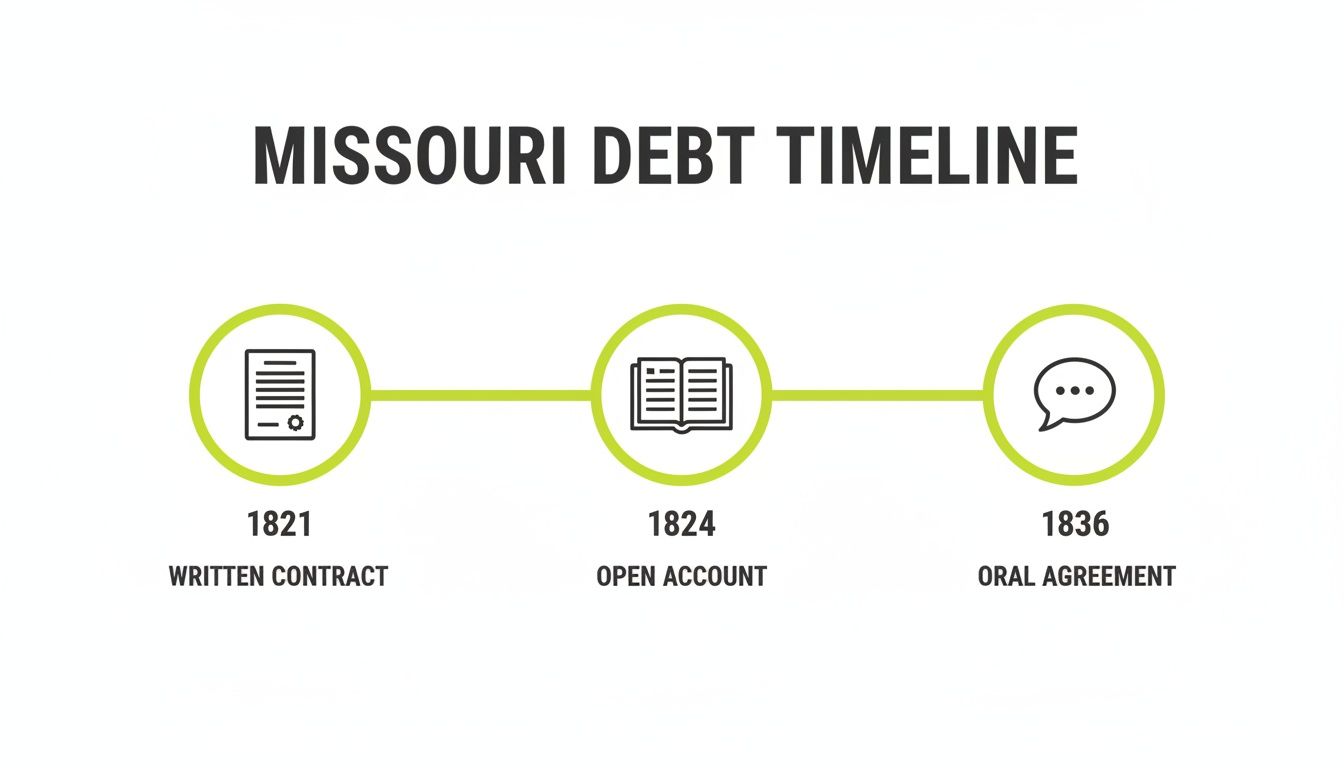
As you can see, a debt backed by a written contract has double the legal lifespan of one based on just a verbal agreement or an open account. That difference alone highlights how crucial strong documentation is from day one.
A Practical Workflow for Assessing Debt Collectibility

When it comes to aging accounts, your accounts receivable team cannot afford to guess. Inconsistent collection efforts lead to compliance risks. The key is to build a clear, repeatable process that removes guesswork and empowers your team to make confident calls on enforceability.
Think of this as an operational blueprint. The goal is simple: bake a standardized assessment right into your existing AR process. This disciplined approach is fundamental to effective Accounts receivable management and directly bolsters your bottom line.
For finance leaders, this isn't a "nice-to-have." Unpaid B2B invoices represent a significant drain on working capital. A manual, reactive approach is no longer sufficient when a systematic process can directly reduce DSO.
Step 1: Locate the Core Documents
Before any decision, gather the evidence. Your team cannot determine the correct Missouri statute of limitations for debt without the original paperwork. This first step is about gathering the facts.
Have your team track down and centralize these key items for every delinquent account:
- The Original Agreement: Was it a formally signed contract or Master Services Agreement? Or was it a simple statement of work or email exchange?
- The Complete Invoice History: A record of every invoice sent under the agreement, complete with dates and amounts.
- The Full Payment Ledger: Every payment received—no matter how small—documented with its date. This is crucial for spotting any activity that might have reset the clock.
This collection of documents becomes your single source of truth for the account. It's a non-negotiable part of a compliant and effective assessment.
Step 2: Verify the Contract Type and Calculate the Deadline
With documents in hand, the next job is to classify the debt and apply Missouri rules to determine the timeline. Using the paperwork, answer one straightforward question: Is this a 10-year debt or a 5-year debt?
If you have a signed written contract or a promissory note, you're working with the 10-year statute. If the agreement was verbal or an "open account" without a master contract, you're looking at the shorter 5-year statute.
Once the timeline is known, calculate the expiration date. The clock starts from the date of default or the date of the last payment/acknowledgment. This calculation is a critical input for accurately calculating your allowance for uncollectible accounts.
Step 3: Document the Assessment with a Checklist
To keep the process consistent and create a bulletproof audit trail, have your team use a simple checklist for every account review. This formalizes the workflow and documents the "why" behind every decision.
A solid checklist should capture these essentials:
- Account Name & Invoice Number(s)
- Total Outstanding Balance
- Contract Type Verified: (Written, Oral, Promissory Note, Open Account)
- Date of Default / Last Payment: The date the statute of limitations clock started or was last reset.
- Applicable Statute of Limitations: (5 or 10 years)
- Calculated SOL Expiration Date: The last possible day to file a lawsuit.
- Is Debt Time-Barred? (Yes/No)
- Recommended Next Action: (Continue standard collections, escalate to legal, or write-off)
This checklist becomes a permanent part of the account's record, providing justification for any future actions. The process can be greatly simplified with AI AR automation, which can flag at-risk accounts for you automatically.
Best Practices for Compliant Collections in Missouri
Navigating Missouri's statute of limitations for debt is about building a disciplined system around your accounts receivable—one that relies on rigorous documentation, careful communication, and a smart escalation plan.
For finance leaders, this isn't about being aggressive; it's about being strategic. Every communication about an overdue account has legal weight. A sloppy approach puts revenue at risk and can open your firm to legal headaches.
Maintain Meticulous Documentation
Your first, and most important, line of defense is an ironclad paper trail. When a debt dispute arises, the party with the better records almost always comes out on top.
A truly compliant documentation system should be a complete library of the client relationship.
- Signed Contracts and SOWs: Every Master Service Agreement, Statement of Work, and change order needs to be signed and centrally stored. These are your tickets for establishing the 10-year statute of limitations.
- Complete Invoice and Payment History: Keep a detailed ledger showing every invoice sent and every payment received, with exact dates. This is critical for pinpointing the "date of last activity."
- Communication Logs: Log every significant conversation—phone calls, emails, letters—about the debt. A simple dated note can make all the difference.
This level of detail removes ambiguity and provides a firm foundation, whether negotiating a payment plan or presenting a case in court.
Implement Clear Communication Protocols
How your team talks about debt is as important as how they document it. One wrong move can restart the statute of limitations on an old debt or run afoul of fair collection laws.
Train your AR team on what they can and cannot say, especially with aging accounts. The goal is to collect payment without creating new legal problems. You can learn more about the rules for time-barred debt collection on consumerfinance.gov.
Your team must be clear: discussing a debt that is past the mo statute of limitations debt deadline requires extreme caution. They should never use language that implies a lawsuit is still on the table if it isn't.
Your communication playbook must forbid any language that sounds like a threat of legal action for a time-barred debt. The conversation should remain professional and factual.
Establish Triggers for Legal Escalation
Not every unpaid invoice is worth a legal battle. Create clear, data-driven triggers that tell you when to involve legal counsel. This ensures you only spend legal fees on claims with a strong chance of a positive return.
Here are a few smart escalation points to consider:
- High-Value, Viable Accounts: Any account over a set dollar amount (e.g., $25,000) that is well within its statute of limitations and backed by solid paperwork should be flagged for legal review after 120 days past due.
- Disputed Invoices with Strong Contracts: If a client is fighting an invoice but your written contract is airtight, escalating sooner can be a smart defensive move.
- Accounts Nearing the SOL Deadline: Set up an alert to flag any major account approaching its 5-year or 10-year cutoff. This gives you a final window to make a calculated decision.
A formal legal demand letter for payment can be a powerful and cost-effective next step. A structured escalation path moves your firm from being reactive to being strategic.
Automating AR Compliance to Improve Cash Flow
Manually tracking the mo statute of limitations debt across hundreds of client accounts is inefficient and prone to error. One missed date or a misclassified contract can mean that receivable is gone for good.
This is where accounts receivable automation provides a significant operational lift. It shifts your AR team from a reactive, administrative role into a proactive, strategic one that actively protects your cash flow.
For CFOs at growing professional services firms, inaction is a costly decision. You can see more data on unpaid debt and its impact on businesses over at freedomdebtrelief.com. Having a firm grasp on the statute of limitations, powered by smart tools, helps you spot at-risk debts early, slash your DSO, and stay out of legal trouble.
From Manual Tracking to Intelligent Oversight
Think of an AI AR automation platform as a tireless compliance expert working for your finance team 24/7. Instead of juggling spreadsheets, the system automatically applies Missouri's debt laws across every account.
Here’s what a system like this can do:
- Automatically flag accounts approaching their 5- or 10-year SOL deadlines, pushing them to the top of your team's priority list.
- Adjust outreach strategies based on legal standing, ensuring compliant communications for accounts nearing or past their expiration dates.
- Keep a perfect audit trail of all communications, payments, and acknowledgments—anything that could reset the statutory clock.
This data-first approach takes the guesswork and risk out of the compliance equation.
The real power of AR automation isn't just sending reminders. It's about building an intelligent system that safeguards your revenue by enforcing compliance with the mo statute of limitations debt at scale.
A good AR software for professional services can give you a real-time dashboard showing at-risk revenue, categorized by how close each account is to its SOL deadline. This allows your team to focus on high-value client relationships and strategic collections, which directly helps you improve cash flow.
Reducing DSO with Automated Workflows
The goal is simple: turn outstanding receivables into cash as quickly as possible. Automation is the straightest line to get there. When you build compliance checks directly into your collection workflows, the entire process becomes more efficient.
For instance, a platform that uses QuickBooks AR automation can sync with your accounting data to pinpoint the date of the last payment, then automatically calculate the time remaining on the SOL. The best AR software for professional services can do even more. To get a better sense of what's out there, you can select the right accounts receivable automation software with the help of our detailed guide.
All of this frees up your finance operators to concentrate on managing client relationships and making smart decisions, not double-checking dates on a calendar.
Your Top Questions Answered
When you're dealing with Missouri's statute of limitations on debt, a few key questions always seem to pop up for finance leaders. Let's get straight to the practical answers you need for managing your accounts receivable and staying compliant.
What Happens if We Sue After the Statute of Limitations Expires?
Thinking about filing a lawsuit on a debt that's past its statute of limitations? Don't. If you do, the debtor has a slam-dunk defense. They simply have to point out that the legal clock has run out.
The court will almost certainly dismiss your case. This means you've not only lost that revenue for good but you've also wasted money on legal fees. Even worse, pursuing what's often called "zombie debt" can damage your company's reputation.
Can a Partial Payment Restart the Clock in Missouri?
Yes, and this is a critical detail for every AR team to understand. In Missouri, when a debtor makes a partial payment on an old invoice, the law generally sees it as an "acknowledgment" of the entire outstanding debt.
That single payment hits the reset button on the statute of limitations, starting a whole new countdown from the date the payment was made. A small check can breathe new life into an aging receivable.
A single payment on a four-year-old debt with a five-year limit doesn't just reduce the balance—it resets the clock, granting your firm a new five-year period to pursue the remaining amount. This is a powerful mechanism if documented correctly.
How Does the Statute of Limitations for a Judgment Differ?
A judgment is a formal court order declaring that a debtor legally owes you a specific amount. Because of this, it operates on a completely different timeline. In Missouri, a judgment is enforceable for 10 years right out of the gate.
But it doesn't stop there. Unlike a standard contract debt, you can "revive" a judgment for another 10-year term. This renewal has to be done before the original 10 years are up, but it gives you a much longer, and potentially renewable, runway to collect.
--- Resolut automates AR for professional services—consistent, accurate, and human. Learn how to improve your cash flow at https://www.resolutai.com.