A CFO's Guide to Payment Gateways for Business
A strategic guide for CFOs on selecting and managing payment gateways for business. Improve cash flow, reduce DSO, and automate accounts receivable.
For a professional services firm, a payment gateway is the digital entry point for all client payments. It functions as the central nervous system for your cash flow, securely and efficiently moving funds into your business. This is not just another tool; it is a core strategic asset that directly impacts revenue, client relationships, and operational control.
A cumbersome payment process introduces friction. It can frustrate clients, create tedious manual work for your finance team, and directly impede revenue. A modern gateway, integrated with your accounts receivable process, removes these barriers and accelerates payment cycles.
The CFO's View on Payment Gateway Strategy
As a financial leader, you understand that cash flow is the lifeblood of the firm. Every engagement, from client acquisition to project delivery, culminates in an invoice. The payment gateway ensures this final, critical step is executed with maximum efficiency.
A clunky payment process creates unnecessary friction, frustrating clients and burdening your finance team with manual tasks that delay revenue. In contrast, a modern gateway integrated with your accounts receivable systems eliminates these obstacles to improve cash flow.
From Cost Center to Strategic Asset
Historically, payment processing was viewed as a simple cost of doing business. For today's CFO, this perspective is obsolete. The right payment gateway is a strategic asset that delivers a clear return on investment by improving key financial metrics.
The most direct impact is on Days Sales Outstanding (DSO). By offering clients convenient payment options—credit card, ACH, digital wallets—you remove common barriers to timely payment. The financial impact is clear: a firm that reduces its DSO from 60 to 50 days on $10 million in annual revenue unlocks over $270,000 in working capital.
A payment gateway should not be a passive tool. It must actively contribute to financial control and predictability, turning accounts receivable from an administrative burden into a competitive advantage.
Aligning Technology with Financial Goals
An effective payment strategy begins with understanding the different types of third-party payment processors available. This knowledge enables you to evaluate solutions based on their fit with your firm’s specific billing models, whether managing retainers, project-based work, or high-value invoices.
The objective is a seamless loop: a client receives an invoice, pays it with a few clicks, and the funds settle in your accounts without delay. This requires a gateway that integrates deeply with your financial stack, especially your accounting software or a platform offering QuickBooks AR automation.
The Growing Importance of B2B Payments
The market data underscores the strategic importance. The global payment gateway market is projected to grow from USD 34.49 billion in 2026 to USD 90.28 billion by 2034. This growth is driven by the scale of B2B payments, which are set to account for over 85% of global payment value by 2026.
For AR teams, integrating gateways with platforms that support AI AR automation is no longer optional; it is essential for maintaining a competitive edge. These trends confirm a core principle for finance operators: mastering payment collection is fundamental to achieving stable cash flow and financial control.
How a Payment Transaction Actually Works
For many finance leaders, the payment gateway can seem like a black box. Understanding the mechanics is key to managing risk and maintaining tight operational control.
Think of it as a high-speed, secure courier service for funds. The gateway acts as a central dispatcher, security checkpoint, and traffic controller. From the moment your client clicks "Pay" to when funds settle in your bank, a series of automated steps occur. Knowing this process helps you select the right provider and strengthen your financial workflow.
The Key Players in a Transaction
Every payment is a coordinated handoff between several entities. A failure at any point can result in delays or failed transactions.
These are the primary participants:
- The Merchant (Your Firm): You initiate the process by requesting payment for services rendered.
- The Customer (Your Client): They provide payment details to authorize the transaction.
- The Issuing Bank: The client's bank, which approves or denies the charge based on funds and security checks.
- The Acquiring Bank: Your firm's bank, which works with the gateway to accept funds from the issuing bank.
- The Payment Gateway: The technology layer that securely encrypts and routes data between all parties.
The gateway's function is to cut through this complexity, providing you with more direct control over your cash flow.
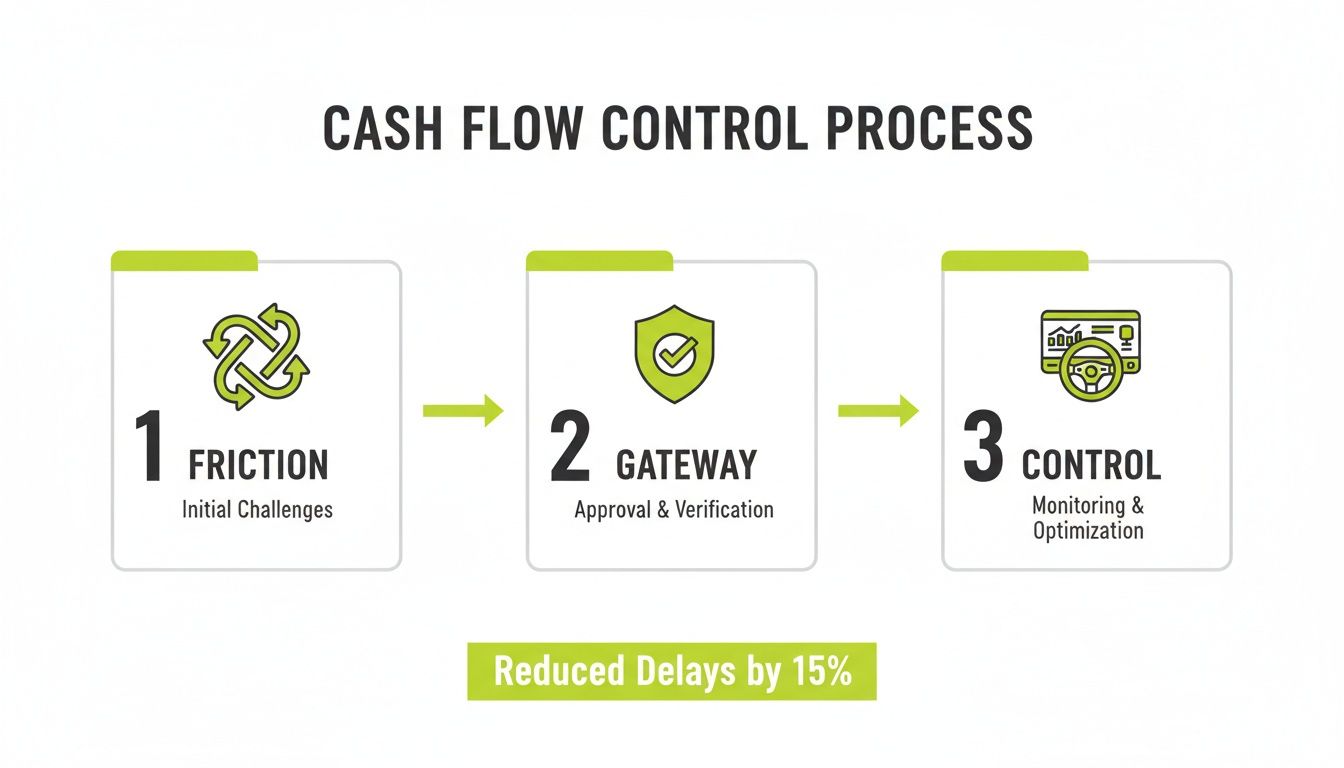
By orchestrating these financial handshakes, a modern gateway transforms a convoluted process into a smooth, automated workflow that accelerates payment.
The Security Handshake of Encryption and Tokenization
For any CFO, the security of client payment data is non-negotiable. A data breach results in financial penalties and can destroy your firm's reputation. Two critical security technologies—encryption and tokenization—are essential safeguards.
Encryption is the first line of defense. It scrambles sensitive payment data the moment a client enters it, rendering it unreadable as it travels to the gateway. This is akin to placing the data inside a sealed, armored vehicle for its journey across the internet.
Tokenization is the more advanced and critical component for modern payment security.
Tokenization replaces the client's actual card number with a unique, non-sensitive placeholder called a "token." This token is used for future billing, but the primary account number never touches your systems.
This significantly reduces your firm's PCI DSS compliance burden. By keeping sensitive data off your servers entirely, you transfer a massive portion of the security responsibility to the gateway provider—specialists built to handle it. This is a direct method for mitigating financial and reputational risk.
When a secure gateway is integrated with an AI AR automation platform, this entire process becomes part of a larger strategy to reduce your DSO and stabilize cash flow. The gateway handles the secure transaction, and the automation platform instantly reconciles the payment, matching it to the correct invoice in your accounting software, as with QuickBooks AR automation. This creates a truly closed-loop system for managing receivables.
Essential Gateway Features for Professional Services Firms
Not all payment gateways are created equal. A generic gateway designed for e-commerce is a poor fit for a professional services firm. A simple retail checkout process is inadequate for managing high-value invoices, complex billing, and long-term client relationships.
Selecting the right features is a financial decision that directly impacts cash flow, operational efficiency, and the bottom line. The global payment gateway market is projected to grow from USD 39.88 billion in 2026 to USD 194.46 billion by 2033. This growth is fueled by B2B payments, which are expected to constitute over 85% of all payment volume by 2026. This trend signals a clear need for gateway technology built for business operations. You can read more about the payment gateway market trends and their implications for B2B finance.
Level 2 And Level 3 Data Processing
If your firm accepts corporate or government credit cards, interchange fees can significantly erode revenue. Level 2 and Level 3 data processing are essential features for any B2B firm.
A standard transaction provides only the total amount. Level 2 and 3 data include additional details, such as purchase order numbers and line-item data. This increased transparency reduces risk for card-issuing banks, which reward you with lower interchange rates. Qualifying for Level 3 processing can reduce card transaction costs by 30-40%—a direct contribution to your bottom line.
Core Functionality For Services Firms
Beyond cost savings, the right gateway must solve operational challenges unique to professional services. It should operate as an extension of your finance team.
- Virtual Terminal: Many client payments still occur over the phone. A virtual terminal provides a secure web interface for manually entering card details, ensuring every payment is processed through a single, compliant, and trackable system.
- Automated Recurring Billing: This feature is critical for firms with retainer or subscription-based agreements. Once configured, the gateway handles monthly billing and collection automatically, smoothing cash flow and freeing up your team from manual follow-up.
- Multiple Payment Methods: Offering payment options is one of the fastest ways to get paid on time. Your gateway must support credit cards and ACH transfers. ACH is ideal for large invoices due to its significantly lower processing fees. For more information, see our guide on the benefits of ACH for business payments.
This checklist is tailored for evaluating gateways for professional services firms.
Gateway Feature Checklist for Professional Services
Feature | Why It Matters for Your Firm | Measurable Outcome |
|---|---|---|
Level 2/3 Data Processing | Reduces interchange fees on corporate and government card payments. | Up to 40% reduction in credit card processing costs. |
ACH Payment Support | Provides a low-cost alternative for large invoice payments. | Lower transaction fees, improved client convenience. |
Virtual Terminal | Securely accept payments over the phone. | Faster payment collection, maintains PCI compliance. |
Recurring Billing | Automates collection for retainers and subscription services. | Improved cash flow consistency, reduced manual work. |
AR Software Integration | Connects payments directly to your accounting system. | Eliminates manual reconciliation, reduces Days Sales Outstanding (DSO). |
This checklist connects technology features directly to financial health and operational efficiency.
Integration With AR And Accounting Software
A payment gateway operating in a silo creates more administrative work. Its value is realized through integration with your other financial systems.
A gateway’s true power is unlocked when it integrates seamlessly with your accounts receivable automation software. This connection eliminates the manual, error-prone task of cash application, where payments are painstakingly matched to open invoices.
When a client pays through an integrated system—such as a gateway connected to QuickBooks AR automation—the payment is automatically recorded and reconciled in your general ledger. This provides a real-time, accurate view of your receivables, reduces DSO, and allows your finance team to shift from data entry to strategic analysis.
Calculating the True Cost of Your Payment Gateway
Payment gateway pricing is often opaque. The advertised rate is rarely the final cost, making accurate budgeting difficult. To determine the true cost, you must look beyond the sticker price and understand the complete fee structure.
Grasping how providers structure their fees is the only way to accurately model costs and compare vendors on a level playing field. This allows you to select the provider that best aligns with your firm's payment profile.
The Three Core Pricing Models
For a professional services firm, gateway pricing typically falls into one of three models. Each impacts your bottom line differently, especially when dealing with high-value B2B invoices.
- Flat-Rate: The simplest model. You pay a single, fixed percentage plus a small per-transaction fee (e.g., 2.9% + $0.30). It is predictable but often the most expensive, as the rate is set high enough to cover the processor's riskiest transactions.
- Tiered: This model advertises attractive "as low as" rates by sorting payments into tiers (e.g., Qualified, Mid-Qualified, Non-Qualified) based on card type and risk. The problem is that most business and corporate cards are downgraded to more expensive tiers, resulting in a much higher effective rate than advertised.
- Interchange-Plus: This is the most transparent model. You pay the direct cost set by card networks like Visa and Mastercard (the "interchange" fee), plus a clear, fixed markup for the processor. It provides a clear view of costs and is usually the most cost-effective option for businesses with significant volume.
Uncovering Hidden Fees and Their Impact
The processing rate is only the beginning. A variety of other fees can appear on your monthly statement, inflating your bill. If you are not vigilant, these charges can lead to significant cost overruns.
Be watchful for these line items:
- Monthly Fees: A flat fee for maintaining an active account.
- Batch Fees: A small charge for settling the day's transactions with the bank.
- PCI Compliance Fees: A monthly or annual fee for maintaining security standards.
- Chargeback Fees: A penalty, typically $25–$50 per incident, charged when a client disputes a transaction.
The most significant financial drain often comes from a mismatch between your transaction profile and the pricing model. A firm processing large-ticket B2B payments on a Tiered model will consistently overpay compared to an Interchange-Plus structure.
Calculating Your Effective Rate
To cut through the complexity, calculate your effective rate. This single metric reveals the true cost of your payment processing, inclusive of all fees.
The formula is: (Total Monthly Fees ÷ Total Monthly Sales Volume) x 100. For example, if you paid $3,000 in total fees on $100,000 in payments, your effective rate is 3.0%. Use this number to compare providers and negotiate better terms. Understanding how different payment methods affect this calculation is also key; our guide to ACH payment processing fees provides further detail.
When your payment gateway is part of a broader accounts receivable automation platform, the objective shifts from simply minimizing transaction fees. An integrated system uses the gateway to accelerate cash collection and reduce Days Sales Outstanding (DSO), delivering value that far outweighs the processing costs.
Integrating Gateways Into Your Financial Ecosystem
A standalone payment gateway is an incomplete solution. If disconnected from your financial ecosystem, it becomes another administrative burden. A gateway's true power is unlocked only when deeply integrated with your existing systems, particularly your accounting software and accounts receivable platform.
This is where operational efficiency is gained. A proper integration creates a unified financial workflow with automatic data transfer. It is the bridge from simple payment acceptance to true accounts receivable automation, eliminating the manual work that burdens finance teams and leads to costly errors.

Pre-Built Integrations Versus Custom Development
When connecting your gateway to your financial stack, you face a choice: use a pre-built connector or invest in a custom solution. For most professional services firms, this decision has a significant impact on budget and time-to-value.
- Pre-Built API Integrations: These are ready-to-use adapters designed to link your gateway with popular software like QuickBooks. They are fast, affordable, and pre-tested, providing a reliable data bridge without a major IT project.
- Custom Development: This path involves building your own integration from the ground up. It offers complete flexibility but requires significant developer resources, ongoing maintenance, and a much longer timeline. This option is typically reserved for large enterprises with unique, proprietary systems.
For firms in the $3M–$50M revenue range, a gateway with robust, pre-built QuickBooks AR automation integrations is almost always the more prudent choice. Exploring the various Integrations available is a critical step to successfully embedding a payment gateway.
The Core Goal: Automated Cash Application
The most important outcome of integration is automated cash application. This is the process of having your system instantly match an incoming payment to the correct open invoice in your ledger without manual intervention.
Without it, your team is trapped in a painful cycle: downloading transaction reports, cross-referencing them against bank statements, locating the matching invoice, and finally marking it as paid. This process is not just slow; it is prone to human error, which can distort your cash position.
A properly integrated payment gateway acts as the trigger for end-to-end automation. When a client pays an invoice, the system should automatically close the receivable, update your books, and provide a real-time, accurate picture of your financial health. This isn't a feature; it's a fundamental requirement to improve cash flow.
This level of automation transforms your AR function from a reactive chore into a proactive, strategic component of the business. It frees your team to focus on higher-value activities, such as analyzing payment trends or strengthening client relationships, instead of chasing data. To delve deeper, learn how to optimize your payment reconciliation process.
A Critical Link in the AR Automation Chain
The rapid shift to digital payments makes integration more critical than ever. By 2026, the payment gateway market is expected to reach USD 58.77 billion, a figure projected to skyrocket to USD 245.71 billion by 2033. This growth is driven by businesses moving away from manual AR processes, which cost enterprises an estimated $200 billion annually.
When a gateway is connected to an AI AR automation platform, it becomes the final component needed to dramatically reduce DSO and capture revenue that would otherwise be delayed. This elevates the gateway to a core element of a broader AR software for professional services strategy.
It is the engine that powers the final, most crucial step in your cash conversion cycle. Without this component working in concert with your other systems, any effort to automate receivables will fall short.
From Payment Processing to Full AR Automation
Viewing a payment gateway as merely a transaction tool is a limited perspective. Its real power emerges when it is recognized as a crucial component of a comprehensive accounts receivable automation platform.
This strategic shift moves beyond simple payment acceptance. An integrated system manages the entire lifecycle, from invoice creation to cash reconciliation in your general ledger.
Unifying the Entire AR Lifecycle
A modern AR platform uses its payment gateway for more than just collecting funds. The gateway becomes the final, seamless step in a process designed from the ground up to improve cash flow and eliminate manual work.
This unified approach provides finance leaders with a clear, consolidated view of receivables. Instead of juggling data from disparate systems, you have a single source of truth for your entire AR landscape.
The goal is to create a system where the payment portal, powered by the gateway, is the logical and easy conclusion to a fully automated collections process. This turns a series of administrative tasks into a single, intelligent workflow designed to get you paid faster.
This orchestration is key to intelligently and dramatically reducing DSO.
From Reactive Collection to Proactive Orchestration
With a standalone gateway, your team operates in a reactive mode, chasing payments after they are already late. An AR automation platform reverses this, enabling proactive financial management.
This is what it looks like in practice:
- Dynamic Billing: Invoices are generated and sent automatically, each containing a direct payment link.
- Automated Collections: The system initiates a sequence of timed reminders via email or SMS based on predefined rules.
- Frictionless Payments: When your client is ready to pay, the integrated gateway offers a seamless, secure portal with their preferred payment options.
- Instant Reconciliation: As soon as a payment is made, it is automatically matched to the correct invoice in your accounting software, which is precisely how QuickBooks AR automation should function.
This level of AI AR automation transforms your AR process from a cost center into a strategic asset. It is the difference between manually chasing individual transactions and intelligently orchestrating your firm's cash flow.
The Human Element in Automation
Full automation does not remove people from the process. The best AR software for professional services combines the relentless consistency of automation with the experienced judgment of your team.
The system handles repetitive, high-volume tasks without error. This frees your finance experts to focus on what matters: managing complex client relationships, analyzing payment behaviors, and making strategic decisions with the clean, real-time data the platform provides.
It is this partnership between machine efficiency and human intelligence that delivers true control over your firm’s financial health, ensuring every part of the AR process is handled with precision.
Frequently Asked Questions
As a finance leader, you evaluate technology based on operational impact, risk, and the bottom line. Here are answers to common questions from CFOs and Controllers regarding payment gateways.
What Is the Real Difference Between a Payment Gateway and a Payment Processor?
Think of it this way: the payment gateway is the secure digital equivalent of a physical credit card terminal. It is the client-facing component that securely captures and encrypts payment details, whether through an online portal or a virtual terminal used by your team.
The payment processor is the back-end engine that executes the transaction. After the gateway transmits the encrypted information, the processor communicates with card networks (Visa, Mastercard) and banks to verify and transfer funds from your client’s account to yours.
While some providers bundle these services, they are distinct functions. The gateway is your front door for security and integration with your AR software for professional services; the processor is the financial plumbing that settles the transaction.
How Does PCI DSS Compliance Affect My Firm?
PCI DSS compliance is not optional. It is the mandatory security standard for handling cardholder data, and the risks of non-compliance—including fines up to $100,000 per month and severe reputational damage from a data breach—are significant.
Your primary goal should be to transfer as much of this compliance burden as possible to your gateway provider. The best gateways achieve this using tokenization.
Instead of allowing sensitive credit card numbers to touch your systems, tokenization replaces them with a secure, non-sensitive "token." This single feature dramatically reduces the scope and cost of your annual PCI audit. Always request a provider’s Attestation of Compliance (AOC) to verify their security posture before signing a contract.
Can Switching Payment Gateways Negatively Impact Our Clients?
A poorly managed transition can create friction for clients and operational issues for your team. However, with proper planning and communication, the switch should be seamless—or even perceived as a clear upgrade by your clients.
Frame the change around the benefits to them. Before migrating, inform clients about the transition and why it is an improvement. Highlight enhancements like stronger security or more convenient payment methods, such as direct bank payments (ACH).
A modern gateway integrated into a professional client portal provides a payment experience that is both simple and trustworthy. The goal is to make it easier for clients to pay you on time. This directly helps you reduce DSO and improve cash flow, creating a mutually beneficial outcome.
--- Resolut automates AR for professional services—consistent, accurate, and human. Learn more at Resolut.