A CFO's Guide to Eliminating Payment on Delivery Drag
A CFOs guide to payment on delivery for professional services. Learn how to reduce DSO, manage risk, and improve cash flow with AR automation.
As a finance leader at a professional services firm, you understand “payment on delivery” isn’t about a courier collecting cash at a doorstep. It's the operational reality of your business: you deliver strategic work—a critical report, a project milestone, or a final consultation—and then you wait. That gap between service delivery and cash receipt is a persistent drag on financial performance.
Understanding 'Payment on Delivery' in Professional Services
In professional services, "delivery" occurs the moment your team completes valuable, intangible work. When an invoice is sent post-delivery, you are operating on a payment-on-delivery model. The core problem: your firm shoulders 100% of the financial risk until that invoice is paid.
This ‘serve now, pay later’ model places a predictable strain on working capital. Each unpaid invoice represents locked cash—capital unavailable for operations, growth investments, or shareholder returns. For firms in the $3M to $50M revenue range, this friction is a material impediment to efficient scaling.

The True Cost of Waiting for Payment
The challenge is not logistical; it's the financial exposure tied up in your accounts receivable. This risk directly inflates your Days Sales Outstanding (DSO), a critical KPI for the health of your cash conversion cycle. A high DSO means your company is unintentionally acting as a bank for its clients.
Consider the operational impacts:
- Constrained Cash Flow: Capital is trapped in AR instead of being deployed for strategic initiatives that drive enterprise value.
- Increased Administrative Burden: Your finance team expends hours on collections instead of high-value financial analysis and forecasting.
- Higher Financial Risk: The longer an invoice ages, the greater the probability it becomes bad debt requiring a write-off.
This problem scales with your growth. More clients and larger projects mean more cash becomes locked in receivables, creating a drag that manual processes cannot overcome. A foundational step is ensuring invoice clarity; our guide on how to create an invoice covers the fundamentals.
A Look at the Global Payment Landscape
While your firm manages delayed B2B payments, other sectors face similar challenges. In global e-commerce, the cash-on-delivery (COD) model remains a significant factor, projected to account for 17% of transactions in emerging markets by 2025.
For retailers, COD can increase order completion by up to 40% by building consumer trust. However, it introduces high operational costs and risks. The parallel for a finance leader is clear: balancing client convenience with the firm's financial integrity. This is a problem that requires a modern, systematic solution, not more manual effort.
The objective is to transition from a reactive collections process to a proactive payment system. The goal isn’t just getting paid—it’s about improving cash flow predictability and transforming AR from a cost center into a strategic function.
How Delayed Payments Impact Your Financial Statements

For most professional services firms, payment after delivery is an accepted cost of doing business. You complete the work, send an invoice, and the payment clock starts. Every day that invoice remains unpaid, it erodes your financial health. This isn't a minor bookkeeping issue; it's a measurable drag on your balance sheet.
Each outstanding invoice is an interest-free loan you are forced to extend to your client. The cash represented on that invoice is frozen. It cannot be used for payroll, technology investments, or operating expenses. This often requires drawing on lines of credit or depleting cash reserves, both of which incur costs that reduce profitability.
The Real Cost of a Single Invoice
Let’s apply numbers to this scenario. You complete a project and issue a $50,000 invoice on Net 30 terms. That receivable is expected to be on your books for a month. In practice, payment cycles often extend beyond these terms.
The true cost of a receivable is not its face value. It is the opportunity cost of that locked capital. Every day that $50,000 is not working for your business represents a financial loss.
If your firm’s cost of capital is 5%, the carrying cost accumulates. A 30-day delay on that single invoice costs your firm over $200 in lost opportunity. This cost compounds across your entire client portfolio.
For a firm generating $5M in annual revenue with an average DSO of 60 days, approximately $822,000 is tied up in receivables. The annual carrying cost on that frozen capital exceeds $41,000. That is the equivalent of a full-time analyst’s salary, lost.
Modeling the Financial Drag of Common Payment Terms
The impact becomes clear when we model how different payment timelines affect working capital. As DSO rises, more cash becomes trapped in accounts receivable. The table below illustrates the capital held hostage by various collection periods for a $5M firm.
Payment Term | Average Collection Period | Resulting DSO | Working Capital Tied Up in AR | Annual Carrying Cost (at 5%) |
|---|---|---|---|---|
Payment on Delivery | 1 Day | 1 | $13,699 | $685 |
Net 15 | 20 Days | 20 | $273,973 | $13,699 |
Net 30 | 45 Days | 45 | $616,438 | $30,822 |
Net 60 | 75 Days | 75 | $1,027,397 | $51,370 |
A shift from a Net 30 reality (45-day collection) to a Net 60 reality (75-day collection) ties up an additional $400,000 in capital and costs an incremental $20,000 annually. This is why controlling AR is a strategic financial imperative.
* **Visual Idea: A simple line chart illustrating the direct relationship between DSO and locked working capital. The x-axis shows DSO in days (30, 45, 60, 75, 90), and the y-axis shows the corresponding dollar amount of tied-up capital. ***
Here's how a 10-day reduction in DSO translates into cash flow for that same $5M firm:
- Current State (60-day DSO): $821,918 in locked capital.
- Improved State (50-day DSO): $684,932 in locked capital.
- Cash Unlocked: $136,986 is freed and returned to the balance sheet.
This is capital that can be immediately redeployed. A systematic approach to accounts receivable is critical, and understanding how to define payment terms is the first step.
The challenge is managing this at scale. As your firm grows, the cash locked in AR can become a significant liability. A manual collections process is unsustainable, leading to an unpredictable cash conversion cycle. To truly improve cash flow, you need a system that enforces payment discipline consistently.
Why Manual Accounts Receivable Fails to Scale
In a firm's early stages, manual accounts receivable is manageable. A small finance team can track invoices, send reminders, and maintain client relationships. This hands-on approach has a definitive ceiling. As a firm scales from $3M to $10M and beyond, the system that enabled initial growth begins to break down.
The scaling model becomes linear and unprofitable: more clients require more administrative staff just to chase payments. Your AR process becomes a bottleneck, working directly against predictable growth.
The Anatomy of a Manual AR Breakdown
These systemic flaws become more pronounced as a business expands. The day-to-day reality devolves into a constant, low-grade fire drill that consumes your team's most valuable resource: time.
This breakdown manifests in several key ways:
- Inconsistent Follow-up: When collections depend on an individual remembering to send an email, follow-up becomes sporadic. Urgent tasks invariably supersede AR, leading to missed reminders and payment delays.
- Zero Visibility: Invoice status is scattered across spreadsheets, email inboxes, and notes. As a CFO or Controller, you lack a real-time, accurate view of your cash position, making forecasting more guesswork than science.
- Crippling Administrative Costs: The cost is not just salaries. It's the massive opportunity cost. Every hour your team spends on manual follow-up is an hour not spent on financial analysis, budgeting, or strategic modeling.
A manual AR process traps your most capable finance talent in low-value administrative work. Their focus shifts from optimizing financial performance to managing a chaotic, reactive collections effort.
This churn creates friction between departments. Sales teams become hesitant to engage in collections, concerned about damaging client relationships. Minor invoice queries that could be resolved in minutes are left to fester, causing significant payment delays.
* **Visual Idea: A cinematic image of a cluttered desk. Piles of paper invoices, a Rolodex, sticky notes on a monitor, and a stressed employee on the phone. The image should convey a sense of analog chaos and inefficiency. ***
Quantifying the Inefficiency of Manual Processes
The true cost of a manual AR process directly sabotages your ability to reduce DSO and improve cash flow. When collection efforts are inconsistent, Days Sales Outstanding (DSO) inevitably rises, locking away working capital.
For a firm with $10M in revenue, a manual process resulting in a 75-day DSO means over $2M is perpetually tied up in receivables. Reducing that DSO by just 15 days would unlock nearly $411,000 in cash.
Then there is the financial bleed from write-offs. The older an invoice becomes, the lower the probability of collection. A manual process prone to letting invoices slip through the cracks directly contributes to higher bad debt. A 1% write-off rate on $10M in revenue is a $100,000 loss that a systematic process could mitigate.
This is where the business case for accounts receivable automation becomes a clear-cut financial decision. The human-dependent model is fundamentally unsustainable for any firm serious about scalable growth.
Using AI Automation to Systemize and De-Risk Payments
If your team is still chasing payments manually, you are not just wasting time—you are capping your firm's growth potential. Hiring more people to make more collection calls is not a scalable solution. The answer is to build a system that executes your collections strategy, enforces payment terms dispassionately, and provides a clear view of cash flow. This is the role of AI AR automation.
When you systematize your AR cycle, you transform it from a reactive cost center into a predictable engine for the business. Instead of relying on human memory or spreadsheets, an automated platform executes a defined strategy for every invoice. This consistency allows revenue to grow without a corresponding increase in administrative headcount.
A Workflow-Based Approach to Collections
Effective AR software for professional services is not about sending robotic reminders. It's about creating intelligent workflows that adapt to different client situations, giving you precise control over the collections process.
Consider a common 'payment on milestone' workflow for a services firm:
- Automated Invoice Generation: When a project milestone is marked "complete," the system automatically generates and sends the corresponding invoice via your accounting software, such as with QuickBooks AR automation.
- Personalized Communication Cadence: A communication sequence begins, tailored to the client. The system considers payment history, contract terms, and communication preferences. A prompt-paying client may receive a single email a week before the due date.
- Proactive Reminders: A client with a history of late payments might be placed on a multi-channel track: an email 10 days prior, an SMS reminder 3 days out, and a direct follow-up on the due date.
- Intelligent Escalation: If the due date passes without payment, the workflow escalates automatically. The system can assign a task for a personal phone call or send a formal notice once an invoice is 15 days past due.
This structured follow-up ensures no invoice is overlooked. It brings a new level of professionalism to your collections and signals to clients that you operate a well-managed firm.

Using AI to Predict and Mitigate Risk
Modern AI AR automation adds a predictive layer that helps you identify payment issues before they impact your cash flow. It is a fundamental shift from defensive collections to proactive financial management.
The AI analyzes data—communication patterns, payment histories, invoice aging—to pinpoint at-risk accounts.
By flagging clients likely to pay late based on subtle behavioral shifts, the system enables your team to intervene proactively. This might involve adjusting payment terms on a future project or making a personal check-in call before an invoice becomes delinquent.
This predictive capability is a game-changer for firms with a large client base. A company with $20M in revenue may have hundreds of open invoices. Manually identifying which ones pose the greatest risk is impossible. AI does it instantly, allowing your team to focus their time where it has the most impact. The principles of **straight-through processing** offer further insight into creating frictionless financial workflows.
Achieve Scalability with Accuracy and Control
Ultimately, this systematic approach allows you to improve cash flow and reduce DSO without damaging client relationships. The consistency of automation builds trust, while the data provides an unprecedented level of control.
- Fewer Errors: Automation eliminates the manual data entry and reconciliation mistakes that cause payment disputes and delays.
- Enhanced Team Focus: It frees your finance experts from administrative work, allowing them to focus on strategic analysis and financial planning.
- Measurable Performance: Centralized dashboards provide a live view of key metrics like DSO, CEI, and cash flow forecasts, ensuring decisions are data-driven.
Accounts receivable automation converts a manual, unpredictable process into a core strategic asset. It de-risks the service-to-cash cycle and builds the stable financial foundation required for sustainable growth.
AR Workflows and Communication That Preserve Client Relationships
When finance leaders hear “accounts receivable automation,” they often picture robotic demands that could damage client relationships. The reality is the opposite. Effective accounts receivable automation removes emotion and inconsistency from the collections process.
Instead of sporadic, manual follow-ups that feel reactive, automation creates a system of predictable, professional communication. This consistency not only reinforces payment discipline but also signals to clients that you are organized and financially sound, building confidence in your entire operation.
Designing a Communication Cadence for Professional Services
The objective is calm confidence, not aggressive collection tactics. Messaging must be firm and clear but always professional. By mapping out a communication workflow, you can gracefully manage the B2B service dynamic.
Here is a sample three-stage messaging sequence that is highly effective for professional services firms and easily configured within most AR software for professional services.
Stage 1: The Courtesy Reminder (7 Days Before Due Date)
This first step is a professional heads-up. The tone is helpful, providing the client with everything needed to process the payment without friction.
Subject: Reminder: Invoice [Invoice Number] for [Project Name] is due in 7 days >Hi [Client Contact Name], >This is a courtesy reminder that invoice [Invoice Number] for $XX,XXX.XX is due for payment on [Due Date]. >For your convenience, a copy of the invoice is attached. You can make a payment directly through our secure portal here: [Link to Payment Portal]. >Thank you,[Your Firm Name]
Stage 2: The Due Date Confirmation (Day of Due Date)
On the due date, the message remains polite but becomes more direct. It confirms that payment is due and reinforces the expectation of timely settlement.
Subject: Invoice [Invoice Number] is due today >Hi [Client Contact Name], >This is a follow-up regarding invoice [Invoice Number] for $XX,XXX.XX, which is due for payment today. >If you have already submitted payment, please disregard this message. If not, you can complete the payment here: [Link to Payment Portal]. >Please let us know if you have any questions. >Best,[Your Firm Name]
Stage 3: The Firm Escalation (15 Days Past Due)
Once an invoice is significantly past due, the tone must shift. It becomes firmer and more urgent, clarifying that the invoice requires immediate attention while remaining professional.
Subject: URGENT: Invoice [Invoice Number] is 15 days past due >[Client Contact Name], >Our records show that invoice [Invoice Number] for $XX,XXX.XX, originally due on [Due Date], is now 15 days overdue. >Prompt payment is required to ensure no disruption to your services. Please remit payment immediately via our portal: [Link to Payment Portal]. >If payment has been sent, please reply with the transaction details so we can update our records accordingly. >Sincerely,The Finance Team[Your Firm Name]
The guide on AI Automation for Business Unlocked is an excellent resource for a deeper look at how AI is transforming financial operations.
Visualizing the Automated Workflow
An automated AR system operationalizes this communication plan, turning the stages into a reliable, hands-off process. This workflow shows how a platform moves an invoice from issuance to escalation, ensuring no step is missed.
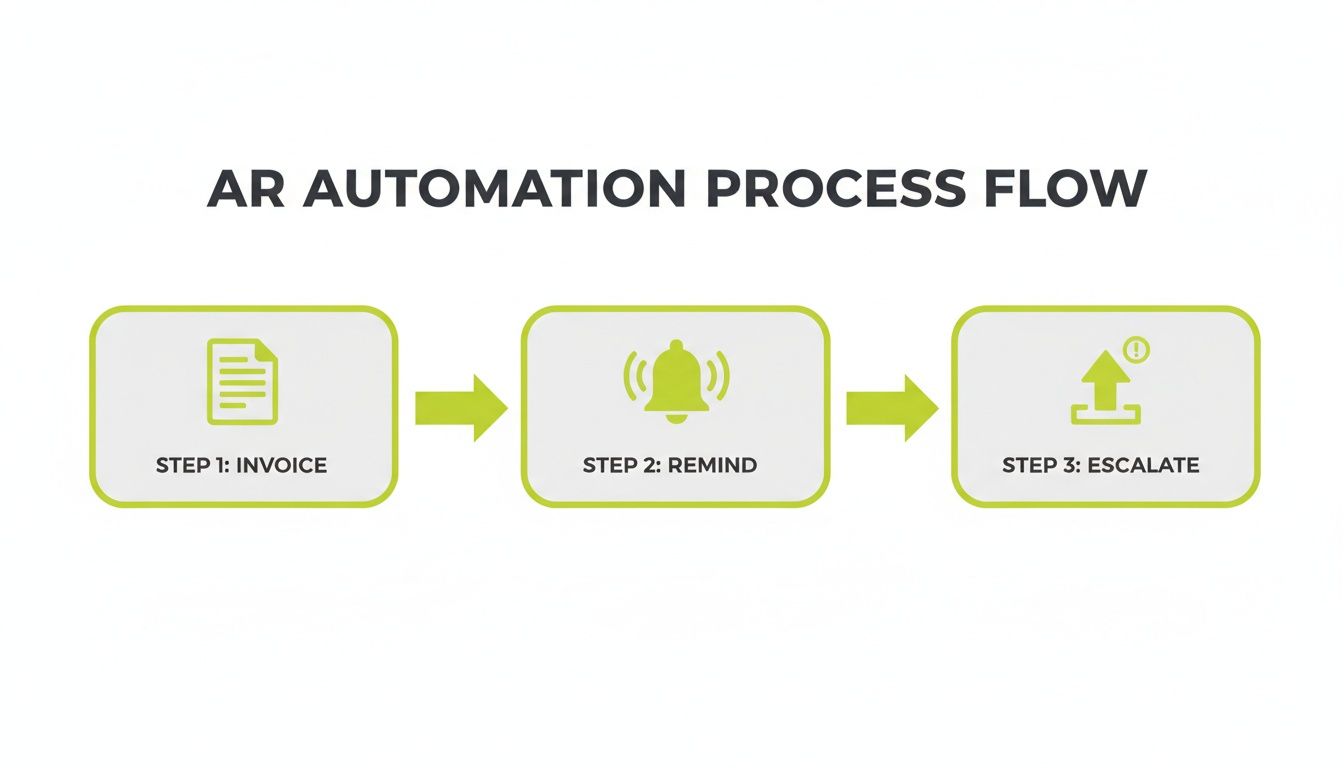
This "Invoice, Remind, Escalate" flow is the backbone of a robust AR strategy, systematically engineered to reduce DSO and improve cash flow.
The best platforms offering AI AR automation can tailor this cadence based on a client's payment history and risk profile, applying the right pressure at the right time.
This is especially important for maintaining brand consistency. Custom, branded communication workflows within your QuickBooks AR automation or ERP-integrated platform are crucial. Research shows that 71% of platforms using embedded financial tools customize them to match their brand, building trust during sensitive financial interactions.
Measuring the ROI of Your AR Automation Strategy
Implementing accounts receivable automation is a capital investment, not an expense. As such, it must generate a measurable return. For CFOs and Controllers, the business case for automation rests on tangible improvements to the balance sheet and P&L. Success is measured by data.
To prove the value of this investment, you must track the right key performance indicators (KPIs). A few core metrics provide the clearest view of the financial impact of AI AR automation.
Core Metrics for Measuring AR Automation ROI
The most critical metric is Days Sales Outstanding (DSO). This number quantifies the average number of days it takes to collect payment after a sale. Lowering DSO directly shortens the cash conversion cycle and improves cash flow.
However, DSO does not tell the full story. A complete financial picture requires looking at other key metrics:
- Collection Effectiveness Index (CEI): This measures how effective your team is at collecting receivables during a given period. It is calculated as
(Beginning Receivables + Monthly Credit Sales – Ending Total Receivables) / (Beginning Receivables + Monthly Credit Sales – Ending Current Receivables) x 100. A CEI consistently above 80% indicates a healthy collections process. - Average Days Delinquent (ADD): While DSO measures the total collection window, ADD focuses on overdue invoices. It tells you, on average, how late your late payments are, helping to identify chronic late payers.
- Aged Receivables Percentage: This is where risk is concentrated. Pay close attention to the percentage of total AR that is over 90 days past due. A primary goal of AR software for professional services is to systematically reduce this figure and mitigate bad debt risk.
Calculating the Financial Return
Calculating the ROI is straightforward: compare the cash unlocked and costs saved against the software subscription price. You can learn how to calculate return on investment for a more detailed breakdown of this financial modeling.
Let's run the numbers for a hypothetical $10M firm with an initial DSO of 65 days.
By implementing QuickBooks AR automation and reducing DSO by 10 days (from 65 to 55), the firm instantly unlocks approximately $274,000 in cash. This is working capital that moves from the AR ledger back to the balance sheet.
When you factor in reduced administrative overhead, lower bad debt write-offs, and potentially lower borrowing costs, the financial case is compelling. If the automation platform costs $25,000 annually, the cash unlocked in the first year alone delivers a 10x ROI.
A systematic approach to AR turns a manual, costly process into a strategic asset that directly strengthens your firm’s financial health and stability.
***
Common Questions About Implementing AR Automation
When we speak with finance leaders about automating collections, a set of practical questions consistently emerges. The core concern is how to accelerate cash flow without damaging the client relationships that are the foundation of the business.
These are valid concerns. Here are direct answers to the questions we hear most often.
Will Automation Harm Our Client Relationships?
No—when implemented correctly, it strengthens them. Clients appreciate predictable, professional communication. An automated reminder is far less awkward than an impromptu, apologetic email from a project manager who is not a collections specialist.
Effective accounts receivable automation removes emotion from collections. It separates the service relationship from the payment conversation, allowing your team to focus on client delivery while the system manages financial housekeeping with calm, consistent professionalism.
How Does AI AR Automation Integrate with QuickBooks?
Modern AI AR automation platforms are engineered to communicate directly with your accounting software. They use secure APIs to establish a two-way connection with tools like QuickBooks or other major ERPs.
This synchronization means invoice data, payment status, and customer information are always current in both systems, automatically. This eliminates manual data entry and ensures everyone operates from a single source of truth.
Can Automation Handle Our Complex Billing Structures?
Yes. Professional services firms rarely have simple, uniform invoicing. Advanced AR software for professional services is designed for this complexity. You can configure unique follow-up rules for different client types, projects, or contract terms.
Whether you use milestone billing, monthly retainers, or complex project-based fees, the system can be configured to send the right message to the right person at the right time. It is not a one-size-fits-all tool; it adapts to your firm's specific operational model.
What Is the Implementation Process Like?
Onboarding is a straightforward, guided process designed to minimize disruption to your team. It typically begins with connecting your accounting system, such as through QuickBooks AR automation.
From there, we help configure communication workflows to match your firm's tone and policies and then import existing receivables data. Most firms are fully operational within a few weeks and begin to improve cash flow and reduce DSO almost immediately.
--- Resolut automates AR for professional services—consistent, accurate, and human.