A Payment Plan Agreement Template to Secure Your Cash Flow
Use this payment plan agreement template to reduce DSO and improve cash flow. A guide for finance leaders on creating and automating payment plans.
A well-structured payment plan agreement template is an operational tool, not a collection last resort. It converts a delinquent account into predictable, scheduled cash flow.
By defining repayment terms in writing, you provide clients a clear path to resolution and protect your firm's working capital.
Why A Payment Plan Agreement Is A Strategic Financial Tool
An invoice past 90 days isn't just an aging receivable; it's a direct drag on your cash conversion cycle. A formal payment plan moves the dynamic from collections to collaboration.
It shifts the conversation from "You owe us money" to "Let's agree on a realistic timetable."

The primary benefit surfaces in your Days Sales Outstanding (DSO). Breaking a large, overdue balance into smaller, automated installments provides a measurable and predictable cash influx.
Clients typically respond better to a structured solution than to the adversarial tone of a standard collection notice. This preserves the relationship while securing the funds.
Improve Cash Flow and Reduce Write-Offs
The objective of a payment plan is to avoid writing off revenue. For many firms, a 3% write-off rate is common; a structured agreement process can reduce that to less than 1%.
A payment plan turns at-risk revenue into recovered cash, directly impacting your P&L.
Key advantages include:
- Predictable Revenue Streams: Convert a single large receivable into regular payments that align with cash flow forecasts.
- Reduced DSO: Clear terms paired with automated reminders accelerate collections and reduce manual follow-up.
- Client Retention: Offering a structured repayment path demonstrates partnership, preserving long-term client value.
A payment plan agreement isn’t an admission of weakness. It’s an assertion of control when standard payment terms have failed.
Integrating a payment plan template into your accounts receivable automation workflow moves your team from reactive collection calls to proactive cash flow management. This systematic approach is one of several effective ways to increase cash flow for your business.
Below are the essential clauses every template must include to be operationally effective and legally defensible.
Key Components of Your Payment Plan Agreement
Clause | Purpose | Example Language to Include |
|---|---|---|
Payment Schedule | Defines installment amounts and due dates with precision. | “Client agrees to pay $2,500 via ACH on the 1st of each month for six months.” |
Interest & Fees | Discourages late payment and covers the cost of carrying the debt. | “A late fee of $50 and interest at 1.5% per month will apply to any payment over 5 days past due.” |
Default & Acceleration | Outlines consequences for non-payment, securing your position. | “Failure to remit payment within 10 days of the due date constitutes default, making the full remaining balance immediately due.” |
Dispute Resolution | Establishes a process for handling disagreements efficiently. | “Parties agree to mediation to resolve any dispute arising from this agreement before pursuing legal action.” |
Governing Law | Specifies which state’s laws apply, reducing legal ambiguity. | “This agreement is governed by the laws of the State of New York.” |
Including these clauses makes your payment plan enforceable and eliminates ambiguity.
Building Your Template: The Clauses That Matter
Using a generic online template introduces unnecessary risk. Your agreement must be a precise instrument tailored to your firm's operational and legal requirements.
Think of it as a financial control designed to secure cash flow and systematically reduce DSO.

The goal is to build a robust framework that can be adapted for specific client situations without requiring legal review for every overdue invoice. Each clause serves to remove uncertainty.
Codifying the Financial Terms
This section is the operational core of the agreement. Begin with an unambiguous statement of the total outstanding debt, referencing specific invoice numbers.
This precision prevents future disputes over the owed amount.
Next, define the payment schedule with absolute clarity. Vague terms like "bi-weekly payments" are operationally useless and legally weak.
- Exact Installment Amount: "$5,000.00 USD per installment."
- Precise Due Dates: "Payments are due via ACH on the 1st and 15th of each month, commencing August 1, 2024."
- Total Number of Payments: "A total of six (6) installments, with the final payment due on October 15, 2024."
This level of detail is required for accounts receivable automation software to execute correctly—triggering reminders, tracking payments, and flagging defaults without manual intervention. You can learn more about how to define payment terms to ensure clarity from the outset.
The Enforcement Mechanism: Default and Acceleration Clauses
A payment plan without a default clause is merely a suggestion. This is where the agreement gains its authority.
Define precisely what constitutes a breach. This is typically a missed payment, but a grace period of five business days is a standard professional courtesy before an account is officially delinquent.
A well-written default clause is not punitive; it is a tool for maintaining control. It replaces emotional follow-up with a pre-agreed, logical consequence.
Upon default, the acceleration clause must activate. This non-negotiable provision stipulates that if the client defaults, the entire remaining balance of the debt becomes immediately due.
Without it, you are forced to chase individual missed payments, negating the efficiency of the plan. This clause provides significant leverage and motivates client compliance.
For firms using QuickBooks, ensure your QuickBooks AR automation platform can identify a defaulted plan and trigger the correct internal alerts and external communications. This is where legal structure and technology converge to provide genuine control over receivables.
Securing Agreement and Initiating the Plan
When proposing a payment plan, the tone should be one of joint problem-solving, not punitive action. This preserves the client relationship while asserting financial control.
Your objective is to convert a potentially contentious collections call into a documented, structured resolution.
You are not asking for a favor; you are professionally defining the terms required to bring the account current. This mindset is critical for maintaining control of the process.
Anchoring the Negotiation
Begin the conversation by presenting your preferred payment schedule first. This is a standard negotiation tactic known as anchoring.
For example, propose a three-month plan with weekly payments via automated ACH debit. This sets the baseline. Any counter-offer from the client is now a negotiation from your pre-defined, reasonable terms.
Anticipate common objections. If a client requests a longer timeline, have a counter-offer prepared that is tied to your operational requirements.
"We can extend the term to four months. To offset the administrative cost of a longer plan, we require setup via automated ACH debit rather than manual card payments."
This isn't about winning an argument. It’s about guiding the conversation toward one of a few acceptable, pre-determined outcomes. The template provides the structure; your negotiation strategy ensures swift execution.
From Verbal Agreement to System Execution
Once terms are verbally agreed upon, immediate action is critical. Any delay introduces risk and weakens commitment.
The workflow must move seamlessly from negotiation to active monitoring within your AR software for professional services.
Here is the operational sequence:
- Finalize and Send Immediately: Populate the negotiated terms into your payment plan agreement template and send it for e-signature while still on the call or immediately following.
- Update Your AR System: The moment the agreement is executed, update the client's account in your QuickBooks AR automation tool or other AR platform. This is not an administrative task to be deferred.
- Activate Automated Communications: Configure automated reminders for upcoming installments and receipts for payments received. This maintains visibility and reduces manual follow-up.
Standardizing this process is a direct lever for reducing DSO. You transform ad-hoc promises into a systematic workflow that generates predictable cash flow from accounts that might otherwise be written off.
Activating Payment Plans with Automation
A signed payment plan agreement has no value until it is operationalized. Manual tracking with spreadsheets and calendar reminders is inefficient and prone to error.
To be effective, these agreements must be embedded into an automated workflow. This is about building a reliable system that tracks every installment, logs communications, and escalates issues based on pre-defined rules.
The goal is to free up your finance team for strategic analysis, not chasing payments.
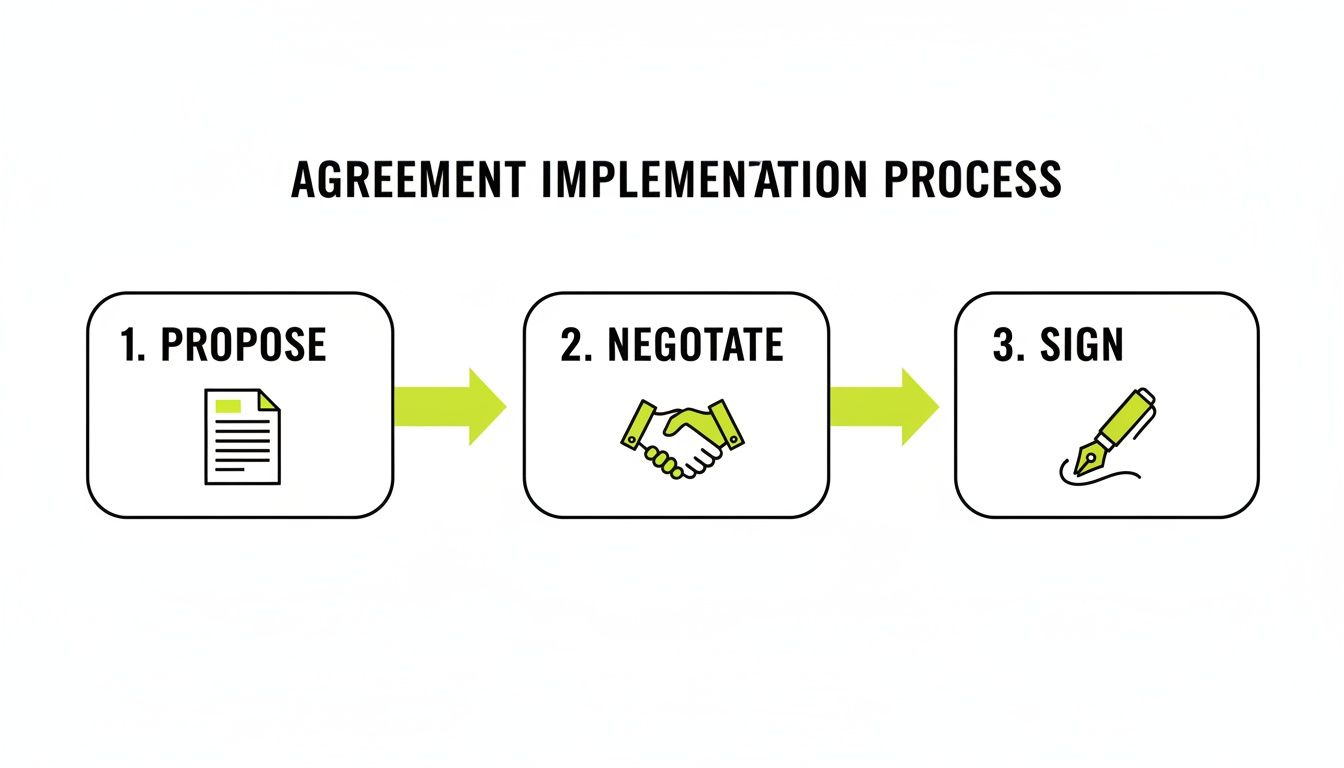
Once signed, the document ceases to be a static agreement and becomes an active collections instrument, managed automatically by your AR system.
Setting Up Automated Communications
The core of effective accounts receivable automation is a sequence of intelligent, event-based triggers.
A baseline workflow includes:
- Payment Confirmations: An automated receipt is sent the instant a payment is processed. This provides confirmation and reinforces positive payment behavior.
- Upcoming Payment Reminders: A notification sent 3-5 business days before the next due date prevents most accidental delinquencies.
- Delinquency Notices: If a payment is missed, an alert is sent automatically the following day. The tone shifts from reminder to a clear call to action.
This systematic approach removes emotion and administrative burden from collections. For firms on QuickBooks, dedicated QuickBooks AR automation tools can manage hundreds of these plans concurrently, enabling scale without additional headcount.
Designing Intelligent Escalation Paths
Not all delinquencies are equal. A payment one day late requires a different response than one 30 days past due. Your AI AR automation platform must differentiate and escalate accordingly.
An automated escalation path ensures your response is consistent and proportional. It moves an account from polite reminders to firm warnings without human delay or subjective judgment.
A typical escalation path:
- Initial Default (Days 1-7): The system sends a sequence of automated emails focused on immediate resolution.
- Continued Delinquency (Days 8-15): The account is flagged for an AR specialist to make a direct call. The system provides the call script and logs the outcome.
- Serious Default (Day 16+): The system can trigger a final demand letter, signaling that more formal collections actions are imminent.
This structured process directly impacts DSO. Firms using this model can see a 15-20% reduction in DSO within two quarters. This is how organizations effectively combat the industry average where 1 in 10 invoices go unpaid, as highlighted in global payment trends.
To implement these strategies, learn more about how to automate accounts receivable and integrate them into your financial operations.
Manual vs. Automated Plan Management
The operational difference between manual and automated payment plan management is stark. The issue is not just time savings; it's risk mitigation and cash flow predictability.
Metric | Manual Process | Automated Workflow (e.g., Resolut) |
|---|---|---|
Time Investment | High. Hours of administrative work for tracking, reminders, and follow-up. | Minimal. Set up once, then runs automatically. Staff intervenes on exceptions. |
Error Rate | High. Prone to human error: missed reminders, incorrect tracking, inconsistent follow-up. | Near-zero. System operates based on pre-set rules, eliminating human error. |
Consistency | Inconsistent. Tone and timing of follow-ups vary by employee and workload. | Perfectly consistent. Every client receives the same professional communication cadence. |
Scalability | Poor. Managing more than 10-15 active plans becomes an administrative bottleneck. | Excellent. Manages hundreds or thousands of plans without additional staff. |
Cash Flow Impact | Unpredictable. Inconsistent follow-up leads to unreliable cash flow. | Predictable. Consistent enforcement produces faster payments and healthier cash flow. |
Automation transforms payment plans from a collections burden into a strategic tool for managing client relationships and ensuring financial stability.
Navigating Compliance and Legal Considerations
A payment plan agreement must be built on a sound legal foundation. For a financial operator, this isn't about practicing law; it's about identifying and mitigating operational risk.
State-specific usury laws, for example, cap the interest rate you can charge on overdue debt. What is permissible in one state may be illegal in another, potentially voiding the clause or the entire agreement.
Furthermore, these agreements contain sensitive financial data. The ability to secure PDF documents with encryption and access controls is a baseline requirement for data privacy compliance (e.g., GDPR, CCPA).
Upholding Fair Collection Practices
While you may not self-identify as a "debt collector," collecting overdue payments can place your firm under the purview of the Fair Debt Collection Practices Act (FDCPA).
This federal law dictates how you can communicate regarding outstanding debt, strictly prohibiting harassment or misleading tactics.
Your accounts receivable automation workflows must be configured for compliance:
- Communication Hours: The system must be set to send communications only between 8 a.m. and 9 p.m. in the client's local time zone.
- Transparent Language: All communications must clearly identify your firm and the debt amount.
- Cease-and-Desist Protocol: A clear protocol must exist to immediately halt communications upon written request from a client.
Adherence to FDCPA guidelines is a reflection of your firm's operational integrity.
Addressing Cross-Border Complexity
International clients introduce further complexity. Cross-border payments are projected to grow from $194.6 trillion to over $320 trillion by 2032.
This growth makes standardized, compliant agreements essential. Regulations like the EU's PSR mandate total transparency on fees and refund policies—details that must be explicit in your payment plans. Stay informed on these 2025 financial trends.
This guide provides an operational framework, not legal advice. The key takeaway is to build compliance checks directly into your AR process and consult legal counsel to validate your templates and workflows.
From Document to System: Mastering Your Cash Flow
A robust template is the starting point. The objective is to build it into a repeatable, automated system. This is the transition from reacting to delinquencies to architecting a process that provides control over your accounts receivable.
When you systematize these agreements, the results are measurable. Firms implementing AR software for professional services can reduce DSO by 20-30% in under six months, achieving predictable cash flow.
Should a client default, a clear, pre-defined process is essential. Understanding effective, compliant debt recovery strategies is necessary to protect the firm's interests while minimizing risk.
The goal isn't just to collect a single debt; it's to integrate the entire process into your financial operations. An automated system ensures every plan is tracked and acted upon without manual intervention.
This operational discipline is what separates high-performing finance teams. You are not just using a template; you are building a reliable engine for cash flow.
Frequently Asked Questions
When is the right time to offer a client a payment plan?
The optimal window to offer a payment plan is when an invoice is 15 to 30 days past due.
Proposing a plan at this stage demonstrates proactive control and a willingness to collaborate. It preserves the client relationship while initiating a formal resolution process.
Can I charge interest or late fees in a payment plan?
Yes, provided it is explicitly stated in the agreement and complies with state law. Clearly define the terms, such as an interest rate of 1.5% per month and the exact conditions under which fees apply.
Transparency is non-negotiable. It prevents disputes and increases the likelihood of swift client agreement. Verify local usury laws to ensure compliance.
What is the single biggest mistake to avoid with payment plans?
The most significant error is attempting to manage payment plans manually. This approach is operationally inefficient and introduces significant risk of failure.
Without a system like accounts receivable automation, reminders are missed and escalations fail to occur. A strong agreement is ineffective without systematic enforcement.
- Predictable reminders are sent systematically, reducing DSO.
- Automated workflows ensure consistent, professional treatment for all clients.
- Integration with your GL, such as with QuickBooks AR automation, ensures data integrity.
Visual Idea: A simple line chart showing DSO trending downward over six months after implementing an automated payment plan system.
When you automate the execution of your payment plans, the static agreement becomes a dynamic tool that actively improves cash flow.
Here is a comparison of key performance indicators:
Metric | Manual Process | Automated Workflow |
|---|---|---|
Time to Reminder | 1-3 Days | < 1 Minute |
Error Rate | High (5-10%) | Near Zero (<0.1%) |
DSO Impact | Marginal | Significant (15-20% avg. reduction) |
We observed a mid-sized engineering firm combine a standardized payment plan template with AR software for professional services. They reduced their DSO by 25% in a single quarter.
Visual Idea: A cinematic, focused shot of a CFO looking at a clean, data-rich AR dashboard on a tablet, showing payment plan compliance metrics.
Resolut automates AR for professional services—consistent, accurate, and human.