A CFO's Guide to Mastering Purchase On Invoice
A guide for CFOs on using purchase on invoice to improve cash flow and reduce DSO with accounts receivable automation and AI. Learn practical strategies.
For professional services firms, allowing clients to purchase on invoice isn't a perk—it’s the standard operating model. But the manual processes behind it create a significant drag on cash flow, consuming resources better deployed elsewhere.
The entire Accounts Receivable (AR) process, from invoice creation to reconciliation, is typically fraught with operational friction. This isn't just an administrative issue; it has a direct financial cost.
This "cash flow drag" erodes profit margins and locks up working capital that could be invested in talent, technology, or business development. For finance leaders, the true cost is measured in wasted hours and missed growth opportunities.
The True Cost of Managing Purchase On Invoice
Offering payment terms builds client relationships, but manual invoice management is a primary source of operational friction. The problem extends beyond late payments to the entire AR workflow, creating bottlenecks from creation to final reconciliation.
This friction directly impacts the bottom line. For a $10M firm, an inefficient AR process can mean hundreds of thousands in locked-up working capital.

This operational drag quietly chips away at profit margins and ties up capital that could fuel growth. For finance operators, the cost is measured in wasted hours and forgone strategic initiatives.
Quantifying the Operational Friction
The administrative load of manual invoice management directly inflates Days Sales Outstanding (DSO) and consumes non-billable hours.
Time is lost on:
- Manual Follow-Ups: Every reminder email and collection call is non-billable time, often handled by senior staff whose expertise is more valuable elsewhere. A $10M firm can lose over 1,000 partner-level hours annually on collections.
- Invoice Error Correction: A missing PO number or incorrect rate can delay payment by weeks or months. Industry data shows up to 39% of invoices contain errors, each one triggering a costly, time-consuming correction cycle.
- Payment Reconciliation: Matching incoming wire transfers or checks to open invoices is a notoriously slow and error-prone task, often delaying cash application by days.
This inflates your Days Sales Outstanding (DSO). A high DSO means your firm is effectively extending interest-free loans to clients, constraining your own operational capacity.
The data confirms the scale of the problem. What appears as a minor administrative task is, in fact, a significant financial drain.
The True Cost of Manual Invoice Management
Metric | Industry Benchmark | Impact on a $10M Firm |
|---|---|---|
Time to Process a Single Invoice | 14.6 days | Creates significant payment delays and inflates DSO. |
Invoice Error Rate | 39% of invoices have errors | Triggers disputes, back-and-forth communication, and further delays. |
Cost of Unpaid/Late Invoices | $200B wasted annually by global firms | Leads to write-offs and direct hits to the bottom line. |
These figures, detailed in research on accounts payable statistics, show the financial impact of inefficient AR processes.
The Strategic Impact on Financial Health
A manual purchase on invoice system undermines sound financial management. Unpredictable cash collection makes accurate forecasting difficult, hindering confident decisions on hiring, service expansion, or other investments.
This outdated approach forces finance teams into a reactive posture. Instead of analyzing performance and shaping strategy, skilled financial operators are mired in collections.
Implementing accounts receivable automation is no longer just about efficiency; it's a strategic imperative. The goal is to transform AR from a reactive cost center into a controlled system that strengthens the firm’s financial position.
This is especially critical for firms using QuickBooks. While an excellent accounting tool, its native AR capabilities are limited. The right QuickBooks AR automation solution bridges this gap, building an intelligent collections engine on top of your existing system.
From Operational Drag to Strategic Advantage
Rethinking your firm's approach to purchase on invoice is a direct path to profitable growth. The opportunity lies in transforming AR into a source of predictable cash flow that fuels the entire business.
Predictable cash flow enables confident decision-making. You can invest in top talent, explore new markets, or upgrade technology. A systematic AR workflow leads to a lower DSO, reliable financial forecasts, and stronger client relationships.
* **Visual Idea 1: A clean, modern chart showing DSO for a professional services firm dropping from 60+ days to under 40 days over six months after implementing AR automation. The chart is overlaid with key metrics: "$410k Unlocked Working Capital" and "15% Reduction in 90+ Day Invoices." The aesthetic is data-driven and focused on measurable outcomes. ***
Improve Cash Flow and Financial Predictability
The most immediate benefit of a systematized invoicing process is improved cash flow. Automated reminders and simplified payment options shorten the payment cycle. This isn't about aggressive tactics; it's about professional persistence.
Financial forecasting shifts from estimation to a data-backed strategic exercise. With a clear view of incoming cash, you can deploy capital with conviction.
For a professional services firm, predictable cash flow is the foundation of strategic agility. It allows leadership to stop managing financial uncertainty and start architecting future growth.
A firm that reliably converts billable hours to cash in 30 days operates at a significant advantage over one waiting 60 or 90 days. Effective AR software for professional services is designed to deliver this outcome.
Reduce DSO and Unlock Working Capital
Days Sales Outstanding (DSO) is the definitive metric for AR efficiency. High DSO means your revenue is sitting in your clients' accounts, not yours. Implementing AI AR automation is the most direct way to reduce this figure.
For a $10M firm with a 60-day DSO, approximately $1.64M is tied up in receivables. Reducing DSO to 45 days unlocks over $410,000 in working capital. This is cash available for immediate use—not just a number on a balance sheet.
This operational improvement becomes a strategic advantage. The unlocked capital provides a permanent boost to your firm's liquidity and operational freedom.
While B2B transactions remain dominated by invoicing, this carries inherent risks. Approximately 1 in 10 invoices require proactive follow-up to secure payment. As global e-invoicing mandates accelerate, businesses adopting modern systems report 82% improvements in financial health. You can discover more insights on the impact of e-invoicing.
Strengthen Client Relationships
A common concern is that automation feels impersonal. In practice, the opposite is true. A well-designed system replaces sporadic, awkward follow-up calls with communication that is consistent, professional, and helpful.
Consider the difference:
- The Manual Way: A partner makes an uncomfortable call to a key client about a 60-day-past-due invoice. The conversation is tense and strains the relationship.
- The Automated Way: The client receives a polite reminder before the due date and another on the day it's due, with a direct link to a payment portal. The process is frictionless.
The automated approach provides clarity for the client and frees your team from acting as debt collectors. This professional consistency enhances your brand and makes your firm easier to work with, building stronger partnerships.
Building a Disciplined Credit and Collections Process
Offering a purchase on invoice option without a structured process is like extending credit without a repayment plan. It leads to unpredictable cash flow and business risk. The key is not aggression, but discipline.
A disciplined credit and collections workflow is the operational backbone that maintains financial health while treating clients respectfully. It replaces guesswork with a reliable system for converting invoices to cash.
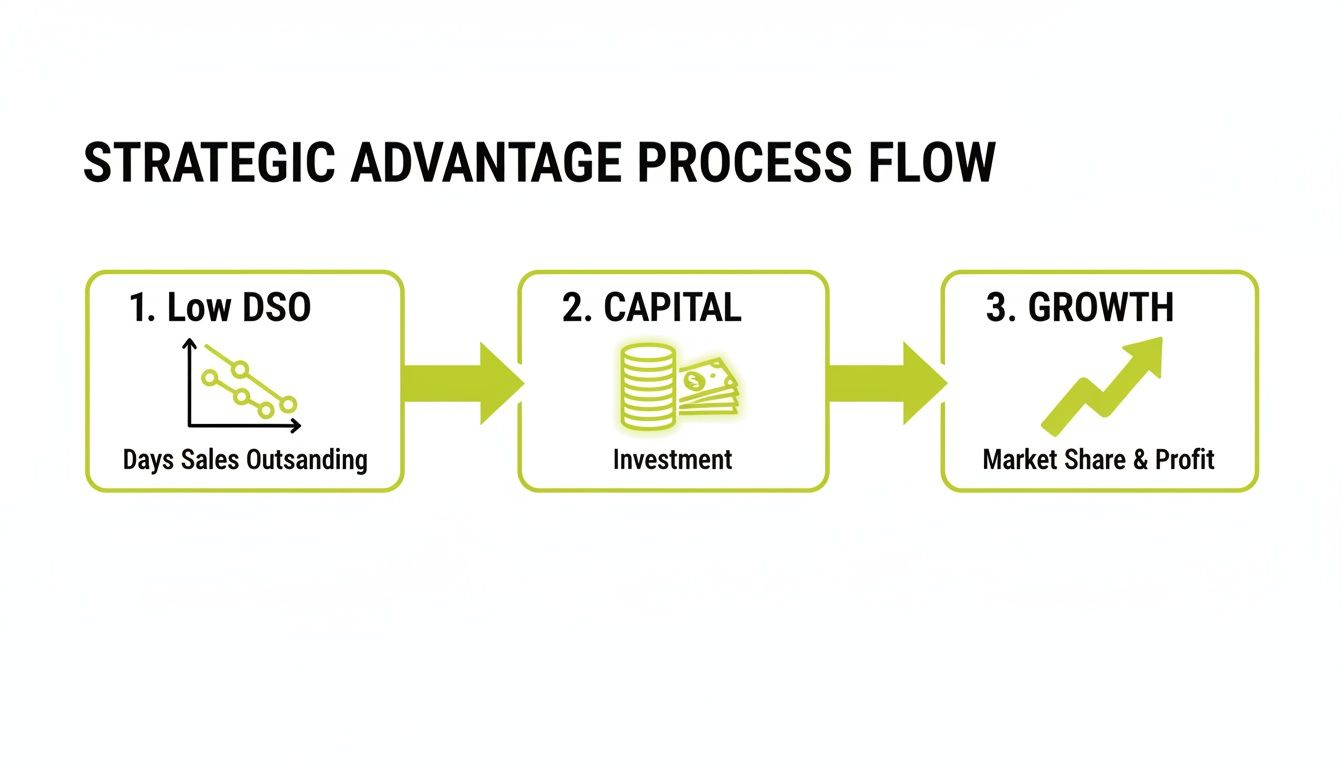
The impact on your bottom line is direct. A disciplined process drives down DSO, freeing up capital for reinvestment.
* **Visual Idea 2: A cinematic shot of a calm, well-lit office. A CFO stands before a large screen displaying a clean dashboard with a downward trend line for DSO and healthy cash flow projections. The feeling is one of control and forward-thinking strategy, not frantic activity. ***
Establish a Clear Credit Policy
Your first step is to codify your credit policy. This should be a straightforward guide for your team that sets clear client expectations.
A strong policy covers:
- Standard Payment Terms: Make default terms unambiguous (e.g., Net 30).
- Credit Limits: Set sensible thresholds for new clients or those with weaker payment histories.
- Onboarding Requirements: Outline information needed before extending credit, such as trade references or a credit check for large engagements.
A formal policy removes ambiguity, empowering your team to make consistent decisions and ensuring all clients are managed under the same framework.
Conduct Lightweight Client Credit Assessments
Assessing a client's creditworthiness doesn't require an intrusive process. For most professional services firms, a "lightweight" assessment is sufficient to mitigate common payment risks. The goal is to gain reasonable assurance of timely payment.
A tiered approach is effective. For smaller projects, a discussion about their payment process may suffice. For larger engagements, more due diligence is warranted. You can learn more about how to evaluate a client's creditworthiness without creating friction.
Incorporate this step into your standard client onboarding. It is a simple measure that can prevent significant write-offs and improve cash flow.
A disciplined collections process isn’t about hounding clients; it’s about professional persistence. It’s a system designed to remind, then escalate, with communications that are firm, fair, and automated.
With accounts receivable automation, this entire sequence can run autonomously, saving hundreds of team hours. This is particularly valuable for firms using QuickBooks, where QuickBooks AR automation can layer this intelligent workflow directly onto the existing accounting system.
Define a Structured Collections Cadence
A collections cadence is a pre-planned communication schedule for client follow-up. It systematizes the process, ensuring timely action without manual reminders.
A standard cadence includes:
- Pre-Due Reminder: An automated email sent 3-5 days before the due date.
- Due Date Notification: An email sent on the due date.
- First Overdue Notice: A professional but firm email at 7 days past due.
- Second Escalation: A more direct message at 15 days past due.
- Final Demand: A formal notice at 30 days past due, outlining next steps.
This structured process, powered by AI AR automation, ensures a consistent, professional experience for every client. It transforms collections from a reactive chore into a proactive, data-driven system designed to reduce DSO.
KPIs for an Optimized AR Process
To control cash flow from purchase on invoice offerings, you must measure it. Gut feelings are insufficient for a finance operator. Data is required to identify process weaknesses, make informed decisions, and validate the impact of interventions like accounts receivable automation.
Tracking the right key performance indicators (KPIs) transforms AR from a reactive cost center into a predictable financial engine. These metrics are the gauges on your financial dashboard.
Days Sales Outstanding (DSO)
DSO is the primary metric for collection speed. It measures the average number of days to receive payment after invoicing. High DSO indicates your cash is tied up in receivables.
For a professional services firm, the calculation is:
DSO = (Total Accounts Receivable / Total Credit Sales) x Number of Days in Period
A firm with $800,000 in AR and $2,000,000 in credit sales over a 90-day quarter has a DSO of 36 days. Reducing this figure directly accelerates cash flow.
Collection Effectiveness Index (CEI)
While DSO measures speed, CEI measures effectiveness. It compares the amount collected to the total receivables available for collection during a period. This provides a clear picture of performance, independent of sales volume fluctuations.
A CEI consistently above 80% signals a healthy process. A declining CEI is an early warning of collection issues, even if rising sales temporarily mask the problem by stabilizing DSO. AI AR automation can immediately improve this metric by ensuring no invoice is missed.
A high DSO tells you cash is slow to arrive. A low CEI tells you it might not arrive at all. Tracking both is essential for a complete view of your AR performance and risk exposure.
Accounts Receivable Aging Reports
An AR aging report is a diagnostic tool that categorizes unpaid invoices by age: 0-30 days, 31-60 days, 61-90 days, and 90+ days. It immediately identifies which accounts are current and which are escalating toward bad debt.
For a controller, this report is an action plan. A significant balance in the 60+ day column requires immediate attention. Good AR software for professional services, especially tools with **QuickBooks AR automation**, can generate and visualize these reports automatically.
Average Days Delinquent (ADD)
For a sharper view of late payments, ADD isolates overdue invoices and calculates the average number of days they are past due.
For example, a DSO of 40 days on Net 30 terms may seem acceptable. However, an ADD of 25 days reveals that a few prompt payers are masking a significant delinquency problem. High ADD indicates that initial collection efforts are ineffective. An automated collections cadence directly reduces ADD and cuts write-offs.
The Measurable Impact of AR Automation
Implementing an AI-driven platform produces an immediate, measurable improvement in accounts receivable health, visible across key performance metrics.
The transformation is clear.
AR Performance Metrics: Before vs. After Automation
KPI | Manual Process Benchmark | Automated Process Target | Impact |
|---|---|---|---|
DSO | 45 Days | 32 Days | 29% reduction, accelerating cash flow significantly. |
CEI | 75% | 92% | 17% improvement, capturing more of the revenue you've earned. |
% of AR > 90 Days | 15% | 4% | Drastically reduces the risk of bad debt and write-offs. |
AR Team Time on Manual Tasks | 25 hours/week | 5 hours/week | Frees up 20 hours/week for strategic, high-value work. |
This data shows that automation not only accelerates payments but also enhances the overall efficiency and predictability of your firm's cash flow. Your team shifts from chasing paper to making strategic financial decisions.

How AI Is Transforming Accounts Receivable
Traditional accounts receivable is a time-consuming, manual process. Modern accounts receivable automation, however, transforms AR from a reactive chore into an intelligent, data-driven system.
For finance teams, this shift provides real control over the entire purchase on invoice lifecycle. AI-powered AR platforms offer specific tools that address the weaknesses of a manual collections process, turning the AR function into a reliable cash flow engine.
Intelligent and Personalized Outreach
Effective collections depend on consistency and tone. An AI AR automation platform executes personalized outreach campaigns that feel human, not robotic. The system adjusts messaging and timing based on client history, invoice size, and payment behavior.
A high-value, long-term client may only need a gentle nudge, while a new customer with a history of slow payments may require a more structured follow-up. Managing this manually is impractical. Automation protects client relationships while systematically working to reduce DSO.
Proactive Risk Identification
The best way to handle a late payment is to anticipate it. AI-driven systems analyze payment patterns to generate risk scores, flagging accounts that show signs of potential delinquency before they become a problem.
For example, the system can flag a client who typically pays within 15 days but is now silent at day 25. This allows your team to intervene proactively, preserving cash flow and predictability.
The global shift toward e-invoicing is already demonstrating value. A recent study of finance leaders found 79% agree that adoption benefits outweigh the challenges. For firms with international clients, 82% reported immediate financial health improvements. This digital transition directly addresses AR challenges, where manual work contributes to 1 in 10 invoices going unpaid. For a deeper dive, read the full e-invoicing research report.
Automated Cash Application and Reconciliation
Matching payments to invoices is a major time sink in AR, especially for teams using QuickBooks. A single payment covering multiple invoices can trigger hours of manual work.
AI-powered cash application automates this process. The software matches payments to invoices with high accuracy, even for partial or batched payments. This ensures your AR ledger is always current, providing a real-time view of your cash position. Learn more by reading about straight-through processing in our article.
An intelligent AR system doesn’t just automate tasks; it provides the operational control to align technology with your firm’s specific collection philosophy.
Operator Control with Autopilot and Co-Pilot Modes
Automation does not mean surrendering control. The best AR software for professional services offers flexible operating modes.
- Co-Pilot Mode: The AI suggests actions—such as sending an email or flagging an account—but requires team member approval. This "human-in-the-loop" approach is ideal for sensitive clients or for teams new to automation.
- Autopilot Mode: The system independently executes pre-defined collection workflows without manual approval. This is optimal for managing the bulk of your invoices, freeing your team to focus on exceptions.
This flexibility puts you in command. You set the rules and define escalation paths, maintaining full oversight while the system handles repetitive work. This is how you reliably improve cash flow and build a resilient AR process.
Taking Control From Invoice to Cash
The path from a reactive, manual AR process to a disciplined, automated system is clear. For a CFO or firm owner, mastering accounts receivable is fundamental to financial stability and strategic growth.
Think of AI AR automation as a tool that elevates your team. It frees them from the grind of manual follow-ups, allowing them to focus on high-impact analysis and strategic decision-making.
Systemizing Collections for Predictable Growth
Systematizing collections creates predictability. When cash flow is predictable, planning becomes a concrete roadmap. You can confidently approve budgets, hire top talent, or make capital investments, knowing the working capital will be available.
This operational control builds resilience against market volatility. You are no longer reacting to financial surprises but making decisions from a position of strength. For particularly challenging accounts, retaining professional Commercial Receivables Management Services can support your internal efforts.
The real goal of accounts receivable automation is to make getting paid the easiest part of doing business with you. It turns a potential point of friction into a smooth, professional experience for your clients.
This positive experience reinforces your firm’s professional reputation and encourages timely payment.
From Manual Burden to Strategic Asset
Moving to an automated AR process is a strategic decision that begins with acknowledging the true cost of manual workflows. The end state is a system that actively contributes to your bottom line. An intelligent platform, particularly one with QuickBooks AR automation, provides the visibility and control needed to manage risk and drive performance.
It's time to stop managing cash flow with spreadsheets and calendar reminders. To build this foundation, you can learn more about creating a perfect invoice process. By adopting technology built for professional services, you can transform AR from a necessary evil into a strategic asset.
Frequently Asked Questions About AR Automation
For CFOs and Controllers considering an AR overhaul, practical questions are paramount. Here are answers to common concerns from finance leaders.
How Can We Implement AR Automation Without Disrupting Client Relationships?
Good accounts receivable automation adds clarity and professionalism, not aggression. It replaces sporadic manual follow-ups with a consistent process that simplifies payment for your clients.
A well-designed system sends polite, timely reminders and offers a simple online payment portal. Platforms like Resolut allow for customized communication tone and frequency. This reinforces your firm's professionalism, an attribute clients value.
What Is the Typical ROI for Investing In Accounts Receivable Automation Software?
The return is realized through both financial savings and strategic gains. Financially, most firms reduce DSO by 10-25% or more, directly improving cash flow. Administrative overhead from manual collections and reconciliation is also significantly reduced.
Strategically, your team is freed for high-level financial analysis. Cash flow forecasting becomes more accurate. The cost of a single major client write-off often exceeds the annual cost of an automation platform, making the investment highly logical. To truly take control, understanding the difference between an invoice and a receipt is fundamental.
Our Firm Uses QuickBooks; Can We Still Automate Our AR Process?
Yes. The best AI AR automation platforms integrate seamlessly with standard accounting software like QuickBooks. This QuickBooks AR automation is not a siloed system.
It creates a two-way sync, pulling invoice data, payment statuses, and customer details directly from QuickBooks. This ensures automated collections operate with real-time, accurate information and eliminates manual data entry. A pre-built integration enables rapid implementation.
--- Resolut automates AR for professional services—consistent, accurate, and human.