When to Sell Debt to Collection Agencies: A CFO’s Guide
Is selling debt to collection agencies a smart move? This CFO guide covers valuation, contracts, and AR automation alternatives for professional services firms.
Staring at aging receivables can feel like dead weight on your balance sheet. Selling that debt to a collection agency is a tool for converting non-performing assets into immediate cash. The transaction is straightforward: you sell a portfolio of delinquent accounts for a fraction of its face value.
This isn't an act of desperation. For finance operators, it's a calculated decision. The right way to view a debt sale is as a capital allocation strategy, not as an admission that your collections process has failed.
The Reality of Selling Aged Receivables
Selling off aged receivables is a tactical move, typically triggered when specific financial metrics are hit. When managed correctly, it’s simply a tool for improving cash flow and sharpening your team's focus on high-value activities. The real skill is knowing exactly when to pull that lever.
Identifying the Financial Triggers
The decision almost always comes down to hard numbers. A stubborn Days Sales Outstanding (DSO) that is compressing working capital is the most common motivator. Another trigger is a growing volume of small-balance accounts where the cost to collect exceeds the potential recovery.
Consider a consulting firm with hundreds of invoices under $2,000, all more than 180 days past due. The administrative cost of chasing those small amounts is immense, pulling finance staff away from pursuing six-figure invoices from key clients.
A targeted debt sale lets you surgically remove those low-value, high-effort accounts. This immediately frees up your team to concentrate on collecting larger, strategic receivables and protecting vital client relationships.
This isn't about giving up. It's about optimizing resource allocation. That immediate cash injection, even at a steep discount, is often more valuable than the administrative cost of chasing debt with a low probability of collection. The sheer scale of the market highlights this economic reality. In the U.S. alone, consumer debt reached a staggering $17.50 trillion by the end of 2023. An entire $20.2 billion third-party debt collection industry has grown around this, buying up delinquent accounts to recover funds. You can dig into these debt collection statistics to see just how big this market is.
A Strategic Capital Allocation Decision
Framing the sale as a capital allocation choice simplifies the math. You are consciously trading the uncertain promise of future collections for a guaranteed cash payment today. This forces an honest assessment of your internal collection effectiveness.
If your team's historical recovery rate on accounts over 180 days old is 10%, and a debt buyer offers you 8% of the face value in cash—upfront, with no further effort—the sale becomes a logical business decision.
This move liquidates an uncertain asset and converts it into working capital.
- Scenario A: An engineering firm sells a block of debt from a specific industry sector that has since collapsed. This cleans uncollectible assets off the balance sheet instantly.
- Scenario B: A marketing agency creates a policy to automatically sell all invoices under $1,500 once they hit 210 days past due. This standardizes a process for offloading accounts that are too costly to manage internally.
Ultimately, the goal is to determine if a debt sale is a smart financial lever for your firm or if it's masking deeper issues in your AR management. Using proactive AR software for professional services can prevent accounts from aging this far in the first place. For instance, tools using AI AR automation or specific QuickBooks AR automation can dramatically reduce DSO long before a debt sale enters the conversation.
How to Value Your Debt Portfolio for a Sale
Before approaching a debt buyer, you need a data-backed valuation of your aged receivables. An inaccurate valuation means you're operating blind. You might accept a lowball offer out of a need for cash, or you could scare off buyers with an unrealistic asking price.
The objective is to establish a realistic value internally first. This allows you to negotiate from a position of strength, armed with data. It starts with analyzing your portfolio through the lens of a potential buyer.
Slicing and Dicing Your Portfolio for Analysis
A collection agency will not view a $50,000 invoice that's 91 days past due the same as a $1,500 bill that's over a year old. To get an accurate picture, you must segment your receivables into logical cohorts.
Start by sorting accounts using key factors:
- Age of Debt: This is the primary valuation driver. Group accounts into buckets like 91-180 days, 181-365 days, and 365+ days. The probability of collection—and thus the value—declines sharply with age.
- Balance Size: Create tiers for the balances: under $2,000, $2,001-$10,000, and over $10,000. This quickly identifies accounts where collection costs may exceed the balance itself.
- Quality of Documentation: An account with a signed contract, a clear communication trail, and proof of service delivery is a high-quality asset. An account with only an invoice is not.
Also, track the statute of limitations on debt. Once this period expires, the debt becomes legally uncollectible and essentially worthless to a buyer.
Debt Portfolio Valuation Factors
Buyers analyze your portfolio to predict how much they can realistically recover. This table breaks down the key factors that influence price.
Valuation Factor | Low Value Indicator | High Value Indicator |
|---|---|---|
Age of Debt | Over 1 year old | Under 180 days old |
Balance Size | Very small balances (e.g., <$500) | Mid-to-large balances (e.g., >$2,000) |
Documentation | Missing contracts or communication logs | Signed contracts, invoices, email history |
Payment History | No payments ever made | History of partial or consistent payments |
Debtor Industry | High-failure industries (e.g., restaurants) | Stable industries (e.g., healthcare, B2B services) |
Personal Guarantee | No personal guarantee on a business debt | Personal guarantee is in place |
Statute of Limitations | Nearing or past the legal expiration | Several years remaining |
The more high-value indicators your portfolio has, the better the offer you will receive. Clean, well-documented accounts are always in demand.
Key Data Points That Drive Value
Collection agencies are data-driven. During due diligence, they analyze specific details to build a recovery model. Having this information organized will accelerate the process and improve the offers you receive.
Beyond age and balance, they will want to know:
- Client Payment History: Has the customer ever made a payment on this debt? Even a small, inconsistent payment history signals acknowledgment of the debt, increasing its value.
- Client Industry and Location: Experienced agencies know that certain industries and geographic areas have higher default rates and will adjust their offer based on that risk profile.
- Presence of a Personal Guarantee: For B2B debts, a personal guarantee from the owner is a significant value driver. It provides an alternative path to collection.
The bottom line is simple: the more organized and complete your data, the lower the buyer's perceived risk. Lower risk translates directly into a higher purchase price for you.
Understanding this data is fundamental to knowing the true value of the asset you're holding. For a deeper look at valuing receivables on your own books, learn how to calculate the net realizable value.
Understanding How Agencies Price Portfolios
With a segmented, data-rich portfolio, you can better interpret the offers you get.
Most common is a one-time portfolio sale, where an agency pays a flat percentage of the total face value. For example, you might sell a $250,000 portfolio of accounts over 180 days old for 5% of face value, receiving $12,500 in cash.
Another structure is a forward-flow agreement. This is an ongoing partnership where you agree to sell all accounts that hit a certain trigger (e.g., 120 days past due) to an agency at a pre-set rate. This automates the removal of aging debt and creates predictable cash flow.
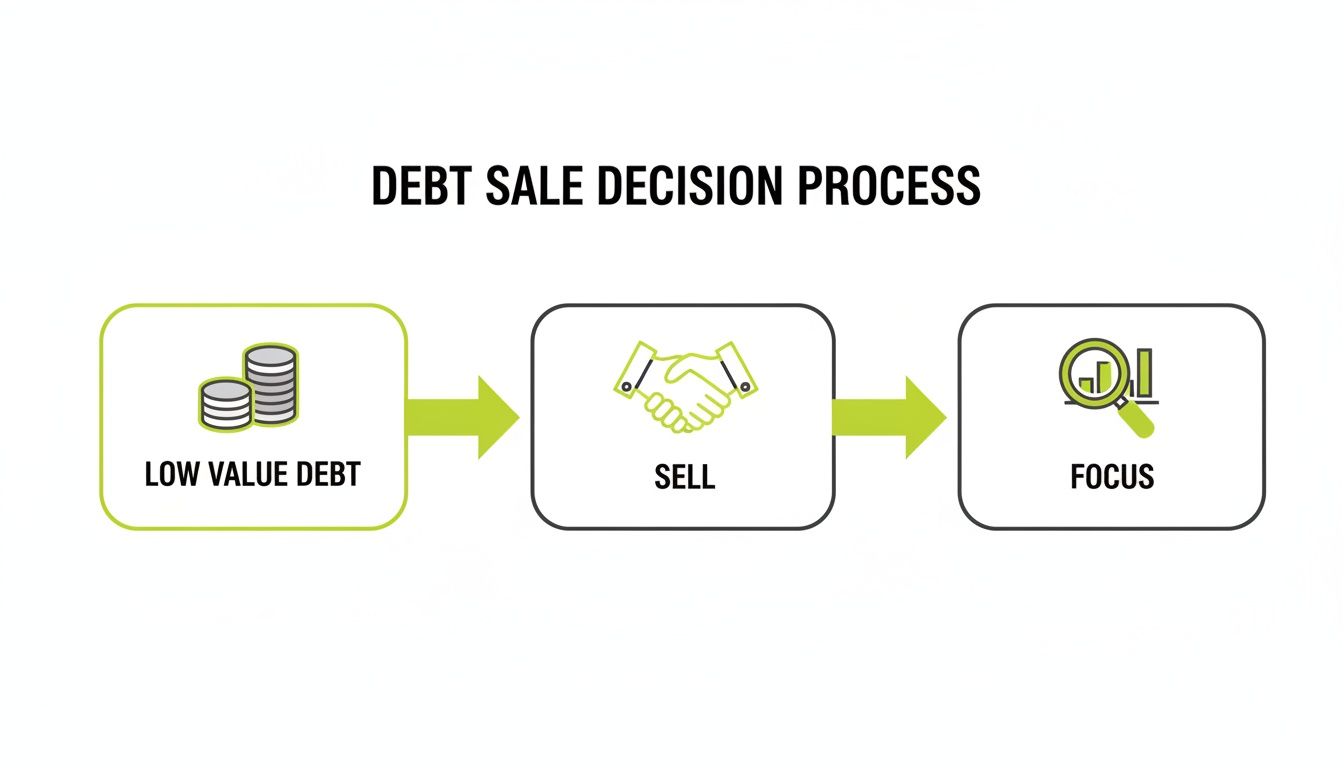
As the visual shows, this isn’t just damage control. Selling non-strategic debt lets your team stop wasting time on low-probability accounts and focus on core business and higher-value clients. Think of it less as a last resort and more as a sharp tool for balance sheet management.
Navigating the Legal and Contractual Minefield
Once you’ve valued the portfolio and selected a buyer, you face the legal paperwork. This is where financial strategy meets legal and reputational risk. A poorly structured debt sale agreement can create new liabilities for your firm long after the transaction is complete.
You don't need to be a lawyer, but you must know which clauses protect your company's interests. The goal is not just to close a deal; it’s to achieve a clean, final break from these specific receivables.
Core Contractual Protections
Every debt sale contract has a few critical sections that define the transaction and outline post-sale responsibilities. A well-constructed agreement is your primary defense against future disputes or compliance violations.
You and your legal counsel should focus on these clauses:
- Representations and Warranties: This is where you formally state what you're selling. You will warrant that the debts are legitimate, the balances are accurate, and you have the legal right to sell them.
- Indemnification: A critical "what if" clause. If you sell an invalid debt and the agency is sued, this section determines who covers the legal costs.
- Post-Sale Conduct: This is your opportunity to set guardrails on how the agency interacts with your former customers. You can and should prohibit aggressive or unprofessional tactics that could damage your brand.
A strong contract acts as a shield. It ensures the buyer acknowledges they are purchasing the accounts 'as-is,' with a clear understanding of the data provided, while you warrant the basic validity of the debt itself.
Getting this balance right is crucial. You are responsible for providing accurate information, but the buyer accepts the inherent risk of collecting aged debt. Without this clear division, you leave the door open for future claims.
Data Privacy and Secure Transfer
When selling debt to collection agencies, you are transferring sensitive customer data. This is a major compliance consideration. Mishandling this information can lead to significant regulatory fines and reputational damage.
The secure and compliant transfer of all client data must be explicitly detailed in the agreement. This means adhering to regulations like GDPR or CCPA, depending on your customers' locations. The contract should specify security protocols for the data transfer and the agency's ongoing duty to protect that information. For some industries, the rules are even stricter—for example, it's critical to know Is Selling Medical Debt a HIPAA Violation before starting the process.
Put-Back Provisions: The Buyer's Safety Net
Most debt sale agreements include a "put-back" or "buy-back" clause. This provision gives the collection agency the right to return certain accounts to you for a refund if they prove uncollectible for specific, pre-agreed-upon reasons.
An agency will typically use a put-back for a few common reasons:
- Bankruptcy: The debtor has filed for bankruptcy, legally halting collection efforts.
- Fraud or Dispute: The debt is proven to be fraudulent or is part of a legitimate, active dispute.
- Inaccurate Information: Key data is incorrect or missing, making it impossible to pursue the debt.
- Prior Settlement: The account was already paid or settled before the portfolio sale.
Your contract must clearly define the exact reasons for a put-back, the documentation the agency must provide as proof, and a time limit for doing so (typically 90-180 days post-sale). A defined window is how you achieve finality.
While a step like sending a legal letter of demand for payment might happen before a sale, the agreement is the document that truly closes the book on these accounts. Careful negotiation ensures the transaction is clean and predictable.
Choosing the Right Collection Agency Partner

When selling debt to collection agencies, you are doing more than closing a transaction. You are entrusting a part of your firm's reputation to a third party. The wrong partner can cause brand damage that far outweighs any cash benefit.
Think of this as hiring a subcontractor who will interact with your former clients. The selection process requires disciplined due diligence. A poor choice can lead to aggressive collection tactics that create liabilities long after the money is in your account.
Vetting Potential Debt Buyers
First, build a shortlist of agencies with experience in the B2B world, ideally within professional services. A consumer-focused agency will lack the appropriate approach for collecting from other businesses.
The current economic climate makes this vetting even more critical. With global debt on the rise, the collection industry is under pressure. For example, recovery enforcement has declined significantly. You can read the full analysis of global debt trends to understand the market forces at play. This is why you must look past the sales pitch and scrutinize an agency's operational performance.
The question you need to answer is simple: Will this agency treat my former clients with the same professionalism I would? Their collection methods are a direct reflection of your firm, even after the sale.
When speaking with potential partners, ask direct questions:
- What is your specific track record with professional services firms of our size and type?
- Walk me through your communication process for a new account.
- How do you handle disputes or complaints from debtors?
- Can I see your compliance certifications and licenses for the jurisdictions you operate in?
You're looking for direct, data-backed answers. Vague platitudes about "industry best practices" are a red flag.
Aligning on Compliance and Methods
Compliance is non-negotiable. The agency must demonstrate a firm grasp of federal and state regulations, especially the Fair Debt Collection Practices Act (FDCPA). Ask to see their training materials or internal audit reports. A reputable partner will have these readily available.
Beyond legality, you must align on collection methodology. For professional services firms, high-pressure tactics are a non-starter. You need a firm but respectful approach. It's wise to request call scripts and letter templates to ensure their tone aligns with your firm's standards.
Executing a Clean Handoff
Once you’ve selected a partner and the contract is signed, the handoff begins. Operational details are critical for a clean transaction.
- Secure Data Transfer: Use a secure file transfer protocol (SFTP) or a similar encrypted channel to deliver the portfolio data. This file must contain all documentation agreed upon during due diligence.
- Final Portfolio Reconciliation: Before transfer, you and the agency must agree on the final list of accounts and total face value, accounting for any last-minute payments.
- Internal Communication Plan: Your AR and finance teams need a clear script for handling calls from sold accounts. All inquiries must be routed to the new owner of the debt to prevent confusion.
A structured handoff prevents accounts from getting lost and ensures a truly clean break. While selling debt is one option, it's often better to look at a full suite of receivable management services that can stop accounts from aging this far in the first place.
Smarter Alternatives to Selling Your Debt

Selling receivables provides an immediate, albeit small, cash infusion. However, it is a costly, short-term fix for a deeper systemic issue. Relying on debt sales is often a signal that your accounts receivable process broke down long before an invoice reached 120 days past due.
Top-tier finance operators don't just react to bad debt; they build systems to prevent it. Instead of selling receivables for pennies on the dollar, they optimize the entire AR lifecycle to get paid on time while preserving revenue and client relationships.
Moving From Reactive Chasing to Proactive Management
A proactive AR model focuses on preventing late payments, not just chasing them. This requires moving from manual follow-ups and spreadsheets to an intelligent, automated workflow. This is where accounts receivable automation becomes a strategic asset.
Instead of identifying a problem invoice at 90 days, an effective system can flag risk factors much earlier. AR software can analyze payment history and communication patterns to spot a potential issue at day 30, giving your team a chance to intervene personally.
The practice of selling debt to collection agencies has grown as global public debt has risen. But the system is becoming less effective; collection recoveries have fallen dramatically. A debt sale that nets only 4–15% of face value contributes to the estimated $200 billion businesses lose annually to AR friction. You can see the full picture of these global debt trends on UNCTAD.
This data shows that outsourcing collections to an increasingly inefficient system is a poor financial trade. The smarter move is to take back control.
How AI Automation Drives Higher Returns
Modern AI AR automation platforms can transform your collections process from an administrative burden into a strategic function. These are not simple email bots; they run sophisticated, omnichannel outreach campaigns customized for each client.
For example, an AI system may learn that one client pays after a gentle email reminder at day 15, while another responds to an SMS with a payment link at day 45. The system can escalate the tone based on your rules, shifting from a friendly nudge to a formal notice as an invoice ages.
The real value is in the consistency and scale. An automated system never forgets to follow up and executes your collections strategy perfectly for every invoice. This frees up your finance team to handle complex exceptions and build client relationships.
This technology addresses the two primary reasons for late payments: the invoice was lost, or the payment process was too complex.
Seeing the Real-World Impact of Automation
The business case for AR software for professional services is built on measurable outcomes. The primary goals are to reduce DSO (Days Sales Outstanding) and improve cash flow—the lifeblood of any services firm.
Consider a $20M firm with a DSO of 65 days. By implementing QuickBooks AR automation, they can achieve measurable results:
- Automated Reminders: This alone can reduce average payment time by 5–10 days.
- Integrated Payment Portals: One-click payment options (credit card, ACH) can cut another 7–12 days from payment cycles.
- Intelligent Risk Scoring: Flagging at-risk accounts 30 days sooner allows for proactive intervention, preventing an average of 15% of invoices from becoming seriously delinquent.
This isn't theory. For a $20M firm, reducing DSO by 20 days (from 65 to 45) unlocks over $1 million in working capital. That is cash on your balance sheet, not a small fraction of its value from a debt buyer.
This approach transforms accounts receivable from a reactive cost center into a proactive, data-driven engine for growth. You recover more of your own money, build client trust through professional communication, and maintain complete control over your firm's financial health.
Your Questions About Selling Debt, Answered
Deciding to sell a debt portfolio is a significant financial decision. It’s a trade-off between immediate cash and potential long-term value. As a finance leader, you must consider both the numbers and the operational reality. Here are the most common questions from CFOs and Controllers weighing this choice.
What Will a Collection Agency Actually Pay for Our Debt?
The price varies widely, typically from 4 to 20 cents on the dollar. Where your portfolio lands in that range depends entirely on its quality.
From the buyer's perspective, a portfolio of invoices only 90–180 days past due, with signed contracts and clear communication history, is a lower-risk asset. For this, you can negotiate toward the higher end of the range. Conversely, accounts over a year old with poor documentation will fetch only a few cents on the dollar.
The single biggest lever you have in this negotiation is data quality. A clean, well-organized portfolio with complete records tells a buyer their risk is lower, and that directly translates into a better offer for your firm.
What Are the Real Risks of Selling Our Firm's Debt?
The primary risks are reputational and financial. Reputational damage can be the most significant. If you sell to an agency that uses aggressive or unprofessional tactics, that behavior reflects on your brand and can damage relationships with other clients.
Beyond your brand, there are other significant risks to consider:
- Financial Risk: The most obvious risk is leaving money on the table. An improved internal collections process, perhaps using accounts receivable automation, could have recovered far more than the sale price.
- Compliance Risk: You are transferring sensitive client data. A mistake during data transfer or a sale that violates your original client agreement can create legal and regulatory liabilities.
Thoroughly vetting potential partners is your primary defense against these risks.
How Does This Sale Show Up on Our Financial Statements?
From an accounting perspective, the process is straightforward. Upon completion of the sale, you remove the receivables from your balance sheet. The main impact is on your income statement.
You will recognize an immediate loss on the sale, calculated as the difference between the receivables' book value and the cash received. For example, selling a $100,000 portfolio for $15,000 means you book the cash and write off the remaining $85,000 as a loss. This one-time hit to net income also provides a guaranteed cash injection, which can significantly improve cash flow and liquidity ratios.
Can We Sell Just a Portion of Our Bad Debt?
Yes, and you almost always should. A targeted sale is a much smarter strategy than selling your entire receivables ledger. Segmenting your accounts allows you to sell only a specific portion.
For example, you could carve out all accounts between $500 and $2,000 that are more than 180 days delinquent. This surgical approach lets you offload accounts where the internal cost to collect is too high, while retaining larger, more strategic accounts for your own team. It is also an effective way to pilot the process with a smaller, lower-risk portfolio.
--- Resolut automates AR for professional services—consistent, accurate, and human.