
The 2026 Automation Software List for Finance Teams
Our curated automation software list for 2026. See top tools for AR, workflow, and IT to improve cash flow and reduce DSO for professional services firms.
Your top consultant just closed a major project. The work was flawless. But the invoice sits unpaid for 45 days, tying up working capital you need for payroll. This isn't a client problem. It's a process problem.
For professional services firms, effective automation isn't about replacing people. It's about freeing up your best talent from manual tasks that drag on cash flow. This automation software list is built for financial leaders who measure success in DSO and predictable cash flow, not feature counts.
Automation spans several categories: RPA for repetitive data entry, workflow tools for approvals, IT automation for system management, and marketing automation for lead nurturing. But for most firms, the fastest path to measurable ROI is through accounts receivable automation. It directly addresses the gap between invoicing and cash-in-hand, which is why this list stays focused there. If you're also evaluating broader partners, an AI automation agency can help frame where AR fits in the larger stack.
A finance team rarely has a volume problem first. It usually has a follow-through problem.
VISUAL IDEA: A cinematic, wide-angle photo of a calm, organized finance dashboard on a screen in a modern office. Key metrics like DSO and cash flow forecast are clearly visible and trending positively. The overall mood is control and clarity.
1. Resolut
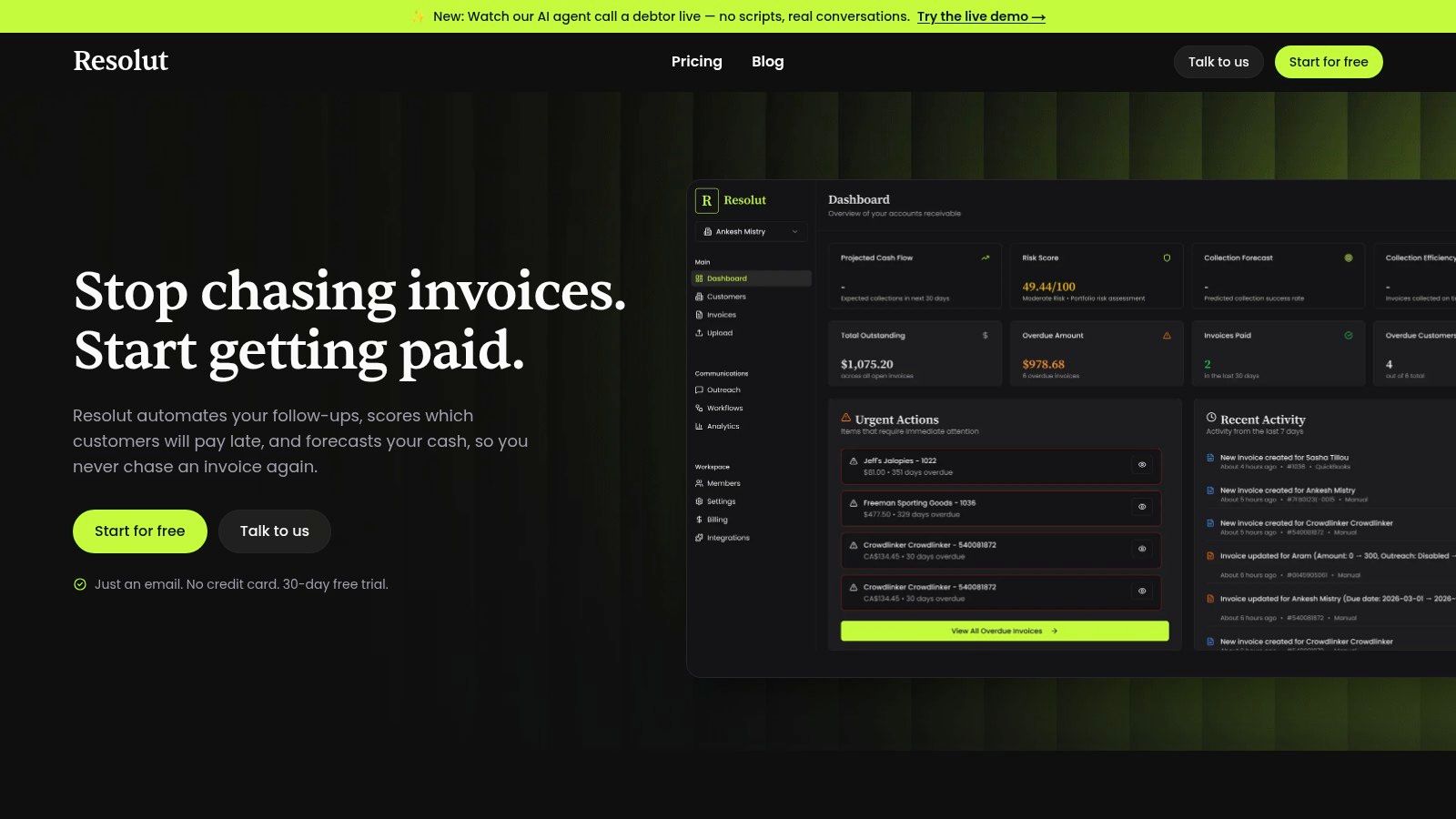
A common services-firm problem looks like this. Invoices go out on time, but collections live in someone's inbox, payment options create friction for clients, and cash application slips until the end of the week. DSO rises even though the work was delivered correctly.
Resolut is one of the few tools in this list built for that exact operating reality. It fits best for professional services firms that need faster cash collection without a long systems project, especially in the lower mid-market where finance teams are lean and every extra day outstanding affects payroll planning and forecasting.
What stands out is the path from invoice to applied cash. Resolut connects to QuickBooks or works from PDF invoices, then handles reminder workflows across email, SMS, and phone while also supporting payment collection and reconciliation. For firms that want a close look at the category, its guide to best accounts receivable software adds useful context.
That matters because many AR tools stop at reminders. Resolut goes further into the part controllers usually end up cleaning up manually.
Where Resolut stands out
The product is strongest when the finance team wants fewer handoffs. Collections orchestration, payment capture, and cash application sit in one workflow, which reduces the back-and-forth between AR, accounting, and whoever owns client communication. In a services firm, that usually means less time spent checking status across inboxes, spreadsheets, and bank activity.
It also gives finance leaders a real choice on control. Teams that want consistency can use Autopilot. Teams that need a controller or collections lead to review tone, timing, or escalations can keep that approval layer in place.
Practical rule: If your collectors still export aging reports into Excel before deciding who to contact, the process is still manual.
A few points matter in day-to-day use:
- Fast deployment: QuickBooks connection and PDF import reduce implementation work.
- Built-in cash application: Payments post automatically, which cuts reconciliation effort.
- Prioritization: Risk scoring and cash forecasting help teams decide where follow-up matters most.
- Client payment options: Cards, bank transfers, and digital wallets reduce payment friction.
Trade-offs to know
Resolut is not the right fit for every environment. Pricing requires a sales conversation, so budget planning takes more work than with tools that publish tiers. QuickBooks Desktop is not supported, and firms with messy invoice source data may need to tighten process before they get the full benefit.
Those trade-offs are reasonable for the target buyer. If the goal is to reduce DSO, improve cash visibility, and give a small finance team tighter control over follow-up, Resolut deserves an early look. For teams also trying to improve Amazon inventory management via Hopted, keep that work separate from AR priorities. For most professional services firms, receivables still has the fastest payback.
2. HighRadius
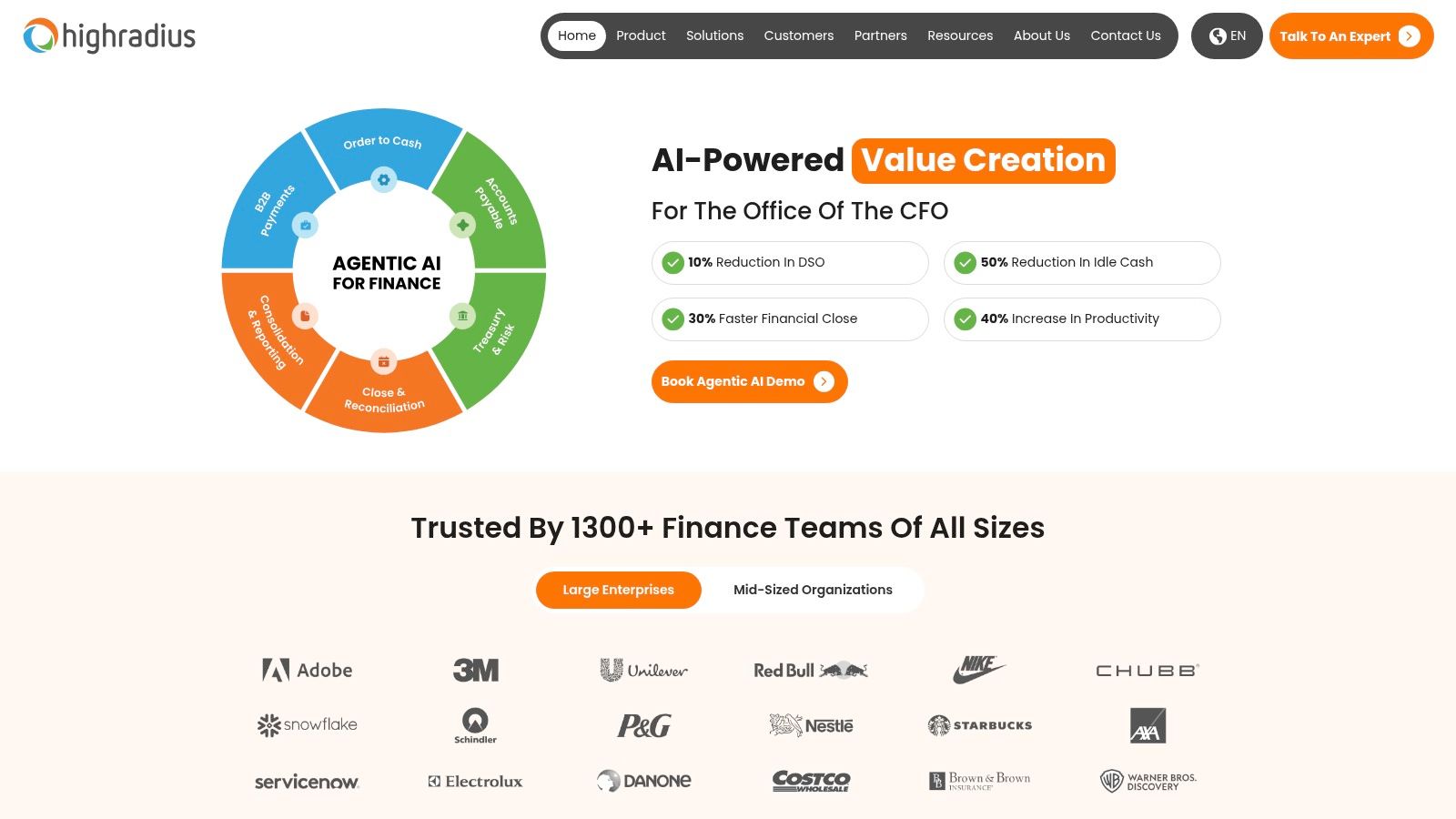
HighRadius is built for scale. If your firm has outgrown point solutions and wants one environment for credit, invoicing, collections, deductions, cash application, and analytics, this is a serious platform.
It's less of a lightweight AR tool and more of an autonomous receivables operating layer. That's attractive for upper-midmarket and enterprise finance teams that need deep ERP connectivity and broad process coverage.
Best fit and trade-offs
HighRadius makes the most sense when receivables complexity is already high. If your team deals with portal-heavy payment workflows, credit decisions, deductions, and large customer portfolios, the breadth helps. If you're a 20-person finance team serving multiple entities, it can centralize work that otherwise lives in disconnected systems.
The trade-off is implementation weight. This isn't the tool I'd pick if your first priority is getting live quickly with minimal change management. It usually requires more process definition upfront.
- Best for: Firms that want broad invoice-to-cash coverage, not just reminder automation.
- Less ideal for: Lean services firms that need speed over system depth.
- Watch for: Quote-based pricing and a more involved scoping cycle.
One broader market point matters here. RPA platforms still dominate automation software by type, and 83% of companies report faster task completion after implementing workflow automation. HighRadius fits that enterprise automation mindset well, especially when finance leaders want operational velocity across a large AR function.
Website: HighRadius
3. Billtrust
Billtrust has been in this category long enough to earn a different kind of credibility. It isn't trying to be a clever automation layer on top of AR. It's a mature platform built around invoicing, payments, collections, credit, and cash application.
For CFOs who want one vendor covering both AR workflows and payments infrastructure, that's the draw. The platform is broad, and the payments rails are a major part of the value.
Why finance teams keep it on the shortlist
Billtrust is a good fit when finance wants fewer handoffs between billing, collections, and payment acceptance. That matters in professional services because a client who intends to pay can still delay for simple operational reasons: wrong inbox, missing portal step, card friction, unclear invoice support.
There is also credible ROI evidence in the AR category. In a study of 500 finance professionals using AR automation software, 93% said the tool delivered the ROI they expected, and 100% reported measurable gains in faster payments, reduced costs, and accelerated cash flows. That doesn't prove one vendor wins every evaluation, but it does support the case for accounts receivable automation as a budget priority.
The strongest AR software doesn't just send reminders. It removes excuses for delay.
The limitation is familiar. Billtrust is quote-based, and platform breadth can lead to longer rollout timelines. If you need a lighter-weight AR software for professional services, this may feel like more system than you need.
Website: Billtrust
4. Versapay
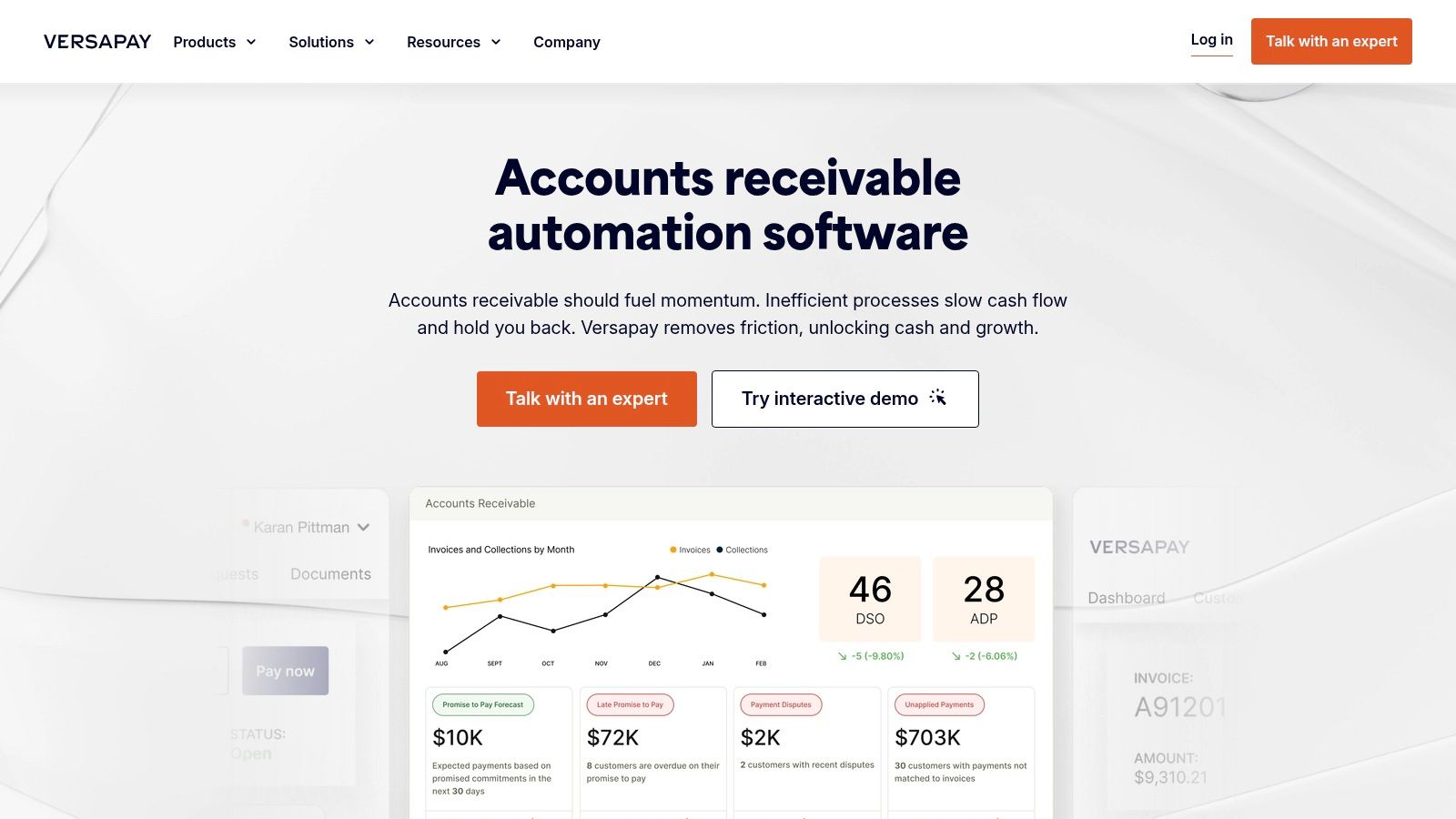
Versapay takes a collaboration-first approach. That's not a branding distinction. It changes how the collections process feels for both your team and your clients.
If your firm loses time to back-and-forth over invoice status, billing questions, or dispute resolution, the customer portal and shared communication threads can reduce that friction. For firms with high-value invoices and relationship-sensitive collections, that's useful.
Where it fits
Versapay is strongest in environments where payment delays are tied to communication gaps, not just lack of reminders. A collaborative payer portal lets clients view invoices, communicate on issues, and complete payments in a more structured workflow.
That can help service firms where partners, project managers, and finance all touch the client relationship. Instead of AR operating in isolation, the system creates a visible record around the invoice.
- Portal experience: Good for clients who want self-service without hunting through old emails.
- Collections support: Better for teams that need context around disputes and follow-up history.
- Potential downside: Smaller firms with low AR volume may not need this level of platform.
If your overdue balances are driven more by process confusion than outright refusal to pay, Versapay deserves a look. If your issue is inconsistent follow-up by a lean team, a more focused AI AR automation tool may move faster.
Website: Versapay
5. Invoiced by Flywire
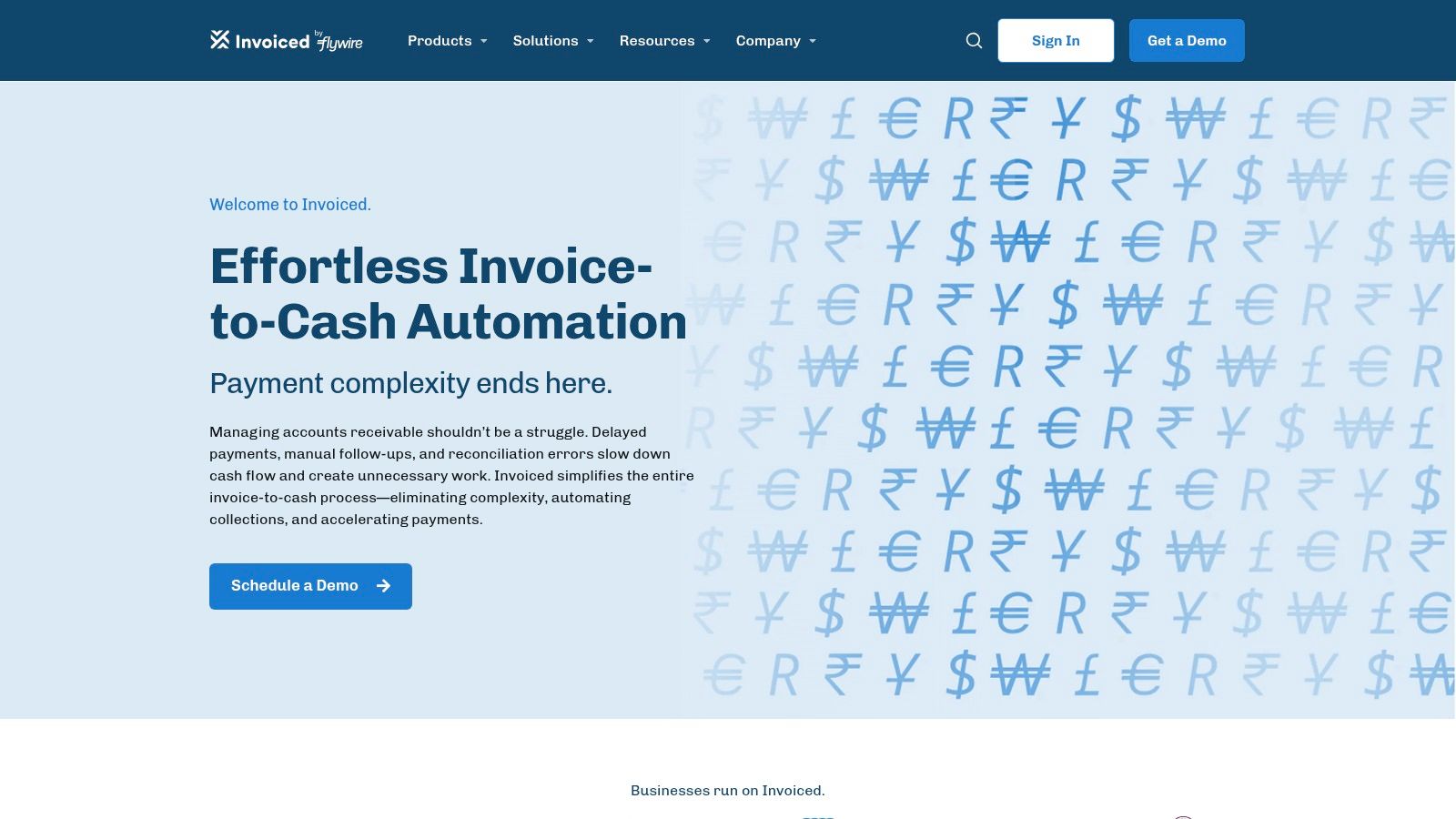
Invoiced sits in a practical middle ground. It isn't as heavy as the biggest enterprise suites, and it isn't just a reminder engine either. That's often the right balance for professional services firms with a lean finance function.
Its strengths are ease of administration, multi-channel chasing, customer self-service, and a UI that doesn't require a long training curve. If your controller wants to automate without taking on a systems transformation project, that matters.
Why lean teams like it
Invoiced works well for firms that need structure more than sophistication. You can automate invoice delivery, reminders, payment collection, and cash application in a way that supports a small team without forcing them to become workflow designers.
Subscription billing support also helps if your revenue mix includes retainers or recurring service agreements. That's common in agencies, outsourced services, and some advisory models.
- Approachable interface: Useful for teams without a dedicated finance systems owner.
- Reminder flexibility: Multi-channel chasing creates more consistency than manual outreach.
- Good fit: Firms moving from ad hoc collections to a defined process.
- Less ideal: Very complex enterprises that need deeper controls and broader order-to-cash functionality.
A lot of automation software list articles stop at general-purpose no-code tools. That's the wrong frame for niche operating realities. As noted in research on underserved SaaS niches, buyers in specialized verticals often need workflow support tied to the way they deliver services, not generic app connections. Invoiced at least stays closer to that operational need than a broad no-code tool.
Website: Invoiced by Flywire
6. Tesorio
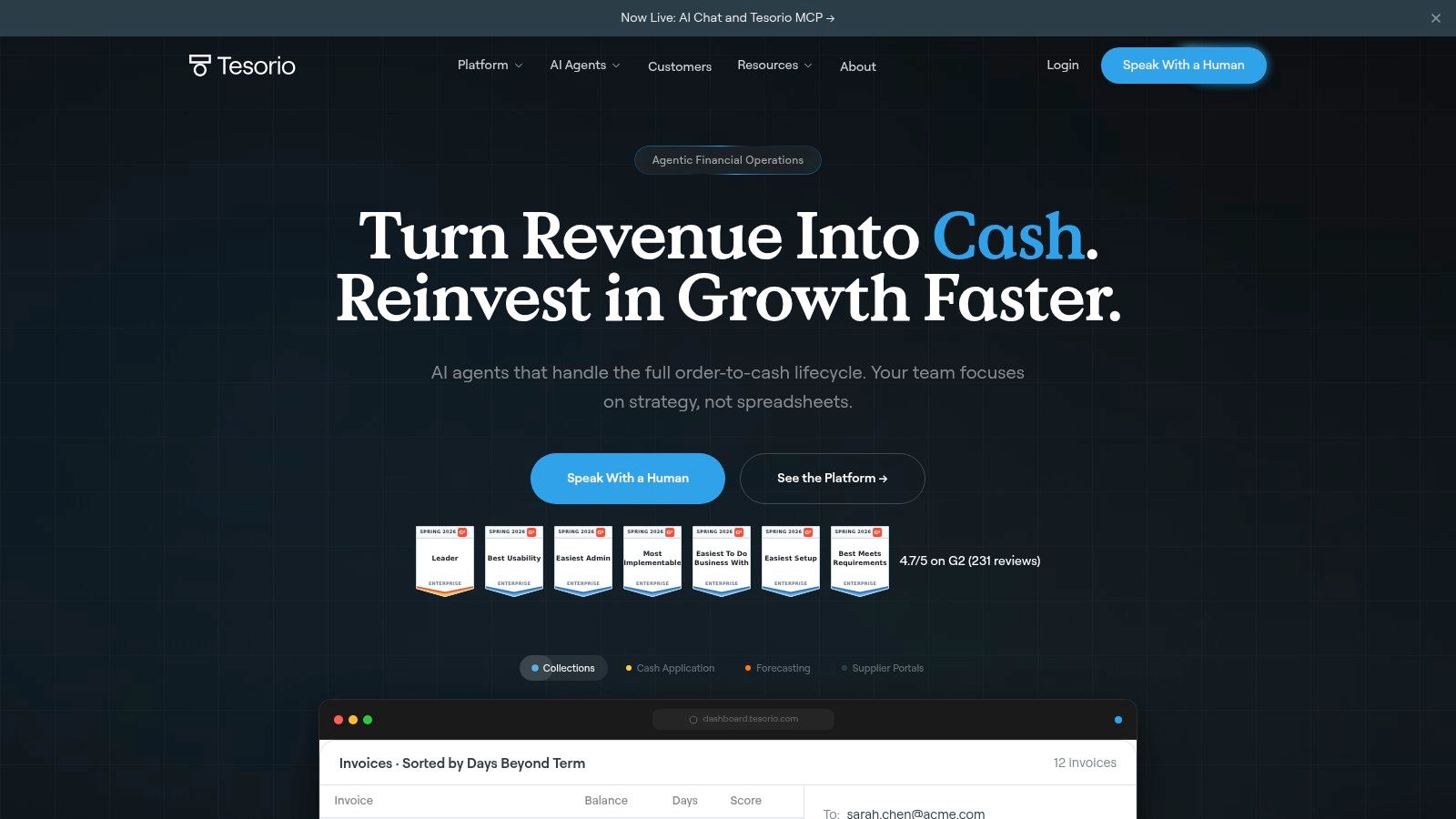
Tesorio is for teams that care as much about what will happen as what is already overdue. Its orientation is cash flow performance, not just collections tasking.
That distinction matters when you need to improve cash flow before problems show up on an aging report. Tesorio reads signals from communications and payment behavior to help teams prioritize risk earlier.
Best use case
I like Tesorio most for firms with a meaningful invoice base and enough data history to benefit from prediction and prioritization. If your team already sends reminders on time but still struggles with uncertain collections outcomes, the forecasting layer can add value.
It also fits finance leaders who want a system that ties collections work directly to expected cash movement. That's often more useful in executive conversations than a simple list of overdue accounts.
If your cash forecast depends on what one AR specialist remembers from email threads, the process is fragile.
Tesorio isn't the broadest invoice-to-cash platform. It's more focused than some suites, which can be a strength or a limitation depending on your environment. If you're evaluating alternatives in this lane, this overview of collections automation software is a useful comparison point.
One structural reason tools like Tesorio matter is that many automation lists overemphasize structured-data RPA and underplay intelligent process automation. Research notes that over 80% of business data resides in semi-structured formats like invoices, emails, or contracts. In AR, that's exactly where many delays start.
Website: Tesorio
7. Quadient AR by YayPay

Quadient AR, formerly YayPay, is a solid choice for teams that want predictive AR with a cleaner, more accessible workspace. It tends to appeal to finance groups that want better visibility without jumping straight into a very heavy enterprise implementation.
The product brings together collections automation, payment insights, and a unified record of communications and status. That single-system view is more valuable than it sounds, especially when different people touch the same account.
What works well
Quadient AR is good at queue prioritization. Controllers usually don't need more data. They need a clearer answer to which accounts deserve attention today, which clients are drifting toward delay, and where the team is spending time.
Being backed by a larger public company also matters for some buyers. It doesn't guarantee better fit, but it can help when vendor stability is part of the decision process.
- Predictive insights: Helpful for deciding where the collections team should focus first.
- Unified workspace: Reduces context switching between notes, emails, and invoice status.
- Middle-ground option: More capable than lightweight reminder tools, less imposing than some enterprise suites.
The trade-off is ecosystem depth. It may not match the largest AR vendors on breadth, and pricing still requires a conversation. For many professional services firms, though, the balance is sensible.
Website: Quadient
8. Esker
A controller inherits five AR processes across three countries after a merger. Invoice formats differ by entity, disputes sit in inboxes, and cash application rules vary by region. In that situation, a narrow collections tool rarely fixes the underlying problem.
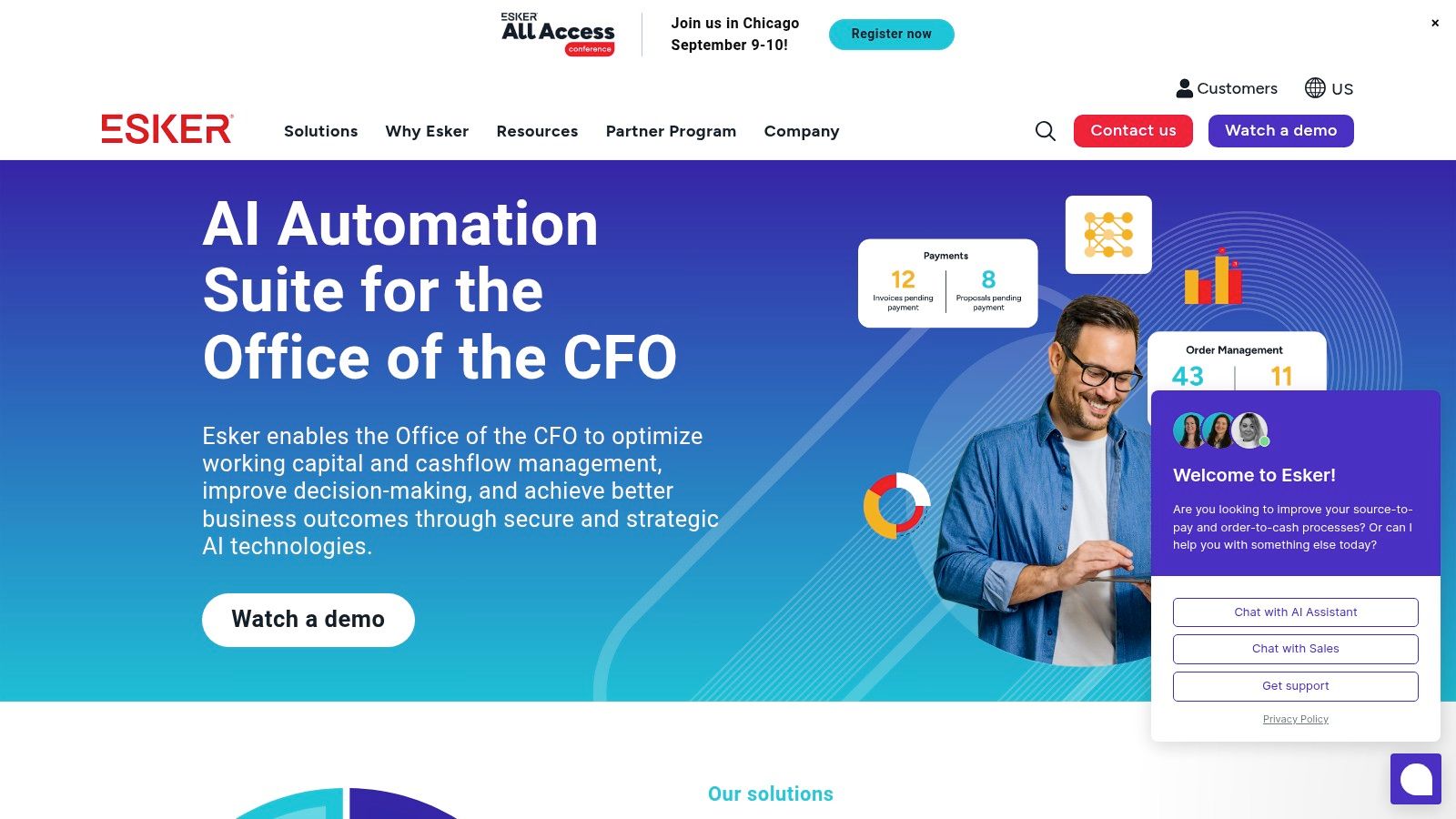
Esker is a better fit for firms that need AR automation inside a broader order-to-cash process, especially when billing, dispute management, document capture, and payment workflows span multiple entities. That matters more in professional services than many buyers expect. Shared services teams still need clean handoffs, consistent approval paths, and auditability across offices if they want to protect cash flow without adding headcount.
When Esker makes sense
Esker stands out in more complex operating environments. Its mix of OCR, workflow automation, AI support, and international coverage helps finance teams standardize how invoices are received, routed, chased, and resolved across regions.
The trade-off is implementation weight. A domestic firm with straightforward billing and a small collections team may not need this much platform. The return comes when process inconsistency is already hurting DSO, delaying dispute resolution, or forcing finance staff to reconcile exceptions manually.
For CFOs and controllers at larger professional services firms, that is the core buying question. Are you trying to automate reminder emails, or are you trying to reduce friction across the full receivables process? Esker is stronger in the second case.
Website: Esker
9. BlackLine
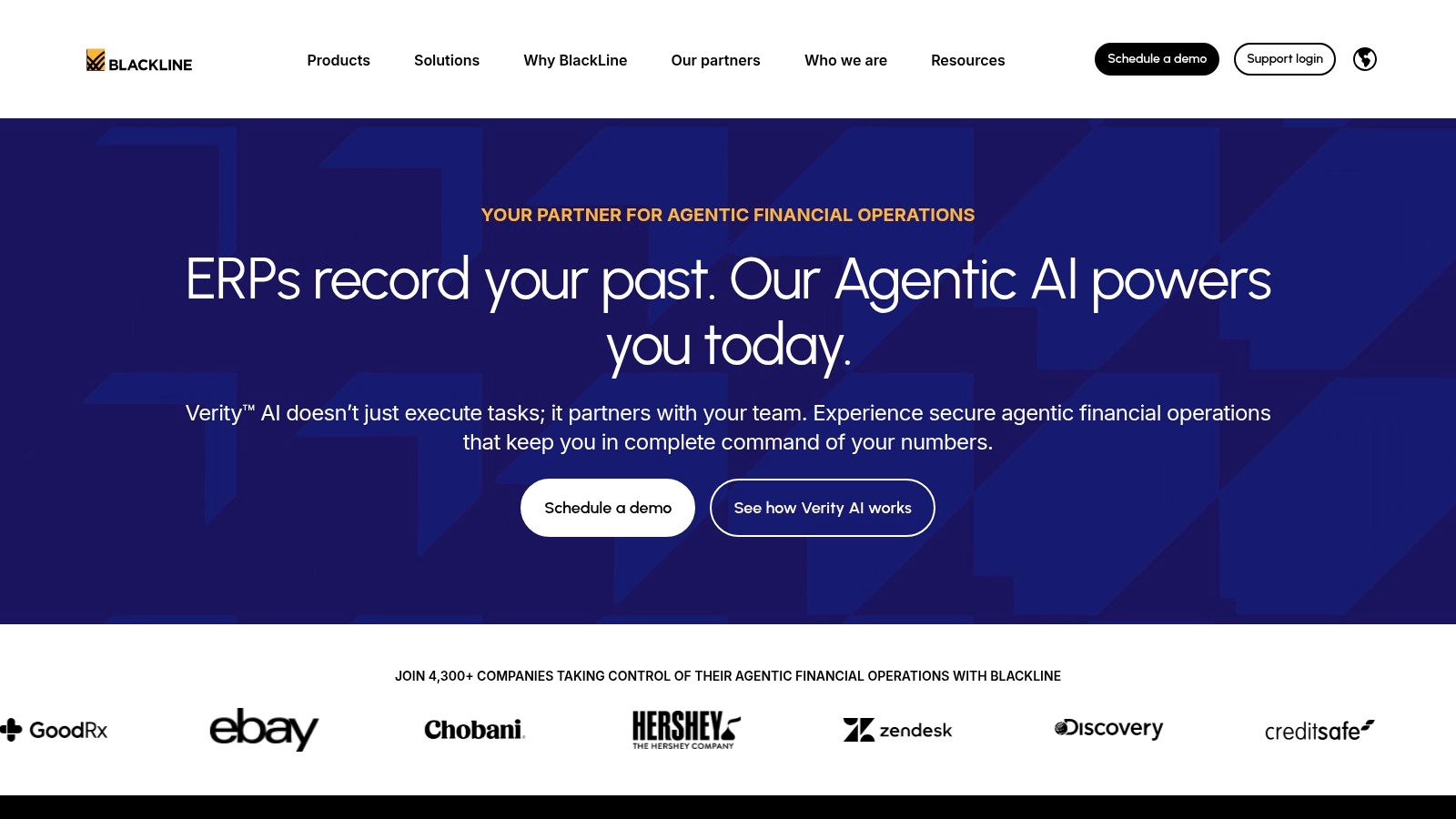
BlackLine is best known for financial close, but its AR strengths are real. If your biggest receivables pain isn't chasing customers but matching cash quickly and getting cleaner visibility into the portfolio, BlackLine is worth serious consideration.
I usually think of it as a cash application and intelligence play first. That can be exactly right for firms where the collections process is workable, but reconciliation and portfolio insight are still too manual.
Strong choice for cash application first
Many firms underestimate how much AR friction sits after the payment arrives. Someone still has to match it, clear exceptions, and update the ledger accurately. BlackLine is built to reduce that manual effort.
Its dashboards around DSO, terms, and customer trends also help finance leaders move from anecdotal account reviews to repeatable portfolio management. If you're modernizing the wider order-to-cash process, that matters.
- Best at: Cash application, matching, and receivables intelligence.
- Not built for: Full billing and collections orchestration on its own.
- Ideal buyer: Enterprise finance teams that already have upstream billing tools and want stronger downstream control.
For professional services firms with straightforward invoicing but messy reconciliation, BlackLine can solve a very specific and expensive bottleneck.
Website: BlackLine
10. Sage AR Automation
Sage AR Automation is a practical option for SMB and mid-market teams that want a fast start, especially if Sage is already part of the finance stack. It focuses on the core motions most firms need: reminders, customer self-service, payment acceptance, and basic dispute tracking.
That makes it easier to justify when the goal is control, not transformation. Many firms don't need the deepest suite. They need the basics done consistently.
Why it fits growing firms
The appeal here is speed to value. Sage customers often want AR automation without a heavy lift, and the platform is positioned accordingly. If your finance team is small and your processes are still maturing, that's a valid priority.
It also supports common portal and payment workflows that reduce back-and-forth with clients. For firms trying to improve cash flow without changing everything at once, that can be enough.
Operator note: The best first automation is often the one your team will actually use every day.
There's a broader reason to prioritize this area. Research shows that nearly 90% of businesses report about 30% of their invoices are paid late, straining AR performance and consuming an average 4.6% of revenue annually. For firms already using Sage, solving that problem with a relatively accessible AR layer is a sensible move.
Website: Sage AR Automation
Top 10 AR Automation Software Comparison
Product | Core Features ✨ | UX & Quality ★ | Value & Pricing 💰 | Target Audience & USP 👥🏆 |
|---|---|---|---|---|
Resolut 🏆 | End‑to‑end AR automation; QuickBooks & zero‑migration PDF import; omnichannel outreach; instant cash application ✨ | Fast onboarding (~10 min); consumer‑grade portal; enterprise security; ★★★★★ | Measurable ROI (example $149/mo in calculator); 30‑day trial; 💰 | 👥 CFOs, AR teams, SMB→Enterprise; ✨ legal‑voice escalation, autopilot/co‑pilot, one‑click QuickBooks; 🏆 |
HighRadius, Autonomous Receivables Platform | Enterprise AR suite: AI collections, ML cash application, 100+ templates, credit agency integrations ✨ | Proven at scale; deep ERP integrations; implementation-heavy; ★★★★ | Outcome‑based commercial models; pricing by quote; 💰 | 👥 Large & upper‑midmarket finance teams; ✨ AI at scale + broad outcome focus |
Billtrust, Unified AR Platform | Invoicing, embedded payments, cash application with high auto‑match rates, 260+ AP portals ✨ | Demonstrated scale & ROI; enterprise-ready; ★★★★ | Processes >$1T annually; pricing by quote; 💰 | 👥 Midmarket → Enterprise; ✨ deep payments rails & broad integrations |
Versapay, Collaborative AR | Collections + collaborative payer portal; embedded B2B payments; dispute threads tied to invoices ✨ | Strong customer self‑service and collaboration; ★★★★ | Quote-based pricing; good for mid volumes; 💰 | 👥 Teams prioritizing customer collaboration; ✨ mature payer portal experience |
Invoiced (by Flywire) | Smart Chasing omni‑channel reminders; AutoPay portal; subscription billing; Automation Builder ✨ | Quick deploy, approachable UI for lean teams; ★★★★ | Fast time‑to‑value for SMBs; pricing often quote-based; 💰 | 👥 SMB → Mid‑market; ✨ subscription billing + easy admin |
Tesorio, Cash‑Flow Performance | Collections campaigns, email‑scanning risk signals, real‑time cash forecasting ✨ | Emphasis on measurable AR→cash impact; proactive alerts; ★★★★ | Mid‑market focus; pricing by quote; ROI‑driven value; 💰 | 👥 Venture‑backed & SaaS/invoice‑driven firms; ✨ proactive communication signals |
Quadient AR (YayPay) | Predictive payment insights, collections automation, unified AR workspace ✨ | Accessible UI, single‑system view; ★★★ | Pricing by quote; may need add‑ons; 💰 | 👥 Teams wanting forecasting & prioritization; ✨ backed by larger public company |
Esker, O2C + AI | Order‑to‑Cash suite with AI/OCR/RPA, multi‑language & multi‑currency self‑service ✨ | Suited for global operations; integrated O2C; ★★★★ | Quote pricing; implementations can be involved; 💰 | 👥 Multinationals with global footprint; ✨ strong international & compliance support |
BlackLine, Cash Application Focus | ML‑driven receivables matching, AR Intelligence dashboards, bank & ERP integrations ✨ | Enterprise controls & governance; deep analytics; ★★★★ | Enterprise-oriented pricing; may need complementary billing tools; 💰 | 👥 Large enterprises modernizing cash application; ✨ deep cash‑app specialization |
Sage AR Automation (Sage Network/Lockstep) | Automated collections, payer portal (Stripe/PayPal), multi‑ERP connectivity ✨ | Fast time‑to‑value for Sage customers; self‑service focus; ★★★ | SMB/midmarket pricing by quote; cost‑effective for Sage users; 💰 | 👥 Sage customers & US SMBs; ✨ quick start & straightforward core AR features |
From Selection to Success Making Automation Work
Month-end closes, revenue looks fine on paper, and cash still trails. In a professional services firm, that usually points to execution gaps inside AR: inconsistent follow-up, unclear exception handling, weak payment workflows, and too much manual cash application.
That is why this list is weighted toward AR automation, not general business automation. For finance leaders in services firms, AR is often the fastest path to lower DSO, tighter forecasts, and fewer hours spent chasing status across inboxes, spreadsheets, and ERP reports.
General workflow tools still have a place. They can route approvals or trigger reminders. They usually fall short once the work gets specific to finance operations, such as payer-level collections logic, remittance matching, unapplied cash review, dispute tracking, and receipt forecasting by account. If your team is comparing QuickBooks AR automation, payment tools, and AI-supported collections platforms, evaluate them against the same outcome: how much faster they turn billed work into collected cash.
A note on AR-specific platforms
AR platforms work best when invoices, disputes, credits, and payment behavior are treated as operating data for finance, not generic tasks in a workflow app.
That matters more in professional services than many teams expect. Billing is tied to project delivery, client relationships matter, and a late payment problem often starts upstream with invoice quality, approval delays, or missing backup. Good AR software helps the team spot those patterns earlier and act on them with more consistency.
VISUAL IDEA: An infographic with a comparison layout titled General vs Specialized AR Automation. Columns compare ledger integration, cash application, DSO impact, and cash forecasting, showing the practical advantage of specialized tools.
A practical checklist for selecting software
Test the tool against your real operating model, not the demo.
- Integration: Does it connect cleanly to your ERP or accounting system, especially if finance also relies on a PSA, separate billing workflow, or payment stack?
- Time-to-value: Can one business unit, office, or client segment go live quickly without overloading finance and IT?
- Total cost: What do implementation, payment fees, support, and internal admin time add to the subscription price?
- Client experience: Will partners and project leads be comfortable sending clients to the portal, and will clients use it?
- Scalability: Can the system handle more entities, invoice volume, and collection complexity without forcing a redesign next year?
VISUAL IDEA: An infographic checklist titled AR Automation Selection Checklist for CFOs, using the five points above with simple icons and a clean finance-team design.
Implementation discipline matters more than the demo
Rollouts go better when finance sets the operating rules early.
Start with one segment, such as retainer clients or accounts with chronic late payment. Define one reminder cadence, one escalation path, and one owner for exceptions. Review results after a full billing cycle, then adjust before expanding. That approach gives the team a clean test and avoids mixing process issues with product issues.
Software will expose weak process design quickly. If invoice data is inconsistent, collector notes sit in personal inboxes, or disputes have no owner, the platform will make those gaps visible. It will not fix them for you.
Measure from a baseline. Track DSO, percent current, average days late by client cohort, collector touches per paid invoice, and time spent on cash application before go-live. Then compare those same measures by segment after launch. That gives finance a grounded ROI view and keeps board reporting tied to actual process improvement, not a promise made during vendor selection.
The first gains are usually operational. Collectors spend less time chasing status. Cash application speeds up. Forecast reviews get tighter because expected receipts are tied to open items and payer behavior, not optimism.
Final takeaway
The right platform gives finance more control over collections execution and better visibility into cash timing. For a professional services firm, that means fewer preventable delays between earned revenue and collected cash.
AR deserves the closest scrutiny because it is the function with the clearest near-term impact on working capital and team efficiency. That is the lens behind this list.
If your firm is also tightening outbound finance communication, it helps to test email deliverability.
Resolut is a strong fit for firms that want to reduce DSO, improve cash flow, and add discipline to collections without making client communication feel transactional. If AI-driven AR automation, QuickBooks connectivity, automated cash application, and follow-up workflows are priorities, it belongs on the shortlist.