
How to Pay Virtual Card: Get Paid Faster in 2026
Learn how to pay virtual card for online purchases and get paid faster. Discover the best ways to use virtual cards securely in 2026.
If you run AR at a professional services firm, you've probably seen this already. A client payment shows up, the bank line looks clean, and yet your team still burns time matching a generic reference to the right invoice, project, or retainer bucket. That is the quiet cost of modern payment rails, the money is there, but the work isn't finished.
Pay virtual card sits right in that gap. On the buyer side, it's a controlled way to move spend, on the receiver side, it can be either a fast settlement tool or a margin leak, depending on how the workflow is set up. The rail is no longer niche, either, Juniper Research projects virtual card payment value will grow 235% by 2029, from $5.2 trillion in 2025, and transaction count from 36 billion in 2023 to 175 billion by 2028 (Juniper Research). That scale matters because it changes the default assumptions around AP, AR, supplier enablement, and reconciliation.
For finance leaders, the question isn't whether virtual cards are “good” or “bad.” It's which side of the invoice you're on, what your fee math looks like, and whether your team has automation strong enough to keep the payment from turning into manual cleanup.
The Moment a Paid Invoice Still Costs You Time
The payment lands on a Tuesday afternoon, and the controller gets a brief win. Then AR opens the remittance and finds a token reference, no invoice detail, and no clean way to tell which project, department, or client the cash belongs to.
That is the part buyer-side decks usually skip. Pay virtual card is a serious B2B payment rail, not a consumer checkout trick. Juniper says B2B virtual cards account for the largest proportion of spend through virtual cards, and earlier analysis put B2B transaction value at almost 80% of the total by value (Juniper Research). For the payer, that signals control. For the receiver, it often means the payment still needs work before it can be posted cleanly.
Two different experiences, one payment rail
On the payer side, virtual cards solve a control problem. The buyer can issue a narrow credential, use it once, and keep spend tightly contained.
On the receiver side, the economics are different. If the payment arrives without invoice-level metadata, AR still has to match, investigate, and post cash by hand. That is where the time disappears, after the money is technically paid, not during authorization.
Practical rule: if your team has to retype most of the remittance to tie the payment to the invoice, the rail did not solve the operational problem, it only shifted it.
That distinction matters more as volume grows. Grand View Research estimates the global virtual cards market at USD 19.0 billion in 2024 and projects USD 60.1 billion by 2030 (Grand View Research). The growth is useful only if the payer's controls and the receiver's workflow can both absorb it without pushing extra work back onto accounting, and that is where payment orchestration starts to matter.
How a Virtual Card Payment Moves
A virtual card is not a static card number sitting in a wallet. Google describes it as a digital version of a payment card that uses a randomly generated number instead of your actual card number, and says it can be used online or in apps (Google Pay support). That distinction matters because the control sits around the credential, not just inside it.
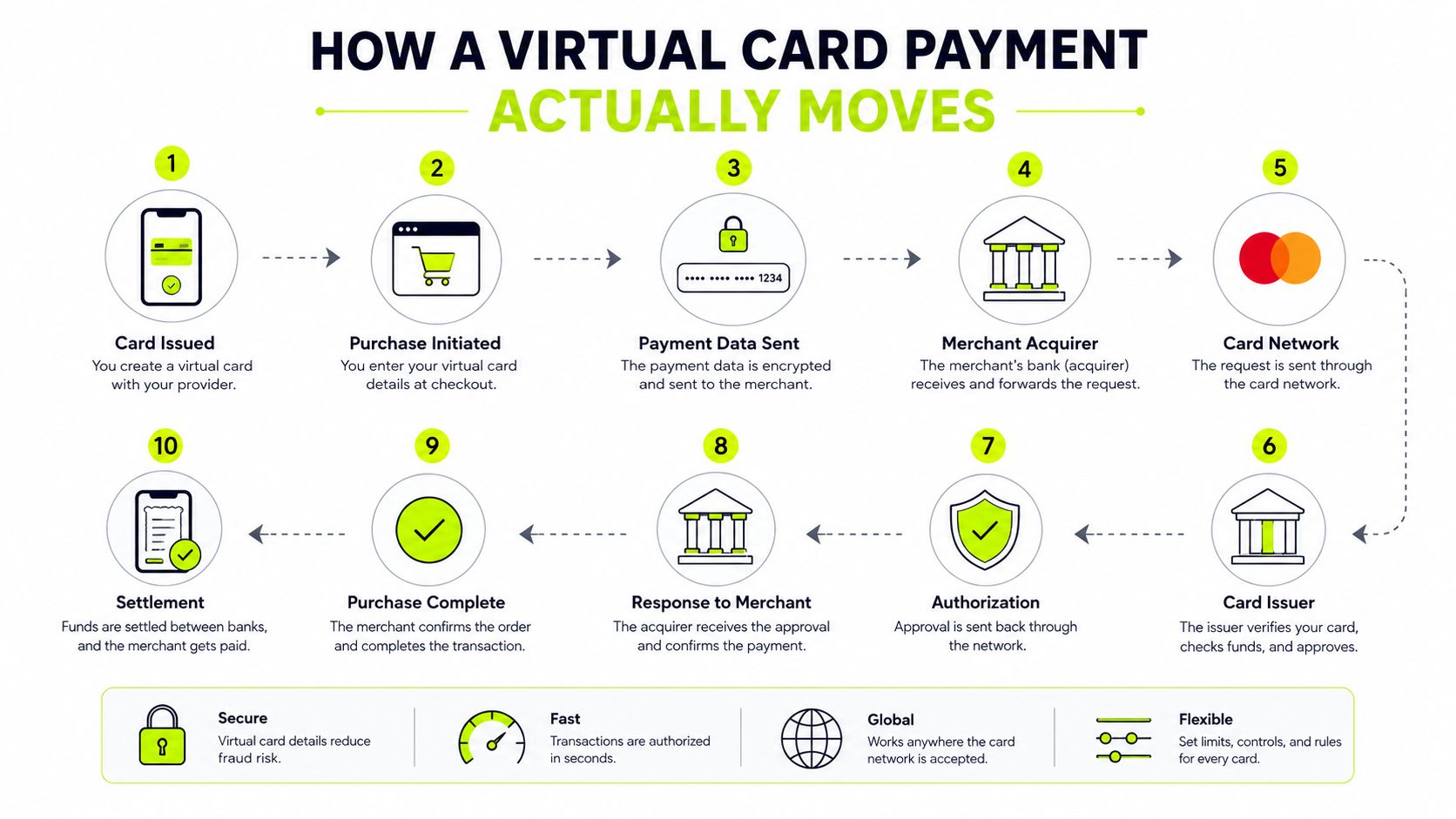
The flow in plain language
The payer starts by enrolling the underlying card in a tokenization network. Google's Virtual Cards API shows the lifecycle in plain terms through methods for enrolling cards, retrieving the virtual number, sending OTPs, retrieving transactions, and unenrolling, which tells you the credential is meant to be controlled, not left hanging around (Google Developers).
The payment request then moves through the rail with the virtual number in place of the underlying PAN. The merchant sees the surrogate credential, not the actual account number, because tokenization masks the account details during checkout. The network authorizes the charge against the limits attached to that card, then the number should be retired or reissued once the payment window closes.
That same control logic only works if the rest of the payment stack can carry the transaction data cleanly. A well-run flow routes issuance, authorization, remittance, and settlement through the same operating model, and that is where payment orchestration becomes practical instead of theoretical.
The card should behave like a temporary tool, not a reusable stored credential.
On the supplier side, the payment looks like a normal card transaction. Corpay's B2B flow breaks it into issuance, presentment, processing, and reconciliation, with settlement usually landing in 1–3 business days while the network movement happens in seconds (Corpay). Good AP teams treat issuance, metadata, and retirement as one process, because splitting them into separate handoffs is how clean payments turn into avoidable work.
If you run payment infrastructure, the internal question is simple. If a provider cannot explain who can issue the number, who can deactivate it, and what data comes back for reconciliation, the control model is too loose.
Virtual Card Versus ACH Check and Wire
A lot of comparison content stops at speed. That's lazy. Finance teams care about four things, settlement speed, cost, control, and how much reconciliation garbage lands on the AR desk.
Resolut's overview of B2B online payment methods is useful because it frames the decision, not just the payment method buzzword. In practice, the right rail depends on whether you're paying a supplier, paying a one-off invoice, or trying to reduce manual follow-up.
Comparison table
Rail | Settlement speed | Typical cost | Control level | Reconciliation effort |
|---|---|---|---|---|
Virtual card | Network authorization happens in seconds, supplier settlement usually 1–3 business days (Corpay) | Buyer may earn rebates, supplier can absorb interchange | High, because the credential can be issued with narrow limits and expiry (Conferma issuer guide) | Moderate to low if invoice metadata flows cleanly |
ACH | Slower than card rails, timing can vary by bank and process | Usually cheaper for the receiver | Lower credential control once bank details are on file | Often moderate, but manual matching still shows up |
Check | Slowest and most operationally messy | Cheap on fees, expensive on labor | Low, because the credential is physical and easy to mishandle | High, especially when remittance is incomplete |
Wire | Fast for same-day or high-value transfer needs | Usually not the first choice for recurring spend | Strong transfer control, but not built for supplier catalogs | Lower mismatch risk, but heavier approval friction |
Where virtual cards actually win
Use virtual cards for controlled supplier payments, travel and expense, and recurring vendor runs where you want a card-style control layer without exposing a permanent card number. Use ACH when the supplier relationship is stable, the banking details are already in place, and the fee burden matters more than the rebate or control benefit.
Rule of thumb: if the vendor is already cleanly onboarded and the payment is routine, ACH is usually the cheaper rail. If the payment needs tighter controls or faster supplier settlement, virtual card is the better tool.
Wires still win for same-day or high-value situations where speed and finality matter more than rebate economics. Checks only make sense when the process requires them, not because anyone enjoys reconciling them.
Issuing and Accepting Virtual Cards in Practice
The payer side is straightforward if you think like a controller. Generate the card for a specific invoice, set the amount tightly, add an expiration date, and lock the credential to the supplier or vendor category whenever the program supports it. Edenred describes virtual cards as regulated instruments tied to standard card networks such as Visa or Mastercard, which means they run on familiar rails, just with tighter controls around use (Edenred).
The operational mistake is giving the card too much room to breathe. A broad amount band, a long validity window, or weak vendor controls turns a smart instrument into another messy card number.
What good issuance looks like
- Amount control: set the card close to the invoice value, not “roughly correct.”
- Date control: keep the window short so the credential can't linger.
- Vendor lock: tie it to the supplier when the issuer supports that rule.
- Confirmation step: use OTP or biometric verification where the platform offers it, because identity checks belong in the issuance chain, not after a disputed charge.
- Retirement: deactivate or reissue the credential once the payment closes.
On the supplier side, the challenge is acceptance without manual data entry. Google's API structure makes the point clearly, virtual cards should support retrieving transactions, sending OTPs, and unenrolling the credential, which means acceptance programs need transaction feeds, not just a card number and a hope (Google Developers). If the AR team still has to key in settlement data, the process is half-baked.
A practical acceptance pattern
The better setup is invoice-level reference data in the transaction record, presentment through a portal or secure workflow, and reconciliation that posts automatically into the ERP. Corpay's B2B model shows why that matters, because the payment can settle quickly while the accounting work still needs to tie back to the invoice cleanly (Corpay).
If your team is accepting virtual cards today, ask one blunt question. Does the platform send structured transaction data back, or just a paid status? Those are not the same thing.
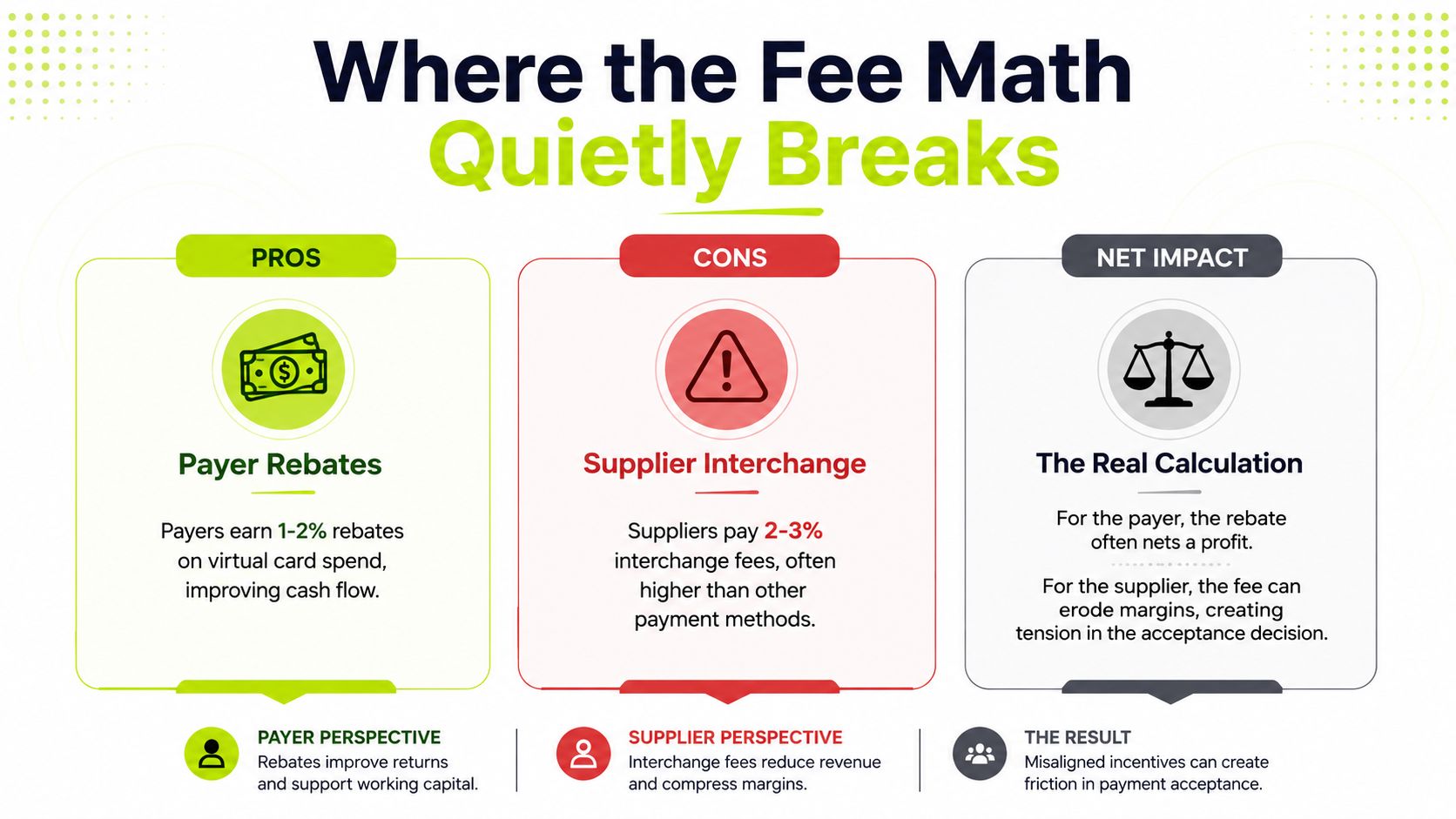
Where the Fee Math Quietly Breaks
Buyer economics and supplier economics point in opposite directions. That's the tension, and pretending otherwise helps nobody.
On the buyer side, one AP-focused source says rebate rates commonly land around 1% to 1.75% of spend, depending on volume, terms, and negotiation (Autopayables). On the supplier side, other sources note interchange or processing fees can run around 3% and sometimes approach 5% in healthcare and similar B2B reimbursement flows (PNHP). That spread is the whole story. One side sees margin relief, the other side sees margin pressure.
Buyer-side discipline
Use virtual cards where the rebate, float, or control benefit outweighs the friction. High-volume suppliers, ad hoc spend, and categories where you can standardize acceptance are the obvious candidates. The worst mistake is routing every invoice through the card program just because the rebate looks attractive on paper.
The program only works when the payment mix is intentional. If you force low-margin suppliers into card acceptance without a reason, they'll either push back or build the fee into pricing later.
Supplier-side discipline
Suppliers should not accept virtual cards blindly. If the interchange cost eats the margin on the invoice, the payment is not a win just because it settles faster. Ask for a clean comparison against ACH, then decide whether the speed and guaranteed funds are worth the fee.
If the payment rail creates hidden cost for the receiver, the buyer should expect negotiation, not gratitude.
The best AP teams don't treat rebates as free money. They route the right spend through the right rail, use supplier segmentation, and keep a close eye on which vendors accept card economics naturally versus which ones need a different method. That's where cash flow improves without hollowing out supplier relationships.
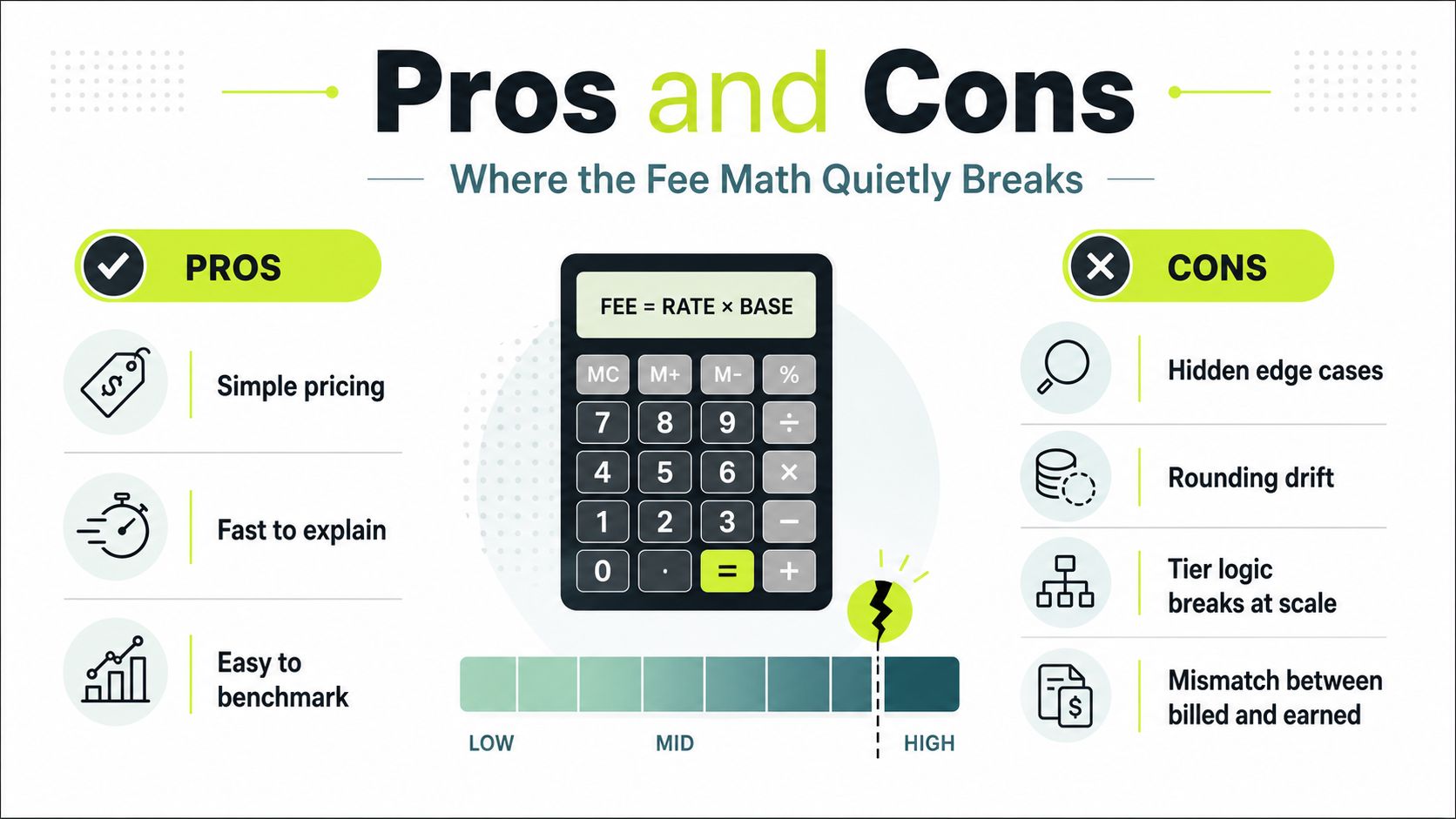
Lifecycle Gaps and Reconciliation Drift
The primary problem with virtual cards is lifecycle control.
A virtual card that stays active too long, or one configured with limits so loose they barely matter, becomes a credential nobody fully owns. Mastercard's 2024 virtual card material calls out the governance gap clearly, because tokens can be turned off in wallet or browser flows but still remain active outside Google Pay until the issuer suspends them (Mastercard). That is not a consumer-side quirk. It is a finance control problem, especially when cards move across multiple systems.
What goes wrong in practice
- Ghost credentials: the number keeps working after the business thinks it has been retired.
- Single-use misconfiguration: the issuer treats a supposed one-time card like a broader credential.
- Orphaned settlement events: the transaction posts, but the retirement feed never reaches the accounting system.
Those failures rarely look like fraud. They show up as reconciliation drift, duplicate matching work, and an aging report that looks slightly off, then stays off long enough to waste time and cash. By the time someone spots the issue, the clean-up cost is already in the books.
For teams that care about payment controls, use the same mindset you would use for Shopify chargeback protection from Disputely. You do not just want the payment to clear. You want a controlled lifecycle around what happens before, during, and after the transaction. That is the part basic explainers usually miss.
The discipline is straightforward. Monitor retrieval and settlement events, retire the credential promptly, and make sure invoice metadata comes through with the transaction. If you do that, the payment stays a payment. If you do not, it becomes a recon problem with a card number attached. If you want the broader operational angle, Resolut's guide to AR automation shows why the matching layer matters just as much as the payment rail.
Closing the Loop With AR Automation
Virtual cards make sense when the payment arrives with enough structure for the AR team to trust it. That's where accounts receivable automation, AI AR automation, and QuickBooks AR automation stop being buzzwords and start being operating discipline.
A strong setup captures the transaction at authorization, matches it to the invoice as soon as the presentment data arrives, and applies cash once settlement clears. If you want to see how that fits into the bigger AR stack, Resolut's guide to AR automation is worth a look alongside Doczen's invoice automation insights, because invoice intake and cash application only work when both sides are clean.
What good looks like inside the AR stack
The portal gives customers or clients multiple payment choices, virtual card among them, and the matching engine uses invoice-level reference data instead of forcing someone to eyeball remittance. Risk flags catch misrouted or misconfigured transactions before they distort the aging report. The result is simple, fewer manual touches, faster posting, and better visibility into what's open.
For a professional services firm trying to reduce DSO and improve cash flow, that matters more than the rail itself. The rail is just the means. The win is when the payment clears, the invoice closes, and nobody spends Friday afternoon reconciling a “paid” status that still isn't posted.
If you're trying to get paid faster without creating a new pile of manual work, that's exactly the problem Resolut is built for. It automates AR for professional services with consistent, accurate, human workflows that close the loop from invoice to cash application. Visit Resolut if you want your receivables process to move faster without losing control.