Send ACH Payment Online: A CFO's Guide to Improving Cash Flow
Learn how to send ACH payment online to reduce DSO and automate accounts receivable. A guide for CFOs and controllers at professional services firms.
To send an ACH payment online is to execute a direct, bank-to-bank transfer over the Automated Clearing House network. It is the established method for predictable business payments like payroll or vendor invoices because it is secure, cost-effective, and highly automatable.
Functionally, ACH allows for both "push" payments to vendors and, with proper authorization, "pull" payments directly from client accounts for receivables. This dual capability is central to its strategic value in treasury management.
Making the CFO's Case for Online ACH Payments
For finance leaders at professional services firms, adopting electronic payments is not a modernization project—it is a strategic financial decision with a clear, measurable impact on working capital. The case for ACH is built on data, offering greater control and predictability over the firm’s cash conversion cycle.

This shift directly improves cash flow by reducing Days Sales Outstanding (DSO). Unlike credit cards, which assess a 1.5% to 3.5% fee, ACH transactions carry a low, flat fee. On a $20,000 invoice, this is the difference between a cost of approximately $1 versus up to $700.
This direct cost-savings, combined with accelerated settlement times, presents a compelling financial argument.
Operational Impact of ACH vs. Other Payment Methods
Metric | Online ACH Payments | Credit Card Payments | Paper Checks |
|---|---|---|---|
Cost Per Transaction | Low, flat fee (typically < $1) | High, percentage-based (1.5%-3.5%) | Moderate (stock, postage, labor) |
Settlement Speed | 1-3 business days | Near-instant authorization | 5-10+ business days (mail + float) |
Security/Risk | High; encrypted, regulated by Nacha | High; PCI DSS compliance required | Low; high risk of fraud and mail theft |
Automation Potential | Excellent; designed for integration | Good; widely supported but costly | Poor; requires manual data entry |
Impact on DSO | Significantly reduces DSO | Reduces DSO, but erodes margin | Inflates DSO due to manual process |
While credit cards offer speed, their cost structure erodes profitability on large invoices. Paper checks introduce unacceptable operational drag and security vulnerabilities into the cash management process. For firms focused on efficiency and capital preservation, online ACH is the most operationally sound choice.
Drive Operational Efficiency and Reduce DSO
Manual payment processing is a primary source of operational friction. The process of tracking inbound checks, managing mail delays, and executing manual bank deposits inflates DSO and constrains cash availability.
Online ACH payments systematically eliminate these variables.
ACH network statistics validate this shift. The network recently handled 29.1 billion payments valued at $72.6 trillion annually. B2B payments grew to 5.3 billion transactions, a 20.4% increase, confirming that businesses are leveraging ACH to accelerate collections and gain control over cash flow.
Unlocking Value with AR Automation
The full value of ACH is realized when integrated with accounts receivable automation. An automated AR system moves beyond simple payment acceptance to streamline the entire cash application and reconciliation workflow. This is where firms see a step-change in efficiency.
By connecting payment processing directly to the general ledger, you achieve straight-through processing, eliminating the error-prone task of manually matching payments to open invoices.
This integration provides a real-time, accurate view of the firm’s cash position. For a business in the $3M–$50M revenue bracket, this visibility is fundamental to accurate forecasting and strategic capital allocation. The right AR software for professional services transforms receivables from a cost center into a strategic, data-driven function.
Building a Secure ACH Processing Framework
The first decision when implementing online ACH is the processing method. As a Controller or finance operator, the objective is to establish a repeatable, secure process that mitigates risk for both the firm and its clients.
The two primary paths are working directly with a commercial bank or utilizing a third-party payment processor. The direct-to-bank model often requires the firm to generate and transmit formatted NACHA files, a technical task that demands in-house expertise and assumes full responsibility for security and compliance.
Choosing Your Processing Path
Third-party processors abstract this technical complexity, providing a secure portal and managing the backend transaction mechanics. For most professional services firms, this is the more practical route, offering a balance of control and efficiency while offloading a significant portion of the compliance and security burden.
The objective is to secure client authorization and banking information without introducing unnecessary operational risk. A processor with embedded compliance tooling provides the most direct path to achieving this.
Regardless of the path chosen, adherence to regulation is mandatory. The 2026 Nacha Rules, for example, will continue to evolve standards for authorization, security, and transaction handling across the network.
Securing Authorization and Client Data
A compliant ACH framework is built on an auditable record of client consent. Before initiating a debit, Nacha rules require explicit, verifiable authorization. Collecting banking details via unencrypted email or phone is a clear security and compliance failure.
A secure online payment portal is the standard for this reason. It should encrypt and tokenize all sensitive data, ensuring raw bank account numbers never touch internal systems. This single control drastically reduces the firm's risk profile. Our guide on ACH payment processing fees details the associated costs.
The authorization process must capture and store a digital receipt of consent, including the date, time, and IP address, creating the audit trail required to defend against payment disputes.
Ensure the process consistently captures these data points for every authorization:
- Client's Full Name or Company Name
- Bank's ABA Routing Number
- Bank Account Number
- Account Type (Checking or Savings)
Executing this process through a compliant platform establishes a system that is both secure and operationally efficient, turning a potential liability into a controlled business function.
Executing and Managing Online ACH Transfers
With a secure framework in place, execution falls to the AR team. Managing these transactions with precision requires an understanding of the mechanics and making deliberate choices between processing options.
The two execution paths are direct file submission to your bank or using a third-party processor's portal.
The direct-to-bank route requires your team to create and format NACHA payment files for submission. This offers maximum control but carries a high technical burden. A single formatting error can cause an entire payment batch to fail, resulting in delays and manual remediation.
For most firms, a processor's portal provides a more efficient workflow. Instead of managing file formats, the team enters payment details into a secure web interface. This significantly reduces the risk of human error and abstracts away the technical backend, allowing the team to focus on collections management.
Standard ACH vs. Same Day ACH
A key operational decision is the choice between Standard and Same Day ACH.
Standard ACH is the workhorse for routine, non-urgent payments, settling in one to three business days. It is the most cost-effective option for scheduled payments like payroll or recurring vendor invoices.
Same Day ACH carries a modest premium but is a powerful tool for time-sensitive transactions. It is not an expense but a risk mitigation tool. An urgent payment to a critical subcontractor to prevent a project delay, for instance, justifies the cost. The same applies to collecting a large, last-minute client payment before a reporting period closes.
View Same Day ACH as a strategic instrument. The incremental fee is negligible compared to the financial or reputational cost of a delayed project or a strained client relationship. Use it to manage risk and secure revenue.
This flexibility drives ACH adoption. The network is projected to process 33.6 billion payments by 2026. Same Day ACH usage grew by 45.3%, with 1.2 billion payments valued at $3.2 trillion, as it enables firms to be responsive while maintaining disciplined cash management. Data shows how ACH adoption accelerates cash application.
Forecasting Cash Flow with ACH
Accurate cash flow forecasting depends on understanding ACH settlement timing. ACH payments are processed in batches at specific cutoff times. An initiation request submitted after a processor's cutoff will not begin processing until the next business day.
This workflow illustrates the core steps for a secure and compliant ACH process, from authorization to final settlement.
The process depends on a structured approach: auditable consent, secure data handling, and precise execution.
The AR team must be aware of the processor’s batch schedule. This knowledge transforms ACH from a simple payment rail into a predictable component of a cash management strategy. Knowing precisely when funds will be debited or credited enables the team to reduce DSO and maintain tighter control over liquidity. Integrating this process with a tool like QuickBooks AR automation provides a clear, real-time view of the firm’s cash position.
Using AR Automation to Improve Cash Flow
Accepting ACH payments online is a tactical improvement. The strategic advantage comes from integrating it with end-to-end automation. This is the transition from accepting electronic payments to re-engineering the accounts receivable function.
Manually matching inbound payments to open invoices is an inefficient, error-prone task that is the primary bottleneck in the cash conversion cycle for many businesses.
The data confirms ACH's central role. By 2026, the network is projected to handle 35.2 billion payments. B2B transactions are forecast to reach 8.08 billion payments, moving $63.11 trillion, signaling a definitive move away from manual AR processes. See the full Nacha network statistics for details.
Automating Cash Application and Reconciliation
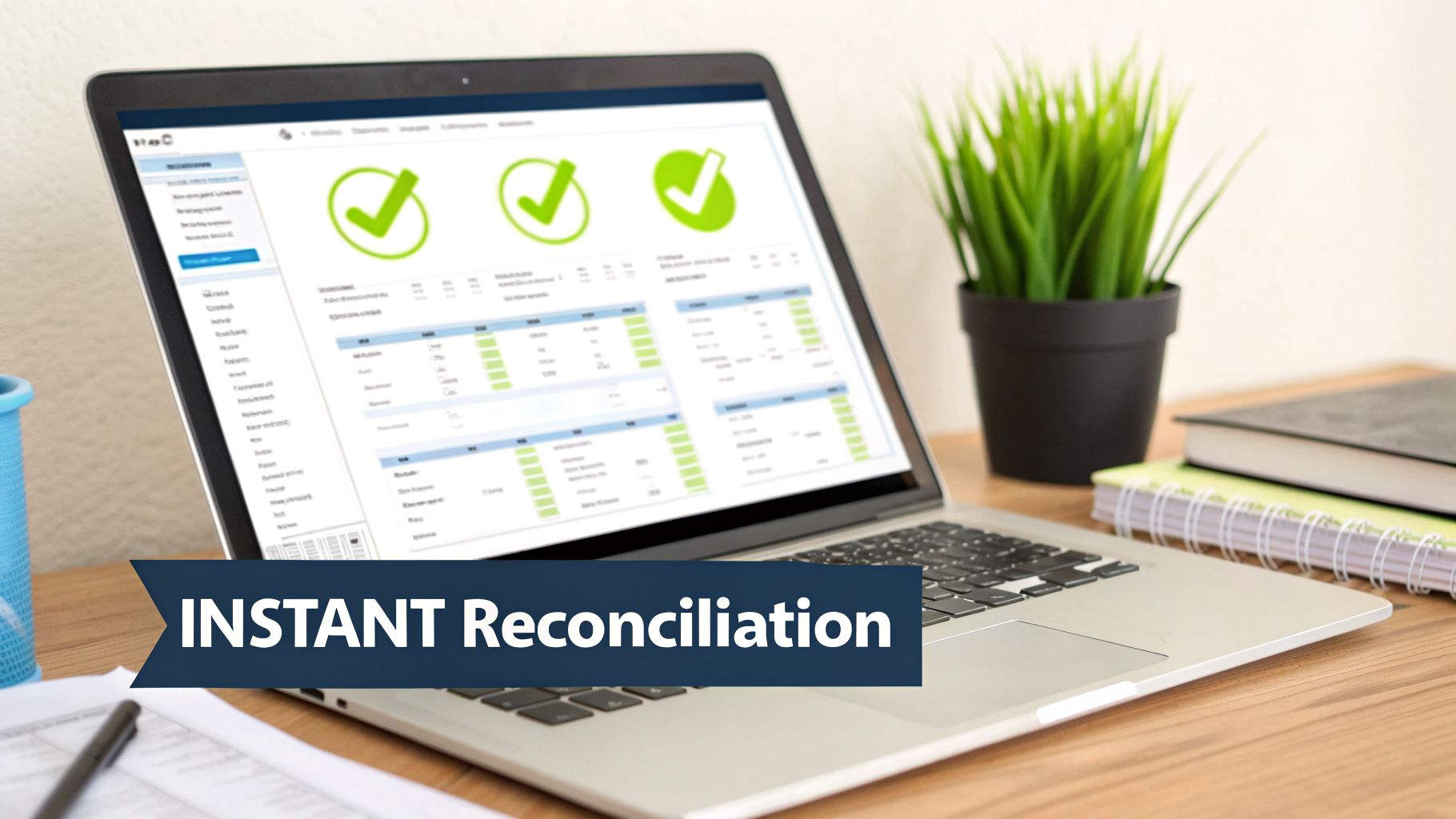
Accounts receivable automation platforms solve the reconciliation challenge by integrating directly with bank feeds and the accounting ledger, creating a seamless data flow.
Instead of personnel manually parsing bank statements, an integrated system automatically ingests remittance data, matches payments to the correct invoices, and closes the receivables in the general ledger. The manual component of the work is eliminated.
At its core, this is an application of data entry automation. With trusted data entering the system at the point of payment, reconciliation shifts from a primary job function to a background validation task. This frees the finance team to focus on high-value analysis rather than data entry.
From Hours to Minutes: A Practical Example
Consider a mid-sized consulting firm with $15M in annual revenue. The controller spent nearly a full day each week reconciling payments in QuickBooks. With dozens of checks and ACH transfers, errors were frequent, and DSO was static at 58 days.
After implementing an AI AR automation platform, the process changed.
- Clients began paying via a branded online portal that captured remittance data upfront.
- The system achieved a 95% automatic match rate for incoming ACH payments.
- The weekly reconciliation task was reduced from 6 hours to under 30 minutes.
The cash flow impact was direct. They reduced DSO by 12 days within the first quarter, unlocking over $490,000 in working capital. This demonstrates how accounts receivable automation directly improves a firm’s financial position.
This is not about saving administrative time; it is about achieving real-time financial clarity and control. You can see how these systems function in our guide on how to automate accounts receivable.
When you send an ACH payment online within an automated ecosystem, you accelerate your entire cash conversion cycle.
The Resolut Approach to Integrated AR and ACH
Legacy accounts receivable processes are inefficient by design. An invoice is sent, followed by a period of waiting, manual follow-ups, and cumbersome reconciliation. This system is slow and creates a persistent drag on cash flow because it was designed for accountants, not for operators who require speed and visibility.
Resolut was built from an operator's perspective. It is more than a tool to send an ACH payment online; it is a complete system that automates the entire invoice-to-cash lifecycle, providing finance leaders at professional services firms with the clarity and control required to manage the business.

Smart Collections and Effortless Payments
Effective collections begin before an invoice becomes overdue. Resolut's AI AR automation initiates personalized payment reminders through the client's preferred channel, whether email or SMS. These communications are tailored to sound as if they came directly from your team, not a robot.
Each reminder contains a secure link to a client-friendly payment portal. There, they can authorize an ACH payment through a simple, consumer-grade interface, entering banking details once. We make it easy for them to pay you promptly.
By embedding the payment link within the reminder, you eliminate process friction. Clients do not need to locate old invoices or navigate their bank’s bill pay system, which significantly reduces your time-to-cash.
Closing the Loop with Automatic Cash Application
Receiving payment is only half the process. The operational burden for most AR teams lies in the manual matching of that payment to the correct invoice in the ledger. This is where data entry errors occur and where teams lose productive hours.
Resolut automates this final, critical step.
The moment an ACH payment clears, our system instantly applies the cash, finds the corresponding open invoice, and reconciles the transaction in your accounting software, delivering seamless QuickBooks AR automation.
This end-to-end accounts receivable automation provides two direct bottom-line benefits:
- A material reduction in DSO. By compressing the time between invoicing and reconciled cash, you immediately improve cash flow.
- A real-time view of your financial position. Your books remain continuously accurate, providing a reliable basis for strategic decisions.
This is a closed-loop system. It transforms accounts receivable from a reactive, manual function into a predictable, automated process that generates measurable value.
A Q&A for Finance Leaders
As a finance leader, you evaluate new initiatives based on cost, risk, and operational efficiency. Adopting online ACH payments is no exception. Here are direct answers to the questions we hear most from CFOs, Controllers, and firm owners.
What Are the Typical Fees and How Do They Compare to Credit Cards?
The cost differential between ACH and credit cards is significant, especially for B2B invoices.
ACH fees are typically flat, ranging from $0.25 to $1.50 per transaction, regardless of the payment amount. In contrast, credit cards charge a percentage, usually 1.5% to 3.5%.
On a $10,000 invoice, the ACH fee might be $1. The same payment via credit card could cost $350. For a firm with high-value invoices, credit card fees directly erode profit margins. The predictability of a flat ACH fee is superior for financial planning and forecasting.
How Can We Securely Handle ACH Authorization Without Compliance Risk?
This is a critical control point. Nacha rules mandate that you must have auditable proof of a client's authorization to debit their account.
The only secure and scalable method is a compliant online payment portal. A robust portal encrypts and tokenizes all banking information, meaning sensitive data never transits your servers. This control alone massively reduces your firm's risk profile and compliance burden.
Never collect banking details over email or by phone. A modern portal captures a digital audit trail for every authorization—including date, timestamp, and IP address—providing irrefutable proof in the event of a dispute. Systems providing QuickBooks AR automation often manage this entire process, removing the compliance burden from your team.
Will Automating ACH Payments Hurt Our Client Relationships?
The concern is that automation feels impersonal. When implemented correctly, the opposite occurs. It enhances the client relationship by making your firm easier to work with.
No client prefers a manual, high-friction payment process. Providing a simple, secure portal to send an ACH payment online is a professional courtesy that respects their time and modernizes their experience with your firm.
The objective of AI AR automation is not to send aggressive, robotic demands. It is to create persistent, professional, and human-sounding follow-up. This organized efficiency reflects positively on your entire operation.
The best accounts receivable automation platforms operate with a "human-in-the-loop" model, giving your team full control. Automated reminders can be personalized, paused for specific clients, or adjusted as needed. You are using technology to ensure nothing is missed, which builds client confidence and preserves the relationship.
--- Resolut automates AR for professional services—consistent, accurate, and human.