Optimize Terms and Conditions Payment Terms for Cash Flow Control
Optimize your terms and conditions payment terms to reduce DSO and improve cash flow. A practical guide for CFOs at professional services firms.
Payment terms are more than legal boilerplate. They are a primary control valve for your professional services firm’s cash flow. Mastering these terms is the difference between chronic cash crunches and operating with predictable financial stability.
Why Payment Terms Are Your Most Powerful Financial Lever
For a professional services firm, cash flow is the operational lifeblood. Yet many firms treat their terms and conditions payment terms as a static, unchangeable part of their contracts. They default to "Net 30" and move on.
This passive approach is a significant operational miss.

Vague or generous payment clauses directly inflate Days Sales Outstanding (DSO), trapping working capital in accounts receivable. Every extra day an invoice sits unpaid is another day you provide an interest-free loan to your client. This directly hobbles your ability to meet payroll, invest in growth, or manage a surprise expense.
From Legal Formality to Operational Tool
It’s time to stop thinking of T&Cs as a defensive legal document and start seeing them as a proactive operational tool. When you are strategic about the language and structure of your terms, you can directly improve cash flow and gain control over your finances. It's a fundamental shift from passively hoping for payment to actively managing the cash collection cycle.
The impact of weak terms is measurable and painful. Unfavorable payment structures like Net 30 or Net 60 are a primary driver of high DSO. Enterprises waste up to $200 billion annually on administrative AR burdens and 1 in 10 invoices go unpaid. You can learn more about the broader impact of payment processing on the market.
This isn't just about getting paid. It’s about getting paid on a timeline that strengthens your balance sheet. The goal is to build a system where your payment terms actively work to improve cash flow, not impede it.
The Direct Cost of Lenient Terms
When payment terms are too relaxed, you create a cascade of financial and operational problems that ripple across the entire firm:
- Increased Working Capital Needs: Longer payment cycles mean you must fund operations with your own capital or draw on expensive credit lines while you wait for clients to pay.
- Higher Administrative Burden: Your finance team spends more time and resources chasing late payments, pulling them from high-value strategic work.
- Inaccurate Financial Forecasting: Unpredictable payment cycles make it impossible to forecast cash positions with any certainty, turning strategic planning into a guessing game.
A firm with $10 million in annual revenue on Net 60 terms is effectively financing $1.67 million of its clients' operations at any given time. Cutting that to Net 30 frees up over $830,000 in working capital.
By optimizing your terms and conditions payment terms, you can directly reduce DSO and build a more resilient financial foundation.
Understanding the direct impact of different term structures is key. The table below illustrates how various terms correlate with financial metrics like DSO and cash flow.
Direct Impact of Payment Term Structures |
|---|
Payment Term | Typical DSO Range | Cash Flow Impact | Operational Overhead |
Net 30/60 | 45-75 days | Slows cash conversion, ties up working capital. | High; requires consistent follow-up and collections efforts. |
Milestone Payments | Varies (aligned with project progress) | Predictable, tied to value delivery. Improves cash flow. | Moderate; requires project tracking and invoicing at each stage. |
Partial Upfront (Deposit) | Immediate for deposit, then Net 30 | Excellent; secures immediate cash and reduces non-payment risk. | Low for the initial payment, standard for the remainder. |
Early-Pay Discount | <10 days | Accelerates cash flow significantly, but at a small cost. | Low; automated systems can manage this easily. |
Moving away from a simple "Net X" model toward more strategic structures has a profound and immediate positive effect. The key is to view these clauses not as static contractual obligations but as dynamic levers for financial performance. Automating this process with tools like QuickBooks AR automation or more advanced AR software for professional services ensures these terms are enforced consistently.
This guide walks you through building a payment structure that protects and enhances your firm’s financial health.
Designing Payment Terms That Accelerate Cash Collection
If your standard payment term is still "Net 30," you are leaving cash on the table. Your terms and conditions payment terms are a tool to actively pull cash into your business. In professional services, where value is delivered over weeks or months, your payment structure must mirror that exchange. This is about creating a smart agreement that aligns incentives and protects your working capital.

A one-size-fits-all term is a blunt instrument. Experienced finance leaders use a menu of payment options, choosing the right one for the right client and project. This transforms your accounts receivable from a passive waiting game into a dynamic system designed to improve cash flow.
Secure Commitment With Upfront Payments
For any new client or project, a deposit or retainer should be non-negotiable. It is the simplest way to assess a client’s seriousness and get cash in the door to cover initial costs, immediately de-risking the engagement.
An upfront payment of 25-50% is a reasonable industry standard. It proves the client has skin in the game and ensures you aren't financing the start of their project. It is also an excellent filter for committed partners.
Align Cash Flow With Project Milestones
For any project spanning more than a month, milestone-based billing is optimal. Instead of sending one large invoice at the end, you tie payments to specific, tangible achievements. The result is a steady, predictable flow of cash.
An engineering firm on a nine-month design project might structure payments as: 25% after initial schematic approval, 30% at design development completion, another 30% upon submitting construction documents, and the final 15% at project closeout.
When you bill this way, you directly connect your invoice to the value you've just delivered. This doesn't just reduce DSO; it makes payment conversations with clients feel like a shared celebration of progress.
Incentivize Behavior With Discounts and Penalties
Early-payment discounts and late-payment penalties are classic behavioral nudges that get invoices paid on time. Frame them as standard, professional business mechanics.
- Early-Payment Discounts: Offering a small discount like "2/10 Net 30" (a 2% discount if paid in 10 days) can accelerate collections. For a firm with $5M in annual revenue, getting just 20% of receivables in 20 days earlier can free up over $50,000 in working capital. See more options in our guide on invoice payment terms examples.
- Late-Payment Penalties: A late fee, typically 1.5% per month on the outstanding balance, acts as a powerful deterrent. When a client knows there's a real cost to being late, your invoice naturally moves to the top of their payment queue.
The best way to manage this is through accounts receivable automation. A good system can apply discounts and calculate late fees with perfect consistency. Modern AI AR automation can even tailor reminder communications based on a client’s payment history, applying the right pressure at the right time.
Designing effective terms and conditions payment terms is about taking control of your cash flow. Moving from a single default term to a strategic, multi-faceted approach is a core skill for any finance leader building a more resilient, cash-positive company.
Drafting Clear and Enforceable Payment Clauses
Smart payment strategies fail if the contract language is weak. Ambiguity is the enemy of healthy cash flow; it creates loopholes for clients, sparks disputes, and delays payment.
Your terms and conditions payment terms are your first line of defense. This isn’t just a document for lawyers; it’s an operational instruction manual you hand to every client. Vague phrases like “payment due upon receipt” are invitations for delay. Your best tool is precision.
Core Components of an Airtight Payment Clause
A strong payment clause is built on non-negotiable pillars. Each one strips away doubt and sets clear expectations. This upfront clarity is the foundation for any effort to reduce DSO.
Every payment clause needs to spell out:
- Due Dates: Be explicit. Instead of "Net 30," use "Payment is due within 30 calendar days of the invoice date." This removes any question of when the payment clock starts.
- Payment Methods: Make it easy to pay you correctly. Clearly list accepted methods (ACH, wire transfer, credit card, client portal). This stops the back-and-forth when a client attempts to pay via an unsupported channel.
- Late Payment Consequences: Be direct. "A late fee of 1.5% per month will be applied to all outstanding balances not paid within the specified term." This is straightforward and enforceable.
- Dispute Resolution: Create a clear pathway for disagreements. For example: "All invoice disputes must be submitted in writing to ar@yourfirm.com within 10 business days of invoice receipt." This contains the problem and prevents a small query from holding up an entire payment.
To make your terms hold up, it’s crucial to understand what legally constitutes a breach of contract. When terms are well-defined, it becomes obvious when a client has failed to meet their obligation, giving you a firm legal footing.
From Vague Language to Enforceable Terms
The difference between a clause that gets you paid and one that gets ignored is in the details. Small wording changes can dramatically improve your ability to collect on time.
Vague & Ineffective | Precise & Enforceable |
|---|---|
Payment is due promptly. | Payment is due within 15 calendar days of the invoice date. |
Late payments may incur fees. | A service charge of 1.5% per month will be assessed on unpaid balances after 30 days. |
Contact us with any questions. | All invoice disputes must be submitted in writing within 10 business days. |
This precision sets a professional tone. It tells clients you run a tight ship and expect to be paid with the same rigor you bring to your work.
We saw a professional services firm tighten its payment language from "Net 30" to "Payment due 30 calendar days from invoice date," while also specifying a 1.5% monthly late fee. Their average DSO dropped by 8 days in six months. That small change unlocked over $130,000 in working capital.
Your goal is to write terms and conditions payment terms that are not only legally sound but also easy to follow. When your rules are this clear, they become much easier to automate. Accounts receivable automation software can then execute your policies—sending reminders, applying fees, and flagging disputes—with perfect consistency.
How to Operationalize Payment Terms with AR Automation
A well-written contract is a starting point. Those carefully negotiated terms and conditions payment terms are just words on a page until enforced. The gap between your legal document and your bank account is bridged by one thing: operationalization. Today, that means automation.
Think of your payment terms as the playbook for getting paid. Accounts receivable automation is the system that executes those plays perfectly, every time. It turns static contract clauses into active, automated workflows that protect cash flow.
Turning Contract Language into Automated Action
Imagine your collections process running on autopilot, guided by your rules. That is what AR software for professional services does. It reads the logic of your payment terms—due dates, discount windows, late fee triggers—and turns them into a sequence of automatic actions.
This goes beyond scheduling generic email blasts. It’s a smart system where:
- Payment Reminders are sent automatically based on each invoice's due date, with escalating tone and frequency.
- Late Fees get calculated and added the moment an invoice becomes overdue, removing awkwardness and inconsistency.
- Early-Pay Discounts are actively offered through a payment portal, giving clients a clear incentive to pay faster.
This systematic approach eliminates human error, removes emotional friction from collections, and lifts a huge administrative weight off your team. Firms that get this right often see a 10-15% reduction in DSO within the first year, simply because their rules are finally enforced without fail.
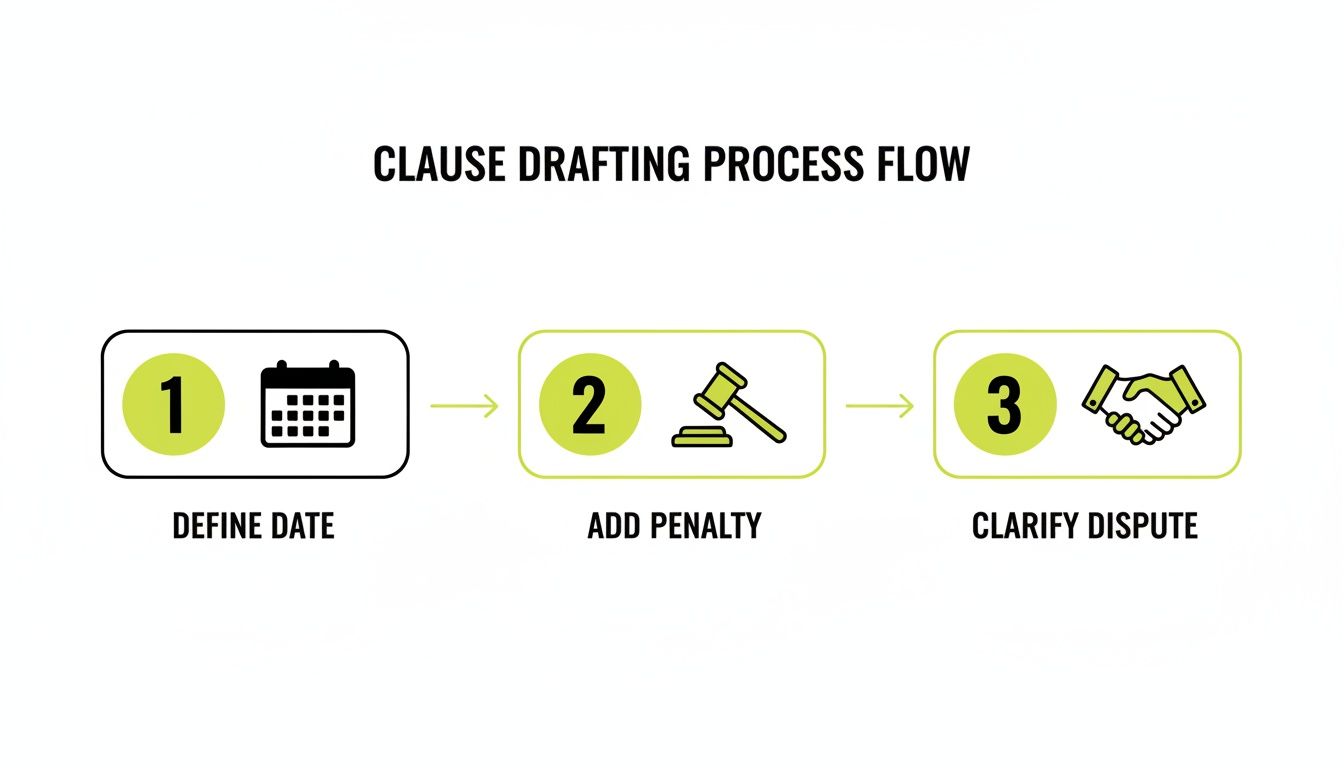
As you can see, strong terms are built on clear dates, defined penalties, and a process for disputes—all elements that automation executes with precision.
The Smart Way to Enforce Terms with AI
Modern AI AR automation adds a layer of intelligence. Instead of applying the same collections cadence to every client, an AI-powered system can segment customers and customize its approach based on payment history, risk factors, and project size.
A high-value client who always pays on time might get a soft, relationship-focused reminder. A client with a history of late payments could automatically be put on a more assertive communication schedule. Manual teams cannot do this at scale. Learn more about how to automate accounts receivable and the results it drives.
By operationalizing their terms with AI AR automation, one $20M consulting firm spotted at-risk accounts 30 days earlier than their manual process allowed. This foresight helped them reduce bad debt write-offs by $250,000 in a single year.
This level of control changes your finance department from a reactive group chasing payments into a proactive team managing the firm's financial health. With platforms that integrate directly with your accounting software, like QuickBooks AR automation tools, getting started is straightforward.
By embedding your terms and conditions payment terms into an automated system, you build a financial framework that practically enforces itself. This not only helps improve cash flow and reduce DSO but also frees your team to focus on high-value strategic work.
Communicating and Enforcing Payment Terms
Even carefully crafted terms and conditions payment terms are useless if not communicated clearly and enforced consistently. For finance operators, "enforcement" isn't about aggression. It’s about professional, predictable communication that keeps cash flowing and client relationships intact.
This process begins at client onboarding. Having a finance leader—not just a salesperson—walk them through payment expectations sets a professional tone from day one. It signals that timely payment is a crucial part of the business partnership.
Proactive Communication Is Key
The best enforcement strategy is proactive. Waiting for an invoice to become delinquent before you pick up the phone is a recipe for cash flow problems. A better approach is a structured communication cadence that guides the client from the moment an invoice is sent.
Think of it as a customer service function. A polite reminder sent a few days before the due date can prevent a significant number of late payments. Firms that set up automated pre-due-date reminders see their DSO drop, often by 5-10 days within the first couple of quarters.
To make this happen, you need a reliable system for sending timely, automated messages. Using a solid invoice reminder template is a great starting point for ensuring your communication is always consistent and professional.
There is a direct line between consistent communication and a lower DSO. Every touchpoint reinforces your terms and nudges you closer to payment.
A Clear Escalation Path
Not every client will pay on time. That's why an automated system needs a clear escalation path for when gentle nudges don’t work. This applies the right pressure at the right time, protecting both cash flow and client relationships.
A well-defined escalation path might look like this:
- Automated Reminders (Day -3 to Day +15): The system sends gentle, automated emails. The tone is helpful, assuming the invoice was overlooked.
- Personalized Email (Day +16): An AR specialist sends a personal email. The tone is collaborative, asking if there's an issue with the invoice.
- Controller Phone Call (Day +30): A senior finance team member makes a direct call to understand the root cause and get a firm payment date.
- Formal Notice (Day +60): A formal letter restates the overdue balance and references the late fee clauses in the signed contract.
This structured process takes emotion and guesswork out of collections. Modern AI AR automation can flag at-risk accounts by analyzing payment patterns, letting your team step in before an account becomes severely delinquent. Our guide on payment reminder templates provides examples for each stage.
By combining clear upfront communication with a logical, data-backed escalation plan, you turn collections into a predictable and effective business process. That level of control is how you build a stable cash flow.
***
The CFO's Playbook for Mastering Cash Flow
For a CFO or Controller, gripping your company’s payment terms is how you steer the firm’s financial future. We’ve covered designing smart terms, drafting clear contracts, automating execution, and handling enforcement. Let’s pull it together into a practical playbook.
The big idea is to stop seeing your terms and conditions as a dusty legal document. Instead, see them as a powerful tool you use every day. This shift moves you from nervously chasing late payments to proactively managing your cash. The win isn't just feeling in control; it's seeing measurable results on your P&L and balance sheet.
A Framework for Financial Control
The path to mastering cash flow is a clear, repeatable process. Think of each step as a lever you can pull to improve cash flow and make your business more resilient.
This framework is your roadmap:
- Strategic Design: Move beyond "Net 30" as a default. Design terms that match your workflow, such as requiring upfront deposits, billing at project milestones, or offering early-pay discounts.
- Airtight Drafting: Vague terms lead to late payments. Use precise, simple language to spell out due dates, late fees, and dispute resolution. A clause that says, “Payment is due within 15 calendar days,” is an instruction. "Payment is due promptly" is a suggestion.
- Automated Execution: This is where strategy meets reality. Using accounts receivable automation, you can turn your T&Cs into workflows that run like clockwork. This means reminders go out on time and late fees are applied correctly, eliminating human error and delays.
- Respectful Enforcement: Automation handles the routine; people handle relationships. Let your AR software for professional services flag at-risk accounts early. When data shows a potential problem, your team can step in personally, protecting the bottom line while preserving client relationships.
Measuring Tangible Outcomes
Putting this playbook into action creates real, measurable results that directly address the pressures every finance leader feels.
A firm with $15M in revenue and a 60-day DSO has $2.5M tied up in AR. By implementing this playbook and using AI AR automation, they can realistically target a 45-day DSO. This single change unlocks over $620,000 in cash—capital for hiring, bonuses, or strategic investments.
The benefits compound on each other:
- Dramatically Lower DSO: Every day shaved off your Days Sales Outstanding puts cash back into your business.
- Predictable Cash Flow: When collections are consistent, financial forecasting becomes far more accurate.
- Less Administrative Drag: Free your finance team from chasing payments to focus on high-value analysis and planning.
- Stronger Client Relationships: Clear, professional communication about money reduces friction and builds trust.
Mastering your terms and conditions payment terms is about operating from a position of financial strength. It gives you the control and predictability to lead your firm with confidence.
Frequently Asked Questions
When it comes to optimizing terms and conditions payment terms, CFOs and Controllers in professional services often have the same practical questions. Here are a few of the most common.
What are the best payment terms for a consulting firm?
There is no single best term; it should mirror your client engagement structure. For project-based work, a hybrid model is highly effective.
Start with a 25-50% upfront deposit. Then, bill against key milestones tied to deliverables, with the final payment due upon completion. This approach keeps cash flowing throughout the project.
For ongoing retainer work, monthly payments in advance are the gold standard. This simple structure aligns your cash flow with service delivery. The goal is to improve cash flow by getting paid as you perform the work.
How do we introduce stricter payment terms to existing clients?
This is a manageable conversation. Frame the change as a process improvement that helps you serve them better—it's about operational maturity, not being difficult.
Give plenty of notice, at least 60 to 90 days. For key accounts, a personal call from a senior finance leader to explain the "why" is non-negotiable.
A good strategy is to grandfather existing projects under old terms. Then, apply the new, stricter terms to all new statements of work. This ensures a smooth and respectful transition.
Are late fees enforceable and do they actually work?
Yes, provided they are clearly stated in a signed agreement and are reasonable under local laws. A 1.5% monthly charge is a common and widely accepted figure.
Their power is twofold. First, they compensate you for financing your client’s overdue payment. More importantly, they create a powerful behavioral nudge that encourages on-time payment.
When you use accounts receivable automation to apply these fees consistently, it takes the awkwardness out of the equation. It sends a clear signal that your due dates are firm and must be respected.
--- Resolut automates AR for professional services—consistent, accurate, and human. Learn more.