
Boost Cash Flow: Subscription Billing Management 2026
Improve cash flow & reduce DSO with expert subscription billing management. A 2026 guide for CFOs on automation, KPIs & best practices for services firms.
You moved clients onto monthly retainers to smooth revenue. Sales did its job. Contracts are signed. Yet cash still arrives in uneven waves, your controller is chasing invoice exceptions, and someone on the team is manually checking whether the right amount went out at the right time.
That's the recurring revenue paradox in professional services. The contract looks stable, but the cash profile doesn't.
In firms between $3M and $50M, I've seen the same pattern repeat. Leaders assume the retainer model itself will improve predictability. It helps, but only if billing is disciplined. Without that discipline, retainers become another source of operational drag. Scope changes get handled in email, invoice dates drift, payment reminders depend on who remembers, and QuickBooks becomes the place where problems show up, not where they get solved.
Subscription billing management matters here, but not in the usual SaaS sense. For a services firm, it's an operating control. It's the mechanism that turns recurring agreements into usable working capital.
The Recurring Revenue Paradox in Professional Services
A common scene in services finance looks like this. An agency has shifted a meaningful share of clients to monthly service agreements. Revenue is more visible than it was under pure project work. But the finance team still closes each month with a scramble. One client started mid-cycle and needs proration. Another added a service line that never made it into billing. A third has a PO mismatch, so the invoice sits.
The result isn't just inconvenience. It's instability.
Recurring revenue only behaves like predictable cash when the commercial model, billing rules, and collection process are tied together. If they aren't, each “simple” retainer creates a string of manual decisions. Those decisions pile up in finance, account management, and delivery.
Why retainers still feel chaotic
Professional services firms usually don't sell a clean, fixed subscription. They sell a retainer plus approvals, extra hours, pass-through costs, scope changes, pauses, credits, and occasional clean-up work. That's why subscription billing management in this context is less about software labels and more about process control.
When firms skip that control, three things happen:
- Billing drifts from delivery: Work gets done before billing rules are updated.
- Collections become personal: Follow-up depends on account managers, not a system.
- Forecasts lose credibility: Revenue may be booked, but cash timing stays uncertain.
Practical rule: If a client can change service levels faster than your team can update billing, you don't have recurring revenue under control.
This is also where growth starts to expose weak finance operations. Teams reading a broader 2026 agency growth guide often focus on pipeline, packaging, and expansion. That's useful. But growth magnifies billing inconsistency. More recurring clients with loose billing controls don't create stability. They create a larger backlog of preventable exceptions.
The operating shift that fixes it
The firms that get this under control stop treating invoicing as an end-of-month task. They treat billing as a managed workflow from contract through cash. That means defined billing triggers, ownership for exceptions, standard rules for changes, and a collection cadence that doesn't rely on memory.
Once that discipline is in place, recurring revenue starts behaving the way leadership expected in the first place. Not perfect. But controlled.
The Core Components of Subscription Billing Systems
Most billing systems look similar in a demo. The difference shows up when a services client changes scope on the 14th, asks for a split invoice, and pays on net terms instead of card. That's where the core components either reduce friction or create it.
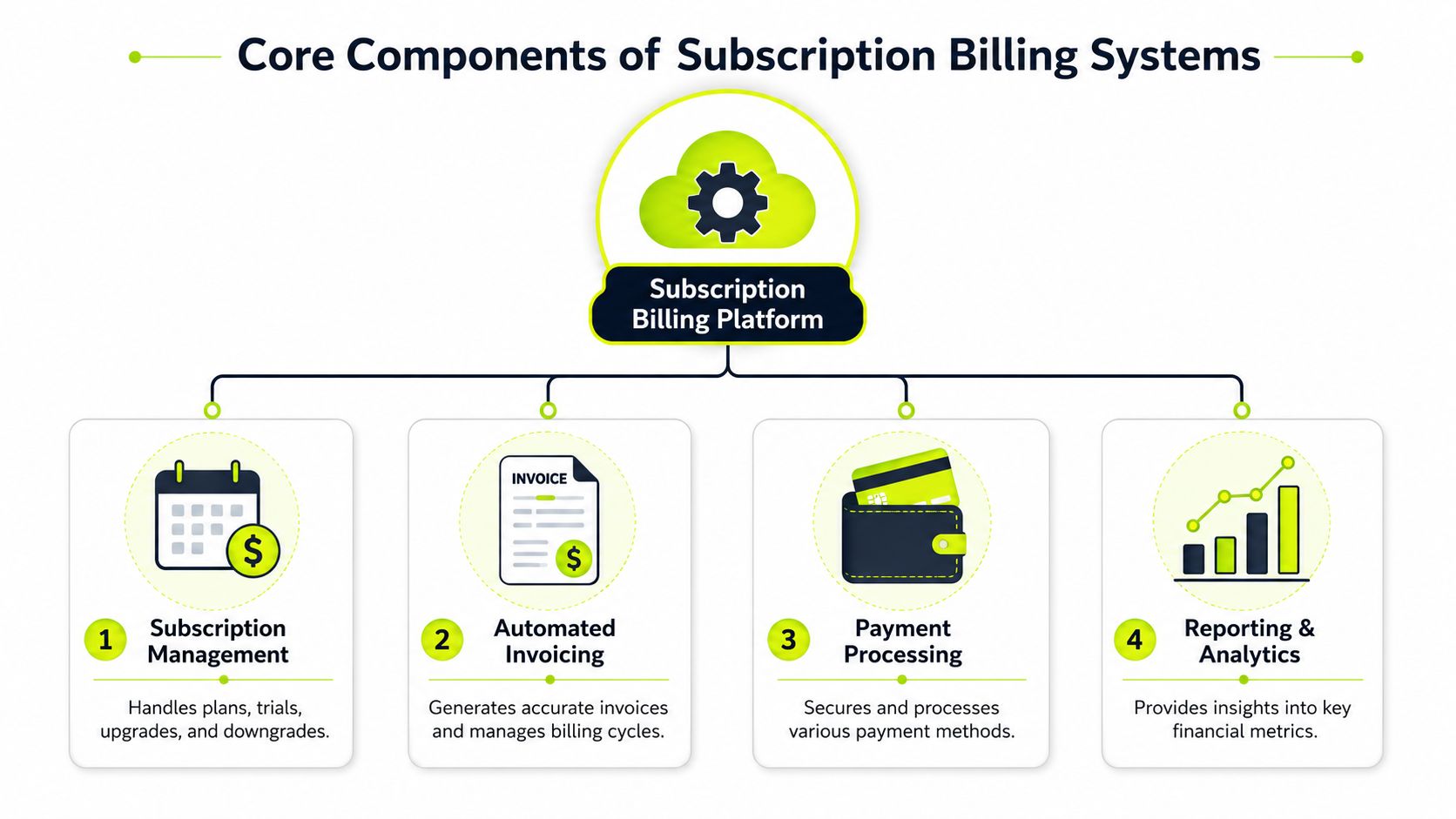
Subscription management
At the front of the system is plan logic. In a professional services firm, that usually means more than one billing shape. You may have a base retainer, overage rates, project add-ons, one-time onboarding, and renewal dates that don't line up neatly with the calendar.
The job here is simple in theory. Keep the commercial agreement reflected accurately in the billing engine. In practice, this means the system has to handle:
- Retainers plus variable work: A client pays a fixed monthly fee, with approved overages added without manual rebuilding.
- Mid-cycle changes: New services, temporary pauses, and credits need rules, not spreadsheet workarounds.
- Renewal administration: Terms shouldn't live only in PDFs and account manager inboxes.
For firms that struggle with client changes, even a simple customer-facing explanation of adjusting service levels is a useful reminder that billing flexibility has to be matched by internal control.
Automated invoicing
Many teams think subscription billing management begins and ends with invoicing. It doesn't. But accurate invoicing is still the hinge point.
A useful invoicing layer should generate recurring invoices on schedule, apply proration consistently, and pull in approved adjustments without finance rebuilding line items by hand. If you're evaluating tools in this area, this overview of subscription invoicing software is a practical starting point.
A controller should expect invoicing logic to answer questions like these:
Billing issue | What the system should do |
|---|---|
Client starts mid-month | Calculate proration consistently |
Scope increases after approval | Add new recurring amount on the correct date |
One-time setup fee | Bill once without altering the recurring schedule |
Paused service period | Apply credit or suspend recurring billing by rule |
Without that structure, finance ends up reviewing every invoice as a custom event.
The fastest way to create billing chaos is to let sales promise flexibility without defining how finance will bill it.
Payment processing and collections setup
Generating an invoice is only part of the control model. Clients need a payment path that fits how they buy. Some will pay by bank transfer. Others need cards or digital methods. Enterprise clients may still work through AP portals and approval chains.
The system should support that reality while keeping collections client-friendly. That includes stored payment preferences where appropriate, clear due dates, and reminder workflows that feel consistent rather than aggressive. In services, tone matters. So does timing.
Reporting and reconciliation
The last component is the one finance teams care about most after go-live. Can the billing system reconcile back to the general ledger, AR, and revenue reporting without manual clean-up?
If the answer is no, automation upstream just creates accounting work downstream.
A sound reporting layer should make it easy to trace billed amounts, collected cash, unapplied payments, credits, and exceptions. Controllers also need confidence that recurring billing activity lands cleanly in the books. Otherwise, the team saves time issuing invoices and loses it all in reconciliation.
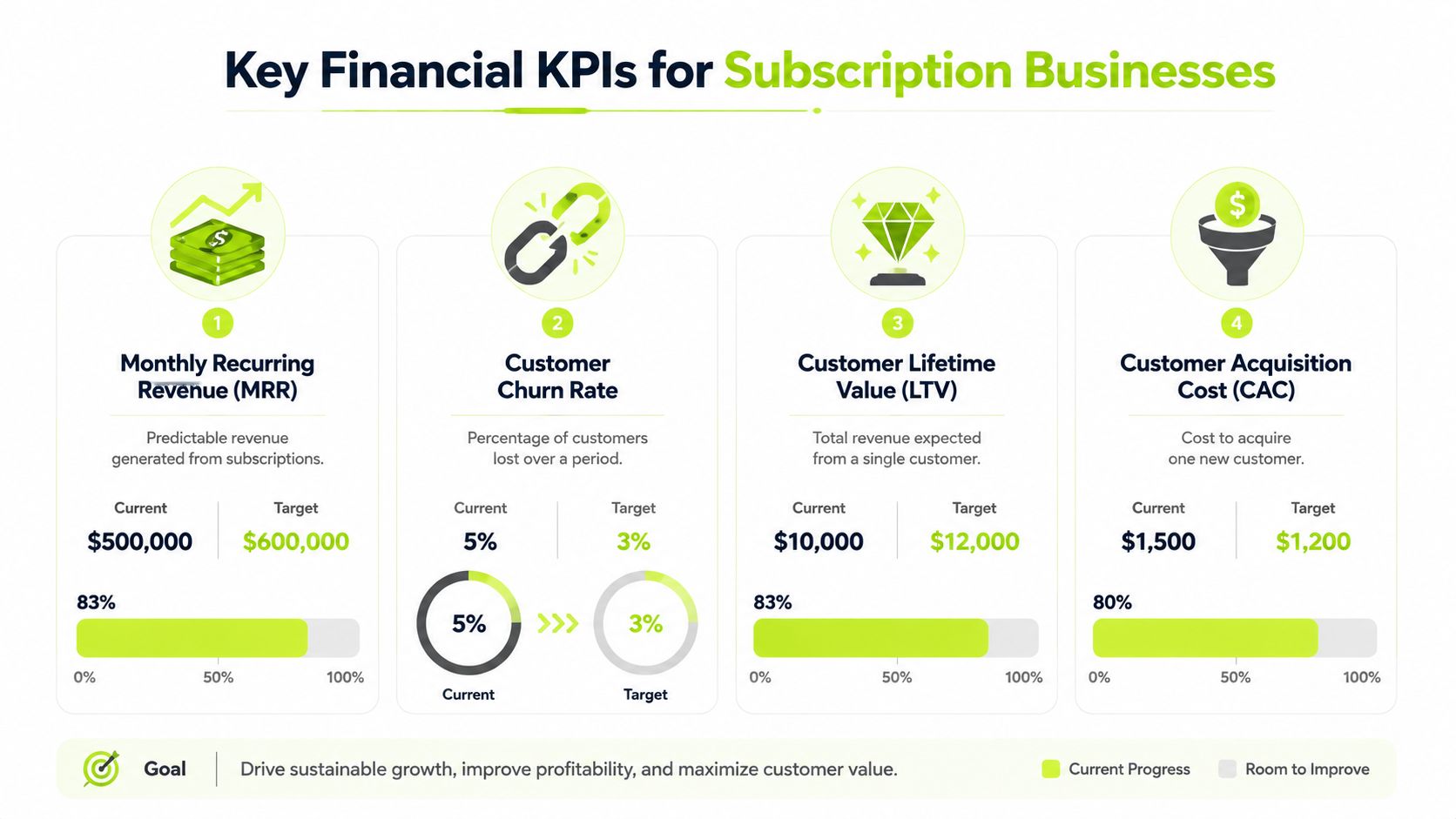
Key Financial KPIs to Track and Improve
Finance leaders don't need more billing activity. They need better control over cash conversion. That means tracking a short set of KPIs that tie billing mechanics to working capital.
A useful dashboard starts with visibility, not volume. If the team can't explain movement in receivables, recurring revenue isn't under management.
DSO and aging first
For professional services firms, Days Sales Outstanding is still the clearest indicator of how well revenue becomes cash. The benchmark is not flattering. Professional services firms have an average Days Sales Outstanding of 74 days, which is high relative to many B2B sectors and ties up working capital, as noted in this Resolut analysis of AR performance.
The formula is straightforward:
- DSO = Accounts receivable / Revenue per day
You don't need a perfect board deck to use it. You need trend visibility. If DSO is rising while retained revenue looks stable, the billing and collection process is leaking time somewhere between invoice creation and payment.
AR aging adds the second layer. It shows where the blockage sits. Current invoices may point to terms and cadence. Older buckets usually point to disputes, weak follow-up, or poor escalation.
Here's a clean operating lens:
KPI | Formula | What it tells you |
|---|---|---|
DSO | AR / Revenue per day | How long cash is taking to arrive |
AR aging | Receivables grouped by due date | Where collection effort is stalling |
Dunning recovery rate | Collected after reminder workflow / Total reminded invoices | Whether follow-up is working |
A small improvement in DSO can materially change day-to-day flexibility. When cash arrives faster, leadership has more room to fund payroll, hiring, and vendor commitments without relying on avoidable financing pressure.
Recurring revenue quality
MRR gets a lot of attention, but for services firms it should be treated carefully. Monthly recurring revenue is useful when the underlying contracts are actually recurring and billing rules are consistent. If not, MRR can become a comforting number that hides invoicing noise.
Churn also matters, although services churn often shows up as downsizing before cancellation. Finance should watch not just logo loss, but changes in contracted value and recurring billing adjustments over time.
A practical KPI set usually includes:
- MRR: Contracted recurring billings expected monthly
- Churn: Lost recurring contract value or clients over a period
- Expansion or contraction: Net movement in recurring client value
- Collection effectiveness: How much reminded AR converts to cash
For teams that want a quick primer before building the dashboard, this short walkthrough is useful.
What a CFO should look for weekly
The dashboard should help answer three questions fast:
- Are invoices going out correctly and on time?
- Is cash arriving when terms suggest it should?
- Which accounts need human intervention instead of more automation?
A billing dashboard should shorten decision time. If it creates more questions than answers, it's reporting activity, not control.
Common Billing Pitfalls That Erode Profitability
Most firms don't lose margin in dramatic ways. They lose it in small billing failures that become normal.
The most expensive phrase in services finance is, “We'll fix it next invoice.” Usually that means some work has already been delivered, the invoice is already wrong, and AR is about to inherit a preventable problem.
Revenue leakage hides in ordinary work
The largest issue is often not pricing. It's execution. Manual billing processes can lead to revenue leakage of 1% to 5% of total annual revenue due to unbilled services, incorrect invoicing, and missed renewals. That finding is cited in the earlier Resolut source discussed above.
In a services firm, that leakage usually comes from familiar places:
- Unbilled scope creep: Delivery teams do the extra work, but nobody updates the billing record.
- Incorrect invoice construction: Retainer, overage, and one-time items are assembled manually and one element gets missed.
- Renewal drift: The client keeps receiving service, but pricing or terms are never refreshed.
These aren't edge cases. They're routine failures in firms without strong subscription billing management.
Manual reconciliation is more expensive than it looks
QuickBooks is often where finance discovers the mismatch, not where the mismatch started. The invoice in the accounting system may be technically issued, but that doesn't mean it aligns with the contract, the service period, or the payment promise.
Controllers see the drag in three places:
Failure point | Operational effect |
|---|---|
Invoice edits after sending | Rework, client confusion, delayed payment |
Payment posted without context | Time lost matching remittance to invoice |
Separate records across CRM, delivery, and accounting | No single source of truth |
This is why QuickBooks AR automation has become such a common conversation. Not because QuickBooks is the problem, but because manual steps around it create downstream friction.
Inconsistent reminders damage collections and relationships
A lot of firms still rely on account managers or finance staff to “nudge” clients manually. The intent is good. The execution is uneven. One client gets a polite reminder before due date. Another hears nothing for weeks. A third only gets attention once the balance is already old enough to create tension.
That inconsistency hurts in two ways. It delays cash, and it teaches clients that payment timing is negotiable.
If your reminder process depends on who remembers to send the email, it isn't a process. It's a liability.
An Implementation Checklist for Billing Automation
Billing automation fails when firms start with tools instead of operating rules. The better path is to tighten the commercial model first, then automate the repeatable parts, then build exception handling around reality.
That sequence matters. Otherwise, bad process gets embedded faster.
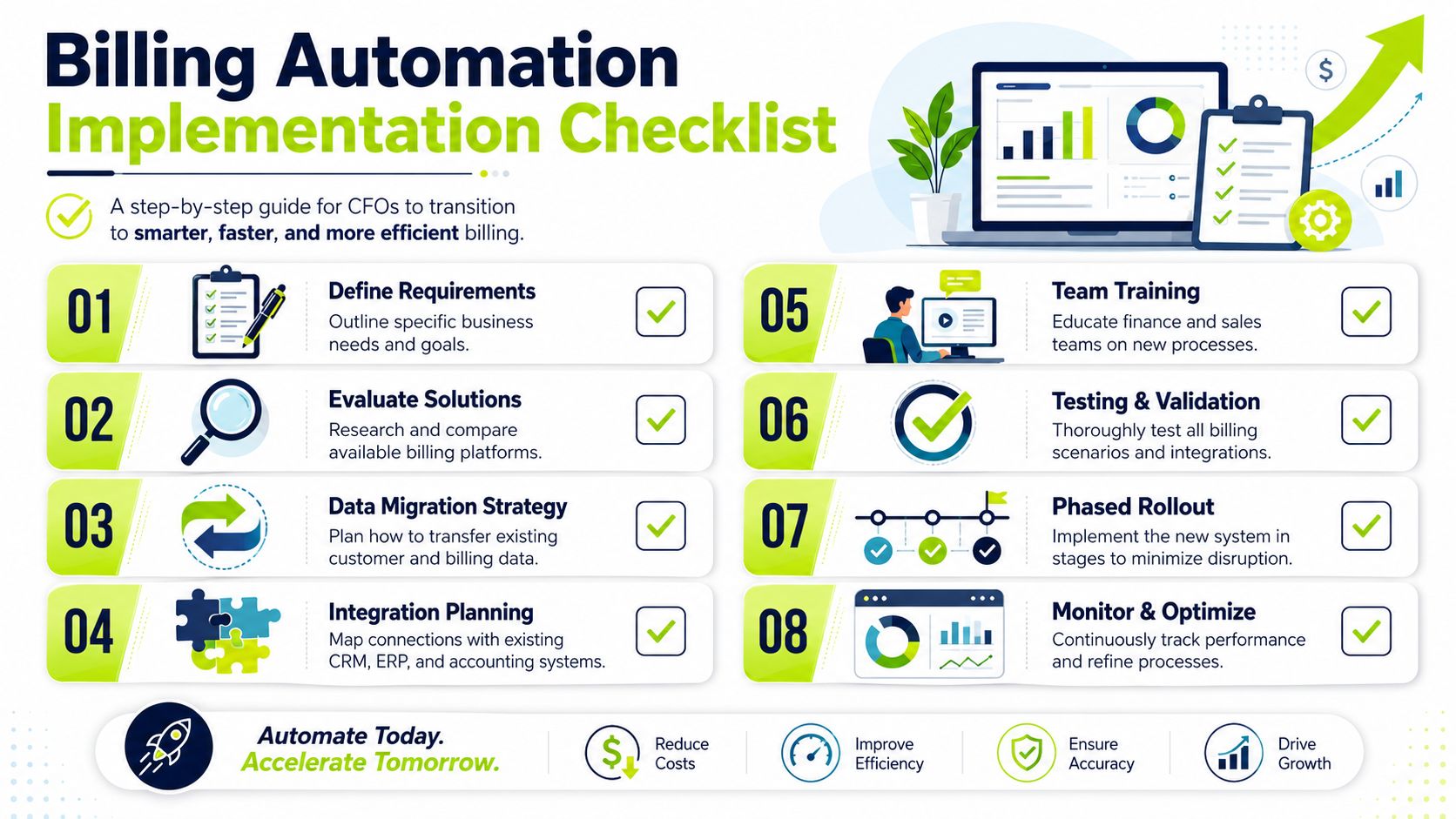
Start with standardization
Before evaluating any platform, define what you sell and how it should be billed. Most services firms think they have a pricing model. What they often have is a pricing narrative, with too many exceptions handled informally.
Get specific on these points:
- Contract structures: Monthly retainer, onboarding fee, project add-on, overage, pause, renewal.
- Billing triggers: Contract signature, service start date, approved change order, milestone completion.
- Ownership: Who approves changes, who updates billing, who resolves disputes.
A short internal matrix helps. If two account managers would answer a billing scenario differently, the process isn't ready for automation.
Evaluate software by integration, not promise
The core test for AR software for professional services is whether it fits your existing finance stack. For many firms, that means accounting, CRM, time tracking, and payment workflows. If you're reviewing the market, this guide to billing automation platforms is helpful for framing the comparison criteria, even if your model is services rather than SaaS.
Look for practical fit:
- Accounting connection: Can it sync cleanly with QuickBooks or your ledger workflow?
- Change management: Can the team update recurring billing without engineering work?
- Collection readiness: Does it support reminders, payment methods, and reconciliation?
Don't buy on feature volume. Buy on exception handling. Every platform looks capable until the first contract amendment lands mid-cycle.
Roll out in phases
A phased launch lowers risk and helps finance keep control. Start with a contained client cohort. Choose accounts with similar terms and relatively low complexity. Prove the billing logic, collection cadence, and reconciliation process before expanding.
A practical rollout often follows this order:
- Phase one: Standard monthly retainers with few adjustments
- Phase two: Retainers plus overages or project add-ons
- Phase three: More complex accounts with credits, PO requirements, or custom terms
Operator's note: The pilot group should be boring on purpose. Complexity belongs in later phases, after the process is stable.
Build exception handling on day one
No automation project removes exceptions. It changes how they're handled.
Define the rules for disputed invoices, scope changes after invoice issue, unapplied cash, and client-specific requirements. If those scenarios go straight into ad hoc Slack threads, the system will decay quickly.
Use a simple decision framework:
Exception type | Default response |
|---|---|
Scope changed before billing | Update billing record before invoice run |
Scope changed after invoice issue | Issue approved adjustment by policy |
Client disputes invoice | Assign owner and pause escalation until reviewed |
Payment received without remittance detail | Route to reconciliation queue |
Monitor outcomes, not launch status
A billing automation project isn't successful because invoices are now automatic. It's successful when invoice accuracy improves, collection effort becomes more consistent, and cash gets easier to forecast.
That's where accounts receivable automation connects back to finance leadership. The project should reduce noise for the team and uncertainty for the business.
Using AI AR Automation to Improve Cash Flow
A clean invoice doesn't guarantee cash. It only starts the clock.
That's why billing automation alone rarely solves the full problem. It speeds invoice creation, but it doesn't necessarily improve follow-up, reduce collection inconsistency, or prioritize the right accounts. To improve cash flow, firms need post-invoice orchestration.

Why AR orchestration matters
In most firms, collections still run on a mix of reminders, inbox follow-up, spreadsheets, and relationship memory. That approach works until volume rises or key people get pulled into other work. Then response times slip, reminder tone varies by sender, and old invoices age.
AI AR automation closes that gap by managing what happens after the invoice lands. It can sequence reminders, adapt timing, route accounts by risk or behavior, and keep outreach moving without forcing finance staff to manually review every account every day. For a practical definition, this explainer on what AR automation means in practice is worth reading.
The operating benefit is consistency. Clients get timely follow-up. Finance gets fewer manual touches. Leadership gets a clearer path to cash.
Dunning is where DSO moves
This is the part many firms underinvest in because it feels tactical. It isn't. Reminder design, timing, and personalization shape payment behavior.
Firms using automated and personalized dunning sequences see an average reduction in Days Sales Outstanding of 10% to 25% within the first six months, according to the earlier Resolut reference cited in the KPI section. That improvement matters because it affects working capital directly.
The difference between weak and effective dunning usually comes down to these practices:
- Message timing: Reminders before and after due date, based on terms and client behavior
- Channel choice: Email first for some accounts, other outreach paths for slower payers
- Human escalation: Finance steps in when the system detects friction, dispute risk, or repeated delay
Billing automation versus AR automation
These are related, but they solve different problems.
Capability | What it does |
|---|---|
Billing automation | Creates invoices accurately and on schedule |
AR automation | Drives follow-up, payment resolution, and collection workflow |
AI AR automation | Prioritizes accounts, personalizes outreach, and reduces manual intervention |
A services firm that automates billing but leaves collections manual will still struggle to reduce DSO. The invoice may be right, but cash timing remains uneven.
Billing tells the client what they owe. AR automation helps make sure they pay it on time.
What works in practice
The strongest setups don't try to remove humans from collections. They remove low-value manual work. Finance teams should still own exceptions, client sensitivity, and dispute handling. The system should own cadence, reminders, prioritization, and visibility.
That's the primary case for improve cash flow efforts in services firms. Not more pressure. Better orchestration.
Conclusion From Financial Discipline to Predictable Growth
Subscription billing management isn't a software trend for services firms. It's a financial control system. When recurring agreements are billed consistently, reconciled cleanly, and followed through to payment, retained revenue starts behaving like real working capital instead of a hopeful forecast.
That shift changes more than AR. It improves planning, reduces month-end friction, and gives CFOs and controllers a firmer grip on timing. Teams stop patching invoices in flight. Account managers stop acting as backup collectors. Finance can focus on exceptions that need judgment.
Firms that want to sharpen the communication side of automation can also learn from adjacent operational disciplines. A practical email automation guide is useful because collections, like other business workflows, improve when timing, consistency, and message control are built into the process.
The payoff is control. Not hype, not theory. Controlled billing, controlled follow-up, and more predictable cash.
Resolut automates AR for professional services, consistent, accurate, and human. If you're tightening billing operations, improving collections, or looking for a better path to predictable cash flow, Resolut is built for that work.