Reduce DSO by Mastering Virginia's AR Timelines
Discover the virginia statute of limitations debt timeline and how CFOs can protect cash flow by managing contract and open account collections.
For a CFO, an uncollected receivable isn't just an operational delay—it's a measurable drag on working capital. In Virginia, the statute of limitations on debt sets a firm deadline for collection. Miss it, and that receivable becomes a permanent write-off, directly impacting your firm's profitability.
The Financial Impact of Virginia’s Collection Deadlines
Time-barred debt is a preventable loss. The Virginia statute of limitations dictates the specific window you have to legally enforce payment. Understanding these timelines is a fundamental control for accounts receivable management.
Different debt types have different expiration dates. Accurate classification of your receivables is the first step in building a predictable and effective collections process.
Visual Idea: A clean, cinematic shot of a Newton's Cradle on a sleek office desk, with one ball swinging away, representing time running out. The background is a blurred-out financial dashboard.
Key Timelines for Professional Services Firms
For professional services firms, most outstanding receivables are governed by short timelines—typically 3 to 5 years.
Debts from oral agreements or "open accounts" (common for ongoing client work) expire in just 3 years. Formal written contracts, like a Master Service Agreement (MSA), provide a 5-year window.
This is a 67% longer collection runway for properly documented work. It's a clear metric highlighting the financial risk of weak contract discipline. Effective accounts receivable automation is critical to tracking these dates.
Virginia Statute of Limitations: At a Glance
Debt Type | Statute of Limitations | Financial Implication |
|---|---|---|
Written Contracts | 5 years | The standard for professional services. Provides the longest runway for standard operational debt. |
Oral Contracts | 3 years | High-risk due to a short timeline and difficulty in legal enforcement. |
Open Accounts | 3 years | Common for retainers; requires disciplined tracking to avoid write-offs. |
These are hard stops. Once a debt is time-barred, legal recourse is lost. A systematic AR process, supported by accounts receivable automation, prevents invoices from aging past these critical legal deadlines. This is a core component of cash flow management.
For more, visit https://www.resolutai.com.
How to Classify Your Firm’s Outstanding Debt
Not all AR is created equal under Virginia law. Proper classification is a critical control for any finance leader. This isn't an accounting exercise; it determines the legal timeline for collection and directly impacts cash flow.
Misclassifying a receivable can shrink your collection window by 40%, from five years down to three. This is an operational failure with measurable financial consequences. Align your collections workflow with the Virginia statute of limitations for debt from day one.

The Written Contract: A Five-Year Advantage
A receivable backed by a signed, written contract is the most secure asset. Virginia Code § 8.01-246(2) provides five years from the date of breach to file for collection. This extended timeframe provides significant operational flexibility.
A "written contract" is your evidence. It must clearly define scope, payment terms, and obligations. For finance operators, MSAs and Statements of Work (SOWs) are financial instruments, not sales formalities.
For example, a signed SOW for a $75,000 project fee, due 30 days post-completion, is a written contract. The five-year clock starts the day after payment is missed.
Open Accounts and Oral Contracts: The Three-Year Risk
Less formal arrangements carry a shorter three-year statute of limitations. This compressed timeline demands a more aggressive AR management strategy.
- Open Accounts: Ongoing work with periodic invoicing against a running balance. The three-year clock typically resets with the last payment or charge, creating tracking complexity. This is where AI AR automation connected to your QuickBooks can prevent missed deadlines.
- Oral Contracts: Legally binding but difficult to prove. The combination of a three-year limit and high burden of proof makes this the highest-risk receivable category.
An ongoing client relationship with rolling invoices feels secure, but if it is legally an "open account," your right to collect expires faster than you might assume. It’s a common blind spot that erodes financial control.
Promissory Notes: A Six-Year Timeline
A promissory note is a formal, written promise to pay a specific sum. Under Virginia Code § 8.3A-118, it carries a six-year statute of limitations from its due date.
A promissory note is a powerful tool for debt restructuring. It can convert a past-due open account (3-year limit) into a formal obligation with a 6-year runway and superior legal standing. This directly reduces DSO and improves cash flow predictability.
Understanding this classification system is fundamental to a strategic AR workflow. AR software for professional services, like Resolut, builds these legal distinctions into your process, turning passive invoice chasing into active asset management.
How Client Actions Can Reset the Collection Clock
The Virginia statute of limitations on debt is not static. It is a countdown that can be reset by specific client actions, creating a new window for collection.
A partial payment or a written acknowledgment of the debt restarts the clock. This can create a false sense of progress, causing collections to de-escalate prematurely. A disciplined finance operator must know these triggers and ensure they are documented meticulously.
Trigger 1: A Partial Payment on the Debt
Any payment on an outstanding balance reaffirms the entire debt under Virginia law. This creates a new "last date of activity."
The clock—whether three years for an open account or five years for a written contract—restarts from the date the payment was processed.
- Example: You hold a $50,000 invoice under a written contract, now four years old (one year remaining on the statute). The client makes a $2,500 payment.
- Outcome: The five-year clock resets. You now have a full five years from the date of that payment to pursue the remaining $47,500. This resets your collection timeline but can negatively impact DSO if not managed with a formal payment plan.
Trigger 2: A Written Acknowledgment of the Debt
A clear, unconditional written acknowledgment of the debt has the same legal effect as a payment. Vague statements like "we'll look into this" are insufficient.
The communication must confirm the debt's existence and the intent to pay. This is why what a promise to pay entails is critical knowledge for any AR team.
An email from a client stating, "I confirm we owe the $15,000 for the Q3 consulting services and will settle this next month," resets the statute of limitations from the date it was sent.
Your AR team must be trained to identify, document, and archive these communications within your AR system. This is not administrative; it is an active preservation of the firm's legal and financial rights.
Thinking Beyond the 90-Day Invoice
Standard AR processes focus on 30-60-90 day aging. However, certain debt instruments have much longer recovery timelines. Managing these long-tail assets requires a different strategy.
Failing to segregate these from operational receivables obscures a critical component of the firm's financial position. This is where manual systems fail and a robust accounts receivable automation platform provides essential visibility and control over years, not just quarters.
The Power of a Court Judgment
Successfully suing for non-payment results in a judgment. This converts a disputed invoice into a recognized, enforceable debt. In Virginia, a judgment has a 20-year enforcement period under Virginia Code § 8.01-251.
This 20-year runway provides unmatched durability. It allows for collection through wage garnishments or property liens long after the original contract's statute of limitations has expired. A judgment transforms a high-risk receivable into a long-term, secured asset.
Promissory Notes and Contracts Under Seal
Beyond judgments, two other instruments offer extended collection windows.
- Promissory Notes: These formal IOUs carry a six-year statute of limitations. They are a strategic tool for converting unstructured, past-due accounts into a formal payment plan with a stronger legal foundation.
- Contracts "Under Seal": An older but powerful tool with a 20-year statute of limitations. Modern application involves specific legal language in the contract, such as "witness my hand and seal."
A contract under seal provides two decades of collection security. For a high-value, multi-year MSA, this can be a critical risk mitigation tool. When structured correctly, you gain significant leverage. You can discover more insights about these long-term debt instruments and their strategic implications.
An AI AR automation system is designed to manage this complexity. By integrating with your ERP or QuickBooks, it tracks these varied deadlines automatically, ensuring no long-term asset is overlooked. For any firm serious about improving cash flow, this level of systematic oversight is non-negotiable.
Designing a Proactive Accounts Receivable Workflow
Knowing the law is insufficient. A finance operator translates legal knowledge into a system that protects cash. Virginia's statute of limitations is a hard deadline that should inform your entire collections process.
A proactive workflow aligns internal operations with this legal countdown, ensuring payment long before collection rights are at risk. A reactive strategy—waiting until an invoice is severely aged—guarantees higher DSO and write-offs. The objective is a predictable, systematic process.
The 30-60-90-120 Day Escalation Cadence
A structured AR workflow operates on a clear, escalating cadence. This provides a predictable playbook for the team and signals increasing urgency to the client.
- 30 Days Past Due: Automated, professional reminder. A low-effort, high-impact action handled by AR software for professional services to ensure nothing is overlooked.
- 60 Days Past Due: Automated reminder, plus a personalized email or call from an AR specialist for high-value accounts. This human touch signals direct attention.
- 90 Days Past Due: Internal alert to a finance manager or controller. A senior team member contacts the client to secure a payment commitment.
- 120 Days Past Due: Decision point. The account is escalated for formal review to determine the next action: collections agency or legal escalation.
This structured cadence transforms AR from a passive administrative task into a strategic, risk-mitigating function, applying consistent pressure well before the three- or five-year statutes are a factor.
Leveraging AR Automation for Strategic Oversight
Modern AI AR automation platforms provide intelligent oversight impossible with manual tracking. For CFOs, this is how you scale financial controls without increasing headcount.
Risk scoring is a key feature. The system analyzes payment history, invoice age, and communication patterns to flag high-risk accounts, enabling proactive intervention.
Visual Idea: A simple, elegant bar chart showing DSO decreasing month-over-month, titled "DSO Reduction with AR Automation." Data points could be: Month 1: 58 days, Month 2: 51 days, Month 3: 45 days, Month 4: 42 days.
This timeline shows the long-term nature of certain collection processes, highlighting why automated tracking is critical.
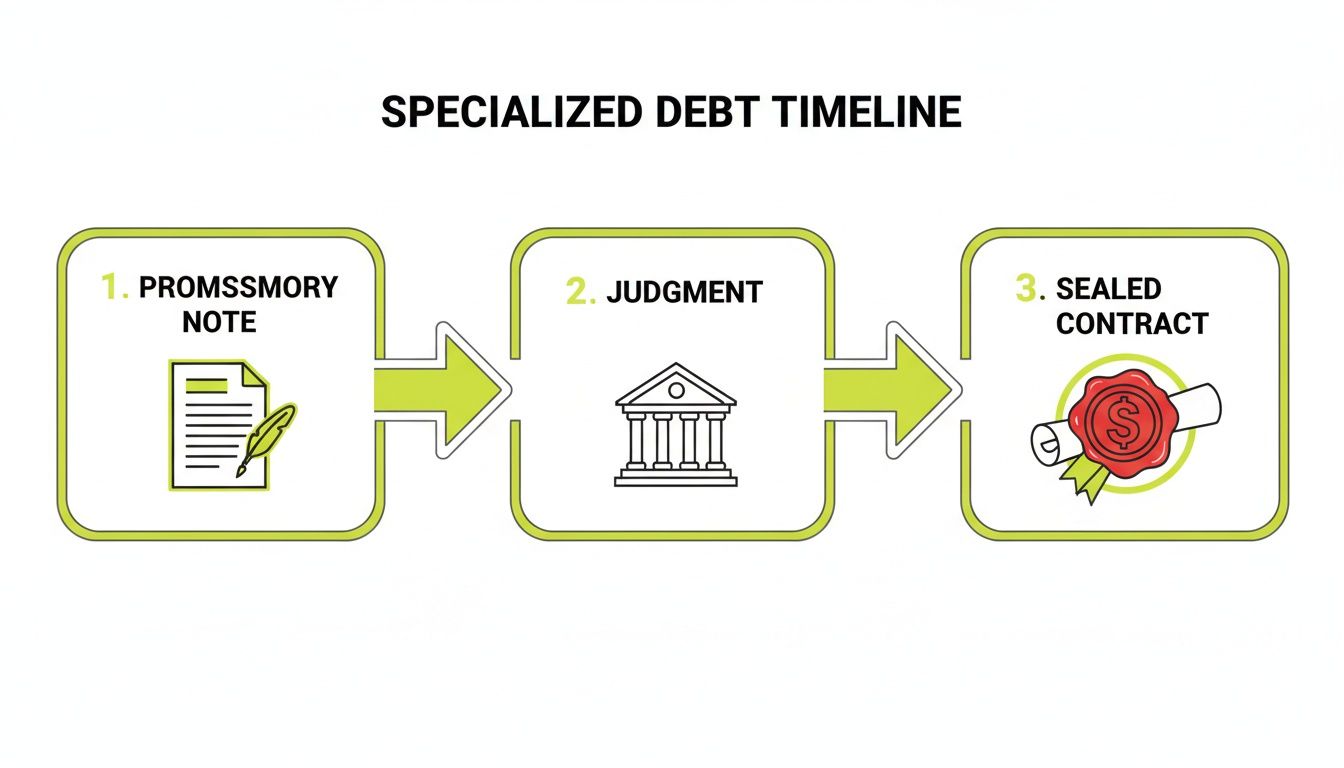
As shown, judgments and sealed contracts create recovery windows measured in decades. A system must be able to track these long-tail assets without failure.
Platforms with native QuickBooks AR automation can tag invoices by legal type—written contract, open account—and generate reports on receivables approaching their Virginia statute of limitations debt deadlines.
This converts your AR system from a payment ledger into a proactive risk management dashboard. You receive an alert 36 months before a $100,000 invoice becomes uncollectible, providing ample runway to act.
Combining proven Accounts Receivable Best Practices with a powerful automation platform creates a defensible and efficient collections engine.
Making the Call on Legal Escalation
Deciding to pursue legal action is not a failure; it is a calculated, strategic decision within a disciplined AR framework. It is a data-driven process, removed from emotion.
The goal is to protect the firm's assets when a client is unwilling or unable to pay. The decision must weigh the debt size, documentation quality, and the probability of recovery.
A Cost-Benefit Framework for Escalation
Legal action is an investment that requires an expected positive return. A quick analysis prevents throwing good money after bad.
Key questions for this analysis include:
- Debt Amount vs. Legal Costs: A firm-specific threshold should exist. Pursuing a $5,000 debt may be uneconomical; a $50,000 debt warrants the cost.
- Documentation Strength: A signed contract, clear SOW, and complete communication history reduce legal risk and improve the odds of a favorable outcome.
- Likelihood of Recovery: A judgment is worthless if the debtor is insolvent. An asset check is a prudent step before incurring legal fees.
From Demand Letter to Lawsuit
The escalation process is methodical. The first step is a formal legal demand letter for payment from an attorney. This action alone often compels payment by signaling serious intent.
A demand letter from legal counsel communicates that the firm is prepared to enforce its rights. Delinquent clients who have ignored all previous communications often respond to this escalation, resolving the issue without litigation.
If the demand letter fails, filing a lawsuit to obtain a judgment is the next logical step. This formalizes the debt and provides a powerful, long-term collection tool. Modern AR software for professional services may include features that send communications with a more serious, legalistic tone, improving collections before outside counsel is required.
Common Questions from Finance Leaders
When it comes to the Virginia statute of limitations on debt, applying legal theory to operations is what matters. Here are answers to common questions from CFOs and Controllers.
Does the Statute Apply if My Client Is Out-of-State?
Yes, in most cases. If your firm is based in Virginia or the contract was executed there, Virginia law governs. You cannot rely on a longer statute of limitations in your client's state.
The "cause of action" is typically tied to your firm's location. Your internal collections clock must be set to Virginia's deadlines.
For example, your Virginia-based firm bills a client in California (which has a four-year statute for written contracts). Virginia's five-year limit will govern a lawsuit brought in a Virginia court based on your written SOW.
How Do I Prove the Date of Last Activity?
Meticulous, systematic documentation is the only way. Your AR software for professional services should be the single source of truth.
It must capture:
- Payment Records: Every transaction date, amount, and reference number, ideally linked directly to bank feeds to eliminate discrepancies.
- Client Communications: All emails or messages where a client acknowledges the debt must be archived and attached to the client record.
Data integrity is not an accounting task; it is a legal control that preserves the right to collect revenue.
Can We Still Collect a Time-Barred Debt?
You can ask for payment, but you have lost the ability to compel it through legal action. Once the Virginia statute of limitations on debt expires, the debt is "time-barred."
If a client voluntarily pays on a time-barred debt, that action can restart the statute of limitations, creating a new window to sue for the remaining balance. However, this is a rare event and should not be a component of any collections strategy. The focus must be on resolving accounts long before they become time-barred.
--- Resolut automates AR for professional services—consistent, accurate, and human.