Wave vs Xero: A CFO's Guide for 2026
Deciding between Wave vs Xero? A detailed guide for CFOs at professional services firms comparing scalability, AR automation integration, and TCO.
The moment most firms outgrow Excel isn’t dramatic. It shows up in quieter ways. A partner asks for current cash visibility and finance exports three files. A client payment lands, but nobody can cleanly match it to the right invoice without checking email threads. Month-end closes, but collections still run on memory and follow-up habits.
That’s the context for wave vs xero in a professional services firm. This isn’t a freelancer deciding how to send invoices. It’s a leadership decision about the system that will hold revenue, expenses, reporting logic, and the data your team will depend on for future automation.
For a firm in the $3M to $50M range, accounting software is less about bookkeeping convenience and more about operational control. Your ledger becomes the source of truth for billing discipline, reporting integrity, and whether accounts receivable automation can work.
Choosing Your Financial Foundation
Once a firm reaches a certain level of complexity, “good enough” accounting software stops being good enough. You need clean reporting, dependable workflows, and a platform that won’t force your controller to build manual workarounds every time leadership asks a better question.
That’s why Wave and Xero shouldn’t be evaluated as feature checklists. They should be evaluated as financial foundations. One is designed to keep the barrier to entry low. The other is designed to support a more controlled operating environment.
For a professional services business, that distinction matters quickly. You’re usually dealing with staged billing, retainer structures, project-based expenses, partner oversight, and a growing need for cleaner receivables management. If the accounting layer can’t support that complexity, the downstream cost shows up in slower collections, weaker forecasting, and reporting that arrives after the decision window has closed.
A useful way to frame the decision is this:
Area | Wave | Xero |
|---|---|---|
Best fit | Freelancers, very small teams, cost-sensitive operators | Growing firms that need stronger controls |
Invoicing model | Simple and accessible | More structured and better suited to scale |
Reporting depth | Basic visibility | Broader reporting for management use |
Workflow support | Lighter operational structure | Better fit for process-driven finance teams |
Automation readiness | Limited foundation for advanced AR workflows | Stronger base for integrations and future automation |
If your team is also weighing other systems, this Xero vs QuickBooks UK comparison gives useful context on how Xero fits into the broader small-business accounting market.
And if your concern isn’t just bookkeeping, but the receivables stack that sits on top of it, this review of accounts receivable software options is worth keeping nearby. For many firms, the accounting decision and the AR automation decision are effectively the same decision made in two steps.
Choose the ledger as if your future collections process will depend on it. In most firms, it will.
Core Philosophy and Ideal User Profile
Wave and Xero solve different problems. That’s the first thing to get clear.
Wave optimizes for simplicity
Wave is built for low-friction setup, low cost, and straightforward invoicing. That’s exactly why many users like it. As of March 2026, Wave holds a 4.4/5 G2 rating across 400+ reviews, compared with Xero at 4.3/5 across 600+ reviews, according to this Wave and Xero comparison.
That rating difference matters, but the reason matters more. Users praise Wave for free invoicing and ease of use. Xero users value deeper accounting functionality, while also criticizing its tiered pricing. In other words, Wave is satisfying the users it was built for.
That user is usually a freelancer, solo operator, or small business owner who wants accounting to stay out of the way.
Xero optimizes for control
Xero’s design philosophy is different. It assumes the business needs more structure. Not necessarily enterprise complexity, but enough process depth to support multiple stakeholders, cleaner reporting, and a more disciplined finance function.
For a professional services firm, that usually aligns better with reality. Even before the business feels “big,” the finance work gets more layered. Someone wants departmental visibility. Someone else wants cleaner cutoff procedures. Collections need consistency, not memory. Leadership wants answers without waiting for spreadsheet cleanup.
That’s where Xero tends to fit more naturally.
Why higher satisfaction doesn’t automatically mean better fit
Many software comparisons make a fundamental error. They treat overall user satisfaction as if it answers every buying question. It doesn’t.
A simpler tool can earn better reviews because it removes friction for a narrower use case. That doesn’t make it the better system for a firm with multi-person approvals, more complex receivables, or a push toward AI AR automation.
Consider the practical trade-off:
- Wave works well when simplicity is the goal. If the business mainly needs basic invoicing and expense tracking, its lower-friction model is appealing.
- Xero works better when finance needs process discipline. If the firm needs stronger reporting, cleaner workflows, and a more scalable operating layer, simplicity becomes a limit.
- The wrong fit creates hidden labor. That labor doesn’t show up on the subscription page. It shows up in exports, reconciliations, rework, and delayed follow-up.
Operational test: If your controller is already asking, “Can the system handle this cleanly?” you’re no longer shopping for the cheapest platform. You’re shopping for the least fragile one.
For most professional services firms above the early-stage threshold, that distinction is decisive.
Financial Operations A Workflow-Based Analysis
Controllers don’t experience accounting software as a product demo. They experience it through recurring work. Invoice creation. Payment application. Vendor bill handling. Reconciliation. Adjustments. Exception cleanup.
That’s where the difference between Wave and Xero becomes harder to ignore.
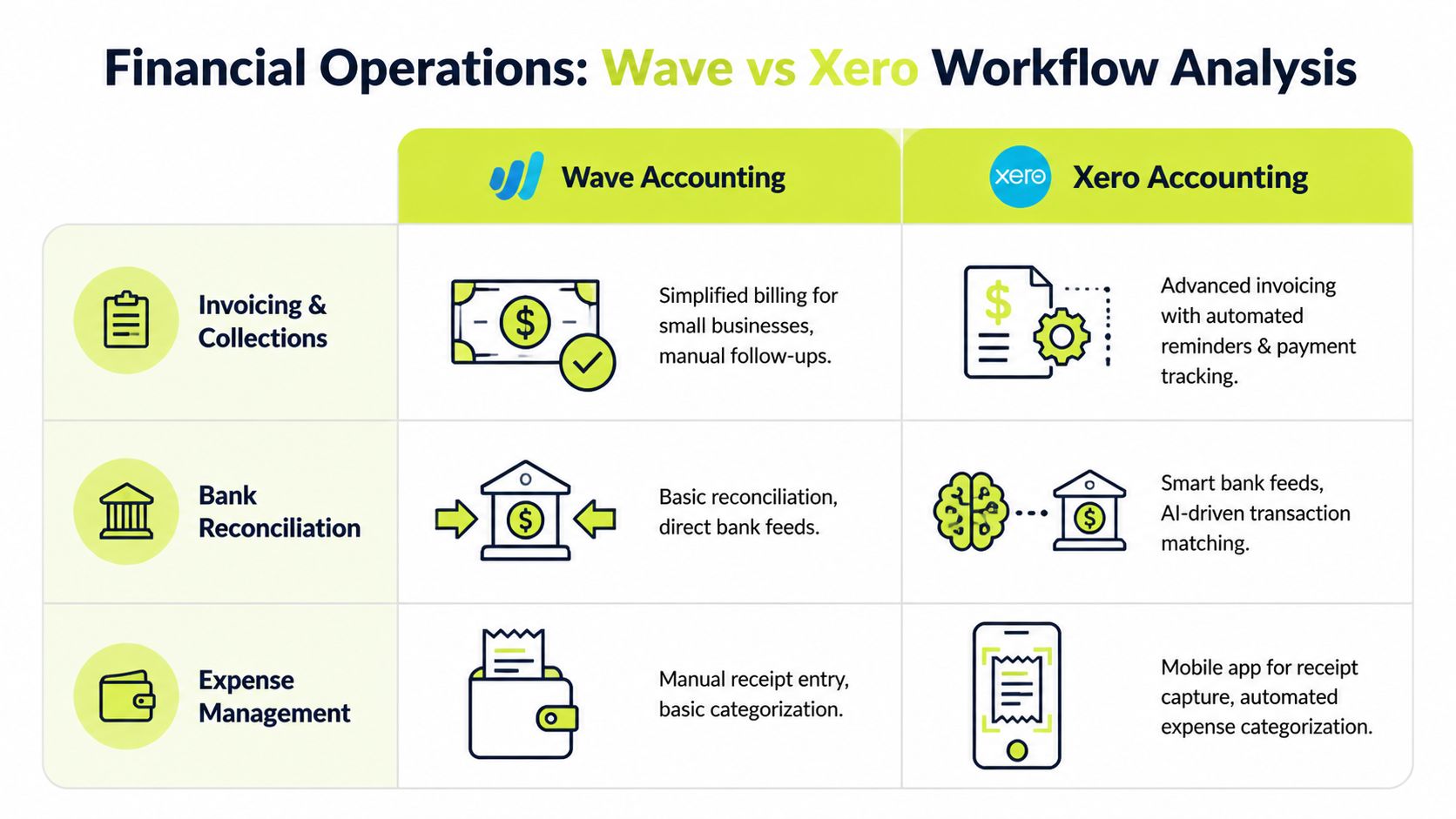
Invoicing and collections
Wave can handle simple billing. For a small shop with straightforward invoices and light follow-up needs, that may be enough.
But professional services firms rarely stay simple for long. They need invoices that align with project logic, approval timing, credits, and client-specific payment behavior. Once collections become a process rather than a side task, the accounting system needs to preserve better detail.
Xero is better suited to that environment because the workflow is more structured. That matters if you want to connect your ledger to a broader order-to-cash process, rather than treating invoicing as an isolated task.
Accounts payable affects receivables more than most teams expect
This is one of the most overlooked points in wave vs xero.
According to this Xero versus Wave operational review, Xero supports purchase order recording, vendor credit memo processing, and recurring payment automation, while Wave lacks those capabilities. That isn’t just an AP story.
It affects AR because structured payables data gives finance teams a cleaner operating model overall. Xero’s AP workflow supports two-way invoice reconciliation and payment matching, which reduces manual cash application work and gives the system better invoice-level integrity.
When AP is weak, finance teams often accept weaker data habits everywhere. That spills into collections.
A finance stack doesn’t become automation-ready because the AR team wants it to. It becomes automation-ready when the underlying transaction data is structured enough to trust.
General ledger integrity
The general ledger should absorb operational complexity without turning every exception into a manual exercise. That’s where Xero has an advantage for firms with multiple workflows touching the books.
Wave’s lighter structure is easier at the start, but that ease can become brittle. If a payment exception, vendor adjustment, or pre-bill revision needs to be reflected clearly, the lack of richer transaction structure creates downstream friction.
From a practical standpoint:
Workflow area | Wave | Xero |
|---|---|---|
AR handling | Better for straightforward billing | Better for controlled collections workflows |
AP handling | Basic expense tracking | Native PO, vendor credit, recurring payment support |
Reconciliation | More manual judgment | More structured matching logic |
Automation foundation | Workarounds are common | Cleaner data flow for integrated tools |
Teams that want to streamline Xero bookkeeping often do so because Xero gives them enough structure to improve process, not just enough software to record transactions.
For firms trying to reduce DSO and improve cash flow, that distinction is practical. The books aren’t just for compliance. They’re the system your collections process stands on.
Scalability Reporting and Total Cost of Ownership
The subscription price is rarely the true cost.
The cost becomes apparent when the finance team exports data to answer basic management questions, when reporting arrives too late to shape collections, or when a partner meeting turns into a debate over whose spreadsheet is right.
Reporting depth changes management behavior
According to this Xero and Wave reporting comparison, Xero provides 50+ customizable financial reports with role-based user access and unlimited users across all plans, while Wave offers 8 basic reports with single or limited user access.
That’s not a cosmetic difference. It changes what a CFO or controller can manage.
With broader reporting, finance can examine receivables by aging bucket, customer segment, and payment method. That’s the kind of visibility that supports better collection timing, cleaner follow-up prioritization, and more disciplined cash flow management. It’s also a better foundation for AR software for professional services, where invoice patterns and payer behavior often vary by client type.
Wave can still provide a basic picture. But basic visibility tends to create delayed analysis. Teams export, manipulate, and reconcile outside the system. Once that starts, reporting integrity becomes harder to maintain.
Finance rule: If the answer depends on a spreadsheet someone built after the close, you don’t have reporting. You have a workaround.
User access and control matter earlier than most firms expect
Professional services firms usually hit a control issue before they hit a pure transaction issue.
A partner wants visibility without edit access. An outside accountant needs clean entry points. A controller needs the team to operate in the same system without creating confusion about who changed what. Xero is built more comfortably for that environment. Wave is less suited to it.
That affects more than governance. It affects speed. When teams can work in one system with clearer roles, the close gets cleaner and finance spends less time policing process.
Total cost of ownership isn’t just software spend
Wave’s free positioning is attractive. For the right business, it’s rational.
But for a growing firm, the hidden costs can outweigh the visible savings:
- Manual reporting labor. Someone has to assemble the management view Wave doesn’t readily produce.
- Process drag. Collections and reconciliation take longer when the transaction structure is thinner.
- Tool sprawl. Firms often add external apps or side processes to cover functional gaps.
- Decision lag. Cash flow issues get spotted later because visibility is weaker.
If your finance lead is already searching for a guide to financial reporting automation, that usually signals the business has moved past entry-level accounting needs.
For a small operator, Wave’s economics can make sense. For a scaling firm, total cost of ownership includes labor, delay, data quality, and the opportunity cost of weak visibility. That’s where Xero often becomes cheaper in practice, even if it doesn’t look cheaper on day one.
Integrating AR Automation The Decisive Factor
For firms that bill clients on terms, accounting software should be judged partly by one question. Can it support a serious collections system without constant human patchwork?
That’s where the decision gets sharper.

Better AR automation starts with better accounting data
Teams often talk about accounts receivable automation as if it begins with reminder emails. It doesn’t. It begins with reliable invoice states, payment records, adjustment logic, and customer-level history inside the accounting system.
Xero is the stronger base for that. Its more developed structure gives downstream systems more to work with. That matters when you want collections logic to reflect real operating conditions instead of generic dunning.
In practice, stronger accounting data enables:
- Cleaner segmentation of open invoices by client and payment behavior
- More accurate follow-up timing based on invoice status and transaction history
- Better cash application because matching logic has more reliable source data
- More consistent forecasting because open receivables are easier to trust
Wave can support simpler invoicing workflows, but its lighter data structure creates blind spots faster. If the firm wants more than reminders, such as specific collection paths and more intelligent exception handling, those limitations become operational.
Why this matters for DSO
If your goal is to improve cash flow, software choice and AR strategy can’t be separated.
A weaker accounting foundation tends to produce weaker automation. The outreach may still go out, but the timing is less precise, the matching is more manual, and the finance team still has to intervene too often. That’s not real automation. It’s assisted chasing.
A stronger foundation supports a more complete receivables workflow. Teams looking into accounts receivables automation usually discover that the quality of the accounting layer determines how effective the automation will be.
Here’s a useful walkthrough on the broader finance operations shift:
Wave can work. Xero works longer
This isn’t an argument that Wave is unusable. It’s an argument that its design ceiling arrives sooner for firms with complex receivables.
For a firm sending a modest number of simple invoices, that may not matter. For a business trying to apply AI AR automation, tighten collections, and build a repeatable process to reduce DSO, it usually does.
The best accounting system for AR isn’t the one that sends an invoice. It’s the one that preserves enough detail for automation to act intelligently after the invoice is sent.
That’s why, in a professional services setting, Xero usually becomes the more durable choice.
Decision Framework for Professional Services Firms
A clean decision doesn’t come from asking which tool is “better.” It comes from asking which one fits the firm you are now, and the finance function you’re building next.
Choose Wave if your needs are still narrow
Wave is still a sensible choice in a limited operating context.
It fits best when most of the following are true:
- You need basic invoicing and expense tracking. Finance is still light, and the system mainly supports recordkeeping.
- One person runs the books. Collaboration, permissions, and workflow separation aren’t yet pressing issues.
- Collections are still manual by choice. Client follow-up happens through direct relationships, and that’s manageable.
- You don’t expect near-term process complexity. No meaningful pressure yet for layered reporting, approvals, or automation.
If that describes the business, Wave can buy time.
Choose Xero if finance is becoming a function
Xero makes more sense once accounting needs to support management, not just compliance.
Common signals include:
- Multiple people need access to financial data. Controller, external accountant, partners, or operations leads all need different levels of involvement.
- Receivables need process, not memory. Collections can’t depend on who happens to remember which client is overdue.
- Reporting needs to shape action. Leadership wants current visibility into performance, cash, and client payment behavior.
- The firm wants to automate. Better systems are needed for cash application, follow-up logic, and cleaner integration.
A practical matrix for firm owners and finance leads
If this sounds like you | Better fit |
|---|---|
“We need low-cost invoicing and simple books.” | Wave |
“We need stronger controls before finance gets messy.” | Xero |
“Our team can manage with manual follow-up for now.” | Wave |
“We want cleaner collections and future automation.” | Xero |
“Reporting is mostly for tax and basic oversight.” | Wave |
“Reporting needs to drive decisions and cash flow management.” | Xero |
The key is not to wait until the books are already painful. Migrations are easier when they happen before finance work becomes highly fragmented.
For most professional services firms above the early stage, Xero is the better long-term decision. It provides a more stable foundation for control, reporting, and automation. Wave remains useful, but mainly when simplicity is the objective and scale is not yet the operating constraint.
Wave vs Xero FAQ
Is Wave good enough for a professional services firm?
It can be, if the firm's operations remain basic. If billing is straightforward, one person manages finance, and reporting demands are light, Wave can cover the basics. It becomes less comfortable once multiple stakeholders need visibility and collections need structure.
Is Xero harder to implement?
Usually, yes. But that’s often because it supports more process. The extra setup work is often justified if the firm needs cleaner controls, stronger reporting, or a base for automation.
Which is better for reducing DSO?
For firms serious about reducing DSO, Xero is the stronger choice because it provides better operational structure for receivables workflows and future automation.
What about firms already using QuickBooks?
That’s a separate evaluation. Some firms searching for QuickBooks AR automation are really trying to solve a receivables problem, not an accounting-platform problem. Others may genuinely need to compare accounting systems before choosing an AR layer.
Is Wave cheaper?
On the surface, yes. In practice, it depends on how much manual work your team absorbs to compensate for limited workflow depth and reporting.
Should a firm migrate before implementing AR automation?
Usually yes, if the current accounting system can’t support the data quality and process discipline automation needs. Better to fix the foundation first than automate around weak records.
Resolut automates AR for professional services. If your firm wants a receivables process that is consistent, accurate, and human, Resolut is built to help finance teams get paid faster without turning collections into a manual burden.