
The 10 Best Billing Automation for SaaS Platforms in 2026
Find the best billing automation for SaaS. We review 10 top tools for CFOs, covering usage billing, tax, rev-rec, and AR automation to improve cash flow.
Billing automation becomes finance infrastructure the moment your pricing stops being simple. SaaS teams have to manage recurring invoices, proration, renewals, plan changes, and increasingly mixed pricing models such as flat-rate, tiered, per-user, usage-based, credit-based, and hybrid structures. Industry guidance also treats real-time or near-real-time usage tracking as essential for accurate billing, because upgrades, downgrades, and mid-cycle changes create invoice risk if the logic isn't standardized end to end (Schematic on the SaaS billing process).
That's the backdrop for choosing the best billing automation for SaaS. This isn't just about sending invoices faster. It's about controlling revenue operations, reducing preventable billing errors, and tightening the path from invoice creation to cash in bank.
Most software comparisons stop at subscriptions and payment collection. Finance leaders need a wider lens. The right platform should support the pricing model you run, give you clean proration and renewal controls, and improve collections, reconciliation, and reporting. If it can't help your team optimise debtor management, it's only solving part of the problem.
I'm evaluating these platforms the way a controller or CFO should. Which system gives you stronger operational control, clearer cash visibility, better accounts receivable automation, and fewer manual workarounds?
The most expensive billing tool isn't the one with the highest license cost. It's the one that still leaves your team chasing payments in spreadsheets.
Visual ideas
- Chart concept: waterfall from booked ARR to cash received, showing where billing errors, failed payments, and manual collections slow conversion.
- Dashboard visual: side-by-side month-end close view comparing manual billing adjustments against automated proration, dunning, and cash application.
- Cinematic image: finance lead reviewing an aging report at dawn, with overdue invoices highlighted against an otherwise clean billing dashboard.
1. Resolut
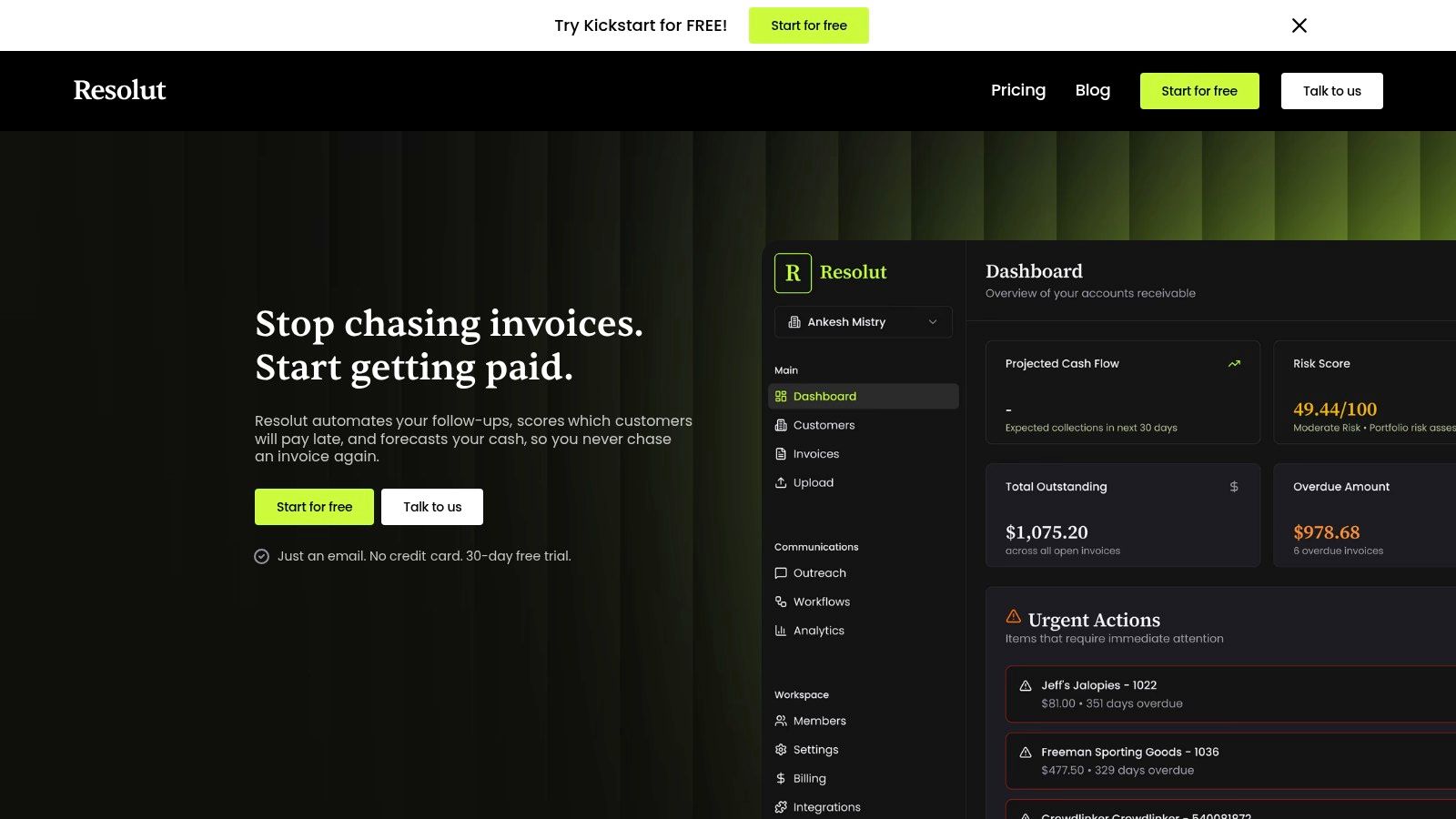
A large share of SaaS cash leakage happens after the invoice is sent. That is why Resolut deserves a different lens than the rest of this list. It is not just a billing layer. It is an accounts receivable operating system built for finance teams that need to shorten time to cash, tighten follow-up discipline, and reduce manual reconciliation work.
That operating model is the point. Many teams already have invoices going out on time. The breakdown often shows up in collections, payment matching, dispute handling, and customer communication. DealHub makes the same broader point in its overview of SaaS billing and the AR gap. The result is that your team spends less time pushing invoices out and more time getting cash in.
Why finance teams pick it
Resolut combines credit risk scoring, automated collections, omnichannel outreach, payment portals, dynamic billing, and cash application in one workflow. For a controller or CFO, that reduces handoffs across billing, AR, and reconciliation while giving the team clearer ownership of the full invoice-to-cash cycle.
It is a strong fit for firms that care about AR automation as much as subscription billing. The platform flags risky invoices early, automates outreach across email, SMS, and phone, and matches payments without forcing the team into manual cleanup. If you are comparing traditional recurring billing software against a more finance-led receivables process, this guide to subscription invoicing software for SaaS is a useful reference point.
Where it stands out
- Best for reducing DSO: Resolut is built to help teams act before invoices age into a collections problem, which improves cash conversion and reduces firefighting late in the month.
- Best for QuickBooks-based finance teams: If AR still runs through QuickBooks, inbox follow-up, and spreadsheets, Resolut gives you a cleaner step up without a heavy implementation.
- Best for controlled automation: Autopilot and co-pilot modes let the team automate routine outreach while keeping judgment calls with finance.
- Best for payment completion: Branded payment pages with cards, bank transfers, and wallets remove friction at the point of collection.
Practical rule: If invoices already go out on time but cash still lands late, prioritize collections automation and cash application before you buy another subscription catalog.
Pros
- Broad AR coverage: Billing, collections, payment acceptance, and reconciliation sit in one platform.
- Earlier intervention: Risk scoring and forecasting help teams address payment risk before aging worsens.
- Fast setup: Lean finance teams can get operational value quickly.
- Useful for invoice-heavy B2B workflows: A good fit when recurring billing is mixed with manual follow-up or services invoices.
Cons
- Pricing is less visible: Larger deployments usually require a direct quote.
- Automation quality depends on source data: Poor customer and invoice records will limit results.
If your evaluation framework starts with DSO, collector productivity, reconciliation effort, and cash visibility, Resolut should be near the top of the shortlist. It is the clearest option here for finance leaders who want billing tied directly to AR outcomes, not treated as a separate system.
2. Stripe Billing
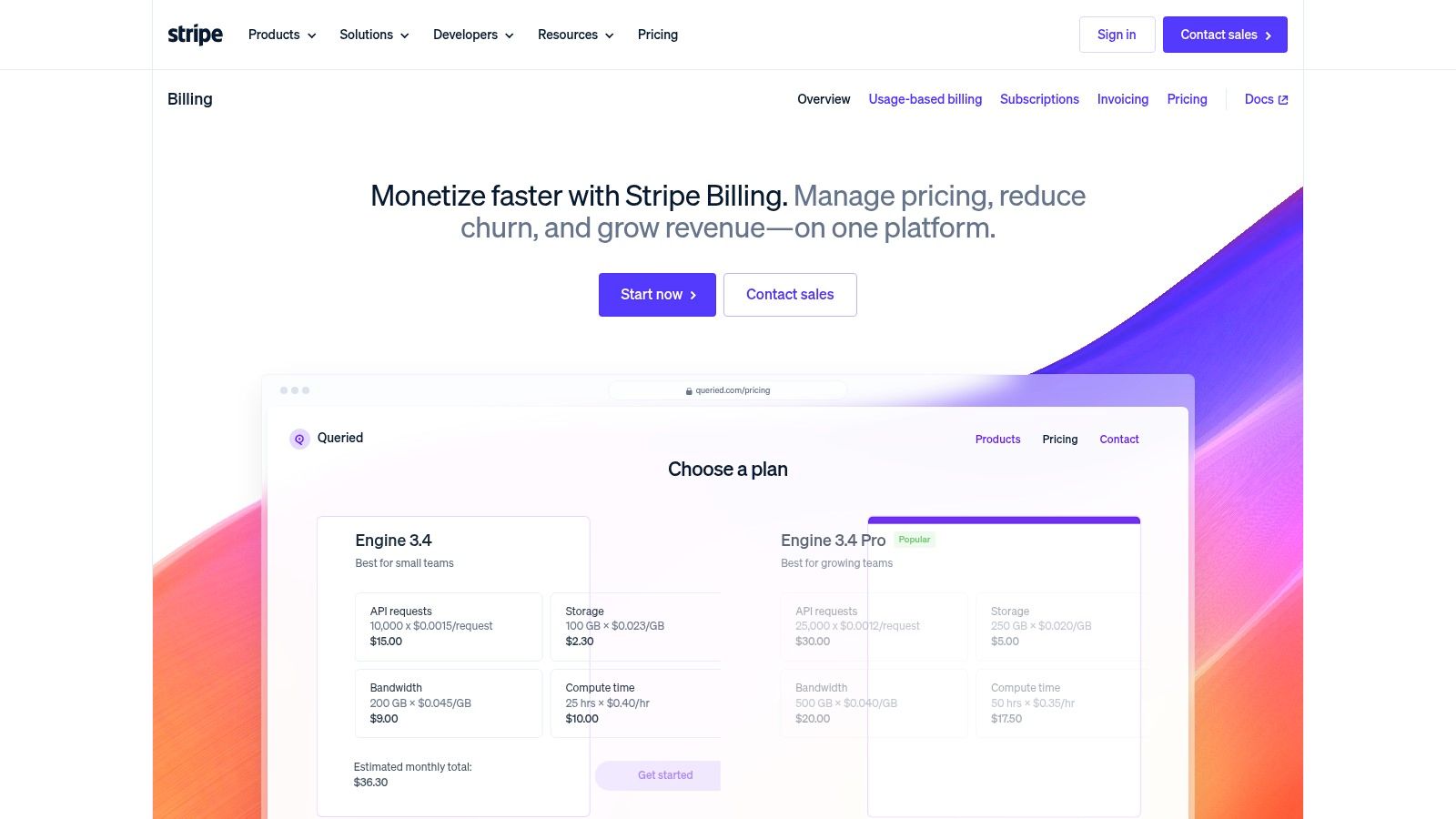
Stripe Billing is the default recommendation for product-led SaaS with standardized pricing and a team that wants to move quickly. LedgerUp's B2B SaaS guidance makes the same broad point. Developer-led teams with simpler pricing can start here, while companies with negotiated contracts, prepaid credits, ramp structures, or hybrid billing usually outgrow it (LedgerUp guide to B2B SaaS billing automation platforms).
That framing is right. Stripe is excellent when payments and billing should sit close together and the finance team doesn't want a long implementation cycle.
Best fit
Stripe Billing works well for recurring subscriptions, self-serve checkout, standard dunning flows, and metered billing where engineering owns much of the implementation. It's also useful when you want one vendor to handle both billing and payments.
If you're comparing basic recurring billing to a more finance-led invoicing motion, this overview of subscription invoicing software is a helpful lens. Stripe tends to win when speed and developer tooling matter more than bespoke contract logic.
- Best for self-serve SaaS: Clean checkout, portal, and payment infrastructure.
- Best for engineering-led implementation: Strong APIs and a broad ecosystem.
- Best for early complexity: Good enough for recurring and moderate usage billing before finance needs become heavier.
Trade-offs
Stripe can become less elegant when finance owns pricing exceptions instead of product and engineering. Negotiated enterprise contracts, nonstandard invoice terms, and layered approvals often push teams into custom work.
It's also important to evaluate total stack cost, not just the convenience of using a single processor.
Pros
- Fast to deploy: Strong documentation and mature APIs.
- Unified vendor footprint: Billing and payments under one roof.
- Good payment coverage: Useful for SaaS with broad payment preferences.
Cons
- Add-ons can accumulate: Billing, tax, and related modules can expand total cost.
- Can strain under bespoke finance workflows: Especially for contract-heavy B2B models.
Stripe is still one of the best billing automation for SaaS options if your business is product-led, your pricing is standardized, and speed matters more than finance-specific complexity.
3. Paddle
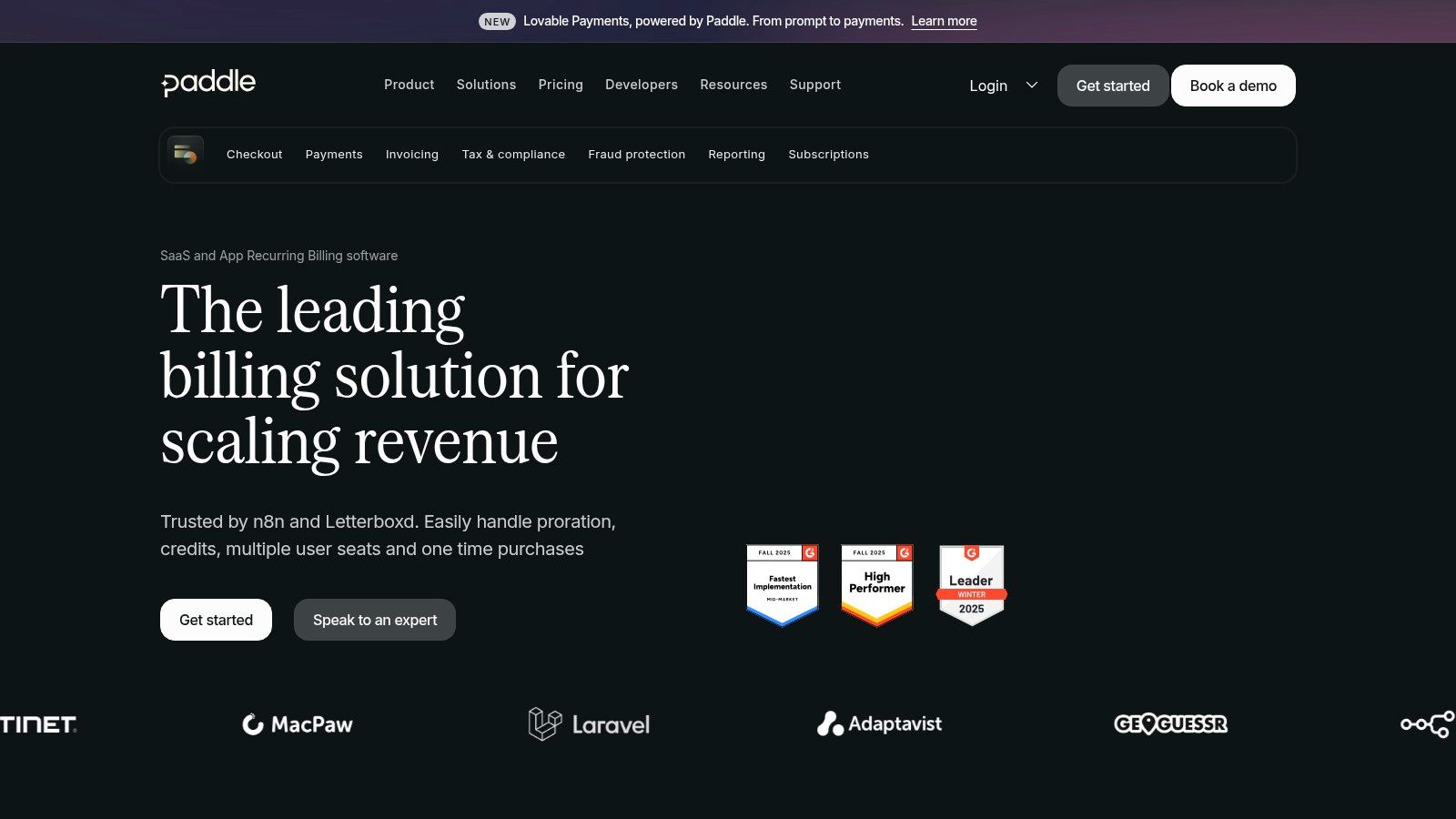
Paddle is the clearest choice when your biggest concern is global tax and compliance overhead, not billing architecture elegance. Its merchant-of-record model changes the operating burden in a meaningful way. That's why I recommend it most often to lean SaaS teams selling internationally without a deep finance bench.
The appeal is straightforward. You offload tax collection, remittance, parts of compliance, and a chunk of payment complexity into one commercial relationship.
When Paddle makes sense
Use Paddle if expansion speed matters more than retaining direct merchant control. That's often the right trade for smaller teams that need a credible global billing setup but don't want to stitch together processors, tax engines, and compliance tooling.
If you're mapping whether your stack should be merchant-of-record or software-led billing, this piece on automated billing software gives a practical comparison lens.
You should also think about the adjacent operating effect. A smoother payment and checkout flow can reduce support burden as well as billing friction, especially when a team wants to streamline customer support with Stripe or similar payment-connected workflows.
- Best for global software sales: Tax and remittance complexity shifts away from your team.
- Best for lean finance operations: Fewer systems to manage.
- Best for compliance relief: Useful when tax exposure is the blocker.
Where finance leaders hesitate
The merchant-of-record structure means less direct control. For some CFOs, that's acceptable. For others, especially those with large B2B contracts or customer-specific terms, it's a limitation.
Pros
- Compliance simplification: Reduces the burden of tax operations.
- Consolidated commercial model: Billing, payments, and tax are packaged together.
- Useful for international growth: Localized checkout is a meaningful operational advantage.
Cons
- Less direct control over merchant setup: You're not the merchant of record.
- May be less attractive for larger invoice-led B2B motions: Especially where custom payment handling matters.
Paddle is one of the most practical choices on this list if your finance team wants fewer systems and faster global readiness.
4. Chargebee
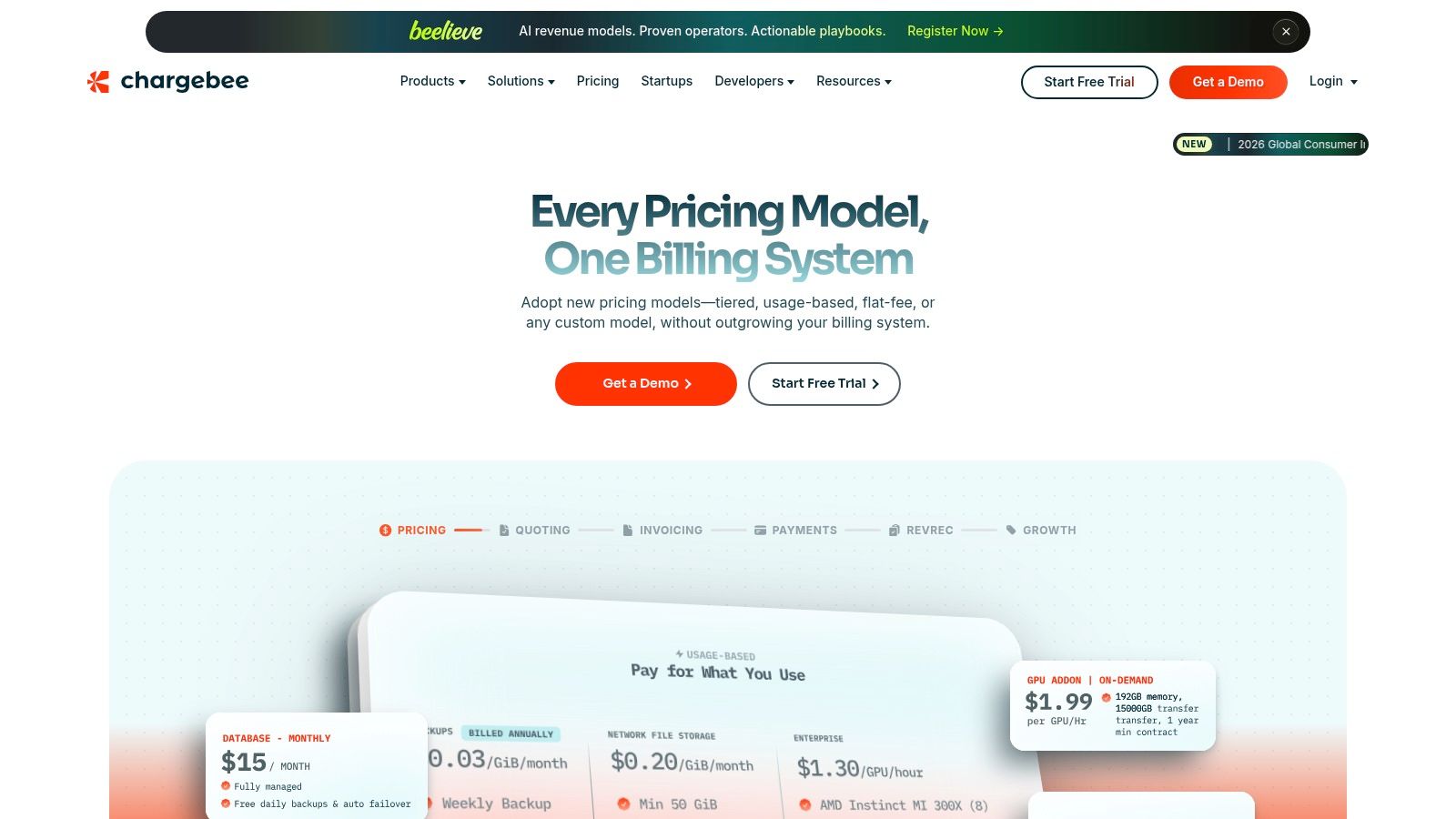
Chargebee is a strong fit for SaaS finance teams that need pricing flexibility without taking on the implementation burden of a heavier enterprise stack. I recommend it most often to B2B companies selling a mix of subscriptions, usage, add-ons, and contract-specific terms across more than one region.
The finance case for Chargebee is straightforward. It helps you standardize billing logic before billing complexity starts driving manual work in invoicing, collections, tax handling, and revenue recognition. If your team is still patching together subscription changes, one-off credits, and usage charges in spreadsheets or disconnected tools, Chargebee usually fixes a real operating problem.
Why it earns a place here
Chargebee is strongest when monetization complexity is the main issue. Hybrid pricing, self-serve and sales-led motions, customer portals, invoicing, and tax management all sit in one billing layer. That matters because the right billing system should do more than send invoices. It should reduce reconciliation effort, support ASC 606 workflows, and give accounts receivable a cleaner process for collecting cash on time.
I would put Chargebee on the shortlist for finance leaders who want flexibility but still care about control. It gives RevOps, finance, and product teams room to change packaging without rewriting the billing back end every quarter.
Finance teams should not buy the platform with the longest feature list. They should buy the one that creates the least downstream cleanup in revenue, tax, and collections.
What to watch
Chargebee works well in the mid-market, but costs and complexity can rise as you add modules, entities, and advanced workflows. Scope the full operating model early. That includes billing, tax, revenue recognition, integrations, and who on your team will own configuration after go-live.
It is also not an accounts receivable automation system first. If your biggest problem is DSO, collections follow-up, or invoice chasing, evaluate how Chargebee will connect to the rest of your AR process instead of assuming billing automation alone will fix cash collection.
Pros
- Flexible billing models: Handles hybrid pricing better than many simpler tools.
- Good fit for growing B2B SaaS: Useful when pricing changes faster than your systems can keep up.
- Strong revenue stack fit: Supports cleaner handoffs into accounting, tax, and revenue recognition workflows.
Cons
- Total cost can expand: Add-ons and higher-tier capabilities can change the ROI quickly.
- Configuration takes discipline: Advanced use cases need clear ownership and process design.
- AR automation may still require another layer: Billing accuracy and cash collection are not the same thing.
If your goal is to support evolving pricing while keeping finance controls intact, Chargebee is one of the safer choices in this category.
5. Recurly
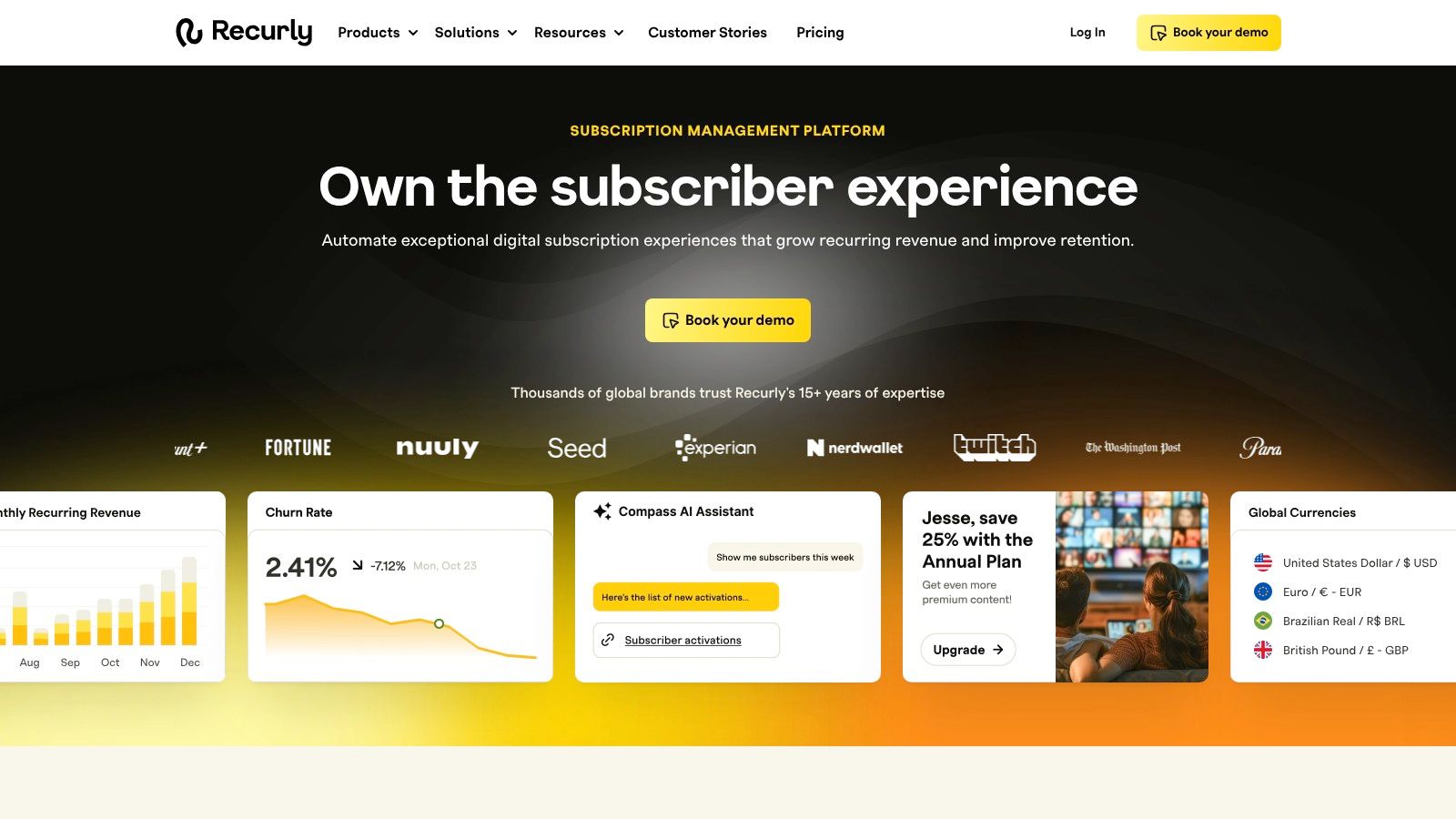
Recurly is a good choice when your payment architecture matters almost as much as your billing logic. I usually recommend it to teams that want gateway redundancy, more control over routing, and a mature recurring billing platform that won't force them into a single processor relationship.
That can be a serious operational advantage if failed payments or regional payment preferences are causing leakage.
Where Recurly fits best
Recurly is strongest for subscription-heavy businesses that want resilient payment operations. Multi-gateway orchestration, token support, migration tools, and lifecycle communications make it useful for finance leaders trying to reduce payment failure risk while keeping billing stable.
- Best for payment routing flexibility: Good when one processor isn't enough.
- Best for subscription lifecycle control: Useful for renewals, customer communications, and retries.
- Best for teams planning gateway migrations: Recurly has a practical reputation here.
What to keep in mind
Recurly isn't the payment processor. That gives you flexibility, but it also means you'll still manage the processor strategy and commercial relationships around it.
Pros
- Gateway flexibility: Strong for redundancy and routing control.
- Established recurring billing capability: Good fit for mid-market subscription businesses.
- Migration support: Useful if you're moving from another setup.
Cons
- Requires a separate processor strategy: More moving parts than all-in-one setups.
- Public pricing is limited: Most serious evaluations require a sales process.
Recurly makes sense when payment operations are part of the finance problem, not just a technical detail.
6. Zuora

Enterprise billing failures are expensive. A small pricing error, weak approval control, or broken revenue handoff can ripple into delayed collections, manual journal entries, and audit friction across multiple teams. Zuora earns its place on this list because it is built for that level of operational complexity.
I recommend Zuora for finance leaders who have already outgrown basic subscription billing and now need billing to support control, scale, and policy. That usually means multi-entity operations, usage-based pricing, contract amendments, ERP integration, and revenue recognition that holds up under scrutiny. If your team is trying to reduce manual work in order-to-cash while tightening ASC 606 discipline, Zuora is one of the few platforms built for it.
Zuora's own product footprint reflects that scope. The company positions its platform across billing, payments, and revenue recognition, which is why larger SaaS businesses often use it as a monetization and finance operations layer rather than just an invoicing tool. That distinction matters. You are not only buying invoice generation. You are buying a system that can reduce billing exceptions, standardize workflows, and give finance better control over how contract data turns into cash and recognized revenue.
Where Zuora fits best
Zuora is a strong fit when billing has become a finance systems problem.
- Best for complex enterprise pricing: Good for usage models, amendments, custom contract structures, and large product catalogs.
- Best for finance control and compliance: Useful when rev rec, approvals, audit trails, and ERP handoffs need to be tightly managed.
- Best for global order-to-cash environments: Works well for companies handling multiple entities, currencies, and payment setups.
The trade-off is clear. Zuora requires a serious implementation and active ownership from finance, rev ops, and IT. That is a cost. It is also the reason many larger teams get real ROI from it. If billing errors are slowing cash collection, creating revenue clean-up work, or forcing spreadsheets into the close, lighter tools stop being cheaper.
Pros
- Strong fit for enterprise billing operations: Handles complex pricing logic and process control well.
- Built with finance workflows in mind: Better suited to ASC 606, ERP sync, and audit requirements than lighter tools.
- Useful for AR automation at scale: Helps standardize invoicing and collections-adjacent workflows across larger teams.
Cons
- Implementation is demanding: Expect integration work, process design, and change management.
- Usually too much platform for smaller SaaS teams: The overhead only pays off when complexity is already real.
Zuora is the right call when the goal is not just to send invoices, but to run a cleaner order-to-cash process with fewer exceptions and better financial control.
7. Maxio
Maxio is the finance-first option for B2B SaaS leaders who need more than subscription billing but don't want the full weight of a large enterprise suite. I like it when the brief includes ASC 606, SaaS metrics, and contract renewals, not just invoice generation.
It's one of the better fits for CFOs who want the billing platform to improve reporting quality and close discipline.
Why finance teams like Maxio
Maxio combines recurring and usage billing with revenue recognition and SaaS analytics. That makes it attractive when your controller cares about revenue schedules, MRR and ARR reporting, and operational visibility in the same environment.
Its integration posture is also practical. Maxio notes connections with 20+ gateways alongside CRM and accounting systems such as Salesforce, HubSpot, NetSuite, QuickBooks Online, and Xero. For firms standardizing workflows across sales, billing, and accounting, that matters.
- Best for ASC 606-focused finance teams: Rev rec is part of the value, not an afterthought.
- Best for B2B contract management: Renewals and consolidated invoicing are useful here.
- Best for reporting-oriented operators: Good fit when billing should strengthen SaaS metrics and forecasting.
The trade-off
It's broader than a processor-native billing tool, so implementation won't feel as instant as Stripe. Some advanced modules may also require added scope.
Pros
- Strong finance orientation: Billing, rev rec, and metrics align well.
- Useful integration set: Supports a practical mid-market stack.
- Good for maturing B2B SaaS: Especially once spreadsheets are no longer acceptable.
Cons
- Can require more setup than simpler tools: Plan for scoping.
- Some functionality may sit behind add-ons: Confirm package details early.
If your finance team wants billing software that supports the close, not just collections, Maxio is a solid choice.
8. Stax Bill
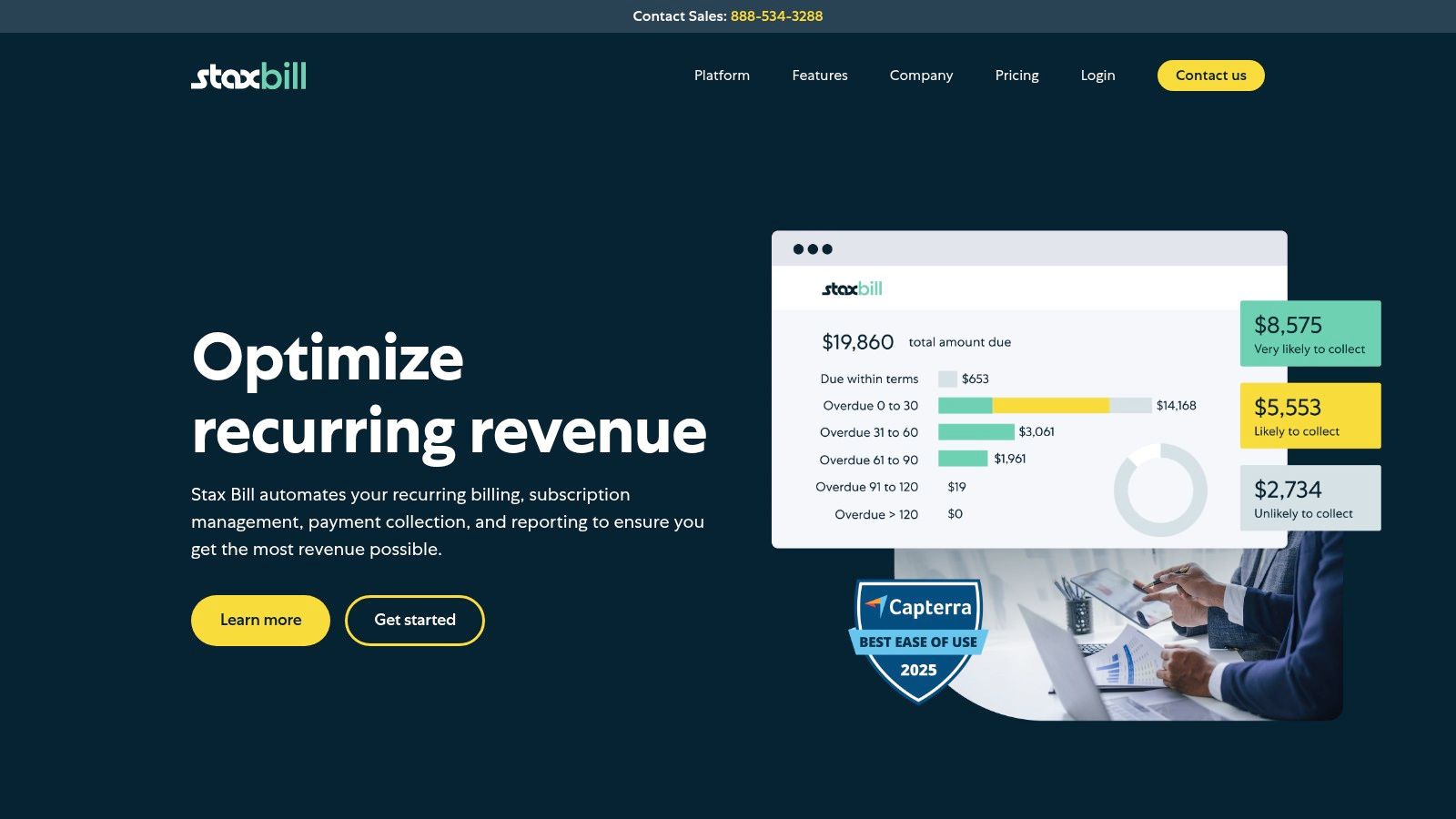
Stax Bill is worth a close look if predictable software cost is one of your buying criteria. That may sound secondary, but for finance leaders it isn't. Billing platforms often become difficult to budget once usage, invoice volume, and add-on pricing start to stack.
Stax Bill takes a more cost-stable approach while still covering recurring billing, proration, scheduled increases, and revenue recognition workflows.
Where Stax Bill fits
I'd shortlist Stax Bill for mid-market teams that want practical B2B invoicing controls without buying a platform built for very large enterprises. It's especially relevant if your business wants milestone-based or broader ASC 606 support without turning implementation into a major transformation project.
Pros
- Cost predictability: Flat pricing is easier to plan around.
- Practical B2B functionality: Covers proration, recurring billing, and rev rec needs.
- Useful for teams that value budgeting discipline: Software cost stays easier to forecast.
Where to be cautious
You'll need to think through the rest of the stack. Gateway strategy, tax tooling, and international complexity may still require additional systems depending on your operating model.
Cons
- Less bundled than merchant-of-record options: More architecture decisions remain.
- Very complex catalogs may require higher plans: Validate fit before rollout.**
Stax Bill isn't the loudest platform in the market, but it's a sensible one for finance teams that value control and cost stability.
9. FastSpring

FastSpring sits in a similar decision bucket to Paddle. If you want a merchant-of-record platform for software and digital products, it deserves consideration. I usually position it for lean teams that want localized checkout, bundled tax handling, and lower compliance lift.
The finance appeal is simple. Fewer vendors, fewer tax workflows, fewer internal handoffs.
Why some teams choose FastSpring
FastSpring can be a clean option for international expansion when your company doesn't want to build a billing-plus-tax stack itself. Subscription management, fraud handling, billing, and reporting are brought together in one model.
Merchant-of-record platforms are best when your constraint is operational bandwidth, not product flexibility.
Main limitation
You trade away some control. That isn't always a problem, but CFOs should treat it as a governance decision, not just a tooling preference.
Pros
- Bundled international operating model: Reduces vendor sprawl.
- Localized customer experience: Helpful for software sellers in multiple regions.
- Lower compliance burden: Useful for lean teams.
Cons
- Less direct control than DIY billing stacks: The structure is opinionated.
- Commercial detail usually requires sales contact: Harder to model quickly.
FastSpring is a practical global expansion tool if tax and compliance complexity are slowing the business down.
10. NetSuite SuiteBilling
NetSuite SuiteBilling is the right answer when NetSuite is already your financial system of record and you want billing to live inside that same control environment. That makes it a strategic fit for finance-led organizations that prioritize auditability, ERP alignment, and fewer cross-system reconciliations.
I don't recommend it because it's the most elegant front-end billing experience. I recommend it because it can simplify governance.
Best use case
If your company already runs NetSuite and wants one environment for billing, accounting, and revenue recognition, SuiteBilling is a logical move. The value comes from tight general ledger integration, customer-specific pricing controls, and a cleaner flow into reporting and close.
- Best for ERP-centric finance teams: Billing stays close to accounting.
- Best for governance-heavy environments: Good fit where controls matter more than implementation speed.
- Best for companies standardizing their stack: Fewer interfaces can mean fewer reconciliation issues.
The trade-off
You inherit ERP-style implementation reality. That means more configuration, longer deployment timelines, and a larger systems commitment than point solutions.
Pros
- Strong auditability and control: Useful for larger firms.
- Native connection to NetSuite accounting: Reporting and rev rec benefit directly.
- Customer-specific pricing support: Good for contract-heavy organizations.
Cons
- Best only if you already run NetSuite: Otherwise it's overkill.
- Longer and costlier to implement than lighter tools: Plan accordingly.
NetSuite SuiteBilling is a finance-led decision. If you want billing to serve the ERP first, it's one of the most coherent options available.
Top 10 SaaS Billing Automation Comparison
Product | Core Features (✨) | Quality / UX (★) | Price & Value (💰) | Target Audience (👥) | Why Choose / Differentiator (🏆/✨) |
|---|---|---|---|---|---|
Resolut 🏆 | End-to-end AR: risk scoring, omnichannel collections, dynamic billing, payment portal, instant cash application ✨ | Fast setup, consumer-grade portal, AI forecasting ★★★★☆ | 30‑day free trial & Kickstart tier; ROI-focused (example $149/mo) 💰 | CFOs, AR/collections, accounting firms, controllers 👥 | Predictive risk, legal-escalation, autopilot + co‑pilot for human-in-loop workflows ✨🏆 |
Stripe Billing | Usage & metered billing, Checkout, dunning, broad payment methods ✨ | Developer-first, excellent docs and tooling ★★★★★ | Pay-as-you-go; Billing & Tax add-ons can stack 💰 | Product-led SaaS, dev teams, platforms 👥 | Tight payments + billing integration; best for custom dev flows ✨ |
Paddle | Merchant-of-Record, global tax remittance, localized checkout ✨ | Simple global checkout & compliance UX ★★★★ | Revenue-share MoR fee (includes tax/remittance) 💰 | Teams offloading tax/compliance for global expansion 👥 | Removes VAT/sales tax burden; speeds market entry ✨ |
Chargebee | Flexible subscription + usage billing, CPQ, portal ✨ | Mature UI; scalable product catalog ★★★★ | Tiered pricing + add-ons; costs rise with volume 💰 | B2B SaaS needing complex pricing & revenue ops 👥 | Rich usage models and broad gateway support ✨ |
Recurly | Multi-gateway orchestration, dunning, analytics ✨ | Resilient processing; enterprise-ready ★★★★ | Custom plans; requires separate gateway fees 💰 | Companies needing gateway redundancy & routing control 👥 | Strong failover/routing and migration utilities ✨ |
Zuora | Enterprise catalog, usage rating, revenue recognition ✨ | Deep finance controls; complex implementation ★★★ | Enterprise pricing; higher TCO for scale 💰 | Large enterprises with complex contracts & finance teams 👥 | Comprehensive monetization + finance automation ✨ |
Maxio | Recurring & usage billing, rev-rec, SaaS metrics ✨ | Finance-first dashboards and reporting ★★★★ | Transparent entry pricing; add-on modules 💰 | Finance teams needing ASC 606 & DSO reporting 👥 | Billing + rev-rec + analytics in one stack ✨ |
Stax Bill | Recurring billing, proration, revenue recognition (milestones) ✨ | Predictable tooling; practical B2B invoicing ★★★★ | Flat pricing model to avoid overages 💰 | Teams prioritizing cost predictability & rev-rec 👥 | Stable flat fees & ASC 606 support ✨ |
FastSpring | MoR: taxes, remittance, fraud, subscriptions ✨ | Bundled seller experience; localized checkout ★★★ | Revenue-share; custom rates via sales 💰 | Lean teams expanding internationally without compliance lift 👥 | All-in-one MoR bundle reduces vendor sprawl ✨ |
NetSuite SuiteBilling | Native billing + usage support, price books, invoice generation ✨ | Tight ERP linkage; enterprise governance ★★★★ | Part of NetSuite licensing; custom pricing 💰 | NetSuite customers standardizing finance in one system 👥 | Single system of record for billing, GL and rev-rec ✨ |
Aligning Your Tech Stack with Financial Strategy
Selecting the best billing automation for SaaS is a financial design decision, not a feature comparison exercise. The right platform should improve control over revenue operations, tighten your invoice-to-cash cycle, and reduce the amount of manual judgment your team has to apply every month. If it doesn't strengthen forecasting, reconciliation, and collections discipline, it's only solving a narrow slice of the problem.
Start with pricing complexity. That's the cleanest filter. If your company runs straightforward subscriptions and wants speed, Stripe Billing is still the practical default. If you need flexible hybrid pricing and broad payment options, Chargebee is a safer choice. If you're operating at enterprise scale with complex contracts and finance controls, Zuora belongs at the top of the list.
Then look at tax and geographic complexity. Paddle and FastSpring make sense when global compliance burden is a primary obstacle and your team would rather offload it than build around it. NetSuite SuiteBilling makes sense when ERP alignment and governance matter more than implementation speed. Maxio is often the better middle ground for B2B SaaS finance teams that want revenue recognition and metrics discipline baked into the stack.
But many finance leaders are solving the wrong problem first. They buy billing software to automate invoice creation, then discover that cash still arrives late, failed payments still need intervention, and collections still live in inboxes and spreadsheets. That's why the accounts receivable automation layer matters so much.
For firms focused on reduce DSO, improve cash flow, and remove manual collection work, Resolut is the standout recommendation. It connects billing-adjacent workflows to the broader AR motion: risk identification, automated follow-up, payment enablement, and cash application. That matters for SaaS companies, but it's especially relevant for professional services firms that want AR software for professional services and QuickBooks AR automation without launching a major systems program.
This is the operating principle I'd use. Buy for the bottleneck that limits cash conversion.
- If billing logic is the bottleneck: Choose the platform that best matches your pricing model.
- If global compliance is the bottleneck: Choose a merchant-of-record model.
- If collections and cash application are the bottleneck: Prioritize integrated accounts receivable automation.
- If close discipline and rev rec are the bottleneck: Choose the finance-first platform, not the fastest checkout tool.
The best finance stacks create control, not just activity. Billing should feed cleanly into collections, reconciliation, revenue recognition, and forecasting. When those systems line up, your team spends less time fixing exceptions and more time managing the business.
Resolut automates AR for professional services, consistent, accurate, and human.
If late payments, manual follow-up, and reconciliation drag are putting pressure on cash flow, Resolut is worth a serious look. It gives finance teams a practical path to accounts receivable automation, AI AR automation, and QuickBooks AR automation without adding another fragmented tool to the stack.