Contact Data Validation for AR Teams: A Practical Guide
Contact data validation for AR teams: practical methods, workflows, and metrics that protect cash flow and ensure every outreach lands with the right person.
The invoice looked routine on day one. The project closed, billing went out, and the AR team expected the usual back-and-forth before cash landed. Then the billing email bounced, the project sponsor had left the company, and the backup phone number routed to someone who no longer handled the account.
That's how receivables slip, not with a dramatic failure, but with three small contact errors that turn a clean invoice into a slow-moving problem. In B2B, contact data validation isn't a marketing hygiene task. It's a cash-flow control, because B2B contact data loses about 2.1% of its accuracy per month, which compounds to roughly 22.5% annually, while email addresses decay 23-30% per year and phone numbers change 18% per year (Landbase industry analysis).
When you manage AR for a professional services firm, that decay shows up in aging reports, not dashboards. A single unreachable decision-maker can stretch a collection cycle, delay dispute resolution, and create extra touches for the same dollar. The list looked fine when it was loaded. It just didn't stay fine.
The Six-Figure Invoice That Disappeared
The first sign wasn't a late payment, it was silence. The billing reminder went out, the email address bounced, and the collections rep called a number that had been reassigned. The project had already delivered, the client wasn't disputing the work, and yet the cash sat untouched because the AR path to the buyer no longer existed.
That's the practical risk most finance teams underestimate. B2B contact data loses about 2.1% of its accuracy per month, and the decay compounds fast enough to erode a list that felt dependable at the start of the quarter (Landbase industry analysis). In a professional services firm, those bad touches don't just waste time. They create a gap between completed work and collected cash.
Why receivables teams feel it first
Billing, dispute resolution, and collections all depend on reachability. If the project sponsor leaves, the AP contact changes, or the inbox dies, the invoice doesn't move forward on its own. It waits while the business keeps paying for labor, overhead, and taxes tied to revenue that should already be in the bank.
Practical rule: if the contact path to an invoice is stale, the invoice is effectively at risk even when the work is fully delivered.
This is why I treat validation as part of the close process, not a cleanup project after things go wrong. The hidden cost is working capital pressure. The visible symptom is a string of polite follow-ups that never get answered because nobody on the other end is there anymore.
Why Static Databases Cost You Cash
Most contact lists fail slowly, which makes the loss easy to ignore. A database can still look complete while the underlying records drift out of date through job changes, domain closures, email deactivation, and reassigned phone numbers. Each one breaks a different part of the AR workflow, but the effect is the same, fewer invoices reach a real human.
Finance teams feel that drift in the collection cycle, not in a dashboard. A stale sponsor record sends reminders to the wrong inbox, an AP contact no longer works the dispute, and a reassigned phone number sends the call to someone who has nothing to do with the invoice. Once that happens, the bill can sit in aging even though the work is finished and the customer never disputed the charge.
The market gap is bigger than many teams realize. Almost a third of companies validate their contact data only annually or never at all, while validated datasets from high-quality providers can deliver 97%+ accuracy with bounce rates below 1%, compared with 5-7% for non-validated data (Informatica analyst report). That gap matters in receivables because every failed touch lowers the odds that the invoice reaches someone who can approve, route, or pay it.
The decay is operational, not theoretical
The reason static lists fail is simple. People move roles, companies rebrand, inboxes get retired, and phone numbers get reassigned. In AR, that means a reminder never lands, a dispute thread stalls, or an escalation step goes to the wrong person. You cannot collect from a contact record that no longer reaches anyone.
A one-time scrub treats contact data like a finished asset. It is not. It depreciates in place, and the write-down happens whether your team measures it or not. The firms that stay ahead treat validation as a standing control, much like they treat approvals, reconciliations, or credit checks. Analysts at Datamagnet found the same pattern in layered verification benchmarks, where single-pass checks left too much bad data behind and waterfall methods recovered far more usable records (Datamagnet benchmark).
A Layered Validation Workflow for Finance Teams
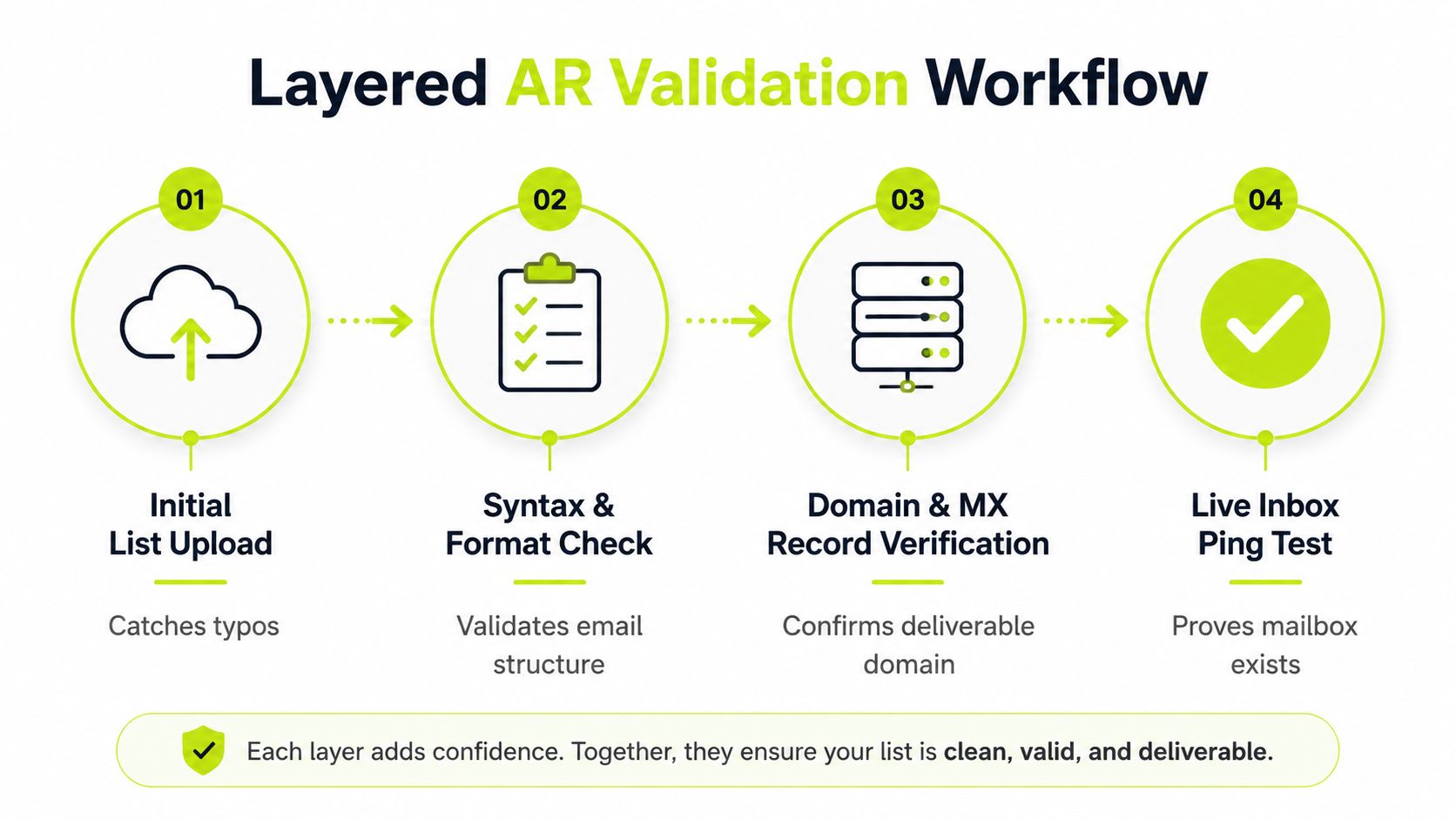
Single-pass verification sounds efficient, but it leaves too much risk behind. A better workflow stacks checks in order, starting with syntax checks, then domain and MX validation, then SMTP mailbox verification, and finally catch-all detection. The point isn't to add process for its own sake. It's to stop bad records before they reach collections.
The benchmark matters here. Single-pass verification leaves bounce rates in the 8-12% range, while stacking methods can reduce bounces to under 2%. In one benchmark, single-source verification produced usable data on only 68.2% of records, whereas a 15-provider waterfall reached 96.4% verified emails in under 11 minutes (Datamagnet benchmark). For AR, that's the difference between a list that merely exists and one that works.
Where the workflow fits
Use layered verification at point of entry when a new customer lands in the CRM. Run it again on a rolling refresh for active accounts, especially the ones with open balances. And recheck before any escalation step, because the cost of a bad touch is higher when the invoice is already aging.
If your team wants a practical implementation path, an Email Validation API can slot into the same workflow and handle the mechanical part of checking deliverability before the email goes into a queue.
For billing records, the contact data itself also has to be clean. Billing information that's current and consistent gives validation a better starting point, especially when the AR team is matching invoices to the right person and the right account.
One-shot cleansing is a snapshot. Collections needs a live process.
A waterfall model doesn't mean every record needs the same treatment every time. It means the highest-risk records get the deepest check, while routine updates can move through a lighter path. That's the kind of trade-off finance teams can live with because it improves reach without making the AR desk slower.
Validating the Four Attributes AR Actually Needs
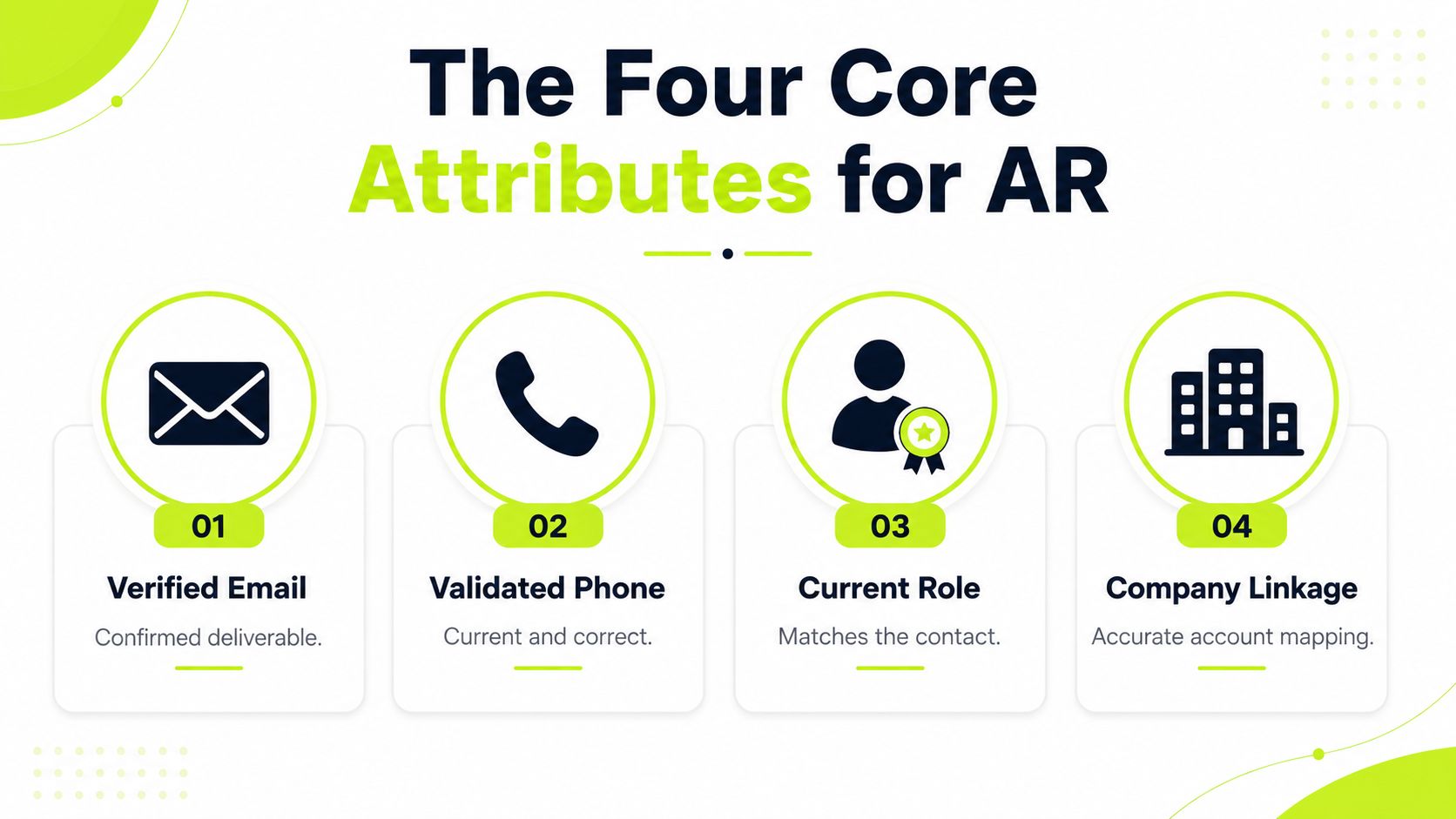
Email alone doesn't keep receivables moving. A contact record has to answer four questions, is the email deliverable, is the phone active, is the role current, and is the person still tied to the right company. If any one of those is wrong, the outreach sequence starts to slip.
Phone validation deserves special attention. It's not a syntax pass. It's a status check against telecommunications data that confirms the number is active and tied to the right user (EDQ). That matters in AR because a formatted-correct number can still be disconnected, reassigned, or mismatched to a VoIP line that never reaches the person who approves payment.
What “verified” should mean in the CRM
A useful validation program doesn't stop at pass or fail. It tags records as Unverified, Stale, or Bounced before they're allowed back into a queue. That keeps the team from reusing bad records just because they're already in the system.
Independent guidance recommends sampling 500-1,000 enriched records and testing them in a real campaign, with hard bounces under 1% considered excellent, phone connect rates above 8%, and job title accuracy above 90% in spot checks. It also says false positives should stay under 2% and false negatives under 5% (Databar guidance). Those thresholds give finance teams a real control standard instead of a vendor promise.
If your team wants a quick external benchmark for inbox performance, it's also useful to check inbox placement before a collections sequence goes live. A valid contact that lands in spam is still a failed touch.
The control point that matters
I've found the best enforcement rule is segment-based, not global. Active pipeline and high-value receivables need tighter verification than dormant accounts. The CRM should make it hard to send from stale data, not just easy to report on it later.
Cadence, Compliance, and Where Validation Fits in AR
The biggest mistake is treating validation like an annual cleanup. AR doesn't run on annual cycles, so the validation cadence shouldn't either. Stable directories can be refreshed quarterly, while active pipeline and high-velocity accounts usually need monthly or 90 to 180 day refreshes, with point-of-entry checks every time a new customer is created (Atlas Systems validation guidance).
Compliance belongs in the same workflow. Advanced validation practices recommend carrier-level line-type checks, reassigned-number scrubs, DNC suppression, internal opt-out lists, and timestamped audit trails before every campaign, because a record can look valid and still be risky to contact (Instantly checklist). That matters to finance teams because AR outreach isn't just about persistence, it's about contacting the right person in a defensible way.

A cadence that fits the work
A practical model looks like this. New accounts get checked at entry. Active balances get revalidated on a rolling cycle. Escalations get one last verification pass before the message goes out. That sequence protects both deliverability and the client relationship, because nobody wants a dunning email sent to a former employee.
For cadence planning, Voicedial explains sales cadence strategy in a way that maps cleanly to outbound timing decisions. The lesson for AR is simple, frequency matters, but the timing has to match the contact's current status.
As regulations tighten, the trend is moving away from batch cleansing and toward continuous validation plus ongoing refresh. That's the posture finance teams need if they want compliance reviewers, auditors, and collections managers looking at the same clean record set.
Metrics That Tie Validation to Cash Flow
Validation only earns budget when it shows up in measurable outcomes. The useful dashboard is small and direct. Track hard-bounce rate, phone connect rate, job-title accuracy, false positive rate, false negative rate, and the percentage of active accounts with a verified contact in the last 90 days. Then tie each one to a receivables outcome, not a vanity metric.
The control rule from Apollo is a good operational anchor. It recommends enforcing a minimum verified-contact percentage per ICP segment, such as ensuring 85% of active pipeline contacts have a verified email within 90 days, with failed records tagged as Unverified, Stale, or Bounced before re-engagement (Apollo guidance). That's the kind of threshold a controller can audit and an AR manager can run.
Validation Metrics and Cash-Flow Thresholds | Excellent | Acceptable | Concerning |
|---|---|---|---|
Hard-bounce rate | Under 1% | 1-2% | Above 2% |
Phone connect rate | Above 8% | Near 8% | Below 8% |
Job-title accuracy | Above 90% | Around 90% | Below 90% |
False positives | Under 2% | 2-5% | Above 5% |
False negatives | Under 5% | 5% or more | Above 5% |
Verified contacts in active segment | At least 85% within 90 days | Near target | Below target |
What the numbers mean in practice
Bounce rate affects sender reputation. Connect rate affects how fast a real person receives the message. Job-title accuracy affects whether AR reaches the person who can move the invoice. The false-positive and false-negative thresholds tell you whether the validation layer is too strict or too loose.
For a basic cash-flow check, think in contact coverage, not abstract quality. If a firm has 2,000 active AR contacts and cuts bounce rate from 5% to under 1%, that's roughly 80 more contacts per cycle receiving the reminder. That doesn't guarantee payment, but it does restore reach, which is the first step in reducing DSO and improving cash flow.
For broader AR reporting, accounts receivable KPIs should sit next to these contact-quality measures so leadership can see the operational link between list quality and cash collection.
Putting a Validation Posture in Place
The operating posture is straightforward. Validate at entry, validate on a rolling cadence, enforce the four attributes in the CRM, and block stale records from re-entering outreach. Keep the dashboard small enough for the weekly AR review, and make sure it shows both contact quality and collection reach, not just list size.
That's how the opening scenario changes. The billing email gets checked before the invoice goes out. The phone number is revalidated before escalation. The contact's role and company association are confirmed before the team assumes the right person is still there. What used to become a 60-day gap becomes a controlled follow-up sequence with an audit trail behind it.
The finance takeaway is simple. Contact data validation protects cash flow because it keeps the receivables path live. It won't replace collections discipline, but it stops avoidable failures from turning into slow payments.
If you want your AR team to work from clean contacts, current outreach logic, and fewer wasted touches, visit Resolut. It brings validation and AR automation together so your team can reduce DSO, improve cash flow, and keep collections consistent, accurate, and human.