What Is AR Accounts Receivable and Why It Matters
What Is AR Accounts Receivable. Learn what AR accounts receivable is, how it affects cash flow and DSO, and where automation helps professional services firms
On Monday morning, the controller opens the aging report and finds six invoices past 60 days. Two clients promised that checks were on the way, but neither payment has appeared. Payroll runs Thursday, and the cash forecast that looked comfortable on Friday now feels thin.
Nothing dramatic happened. The firm sold good work, delivered it, invoiced it, and kept serving clients. Yet the finance team is scanning inboxes, reconciling partial remittances, and answering partner questions about cash instead of focusing on utilization, hiring, or growth.
That's the practical meaning of what is AR accounts receivable. AR is not just a bookkeeping line. It's the operating gap between revenue recognized and cash available. Managed well, it releases working capital. Managed casually, it makes the firm's calendar revolve around other people's payment habits.
The Week You Realize Receivables Are Running the Firm
The first warning usually isn't a dramatic write-off. It's a change in the finance team's week.
A controller starts Monday by checking whether invoices were sent correctly, whether client purchase orders were included, and whether accounts payable contacts received the billing email. By midmorning, the team is following up on overdue balances. Before lunch, a partner asks whether a large client's payment has cleared. By afternoon, someone is matching a partial deposit to several invoices because the remittance advice never arrived.
The work is familiar, but the pressure is different. Finance has stopped managing the cash cycle and started reacting to it.
For a professional services firm, this matters because revenue and cash rarely move together. A consulting engagement can be complete, the invoice can be valid, and the revenue can be recorded while the bank account remains unchanged. The firm has effectively financed the client for the length of the payment term, plus any delay caused by missing documentation, an approval queue, or a billing dispute.
Operator's observation: A healthy revenue report can coexist with an uncomfortable cash position when the firm lacks control over collection timing.
The problem often becomes visible during month-end. The team needs clean balances for reporting, partners want confidence in distributions, and the cash forecast needs to support payroll and tax planning. If the aging report is updated manually, the answer depends on whether someone remembered every follow-up, applied every payment, and investigated every exception.
That's when many firms realize accounts receivable is steering the business. The response shouldn't be to add another person to an already manual process by default. First define AR correctly, then measure collection speed, trace the invoice lifecycle, and identify the points where consistent orchestration can replace memory and spreadsheet maintenance.
What AR Accounts Receivable Actually Means on the Balance Sheet
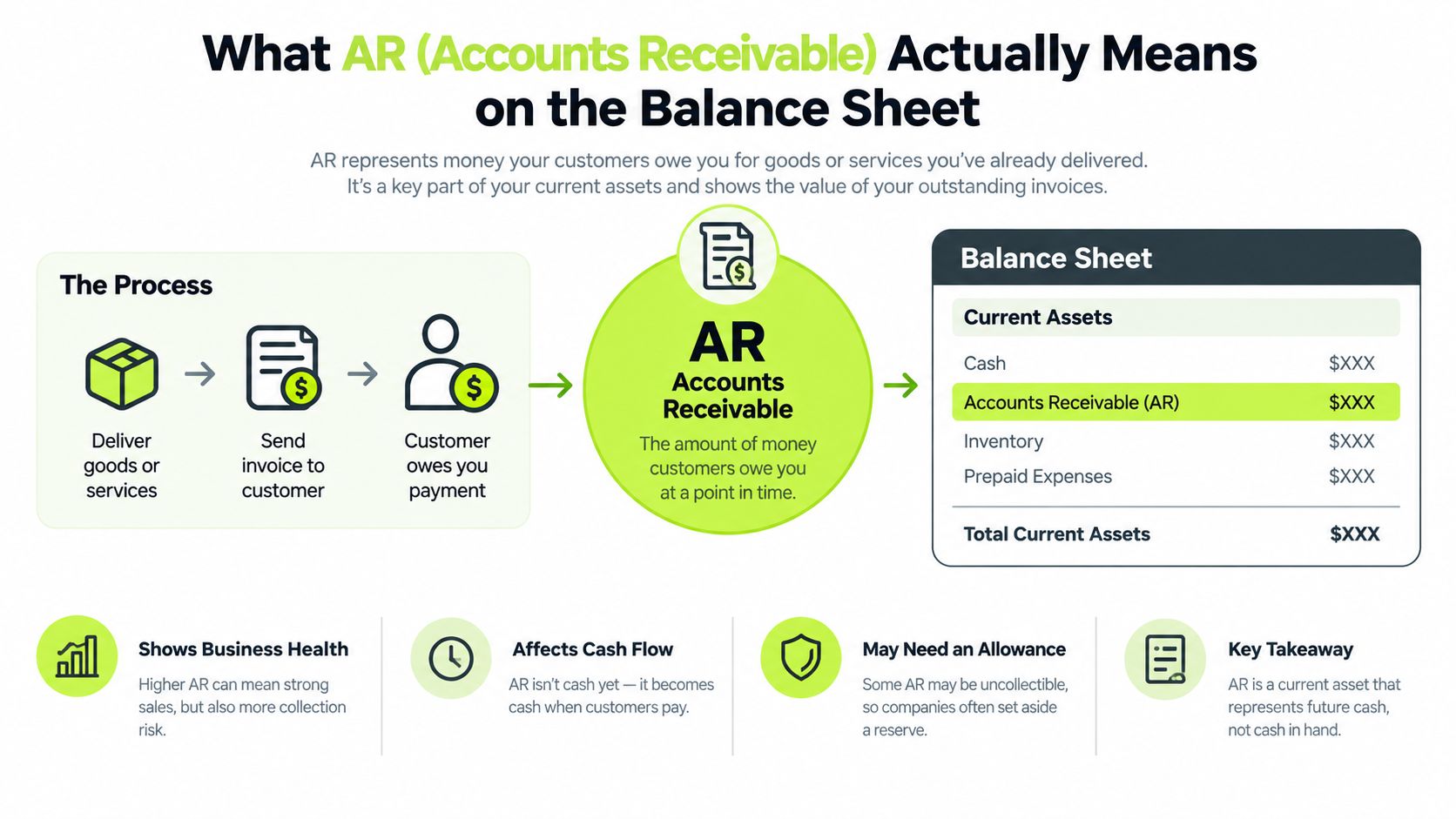
A consulting firm can finish December work, issue an invoice, and report revenue while its bank balance stays unchanged. Accounts receivable is the amount customers owe a business for goods or services already delivered on credit. It appears as an asset because the firm holds a contractual right to receive cash, not cash itself. JPMorgan's explanation of AR turnover and DSO connects this distinction to cash conversion and working capital management.
Suppose the firm bills $200,000 of December work on net-30 terms. Under accrual accounting, it recognizes the revenue when the work is earned and records approximately $200,000 in AR at month-end. The income statement reports the activity. The balance sheet records the unpaid client obligation.
Cash accounting shows the practical constraint. Until payment arrives, the bank account has not improved. That gap can force a profitable firm to use a credit line or postpone a distribution. AR is the working capital position between delivery and collection, so it should be managed as an operating lever rather than treated as a static bookkeeping line.
AR and working capital
Working capital is commonly calculated as current assets minus current liabilities. Inventory may be limited in a professional services firm, making AR one of the largest operating assets after cash. Accounts payable records amounts owed to suppliers and contractors. AR records amounts clients owe the firm.
Collection timing therefore affects operating capacity. Faster conversion can fund hiring, partner distributions, tax reserves, and other commitments without immediately increasing debt. Slower conversion restricts those choices, even when sales remain strong. The firms that manage this gap well usually coordinate billing, documentation, follow-up, dispute handling, and payment application instead of adding staff to compensate for fragmented work.
For a clear review of how these accounts connect, use balance sheet help from Alignmint to examine the structure behind the balances.
DSO in a working example
DSO measures how quickly credit sales become cash. The standard formula is:
DSO = accounts receivable ÷ credit sales × number of days in the period.
A business ending a 90-day quarter with $900,000 in AR and $3,600,000 in credit sales has a DSO of 22.5 days, according to JPMorgan's DSO guidance. In practical terms, the firm waits about 22.5 days, on average, to collect each credit sale.
Controllers should calculate DSO consistently and investigate what drives the result. A rising figure may reflect weak credit decisions, late invoices, disputed work, poor follow-up, or payments that arrived but remain unapplied. The formula is simple. The operating diagnosis requires tracing the process behind the balance.
For the calculation mechanics, use this guide to calculate accounts receivable, then connect the result to the firm's cash forecast.
The Metrics That Reveal How Healthy Your AR Really Is
An AR balance can look stable while cash conversion deteriorates. Controllers need to examine three questions: how much remains outstanding, how long invoices have been open, and whether the collection process turns billings into cash at a dependable pace. That view treats AR as a working capital lever, not merely a bookkeeping line item.
DSO is the starting measure. It shows the average time required to collect credit sales. Current benchmark data shows a wide spread. One 2026 benchmark reports 39 days for one large provider's clients, while global DSO is cited around 50 to 54 days. The same source reports that top performers collect in 28 days, compared with a 46-day median. That gap gives controllers a useful operating question: which steps separate faster collection from the median, and can the firm coordinate those steps before adding staff? Kaplan Collection Agency's 2026 survey insights provides the benchmark context.
A second measure is aging distribution. Separate invoices into current, 1 to 30, 31 to 60, 61 to 90, and 90-plus day buckets. The pattern matters more than the total. A large current balance may be manageable, while a smaller balance concentrated beyond 60 days can carry substantially greater collection risk.
A practical benchmark view
Metric | Best-in-Class | Median | Action Threshold |
|---|---|---|---|
DSO | 28 days | 46 days | Review any sustained increase |
Companies above 60 days DSO | Not stated | Not stated | 44% benchmarked above 60 days |
Companies above 90 days DSO | Not stated | Not stated | 21% benchmarked above 90 days |
DSO tracking discipline | Not stated | Not stated | Investigate if DSO isn't actively tracked |
The figures in this table come from the 2026 DSO benchmark survey. A separate AR automation survey reports that most companies remain in the 31 to 60 day DSO range, only 17% get under 30 days, and 2% don't actively track DSO. It also identifies poor cash flow or high DSO as the top consequence named by 78% of respondents. BillingPlatform's AR Automation Survey Report supplies those findings.
The Collection Effectiveness Index, or CEI, adds another perspective. It evaluates how effectively the firm collects receivables available during a period, including beginning balances and new billings. DSO shows how long collection takes. CEI shows whether the team converts the collectible pool into cash.
Review these measures weekly rather than waiting for month-end. A weekly aging review gives the controller time to correct billing errors, assign ownership, escalate a dispute, or adjust the cash forecast before a late invoice affects payroll. For the DSO calculation and interpretation, see a practical explanation of what DSO means.
A Day in the Life of an Invoice From Send to Cash
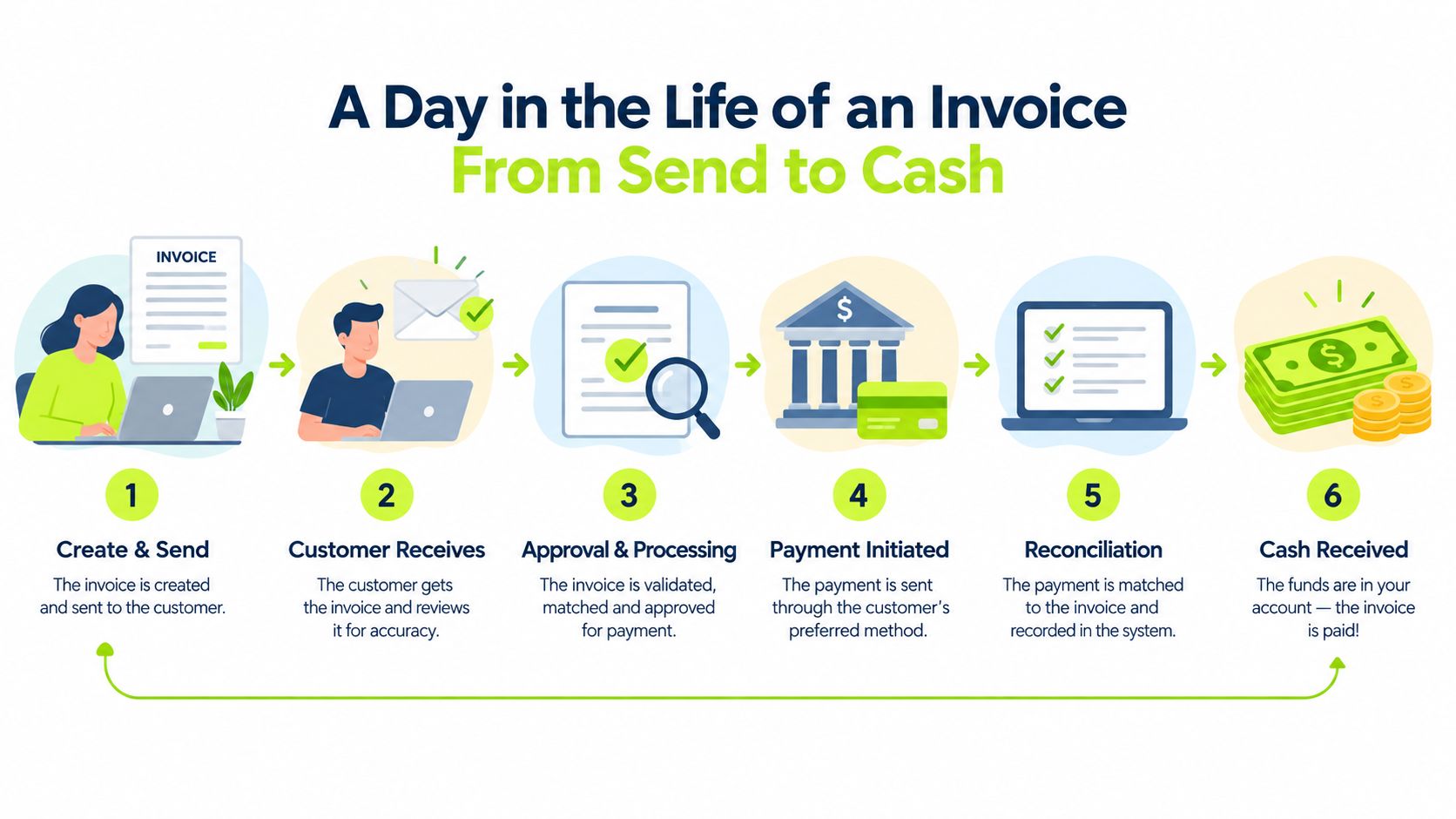
Take one invoice from a typical professional services firm. The project manager approves the final time and expense data, the billing team pulls the information from the project system, and the controller's staff formats the invoice for the client's requirements. Then someone sends it to the correct AP contact, often with a purchase order, statement of work, or approval reference attached.
The invoice may be accurate, but the work doesn't end at send.
Five days later, a team member checks whether the client received it. Around day thirty, the invoice appears in an aging review. If the payment hasn't arrived, the collector emails again and calls the client's AP clerk to confirm receipt, approval status, and any missing documentation.
Where the manual touches accumulate
Suppose the client sends a partial payment without remittance detail. The AR analyst now searches email threads, bank records, and invoice files to identify which balance the payment covers. The analyst applies the cash, reconciles the result to the general ledger, and investigates any difference.
If the payment doesn't match the invoice exactly, someone decides whether the difference is a short pay, an approved credit, a disputed charge, a bank fee, or a potential write-off. That decision may require input from the project manager, account lead, and client contact.
A single invoice can therefore create work across billing, collections, cash application, account management, and accounting. The issue isn't only the time spent on one invoice. It's the interruption pattern. A five-person finance team can feel buried on the fifteenth of the month because every unresolved exception arrives while the team is also closing the books and preparing reports.
Practical rule: Automate the repeatable touchpoints, but keep human approval for disputes, write-offs, unusual payment plans, and relationship-sensitive escalation.
The invoice lifecycle includes credit decisions, invoicing, payment acceptance, cash application, and collections. This guide to how invoices work provides a broader process view. Firms evaluating ways to free up cash from overdue invoices can also review invoice recovery capital financing, while recognizing that financing addresses liquidity timing and doesn't fix the underlying collection process.
The best AR process makes ownership visible at every stage. Someone should know who sent the invoice, who owns the next follow-up, what evidence supports the balance, and when the exception must be escalated.
What Slow AR Quietly Costs a Professional Services Firm
A firm can report a profitable month and still struggle to fund payroll when client invoices remain unpaid. Slow AR traps operating cash in outstanding balances, limiting hiring, recruiting, distributions, and investment in the business.
The practical test is the gap between actual DSO and the firm's operating target. The plan for this analysis uses a 35-day benchmark, $15 million in annual revenue, and 55-day DSO. The controller should calculate daily credit sales using the firm's own revenue basis and method rather than apply a universal shortcut.
A 20-day DSO gap means roughly 20 days of sales remain in AR beyond the benchmark. That balance may require the firm to delay hiring, draw more heavily on a credit facility, or retain cash that could support other priorities. AR is therefore a working capital lever, not just a bookkeeping line item.
Translating the gap into decisions
DSO | Working Capital Tied Up in AR | Annual Opportunity Cost vs 35-day Benchmark | Practical Effect on the Firm |
|---|---|---|---|
35 days | Target-level outstanding sales | No excess against benchmark | Cash planning follows the operating plan |
46 days | More revenue remains uncollected | Positive financing and opportunity cost | Forecast depends more heavily on client timing |
55 days | Material additional sales remain outstanding | Higher cost than the 35-day benchmark | Hiring, distributions, and reserves face more pressure |
60-plus days | A larger share of cash is delayed | Risk increases as aging extends | Credit exposure and collection effort require escalation |
The gap between strong operators and the median is often a process difference, not a staffing difference. Firms with clearer ownership, consistent follow-up, and faster exception handling can protect cash without adding a collector for every increase in invoice volume. Kaplan's DSO benchmark and Chaser's 2026 accounts receivable report document the broader payment-timing findings.
Chaser reports that 92% of surveyed businesses typically receive invoice payments after the due date. It also reports that 39% of invoices are paid late in the U.S. and that businesses in the Americas lose 51.9% of unpaid receivables that remain unpaid after 90 days. These figures support a separate recovery plan for the 90-plus bucket, rather than another generic reminder.
The actionable unit is the day. Each day above the firm's target represents identifiable working capital that the controller can assign to late billing, client approval delays, disputes, missing remittance details, or inconsistent follow-up. Addressing the cause protects cash more reliably than asking the team to work harder.
From Spreadsheets to Orchestration How AR Automation Evolves
AR operating models usually fall into three categories. The differences aren't about whether a team owns a spreadsheet or a software license. They're about where work happens, how exceptions move, and whether the system closes the loop.
Operating model | Invoice volume per AR analyst | Exception resolution | DSO impact |
|---|---|---|---|
Manual | Limited by spreadsheet maintenance and email volume | Depends on individual memory and cross-team availability | Often reactive and difficult to isolate |
Software-assisted | Higher for reminders and balance visibility | Humans still resolve disputes and unallocated cash | Can improve cadence, but results depend on follow-through |
Orchestrated | Scales repeatable work across connected systems | Rules and prioritization route exceptions to the right owner | Designed to support consistent collection timing |
Manual AR
The manual model uses accounting software, spreadsheets, inboxes, and bank portals. An AR analyst exports an aging report, marks follow-ups, sends emails, and reconciles payments by hand. Invoice volume increases the workload almost linearly because every additional balance creates another item to monitor.
This approach can work for a small, stable book of business. It becomes fragile when client requirements vary, invoices include multiple projects, or payment details arrive through different channels.
Software-assisted AR
A standalone AR tool can automate reminders, centralize invoice statuses, and make aging easier to review. That's a meaningful improvement, especially when the previous process depended on a single spreadsheet owner.
The limitation is fragmentation. If the ERP, billing system, payment channels, and client communications don't share context, the team still rekeys information and handles unallocated cash manually. The software records activity, but it may not decide which exception deserves attention next.
Orchestrated AR
An orchestrated approach connects the ERP, project or billing system, payment channels, and communication workflow. It can use machine learning to support remittance matching, prioritize outreach by aging and risk, and route unusual cases to a human without forcing the team to rebuild the record in another system.
That distinction matters for professional services firms. Human judgment remains valuable when a client disputes scope or a partner needs to protect a strategic relationship. Automation should enforce the cadence around that judgment, not pretend every invoice is interchangeable.
The right comparison isn't “people versus software.” It's manual coordination versus connected execution. A tool that sends another email but leaves cash application, risk prioritization, and exception ownership untouched may reduce some administrative work without changing the firm's working-capital position.
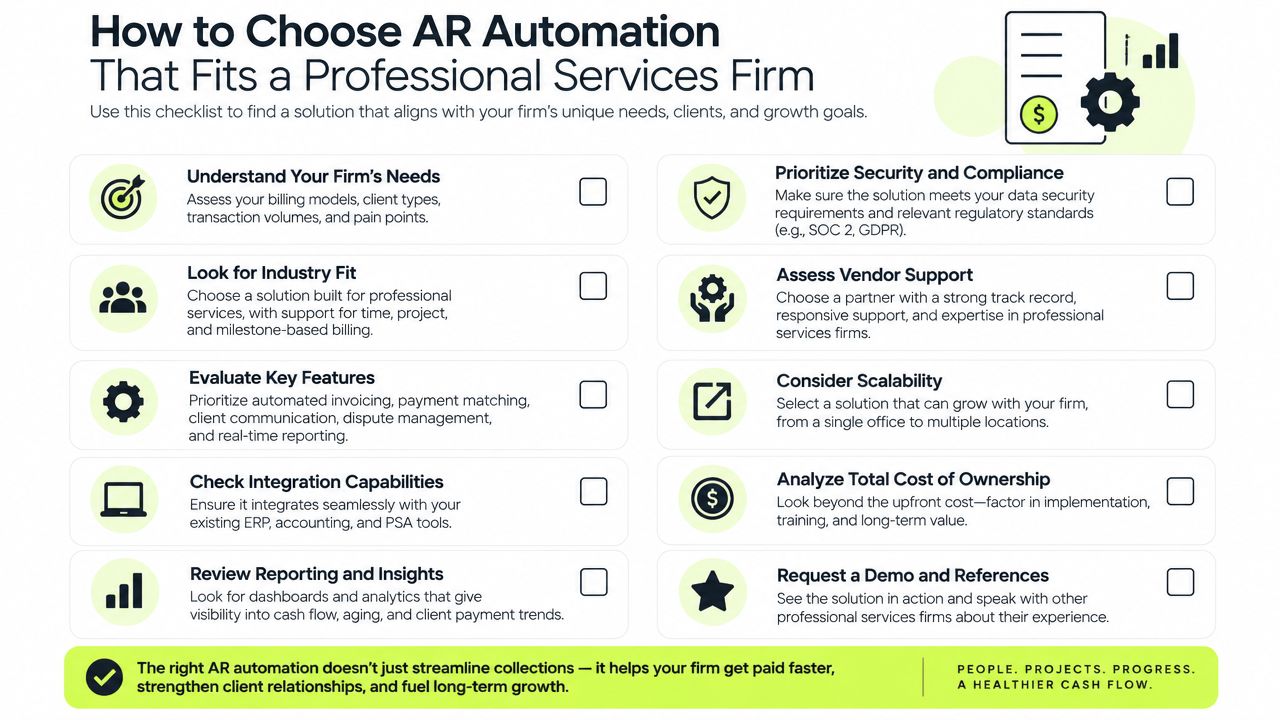
How to Choose AR Automation That Fits a Professional Services Firm
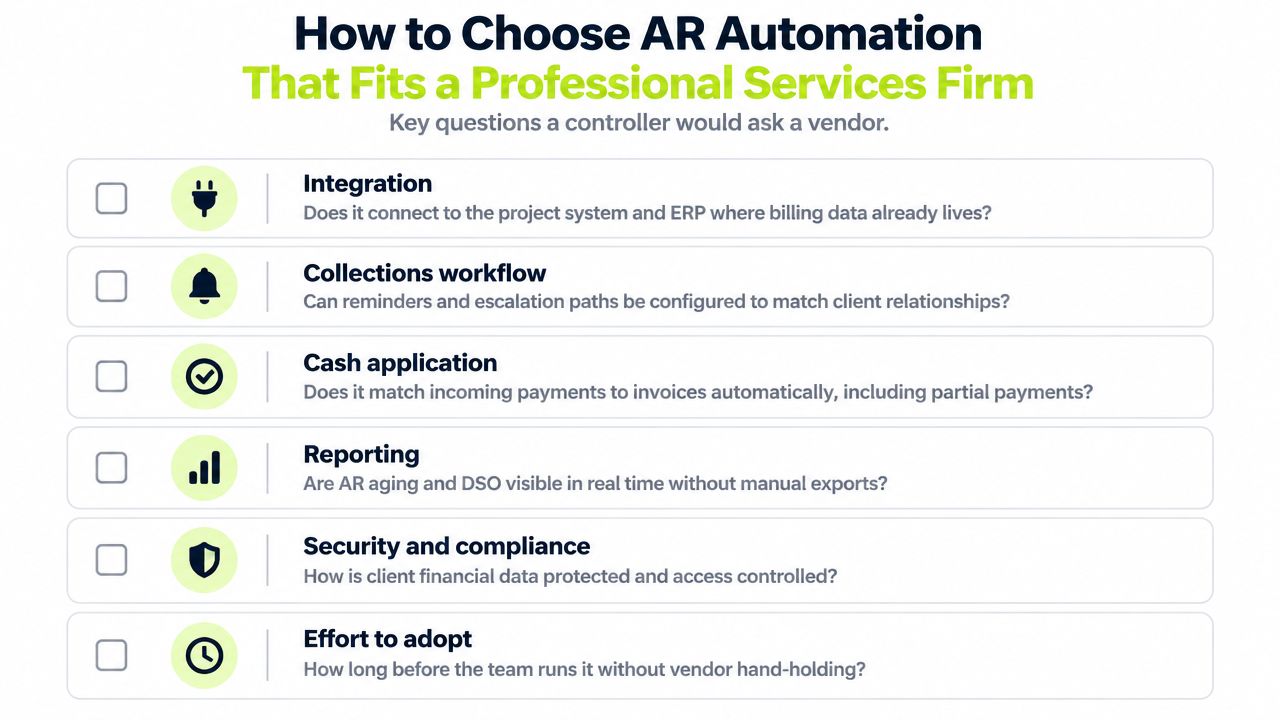
Start with the firm's actual aging report, not a polished vendor presentation. Ask the provider to demonstrate what happens when an invoice is partially paid, disputed, missing a purchase order, or assigned to the wrong client contact.
Questions for the vendor
- Integration: Does the platform connect cleanly to the ERP, CRM, billing system, and project system where the firm's source data already lives?
- Collections workflow: Can the controller configure reminders, escalation paths, approval rules, and account-specific communication preferences?
- Cash application: Can it match incoming payments to invoices, including partial payments and remittances that don't use the expected invoice reference?
- Reporting: Are aging, DSO, collection activity, promises to pay, and exceptions available without repeated spreadsheet exports?
- Audit trail: Does every email, call note, status change, approval, and cash application decision remain traceable?
- Access control: Can outsourced accountants, partners, collectors, and finance leaders receive different permissions?
- Commercial model: Is pricing tied to invoices processed or collection activity rather than only seats?
A live demo should use a sample of the firm's own aging structure. Ask the vendor to show how the platform handles a client with several open invoices, a short payment, an unresolved dispute, and an overdue balance requiring partner involvement. Sanitized data hides the friction that determines whether adoption will stick.
Red flags that deserve scrutiny
Long implementation timelines may indicate that the product depends on extensive custom work. Vague service-level commitments around cash application accuracy create risk when the finance team must prove how a payment was allocated. Reporting locked behind premium tiers can leave the controller paying extra to answer basic operating questions.
The central question is simple: will the platform own the follow-through, or merely document it? A dashboard that shows overdue invoices is useful. A workflow that assigns the next action, sends the right communication, records the response, and escalates an exception is operationally different.
Security and compliance also belong in the evaluation. Client financial data should have controlled access, clear retention practices, and an audit history that supports internal review. Professional services firms often manage sensitive client relationships, so a collection workflow must be firm without exposing unnecessary account information to the wrong person.
The decision should be based on the firm's bottleneck. If invoices are late, fix billing discipline first. If payments arrive but remain unapplied, prioritize cash application. If the team knows what to do but cannot maintain the cadence, orchestration may address the actual constraint.
Bringing It Together A Calmer Way to Run Accounts Receivable
The Monday problem at the beginning was not a controller failure. It was a working-capital process built around late discovery, personal memory, and manual coordination.
AR is the firm's claim on cash that has not arrived. DSO measures how long that claim stays outstanding. Aging shows where exposure is concentrated, while the invoice lifecycle reveals why a busy finance team can still lose track of the next action.
The performance gap matters. A 2026 benchmark reports top performers collecting in 28 days, compared with a median of 46 days. Another survey places most companies in the 31 to 60 day DSO range. As noted earlier, collection speed and measurement discipline vary materially across companies. That difference points to an operating problem, not just a staffing problem.
Orchestration gives the finance team a repeatable cadence. It can connect billing data, assign follow-ups, prioritize risk, match payments, and preserve an audit trail. People still handle disputes, judgment calls, and important client conversations. The trade-off is clear: automation removes repetitive coordination, but it does not remove accountability.
Start with three practical actions:
- Measure current DSO: Calculate it consistently and review the trend with the aging distribution.
- Map one invoice end to end: Record each handoff from project approval through delivery, follow-up, payment, cash application, and ledger reconciliation.
- Test one platform against the checklist: Use real exception scenarios, not only a standard invoice, and check whether the system closes the loop.
Calmer AR comes from clear ownership, reliable evidence, and disciplined follow-through. Technology should make those practices repeatable without weakening human judgment.
Resolut automates AR for professional services firms by connecting collections workflows, client outreach, payment handling, reconciliation, and cash application in one operating process. Visit Resolut to evaluate that approach.