
Credit Risk Management Process for Service Firms
A credit risk management process for professional services: tiers, onboarding, scoring, monitoring, collections, and DSO you can defend.
Your best client loves the work, approves the deliverable, and then pays on their own calendar. No dispute. No apology. Just a balance that sits in the aging report while payroll, subcontractor draws, and rent approach on schedule.
That's the daily version of credit risk for a professional services firm. You've already delivered the expertise. You're financing the gap between delivery and cash, whether you call it trade credit or not.
A workable credit risk management process doesn't turn a services firm into a bank. It gives the finance lead and the partners the same rules before the invoice goes out, so getting paid doesn't depend on who has time to chase and keeping the client doesn't mean carrying unlimited exposure.
I would build it from your own ledger first. A bureau score can help at onboarding, but a broken promise, a pattern of disputes, or a client growing too large for payroll tells you more about next month's cash than a stale external file.
Why Late Clients Become a Credit Problem
Say it's Tuesday afternoon and the aging report is open. One client balance is highlighted, not because it's the oldest, but because it's big enough to cover the next payroll cycle. The partner calls it a relationship account. The controller sees an unsecured loan with no approved limit.

That framing changes the conversation. This isn't a collections annoyance to handle when someone gets frustrated. It's credit exposure you chose, invoice by invoice, each time new work started before the prior balance cleared.
Six Controls Worth Owning
For a firm from $3M to $50M, I would keep the process to six controls the finance lead owns with sales. Write down your risk appetite, check the client before work starts, assign a tier with a limit, watch payment behavior continuously, escalate by rule, and track a short KPI set against contract terms.
None of those controls needs a bank capital model. Each one needs a named owner and a record. When a partner asks why a reminder went out, or why new work paused, the answer points to a rule agreed in advance rather than to a personality.
The goal isn't to be tougher with clients. It's to be consistent enough that good clients aren't subsidizing slow ones.
The outcome should sound boring in the best way. Fewer surprise write-offs. A DSO figure you can explain. Reminders that arrive on time with the same tone, so the relationship doesn't hinge on who remembered to follow up.
Two visuals help leadership see that quickly. One is a close-up of an aging report at dusk with one overdue line highlighted, because that's where the risk lives. The other is a six month line chart of DSO plotted against contract terms, which shows whether cash is slow or your agreements allow it to be slow.
Start with the tier decision. Every later reminder, limit, and escalation executes that decision.
Risk Tiers That Set Terms and Limits
Assign every active client to a tier before you change a single reminder cadence. If the tier is wrong, accounts receivable automation will send the wrong treatment faster.
Credit tiers for a professional services book
Tier | Typical client | Terms and billing | Exposure rule | Review trigger |
|---|---|---|---|---|
Low | Established payer, few disputes | Standard Net terms | Named cap, annual review | Payment behavior or terms change |
Watch | New client or one broken promise | Milestone, deposit, or shorter terms | Lower cap, finance approval | Any past-due invoice or second broken promise |
High | Chronic late pay, disputes, or concentration | Deposit, card, or ACH before more work | Minimal unsecured exposure | Before any new engagement is accepted |
Restricted | Overdue balance and a request for new work | Stop-work or a written payment plan | No new exposure | Immediate, before delivery continues |
How Each Tier Works in Practice
Low clients have earned standard terms. They pay inside terms, disputes are rare, and the file is clean. They still get a named dollar cap, because unlimited isn't a limit, and the cap is reviewed annually or sooner if behavior shifts. Treating them lightly is the reward, and it frees your team to focus elsewhere.
Watch is where most of the value sits. A new client with thin documentation belongs here, and so does an established client after one broken promise to pay. Put them on milestone billing, a deposit, or shorter terms. Finance approves any increase to the cap, and the review happens before the next large deliverable, not after it.
High clients show repeated lateness, rising disputes, or a share of revenue large enough to move cash on their own. Require a deposit, card, or ACH before more work starts. Don't accept a new order while an older invoice sits open unless finance documents the exception. The point isn't punishment. It's keeping unsecured exposure small enough that one client's delay doesn't force a draw on your line.
Restricted means overdue plus a request for more work. Stop new exposure, offer a written payment plan, and escalate to a named owner. A polite pause with a clear restart condition preserves more relationships than silent resentment followed by a sudden cutoff.
Context helps, but it isn't a grade. The Synovus guidance on reducing days sales outstanding lists a typical 40 to 55 day DSO range for professional services and notes that DSO above 45 to 60 days commonly signals collection inefficiency for B2B companies. If your contracts promise faster payment, that range should concern you. If your terms are longer, judge against the contract.
That same guidance supports the core rule here. Connect limits and terms to objective criteria, require finance sign-off before sales overrides them, and review creditworthiness on a recurring basis rather than relying only on the original onboarding decision. For firms where one delayed major account can affect payroll, recurring review is not optional.
Setting the Cap and the Override Rule
Size each cap from the client's recent billings and a simple question. What unsecured balance can the firm carry for one collection cycle without touching payroll? Write that answer in dollars in the client record, with the approver's name and the review date.
Tell sales the override rule up front. They may request an exception, finance records the reason and the expiry, and the tier does not change in a side email. That single habit prevents most partner and controller conflict later.
If you need a starting point for evaluating onboarding checks against this tier structure, our guide to credit risk assessment tools can help you compare options without rebuilding the policy around a vendor.
Practical rule: A tier without a dollar cap is an opinion. A cap without a review trigger is a hope.
How to Run the Process From Policy to Escalation
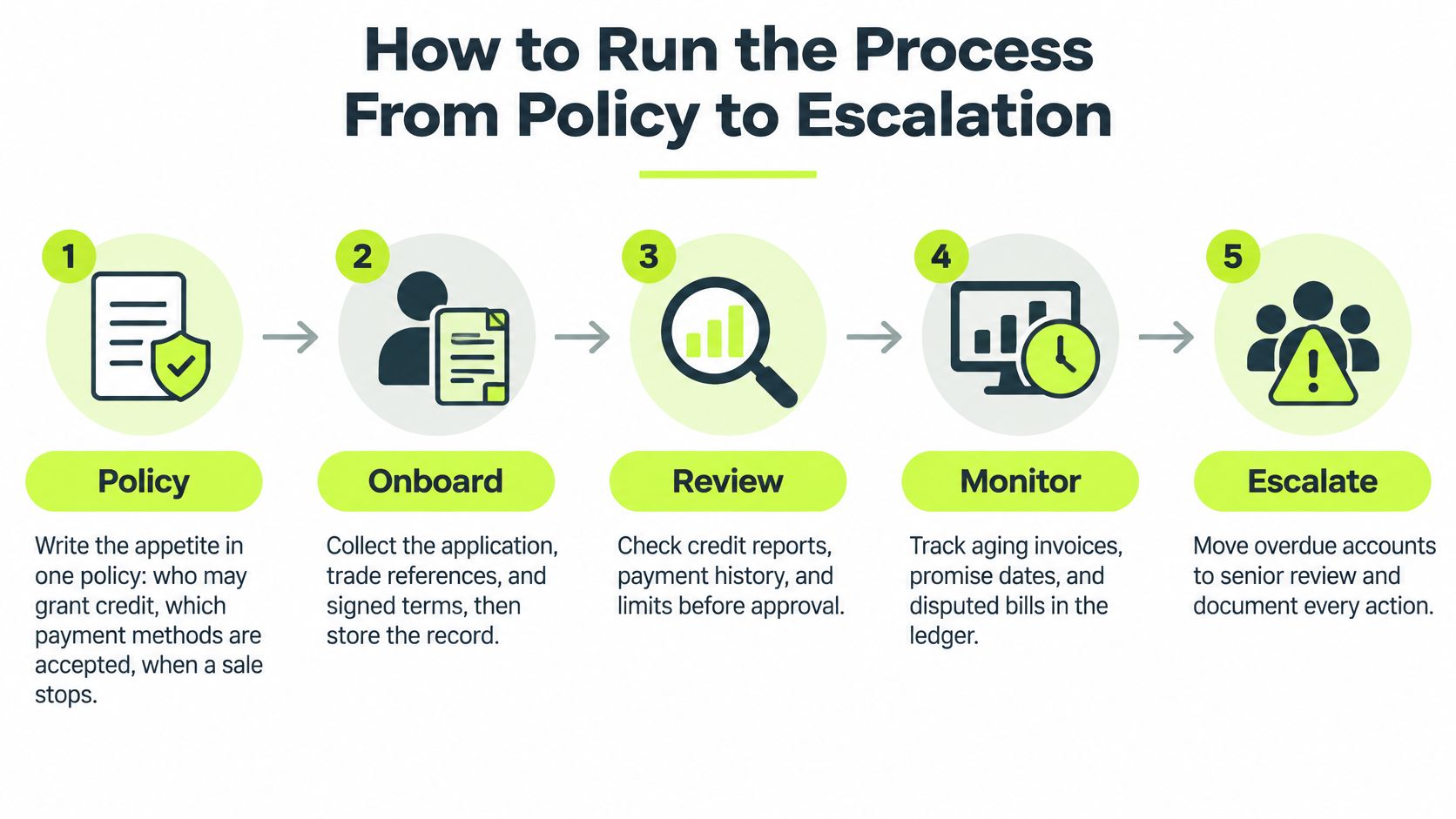
The sequence below works because each step leaves a record the next person can use. Number the steps, name the owner, and keep the policy short enough that partners will read it.
The flow at a glance looks like this.
Steps 1 to 3 Set the Decision
1. Write the policy. The controller drafts it and ownership approves it. State who may grant credit, which payment methods are accepted, when a deposit is mandatory, the risk categories, the escalation rules, and who approves exceptions. The Allianz Trade guide to a solid credit policy recommends documenting risk appetite, KYC procedures, credit assessment methods, customer risk categories, payment terms, accepted payment methods, escalation rules, and responsibilities. Use that list as your contents page and you will miss very little.
Add the situations firms usually leave vague. Specify when financial information is required, which liquidity or solvency tests apply to larger requests, how often limits are reassessed, and what happens when a new order arrives while a balance is overdue or a client asks for a payment plan.
2. Onboard before the engagement letter is final. Operations collects the legal name, billing contact, purchase order rules, invoicing portal requirements, and payment method. Ask for trade references or basic liquidity evidence when the first invoice will be large relative to the client. You don't need a full bank underwriting file for a services engagement. You do need to know who pays, how they approve, and what will stall payment.
3. Tier, set the limit, and store it. Finance assigns the tier using the table, writes the cap and approved terms into the client record, and notes the review trigger. Sales sees the same record. If the limit lives only in finance, the next scope expansion will ignore it.
Steps 4 to 7 Protect Cash Without Drama
4. Bill at the milestone. The delivery lead confirms completion and finance issues the invoice the same day. Make card, ACH, and bank transfer obvious on the invoice and in the payment link. Delay here is silent credit you granted for free, and it's the first place QuickBooks AR automation and broader accounts receivable automation earn their keep by removing manual handoffs.
5. Monitor against the tier, not a generic calendar. A Low client a few days late needs a routine reminder. A Watch client the same number of days late needs a finance check, because the tier already told you the margin for error is thin. Review open invoices, promise dates, and disputes in one weekly pass owned by the controller.
This short video walkthrough is useful if your team wants to see the policy to escalation sequence in motion before you write your own version.
6. Escalate by threshold. Send a pre-due reminder, follow up promptly after the due date, move to a direct finance conversation, then agree on a written plan or pause work. Document each action, the promise made, and the next date. Don't let tone swing with whoever is frustrated that week. Consistent, factual outreach protects the relationship better than alternating silence and urgency.
Know where the legal boundary sits before you need it. If an account ever reaches formal proceedings, your documented policy, signed terms, and escalation record become the file, and understanding responding to a debt collection summons helps owners see why clean paperwork matters long before lawyers are involved.
7. Give sales the same rules. Partners get the one page policy and the tier list. A partner can't reopen exposure the controller just closed without a recorded exception. That isn't finance blocking growth. It's growth with a limit everyone agreed to when nobody was under deadline pressure.
Review the policy when book behavior changes, not just at an annual offsite. A rising dispute rate, a new client segment, or a shift to larger milestone projects all mean the appetite written last year may no longer match the risk you're carrying.
Ledger Signals and Human Overrides
The bureau file looks clean. In your ledger, the same client's promised payment date has slipped by a week twice, and every third invoice draws a dispute about hours nobody questioned before delivery. Which signal would you trust with payroll?
That tension is showing up across lending. The LexisNexis Risk Solutions release on global alternative credit data reports that 40% of surveyed lenders identified default prevention as a leading challenge, while 39% cited credit risk assessment at origination. It also reports that 42% expected to increase the weight of alternative data in decision models, which tells you where decision makers think the useful evidence is moving.
For a services firm, that alternative data already sits in the ledger. You don't need to buy a new signal before you rank the ones you have.
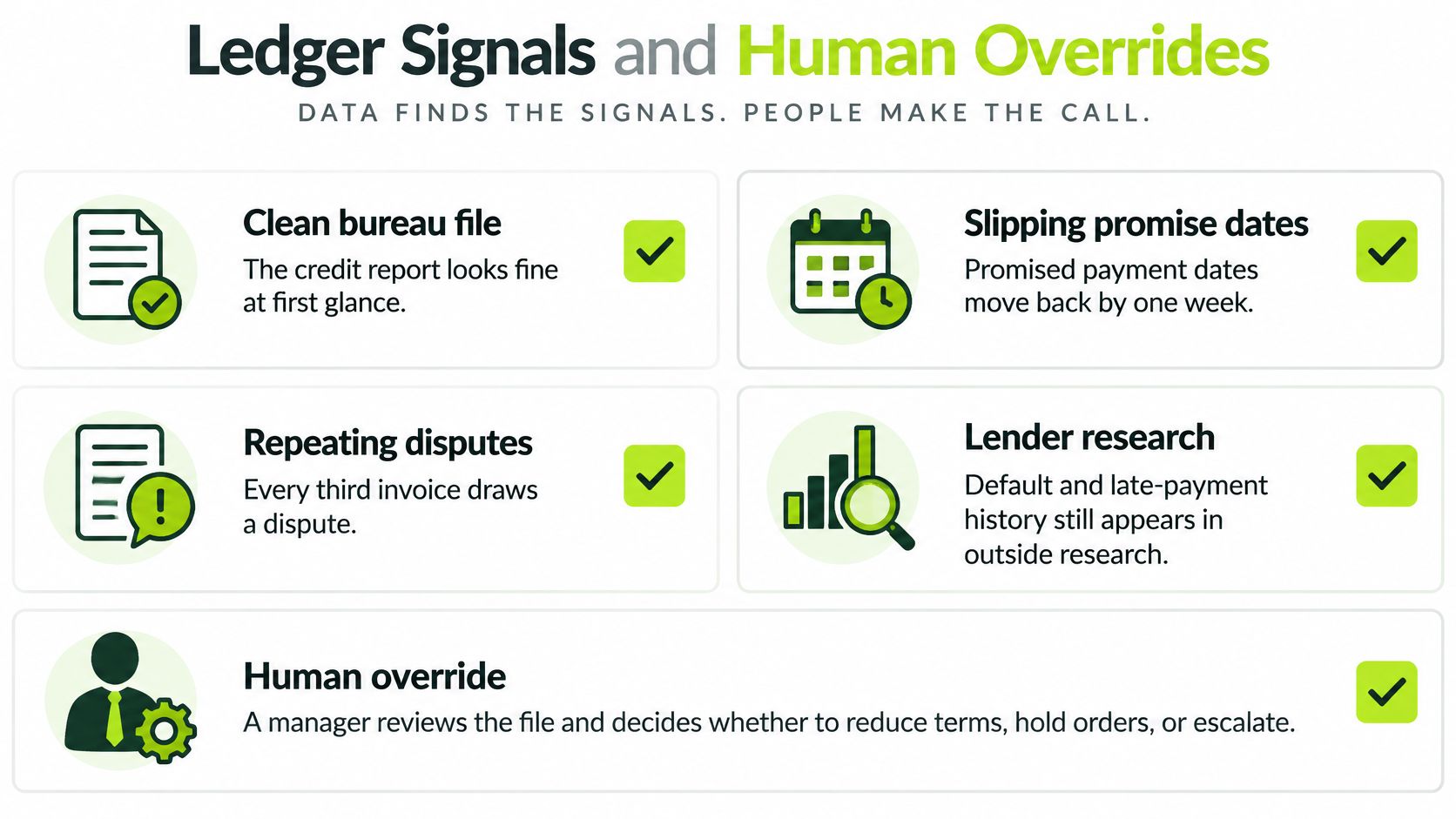
Ranking the Signals That Matter
I would rank the early warning signals this way for a B2B services book.
- A broken promise to pay: A specific date was given and missed. This outranks a generic late payment because the client chose the date.
- Rising dispute frequency: Occasional questions are normal. Repeated disputes that appear only after invoices age often signal cash strain or internal approval trouble.
- Aging that moves without a billing hold: A balance rolling from current to the next aging bucket while delivery continues means exposure is growing by default.
- A shift in buying pattern: Smaller retainers, skipped phases, or requests to split invoices differently can show budget pressure before a payment is missed.
- Concentration: A good payer can still be a risk if their balance alone can move your cash position. Size changes the treatment even when behavior is clean.
Sector stress belongs on the list, but below your own cash evidence. A weak sector headline doesn't tell you whether this client will pay this invoice. Two broken promises come much closer, and our explanation of concentration risk is worth reviewing if one client dominates the book.
Sorting Real Risk From Billing Noise
Tag the reason an invoice is open before collections touches it. Client approval delay, missing purchase order, scope dispute, and a milestone that hasn't been delivered are workflow problems, not credit problems. Chasing a client who is waiting on your partner's timesheet damages trust and hides the accounts that can't pay.
Give each tag an owner and a clearing date. A dispute without an owner becomes an excuse that ages alongside the invoice. Once delivery or approval is confirmed, the invoice returns to normal credit treatment the same day.
Don't let a billing defect wear a credit risk label, and don't let cash strain hide behind a billing question that was answered weeks ago.
Conflict and Override Rules
Signals will conflict, so write the rule now. A clean onboarding file plus two broken promises moves the account from Low to Watch and pauses new work until finance resets terms. A strong payment history plus one documented dispute keeps the tier, puts the disputed amount on hold, and leaves undisputed invoices on normal cadence.
Overrides need a documented reason. Acceptable reasons include a genuine dispute, an undelivered milestone, or a written commitment approved by finance with a date. A chat message asking you to hold off because the partner is having lunch with the client is not an override. Record who approved it, what replaces the standard treatment, and when normal treatment resumes.
Human in the loop discipline matters in collections, just as it does in other customer facing automation, and the practical guidance for contact center leaders on keeping people in control of automated decisions maps well to credit treatment. The model ranks. The person decides on relationship accounts.
What AI Should and Should Not Do
AI AR automation changes the work from a calendar driven reminder process into a risk prioritized queue. The APQC overview of AI in accounts receivable describes three concrete uses, predicting which invoices are likely to be paid late, directing collection effort toward accounts that need intervention, and automating routine reminders and cash application. That is the right division of labor for a services firm.
Let the system score open invoices from payment history and account behavior, route high risk or high value items to earlier human review, send routine reminders automatically, and match incoming payments to invoices. Don't let it rewrite terms, lift a hold, or change a tier on a relationship sensitive account without approval.
Store the evidence for every automated recommendation. Keep the inputs, the reason code, the confidence level if your tool provides one, and the person who accepted or overrode it. If a client asks why their terms changed, you should be able to answer from the record in plain language.
In Resolut, every customer gets a risk score and the platform flags at risk invoices for earlier intervention, which fits this model because the score sorts the queue while your team keeps approval on terms and holds. Whichever tool you use, demand that same audit trail before you trust the ranking.
Real time is not automatically better. A model fed stale promise dates or uncoded disputes will react faster to bad information. Clean the ledger tags first, then automate the routine, and the human time you save can go to the few conversations that move cash.
KPIs That Show Whether Cash Is Actually Moving
A monthly AR review should connect the balance on the ledger to the cash the business can use. Track DSO alongside past-terms receivables, promises kept, client concentration, and cash collected against forecast. The figures need context: a low DSO can hide a large overdue account, while a higher one may reflect agreed approval steps.
Credit and AR measures worth a monthly review
Measure | How to read it | Reference point | When it slips |
|---|---|---|---|
DSO | Ending receivables / credit sales x 365 | 45.0 days on $739,726 and $6 million sales; compare with the contract, not a universal score | Separate overdue from approval, dispute, and unearned milestones |
Collection speed | Average days to collect | Fast collectors clear invoices far sooner than slow ones | Stop chasing every invoice equally |
Past-terms AR | Share of open AR beyond agreed terms | Should trend down after tiering | Re-tier the accounts driving the balance |
Promise-kept rate | Promises paid by the date given | Broken promises outrank a stale external score | Move the client up a tier |
Concentration | Exposure in the largest clients | One account can move payroll at $3M to $50M | Cap new work or require a deposit |
Reading DSO Against the Contract
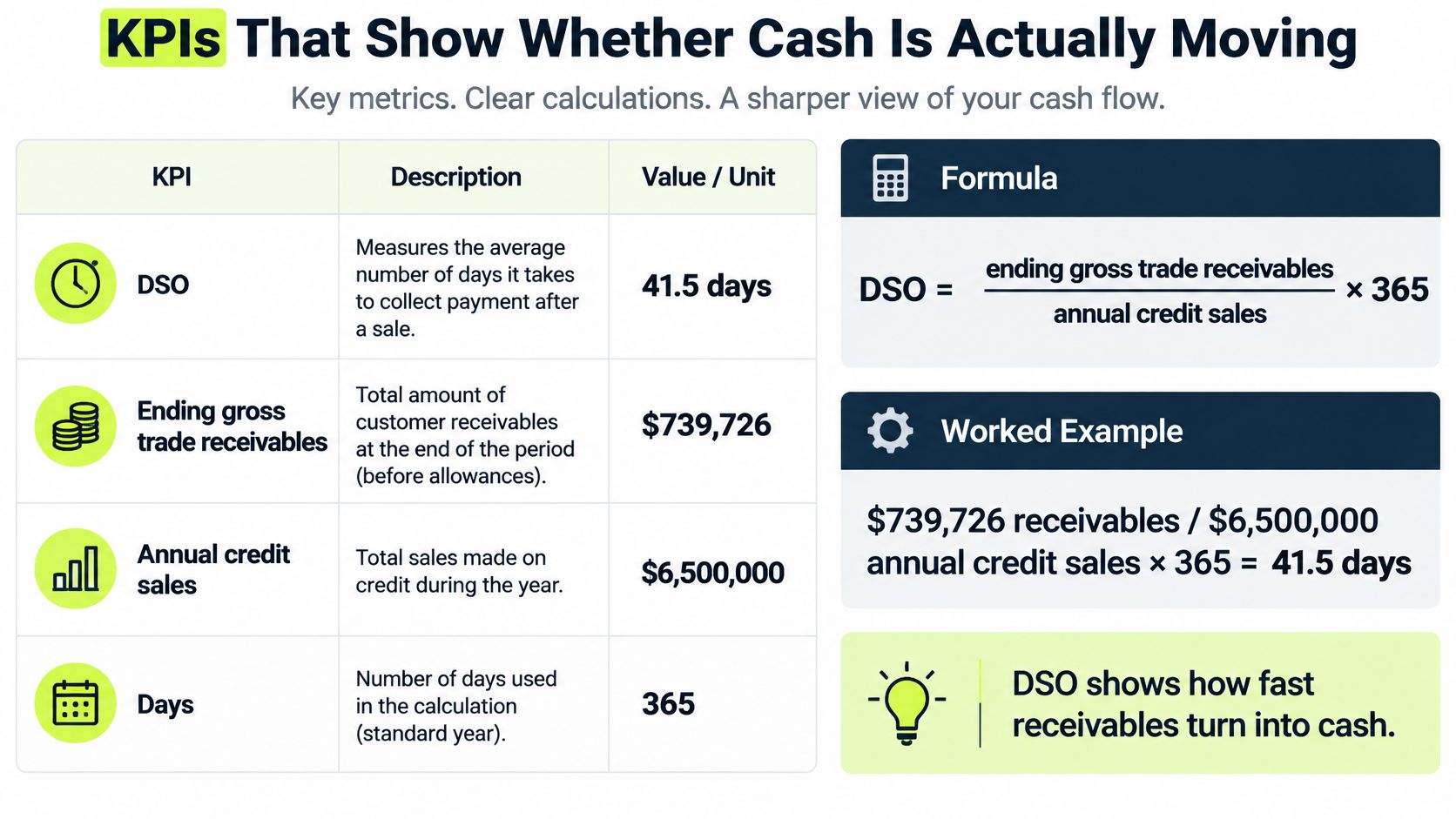
DSO is ending gross trade receivables divided by annual credit sales, multiplied by 365. The Bennett Financials accounts receivable analysis illustrates a company with $739,726 in ending gross trade receivables and $6 million in annual credit sales, producing DSO of 45.0 days. Compare that result with the contracts. What payment timing did the firm agree to?
A short-term book sitting at 45 days points to a collections problem. A milestone-based book with retainers, deposits, and approval steps can show the same DSO even when cash has arrived as planned. Deposits, seasonality, customer type, and billing structure all affect expected timing, so a single benchmark can mislead in either direction.
Collection speed also varies: fast collectors clear invoices far sooner than slow ones. Use that difference as a prompt to examine whether routine reminders and cash application are working, while people focus on invoices that need judgment. The aim is timely payment without turning collections into a personality contest. Keep outreach tied to documented terms, payment behavior, and the reason an invoice is held up.
The Companion Measures
Split open AR into four buckets before acting. True overdue needs credit treatment. Client approval delay needs the delivery lead. A dispute needs an owner and a resolution date. Billing not yet earned should not be chased. A chart of these buckets beside a DSO-versus-terms line for the same quarter makes the difference visible on one page.
The strongest signal for a services firm may be inside its own ledger: broken promises, unresolved disputes, and concentration can show a changing risk before an external score does. Review percent of AR past terms, promise-kept rate, exposure in the largest clients, and cash collected versus forecast. Set a clear owner and next action for each exception, so a relationship-sensitive account gets a measured response rather than an automatic escalation.
For a rolling view of expected receipts, the Nanak Accountants and Associates cash flow forecasting resource complements the AR measures. Review the figures monthly with sales, so partners can see concentration before it becomes a write-off. The guide to accounts receivable KPIs can help the team use consistent definitions.
A useful monthly pack connects reduce DSO and improve cash flow to the firm's own terms, exceptions, and expected receipts, rather than treating one target as right for every business.
Review One Portfolio Before the Next Invoice Run
Spend one sitting on the current book rather than designing a new framework. Export open AR and tag each client Low, Watch, High, or Restricted using payment behavior first and onboarding paperwork second.
For each client, write down the limit that already operates in practice, even if nobody named it. Compare that figure with the cap the tier allows. The gaps you find are your real credit policy today, and they're usually more generous than anyone intended.
Freeze new work on Restricted accounts until a written payment plan is in the file. Move Watch accounts to a deposit or milestone billing on the next invoice run. Leave Low accounts alone except for a clean reminder inside terms, which is how good clients feel the benefit of paying well.
Share the one page list with partners so sales and finance argue from the same tiers. Then decide where the routine should live. If follow-ups still depend on someone's memory, AR software for professional services can carry reminders, cash application, and late payment flags while a person keeps approving terms on relationship accounts.
Resolut automates AR for professional services, consistent, accurate, and human. That combination is the point. Rules handle the routine, and your judgment stays where the risk and the relationship meet.
If your tiers are clear but follow-up still depends on memory, Resolut can carry the routine work, scoring which customers will pay late, automating follow-ups, and forecasting cash each month so your team spends its time on the exceptions that need a person. See how it fits a professional services book at Resolut and put your next invoice run on a process you can explain to any partner or client.