Accounts Receivable Collections: How to Get Paid Faster
Learn how accounts receivable collections work, from aging reports to escalation, with metrics, common fixes and ways to protect client trust.
Your biggest client is on day 63. The work was signed off, the invoice went out on time, and someone in accounts payable says the payment is in the queue, which is what they said twelve days earlier. Payroll runs Thursday, and the $46,000 you already earned is sitting in a folder instead of the operating account.
That is the most common shape of a receivables problem in a professional services firm. Not a client who refuses to pay, but an invoice that nobody owns at the exact moment it needs an owner. Across the wider market, this is normal rather than exceptional: the 2024 UK government research on payment performance found businesses with business customers reported an average of 17% of customer payments arriving after the agreed deadline, with construction at 18% and goods at 21%.
Accounts receivable collections is not a single activity. It's a routing problem. The right owner and the right next action depend on why a payment is late, and escalation should be judged by value and evidence rather than by age alone. Treat it that way and the tone of the whole firm changes: fewer awkward calls, more dates on the calendar, and a cash forecast you can defend.
Who Acts at Each Aging Stage and How the Week Runs
Every aging report hides the same gap: rows with dollars attached and no name next to them. A firm billing around $4 million a year can watch one long-standing client drift from 30-day payments to 70-day payments without anyone ever making a decision. The balance moves from current, to watch, to a spreadsheet line that three people can open and none of them owns.
Late invoices pile up through omission. The client's AP team isn't refusing to pay; the invoice arrived during a system migration, the approver changed roles, and nobody chased because chasing felt awkward. By day 70 the balance is large enough to be embarrassing to raise, which is exactly how it reaches day 120.
The fix is structural. Each bucket gets one named owner, one action and one trigger that moves the account up a level.
One owner for every bucket
Stage | Timing | Action | Owner | Move up when |
|---|---|---|---|---|
Before due date | 3 days before due date | Reminder with invoice copy and payment options | AR coordinator | Client asks to change terms |
1-30 days late | Day 1 to 30 | Friendly reminder and request for a payment date | AR coordinator | No reply within 5 business days |
31-60 days late | Day 31 | Call the accounts-payable contact and confirm any dispute | AR lead | Dispute opened or promised payment missed |
61-90 days late | Day 61 | Partner call, payment plan or credit hold review | Controller and engagement partner | Balance not moving after a payment plan |
91+ days late | Day 91 | Executive escalation, legal review and reserve decision | CFO | Any balance still unresolved past 90 days |
The pre-due reminder is the cheapest contact in the entire sequence. Sent three days before the due date, with a copy of the invoice and a payment link, it catches the invoice sitting in the wrong inbox, which is one of the most common and most easily fixed causes of a late payment.
The first contact after a due date should ask for a date. A promise is easy to give and easy to miss, so ask when the payment will be released. You either get a calendar entry or you learn something useful.
Between day 1 and day 30, the AR coordinator asks for that date and holds the line on the five-business-day rule. Silence is information: it moves the account to a human call rather than triggering a third email into the same void. At day 31 the AR lead phones the accounts-payable contact directly and asks two questions: is the invoice on the payment run, and is anything disputed. That second question saves weeks, because a disputed invoice will never clear a reminder sequence.
At day 61 the call moves to the engagement partner. A partner asking a peer at the client why an invoice is stuck changes the temperature of the conversation, and it opens the door to a payment plan or a credit hold review while the relationship is still intact.
The 91-day line is a different account
The 91-plus bucket deserves its own owner and its own dashboard, because the collection playbook that works at day 40 does nothing here. Dun & Bradstreet's Q2 2025 accounts receivable aging report found 15 of 203 industry segments had at least 10% of aging dollars more than 91 days past due, and business and professional services is named as a category. A balance at that age may need executive involvement, a documented dispute path, a credit review or legal referral.
Split that view by client, engagement partner, dispute status and owner. Then check where the 91-plus dollars sit in your own data: in many firms they concentrate in a handful of accounts and one or two partners who dislike making the call. That is a management problem as much as an accounting one, and it belongs in the partner review.
The Monday routine
Thirty minutes a week, run in this order:
- Pull the aging report. Sort by dollars past due, not by invoice count or client name.
- Check terms and disputes. No contact goes out until you've confirmed the contractual due date and whether a dispute is open.
- Log every promise with a date. A promise without a date is not a promise.
- Route disputes within two business days. They belong with the engagement owner, not the collections queue.
- Apply payments the moment they land. Nothing destroys trust faster than a reminder for an invoice that was paid last week. On Resolut, paid stamps on uploaded PDFs switch outreach off automatically, and any invoice can be marked paid in a single click.
A clean week still has late invoices. What changes is that every past-due balance has an owner, a next action and a date, and you can prove it. If you want the underlying mechanics, this guide to account receivable aging walks through how to structure the report so the buckets drive decisions instead of just describing them.
Why Late Payments Cost More Than Days
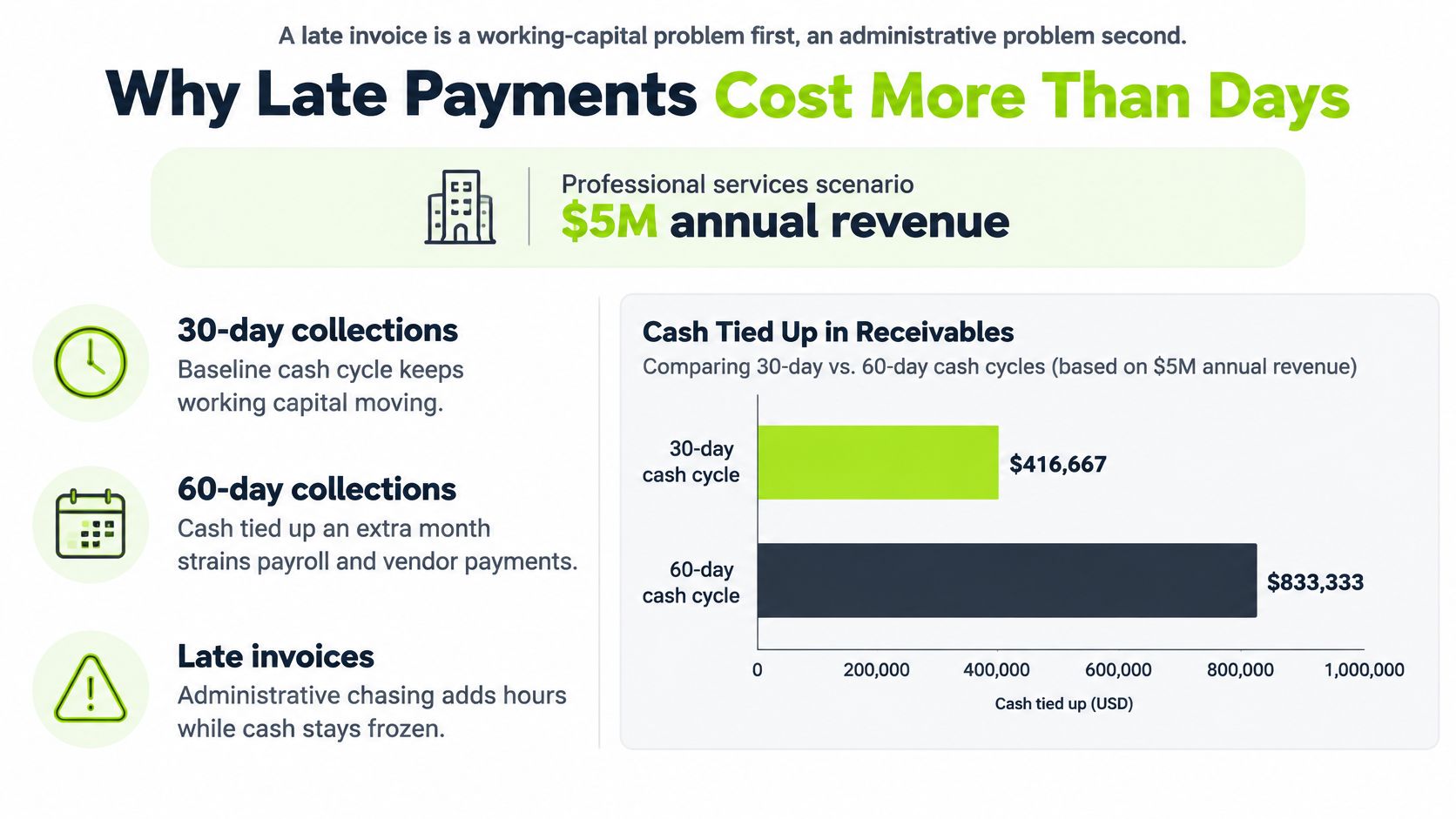
A late invoice is a working-capital problem first and an administrative inconvenience second. The administrative framing is why it stays on the to-do list for six weeks.
Start with the cash. A professional services firm with $5 million in annual revenue that collects in 48 days instead of 30 carries roughly $246,575 more in receivables, calculated as $5,000,000 divided by 365 and multiplied by 18 days, according to APQC benchmarking reported by CFO.com. That's the same benchmark where top performers collected within 30 days or less and bottom performers needed 48 days or longer.
That money has a job. It funds the credit line draw you didn't plan, the two hires you postponed a quarter, and the bonus pool that gets decided on a Friday afternoon. It also explains why payroll timing feels tighter in months where nothing obviously went wrong.
Then there's the labor that never reaches the P&L. The Small Business Commissioner's research on late payments reported that among affected businesses, 22% spent staff time chasing late invoices, averaging 86 hours per affected business annually. Eighty-six hours of a controller's attention is real capacity, and it's the hour before a client deadline, not after.
Days sales outstanding turns the whole gap into one number leadership can track monthly. The goal of everything that follows is to shorten that gap without bruising the relationships that produce the revenue in the first place.
Metrics That Show Whether Collections Work
One DSO figure can hide the reason cash is slow. A Credit Research Foundation benchmark cited in an AR collections report put median DSO at 37 days, median best-possible DSO at 28 days, and median average days delinquent at approximately 3 days for companies with average net-30 terms. Read as a set, those three numbers say more than any of them alone.
The gap between actual and best-possible DSO measures collection friction beyond the cash-conversion baseline: billing lag, acceptance cycles, invoices released in batches. Average days delinquent isolates lateness after the contractual due date, which is a follow-up and credit-risk question. Different gaps, different owners.
Read the gap, not the average
Metric | Calculation | What it reveals | Pattern to watch |
|---|---|---|---|
DSO | Receivables divided by revenue, multiplied by days in period | Days cash stays tied up after invoicing | Rising for two quarters in a row |
Best-possible DSO | Current receivables not yet due, divided by revenue, multiplied by days | Cash cycle under the contractual terms | Wide gap against actual DSO |
Average days delinquent | Days past due, weighted by balance | How late invoices are paid after the due date | Above the benchmark median of about 3 days |
Promise-to-pay kept rate | Kept promises divided by total promises | Reliability of client commitments | Falling for one client or one partner |
Cure rate | Balances brought current divided by balances past due | Whether follow-up recovers overdue accounts | Flat across a full quarter |
If DSO is high and delinquency is low, your clients are paying on time but the invoice is reaching them late. The owner is the billing process, not the collections team. If delinquency is climbing while DSO holds steady, follow-up is failing on a specific segment, and you'll only see which one after segmentation.
Segment every metric by client, engagement partner, invoice type, dispute reason and aging bucket. Then give the widest variance a named owner. This decomposition is exactly what the collection effectiveness index framework is built to expose across a full period rather than a single month.
Report DSO and average days delinquent first in the monthly finance review, before revenue. The order tells the room which number actually matters.
Assign one owner to the largest gap between actual and best-possible DSO. One, not a committee.
Telling Liquidity Stress From Process Friction
A client in real cash strain and a client whose AP system never received the invoice need opposite responses, yet both appear identical on an aging report. Send each the same escalating reminder sequence and you waste effort on one while pressuring a relationship that only needed a re-sent PDF. Collections at this stage is a routing problem: find out why the payment is late, then assign the right owner and the right next step.
The causes split. In North America, customer cash-flow problems were the leading reason for late B2B payments, cited by 49% of respondents, followed by banking delays at 36%, complex payment processes at 17% and internal approval delays at 16%. Late payment often traces to cash strain, bank delays or approval bottlenecks rather than a refusal to pay, so the diagnosis comes before the dunning letter.
A fixed cadence misses this. It applies pressure where a short plan would close faster, and no pressure at all where the blocker is an unread invoice or a departed AP contact. Every wrong first action costs a cycle: the payment plan arrives weeks after the client could have scheduled it, or the dispute sits in a reminder queue while the engagement owner never hears about it.
Match the signal to the route
Behavioral signal | Likely cause | Intervention |
|---|---|---|
Partial payments each cycle | Temporary cash strain | Offer a short payment plan with dates |
Broken promises to pay | Weak commitment or an unresolved issue | Escalate to a senior contact on the client side |
Repeated disputes on one service line | Scope or billing process gap | Route to the engagement owner before sending reminders |
Payment method or AP contact changed | Process or bank delay | Confirm the payment route and update the contact record |
Aging getting worse over three invoices | Structural credit deterioration | Credit hold review and tighter terms |
Take a client who pays about 60% of each invoice on time and asks to split the remainder. The right response is a payment plan on a fixed schedule, one that probably protects an account worth more than the balance. The same partial payments from a client whose aging has worsened across three consecutive invoices carry a different signal entirely, and the intervention shifts from a plan to a credit review.
Three questions before any escalation
Ask them in this order and let the answers assign the route.
- Is the cause money, process or a dispute? Cash strain gets a plan. Process failure gets a route fix and a new contact. A dispute goes to the engagement owner and the reminder clock stops.
- Has the same pattern appeared on the last three invoices? Once is an event. Three times is a trend, and trends justify tighter terms.
- Who owns the fix on the client side? A named person with a title resolves faster than a general inbox.
Log the answer in the client record, not in your head. Next month's invoice should start on the right route without anyone re-diagnosing it. If the constraint sits on your side of the ledger, Wistec's cash flow management guide covers forecasting the shortfall before it reaches the collections queue.
When to Escalate, and When Escalation Hurts

Aging is a weak trigger on its own. An invoice can be 75 days old because the client is circling insolvency, or because a purchase order number was wrong. One of those needs legal review. The other needs an email to the right AP clerk, and treating them the same costs you either cash or the account.
The prevalence data explains why blanket escalation fails. A European Union SME panel on late payment found 73% of respondents had experienced late-payment problems, 30% described them as systemic, and almost 60% of late payments occurred in B2B transactions. A 2025 Western European survey in the same report put B2B invoices paid late at 47%, with financial stress a major driver.
A late invoice is often a macroeconomic symptom rather than a customer decision. Firms that escalate on age alone spend scarce capacity on accounts that would have paid anyway while missing the ones that will not.
U.S. payment data points the same way. A [European Commission thematic report drawing on Dun & Bradstreet data](https://single-market-economy.ec.europa.eu/document/download/e9c04957-62f3-4a5d-a45b-852e40a6ef06_en?filename=1st%20thematic%20report%20(non-EU%20countries)%20-%20final%20-%20for%20publication.pdf) states that 58.9% of U.S. companies made payments on time by the end of 2024, down from 59.5% in 2023, while payments more than 90 days late sat at 2.9%. Terms do not guarantee timing, so escalation policy has to follow behavior and evidence rather than the calendar.
Weigh value and evidence, not the days
Before an account moves a stage, weigh the amount, client concentration, whether the contract is enforceable, dispute status, payment history, jurisdiction and any insolvency indicators. Then compare expected recovery against the cost of pursuing it, including the revenue you lose if the relationship ends.
Consider two invoices for $38,000 at the same point in the aging. The first has a signed scope, an approved deliverable and no dispute. The second has an open change order the client is contesting. Same amount, same age, and they should sit with different owners on different days. Escalating the second one looks like pressure applied to a billing error, and it invites the client to question every invoice you send for the next year.
A formal letter protects cash when the evidence is clean. Sent too early, it costs you the account and teaches the client to audit you.
Staged triggers work better than a single threshold. Operational escalation follows a verified dispute that nobody is resolving. Executive escalation follows a broken commitment or a balance still unresolved past 90 days, not a single missed date. A credit hold follows worsening risk signals across several invoices. Legal referral happens only when the documentation is complete and the expected recovery, net of legal cost, justifies it.
Escalate one stage at a time, with a named owner and a checkpoint 14 days later. Each stage should also produce evidence for the next one: a documented dispute file before legal sees the account, a dated record of the commitment before the executive call. If the account has not moved by the checkpoint, the next stage is justified by what you have learned rather than by the date.
Prevent Late Payments Before the Invoice Goes Out
An invoice that pays on time was usually routed correctly before it was ever sent. Three upstream fixes decide which queue it lands in: approved and scheduled, stalled on a missing detail, or parked in a dispute. All three cost less than chasing.
Set the terms in the engagement letter, not on the invoice. State the due date, whether you bill on retainer or milestones, and the name of the client-side approver who signs off invoices. If that person is named at signature, you never have to guess who to call at day 45. These payment terms and conditions cover the clauses worth including.
Run an accuracy check before release. Engagement code, purchase-order number, time detail matching the agreed fee, and the correct accounts-payable contact. A rejected invoice restarts its own clock, and a disputed one typically takes noticeably longer to settle than a clean one.
Deliver faster. Invoice delivery is the first lever on the cash cycle and the cheapest one to fix, because the work is already done by the time you're assembling the bill. Batching invoices weekly or monthly adds days to every one of them.
The market backdrop makes this urgent rather than theoretical. In 2024, 50% of surveyed law firms reported that their collection cycles had lengthened, with some extending beyond 90 days, according to Oddr's Invoice-to-Cash Survey. And in 2025, 47% of U.S. small businesses reported some invoices more than 30 days overdue, per Intuit QuickBooks' small business late payments report.
Prevention also decides what happens when a balance does age. The documentation behind cash flow protection for advisory firms needs to exist before a balance becomes a dispute, because the file you build at signing is the file you escalate with later.
Before release, confirm four things:
- Terms signed. Due date, billing method and named approver on the engagement letter.
- Invoice checked. Engagement code, PO number and time detail reconciled to the agreed fee.
- Delivered inside the window. Same week the work is accepted, not at month end.
- Contact confirmed. The AP contact and payment route are current in the client record.
Decide Which Collections Steps to Automate
Automation earns its keep on repetition, not judgment. The sorting question is simple: does this task follow a fixed rule and happen more than twenty times a month? If yes, it shouldn't consume a person's attention. If no, it shouldn't be automated at all.
The payoff is measurable. A global benchmarking study of credit and collections teams reported that organizations using automation and workflow technology for two and a half years reduced late payments by half and improved DSO by 21%. The same study found customer-specific payment history predicts future payment behavior better than generic credit scores, which is why scoring belongs in the routing logic rather than in a report nobody opens.
Automate the pre-due reminder, the weekly aging report, payment matching, and promise-to-pay tracking. Keep human judgment on disputes, credit holds and any escalation that carries relationship risk. Consistent, neutral reminders also protect trust: a reminder that arrives on time reads as routine administration, while a third follow-up in nine days reads as pressure. That distinction is most of the reason firms fear automation and then find the opposite happens. Stewart Accounting Services' walkthrough of automated invoice reminders is a useful reference for setting up the reminder ladder without over-contacting clients.
Test your stack before you commit. Many professional services firms run receivables in QuickBooks, so confirm whether invoice data flows in automatically or needs a manual upload, and whether payments reconcile back on their own. QuickBooks AR automation is only worth having if the data moves without a person in the middle.
Do the inventory once: list every collections task your team performs, count how often it runs each month, and mark the ones that follow fixed rules. Automate that column. Leave the rest to the people who can read a client relationship. Resolut automates AR for professional services, consistent, accurate, and human.
Resolut handles the routing this article describes, from the pre-due reminder through to escalation, so every past-due balance carries an owner, a next action and a date rather than sitting in a spreadsheet. It automates follow-ups, scores which customers will pay late, and forecasts cash, which lets a controller spend the week on the two accounts that need judgment. If your team is still running collections from a shared inbox, visit Resolut to see how the workflow runs end to end.