Dispute Resolution Process: End-to-End Guide 2026
Master the dispute resolution process for accounts receivable. Learn workflows and automation strategies to reduce DSO and improve cash flow.
Every controller knows the feeling. A client likes the work, the project is moving, and then one invoice lands in the dispute queue because a deliverable was unclear, a rate changed, or the scope read differently on their side. The work is already done, but cash is now stuck behind a process that's often too manual, too slow, and too dependent on who remembers to follow up.
For professional services firms, that's not a billing annoyance, it's a working-capital problem. The dispute resolution process determines whether AR stays a clean operating function or turns into a hidden drag on DSO, client trust, and forecast accuracy. The firms that handle disputes well don't just collect faster, they preserve the relationship while removing friction from the path to payment.
The Hidden Cost of Unresolved AR Disputes
A disputed invoice rarely starts as a collections problem. It usually starts in delivery, when scope gets interpreted differently, a time entry looks off, or an expense feels out of bounds. The finance team then inherits a problem that's part contract interpretation, part documentation quality, and part communication discipline.
That's why manual handling hurts so much. One person looks for the SOW, another checks the timesheet, a third asks the account lead what happened, and the client waits while the invoice sits open. The cost isn't just the delayed payment, it's the silence between teams, which makes the client feel ignored and makes the finance team look disorganized.

Why the cash impact is bigger than the invoice
Professional services firms often treat disputes as exceptions. In practice, they behave like a system leak. Every unresolved invoice ties up attention, creates follow-up work, and stretches the time between work delivered and cash collected.
The ICC's 2024 dispute-resolution reporting shows how large and economically significant disputes can be, with 841 arbitration cases registered, an average proceeding duration of 26 months, a median of 22 months, and 391 cases withdrawn before a final award was rendered, according to the ICC's 2024 statistics report (ICC Dispute Resolution Statistics). That's a reminder that unresolved conflict isn't a side issue. It can become a long-running operational burden.
Practical rule: if a dispute can't be classified within one business day, it's already costing more than the original billing issue.
For a CFO, the question isn't whether disputes happen. They do. The question is whether the firm has a reliable way to absorb them without letting them distort cash flow, client experience, and monthly close.
The quickest improvement usually comes from treating every dispute as a managed workflow rather than a one-off rescue. That means documented intake, clear ownership, and a standard path from challenge to resolution. If you're measuring the broader AR burden, the companion discussion on the true cost of inefficiency in professional services is worth a read in the context of AR friction.
The End-to-End Dispute Resolution Lifecycle
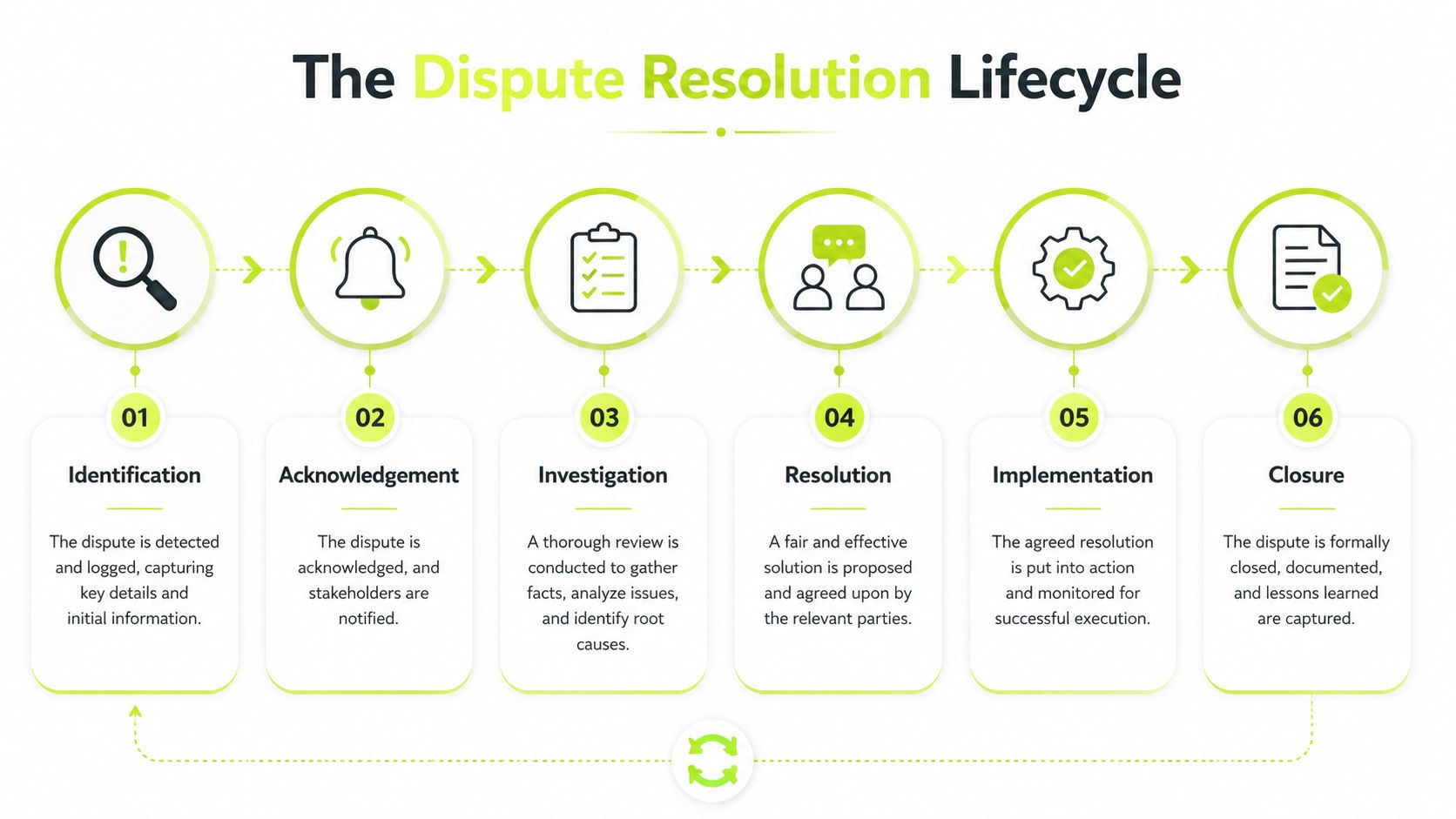
A useful dispute resolution process has to do more than assign blame. It has to move an invoice from uncertainty to a decision, then from decision to closure, without losing evidence or letting the work vanish into someone's inbox. The most reliable workflows use six stages, and each stage needs a named owner.
1. Identification and acknowledgement
Disputes should be tagged as soon as they appear, whether they come in by email, portal, or account manager escalation. The first job is simple, confirm the issue exists, assign a case owner, and acknowledge receipt quickly so the client knows the matter is being handled.
2. Investigation
The controller or AR lead should gather the invoice, contract, time records, approvals, and any supporting work product. Digital channels matter here because a dispute with no evidence trail turns into a debate about memory instead of facts.
If your intake process depends on email, it helps to harden the sender side too. Clear billing messages are more likely to land properly when the firm has strong email authentication, especially when clients are checking whether an invoice or notice is legitimate.
3. Resolution or escalation
At this stage, the question is whether the invoice can be corrected, explained, or partially settled. If it can't, the dispute should move to a higher authority or a defined formal path. The point is to stop back-and-forth loops before they become permanent stalls.
A good process gives the client a next step, not just another apology.
4. Settlement and implementation
Once the amount is agreed, the revised invoice, credit note, or payment plan has to be issued immediately. A resolution isn't real until the billing system reflects it and the cash application team can recognize it cleanly.
5. Closure
The case closes only after the payment status, notes, and supporting documents are stored in one place. That matters for auditability and for future disputes on the same account.
For firms building their operating model, the broader order-to-cash sequence is the right adjacent reference point, because disputes should sit inside a wider collections and billing workflow, not outside it. A useful foundation is the order to cash process.
A basic operating rule works well across firms: acknowledge fast, investigate with evidence, escalate when needed, and close with documentation. That sequence is simpler than the way teams typically work today, but it's more resilient.
Common Dispute Types and Legal Considerations
Most AR disputes in professional services fall into a small number of patterns. Scope creep, missing deliverables, rate disagreements, and unauthorized expenses show up again and again because they're all rooted in the same issue, the client believes the invoice reflects something different from what was agreed or delivered.
The practical response starts with the contract. A signed SOW, clear rate card, approved change order, and documented acceptance path give finance a factual base. Without that, collections becomes negotiation by memory, which is always expensive.
Common AR dispute triggers in professional services
Dispute Type | Common Cause | Required Evidence |
|---|---|---|
Scope disagreement | Client says the work exceeded the agreed scope | SOW, change order trail, status emails |
Missing deliverables | Client believes something was not delivered | Deliverable log, acceptance notes, project records |
Billing rate error | Wrong hourly rate or fee structure was applied | Rate card, engagement letter, invoice backup |
Unauthorized expense | Client disputes travel or pass-through charges | Expense policy, pre-approval, receipts |
In commercial disputes, documentation has to do the heavy lifting. British Columbia's RTB-114 guide is a clean example of that standard in practice, because it requires the applicant to prove the dispute on the balance of probabilities, serve the proper digital evidence form, meet deadlines, and explain how each item of evidence relates to each issue (RTB-114 guide). That same logic applies in B2B AR, even when the forum is private rather than statutory.
For firms that need a more formal escalation path, a legal demand letter is usually the point where the tone changes from collaborative to authoritative. The mechanics of that transition are worth understanding before the case gets that far, which is why many finance teams keep a structured reference like legal demand letter for payment close at hand.
The standard isn't perfection. It's proof. If the invoice is challenged, the firm should be able to show what was agreed, what was delivered, what was approved, and why the charge stands. Where that evidence exists, disputes usually become manageable. Where it doesn't, they become expensive.
How Automation Compresses the Dispute Timeline
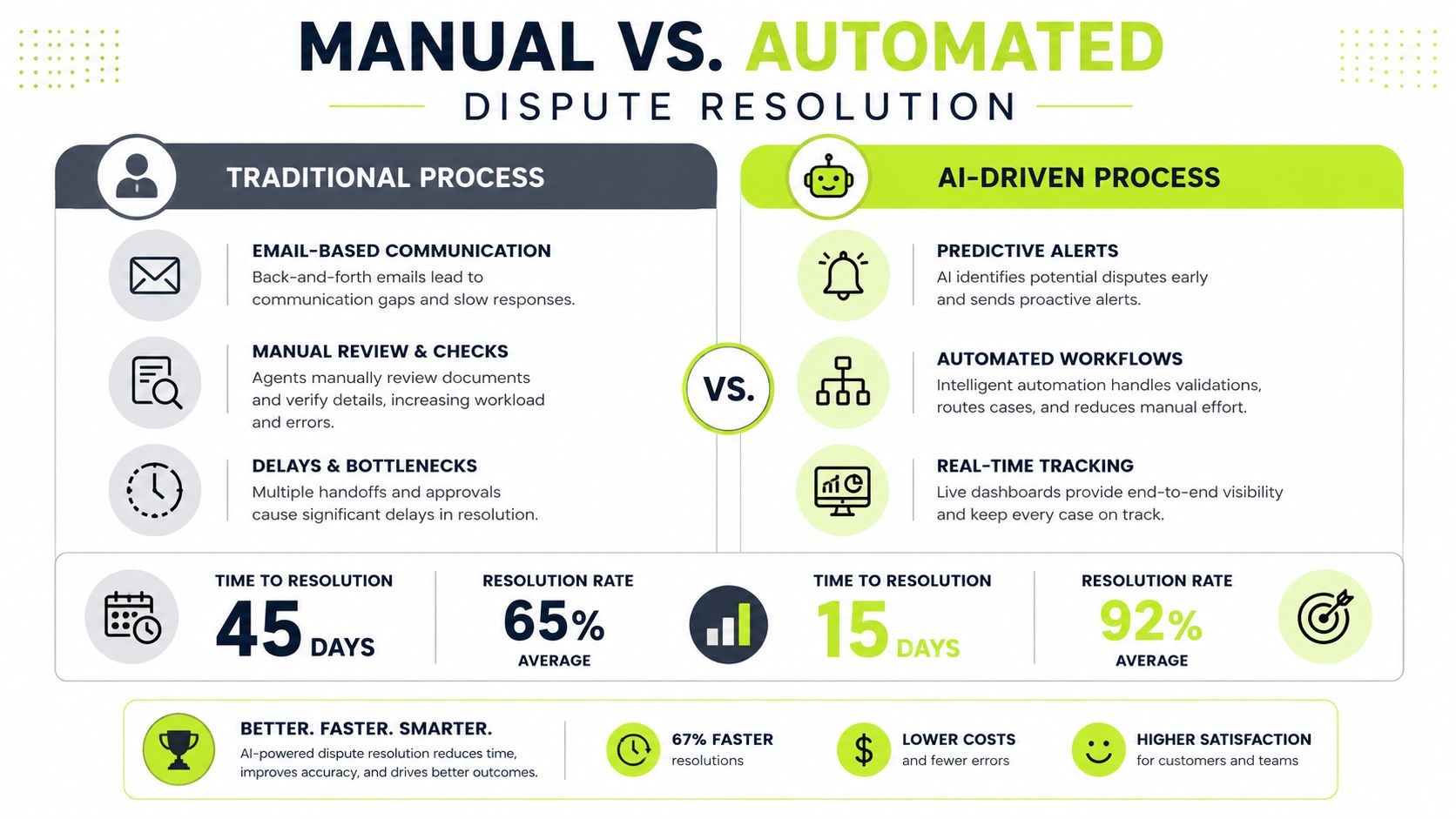
Manual dispute handling is slow because every step depends on a person noticing, routing, chasing, and remembering. Accounts receivable automation changes that by making the workflow visible before the invoice becomes a problem, then keeping the case moving without waiting for someone to dig through their inbox.
That shift matters in professional services, where the same client can have multiple invoices open at once. AI AR automation can flag at-risk invoices early, route them by type, and trigger the right follow-up sequence based on the account's history. The result is less emotional friction, fewer stalled threads, and faster movement toward settlement.
Where orchestration beats manual follow-up
A disciplined system starts with intake and classification. The workflow then checks whether the invoice needs clarification, a payment arrangement, or escalation. That logic fits well with the World Bank's description of digital payments dispute workflows, which begin with intake, evidence verification, and classification, then move to investigation by the payer's PSP before a validity decision is made (World Bank dispute workflow paper).
Once the dispute is categorized, automation can reduce handoffs. One sequence may go to the account manager, another to the controller, and a third to legal only if thresholds are met. That is where AR software for professional services earns its keep. It turns an unstructured complaint into a managed case with timestamps, evidence, and ownership.
The best automation doesn't sound robotic to the client. It sounds consistent.
For teams evaluating platform design, AI agents for finance teams is a useful frame because it focuses on task orchestration rather than isolated reminders. That distinction matters. A reminder asks someone to act. Orchestration makes sure the right action happens next.
The main operational benefit is compression. A manual dispute can sit untouched because three people each assume someone else owns it. A structured system removes that gap. It routes, tracks, and escalates with less human friction, which helps reduce DSO and improve cash collection discipline without damaging tone.
KPIs and Ownership for Finance Leaders
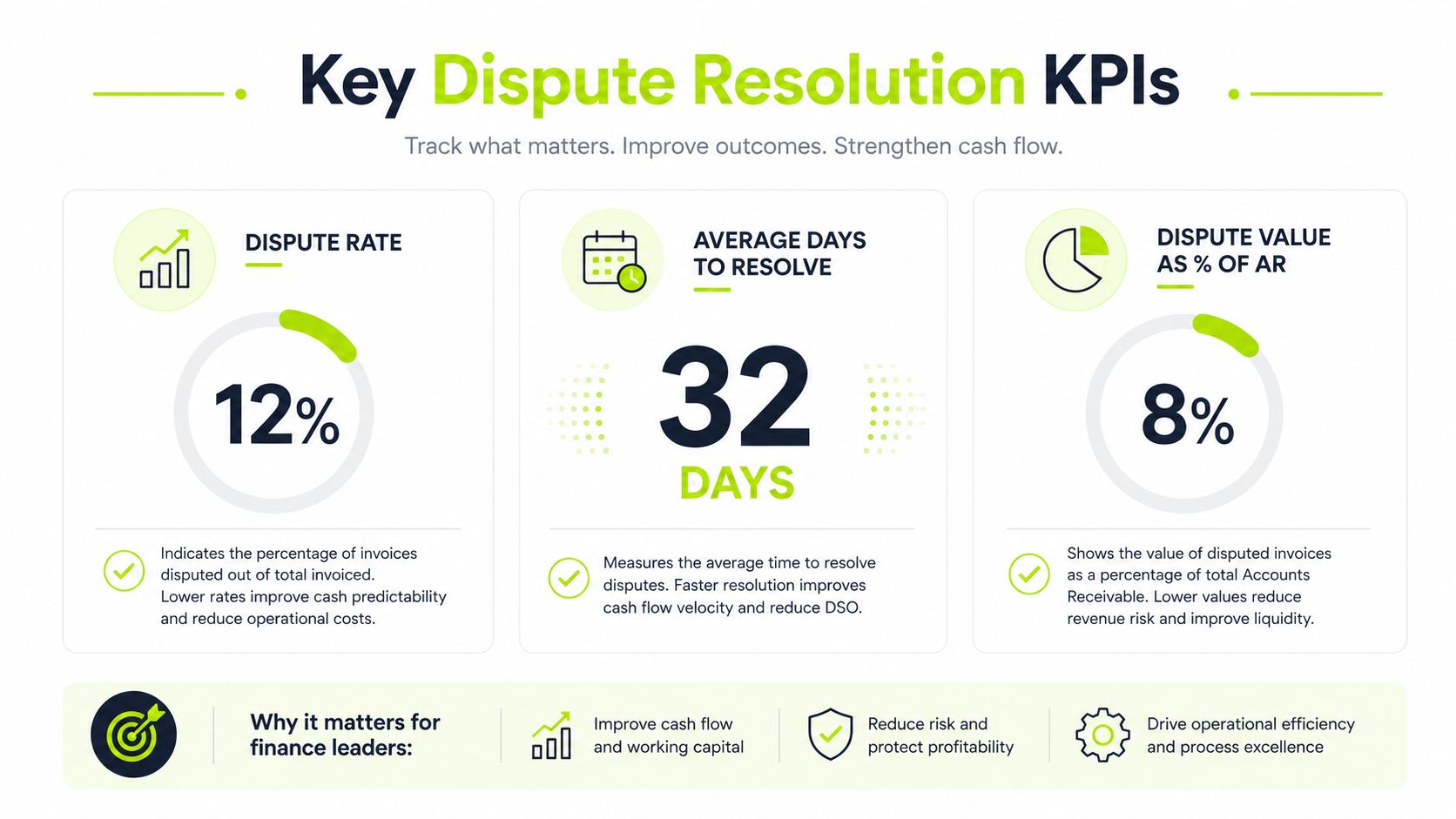
A dispute process only helps finance when it can be measured. If the team cannot see the numbers, it is hard to tell whether disputes are rising because billing rules are unclear, the project team missed approvals, or the client is paying slowly. CFOs need a small set of metrics that show control, not noise.
The metrics that matter
Dispute rate shows how often invoices become cases. Average days to resolve shows whether the team is clearing work or only relabeling backlog. Invalid dispute percentage shows how much of the queue comes from issues that should not have been raised in the first place.
A useful control panel stays simple:
- Case owner: one person owns each dispute from intake to close.
- Escalation owner: a manager or controller steps in when the first pass stalls.
- Reporting cadence: weekly for open cases, monthly for trend review.
- Root cause review: recurring issues go back to billing, delivery, or contract management.
The same discipline appears in the RTB-114 guide, which ties claims to deadlines and links evidence to the issue. AR reporting needs that same structure. If the evidence is not attached to the dispute, the case is not ready for review.
Ownership is about accountability without chaos. Controllers do not need to investigate every line item themselves, but they do need a visible chain of responsibility. That chain keeps disputes from bouncing between billing, project management, and the account team until the original problem is lost.
For teams looking at automation to support that control layer, automated dunning with Robotomail is relevant because dunning only works well when it is tied to a case workflow, not sent as a generic reminder.
Building a Scalable Dispute Resolution Playbook
A scalable playbook gives the firm the same answer every time a dispute arrives. That answer should spell out who owns the case, what evidence is required, when the client hears back, and what happens if the issue cannot be solved at the first step. When those rules are written down, the finance team stops improvising and starts operating with a repeatable process.
The strongest playbooks are plain on purpose. They use standard acknowledgment templates, a defined escalation matrix, and payment options that let the client settle the undisputed portion quickly. They also set out when legal involvement starts, so nobody waits until the relationship is already strained before asking for help. That matters in professional services, where delay often comes from manual handoffs, not from the dispute itself.
What belongs in the playbook
A strong process should include:
- Acknowledgement templates that confirm receipt and state the next action.
- Evidence checklists that match dispute type to required backup.
- Escalation thresholds that define when legal, sales, or leadership gets involved.
- Payment portal access so resolved amounts can be paid without extra friction.
That structure is not just about compliance. It signals reliability. High-value clients notice when a firm responds with a clear process instead of a scramble, and that tone often protects the relationship more effectively than a long explanation. In practice, a consistent workflow also helps finance teams cut the back-and-forth that keeps invoices open longer than they should be.
A mature playbook also gives finance a cleaner view of cash. When disputes are logged consistently, CFOs can separate true collection risk from temporary friction, which leads to better cash planning and fewer surprises at month end. That same discipline is why structured dispute handling shows up across formal arbitration systems, including the case volumes tracked in ICC Dispute Resolution Statistics.
Consistency is what makes the process feel fair, even when the invoice is contested.
For professional services firms, the operational benefit is straightforward. A clear playbook shortens the time spent chasing missing approvals, locating backup, and deciding who should respond. It also gives automation something useful to work with, since AI-driven routing can only reduce DSO if the underlying steps, owners, and escalation paths are already defined.
The Future of AR is Consistent and Human
The wrong assumption is that disputes are just client problems. In practice, they're often process problems that show up at the client-facing edge. If the billing team, the delivery team, and the account owner aren't aligned, the invoice becomes the place where that misalignment gets exposed.
That's why the future of AR won't be fully hands-off or fully manual. It'll be consistent, documented, and human where it matters. The firm that wins is the one that can resolve disputes without making the client feel fought, while still protecting cash and enforcing discipline.
A modern dispute resolution process gives finance that balance. It replaces scattered follow-up with clear ownership, evidence, and escalation, which is how teams improve cash flow without turning collections into a relationship problem.
Resolut automates AR for professional services, so dispute handling stays consistent, accurate, and human. If you want a cleaner workflow for invoices, follow-up, and escalation, visit Resolut and see how it fits into your billing operation.