
AR Follow Up That Actually Gets You Paid Faster
AR Follow Up. Practical AR follow-up playbook for professional services firms. Cadence, templates, escalation triggers, and KPIs to cut DSO and improve cash
An invoice crosses 60 days past due. The finance lead sees it, flags it, and decides not to call yet because the client relationship matters. A polite email goes out when someone remembers. The client replies that payment is “in process,” but nobody records a date, confirms the approval blocker, or changes the next action. Another week passes.
That pattern is common in professional services firms. It also explains why cash gets trapped after the work is complete. AR follow up isn't a test of how assertive your controller is. It's an operating system for turning completed work into cash.
The AR Follow Up Problem Nobody Wants to Admit
Most firms don't have a collections problem because their people are careless. They have one because the process depends on memory, personal judgment, and a single channel.
A project manager sends one reminder. The controller waits because the client is strategically important. The partner assumes finance is handling it. Accounts payable at the client never sees the invoice, or sees it but can't approve it without a different document. Everyone is busy, and the invoice ages.
That is why AR follow up gets framed as a politeness question. Finance teams worry that a phone call will sound confrontational, so they use softer language and less frequent contact. But being nice and being unclear aren't the same thing. A professional follow-up can protect the relationship while making the requested action unmistakable.
Operating rule: Treat every overdue invoice as a workflow with an owner, a next channel, a requested commitment, and a recorded outcome.
The financial risk grows with age. A widely cited 2026 accounts receivable benchmark reports that top-performing teams collect in 30 days or less, median performers in 38 days or less, and bottom performers in 46 days or longer. It also reports that 26% of receivables become uncollectible after 90 days past due, 70% after 180 days, and 90% after one year. Those figures are summarized in this accounts receivable benchmark, and they make the operational point clearly: early follow-up protects recovery options.
Every extra day of DSO keeps working capital in a completed job instead of in the bank. That can force borrowing, delay hiring or distributions, and reduce the margin on work you've already delivered. If you want a practical overview of the mechanics behind getting cash in faster, start by separating the cadence from the personality of whoever happens to be chasing invoices this month.
The fix isn't harsher language. It's a documented cadence, channel rules, escalation triggers, and tracked outcomes. The rest of this playbook turns those principles into a system your finance team can run consistently.
What DSO Actually Measures in a Professional Services Firm
Days Sales Outstanding measures how long revenue remains in accounts receivable before collection. The standard formula is accounts receivable divided by average daily revenue. An alternate formulation uses accounts receivable divided by credit sales, multiplied by the number of days in the period, as explained in this DSO guide for finance teams.
For a professional services firm, DSO is shaped by two operational drivers:
- Invoice production: how quickly the firm converts delivered work, approved time, and reimbursable expenses into a valid invoice.
- Collection speed: how many days pass between invoice delivery and cleared cash.
This is closely related to total lockup. Professional services firms commonly separate WIP days, the time from doing the work to issuing the invoice, from AR days, the time from invoice issuance to cash receipt. The professional services DSO explanation from nStar Finance frames each DSO day as one day of daily revenue trapped in receivables, using average monthly revenue divided by 30 to estimate daily revenue.
A firm's broad client base may pay reliably while a small number of large accounts pull the average upward. Those clients often have layered procurement, legal, and budget approval workflows. That makes client mix and invoice concentration more important than a simple average invoice amount.
A practical example shows the cash consequence. If a firm carries $4 million in receivables, reducing DSO by 10 days frees roughly $110,000 in working capital at any point in time. The estimate uses $4 million divided by an assumed 365-day year, multiplied by 10. Treat it as a planning approximation, not a substitute for your own revenue and billing data.
DSO components and where follow-up moves the needle
DSO Driver | What It Means | Follow-Up Influence |
|---|---|---|
WIP days | Time from completed work to invoice delivery | Limited after billing, but strong billing controls can shorten it |
Invoice validity | Whether the invoice contains the required details and support | Moderate, through accurate documents and early issue resolution |
Client approval time | Time spent in the client's internal workflow | Moderate, through named contacts and targeted escalation |
Days to collect | Time from invoice delivery to cash receipt | High, because cadence and channel choices are directly controllable |
Client mix | The weighting of large and small accounts in total AR | Indirect, through account-specific workflows |
Aging tells the controller which balances require action today. DSO tells the CFO whether the portfolio is converting revenue into cash at an acceptable speed. The cadence below is designed to compress the days-to-collect component, especially before invoices move into the older aging buckets.
The Follow Up Cadence That Moves DSO
A useful cadence begins before an invoice becomes overdue. The message should become more direct as the balance ages, but the objective remains simple at every stage: produce a payment, identify a genuine dispute, or secure a documented commitment.
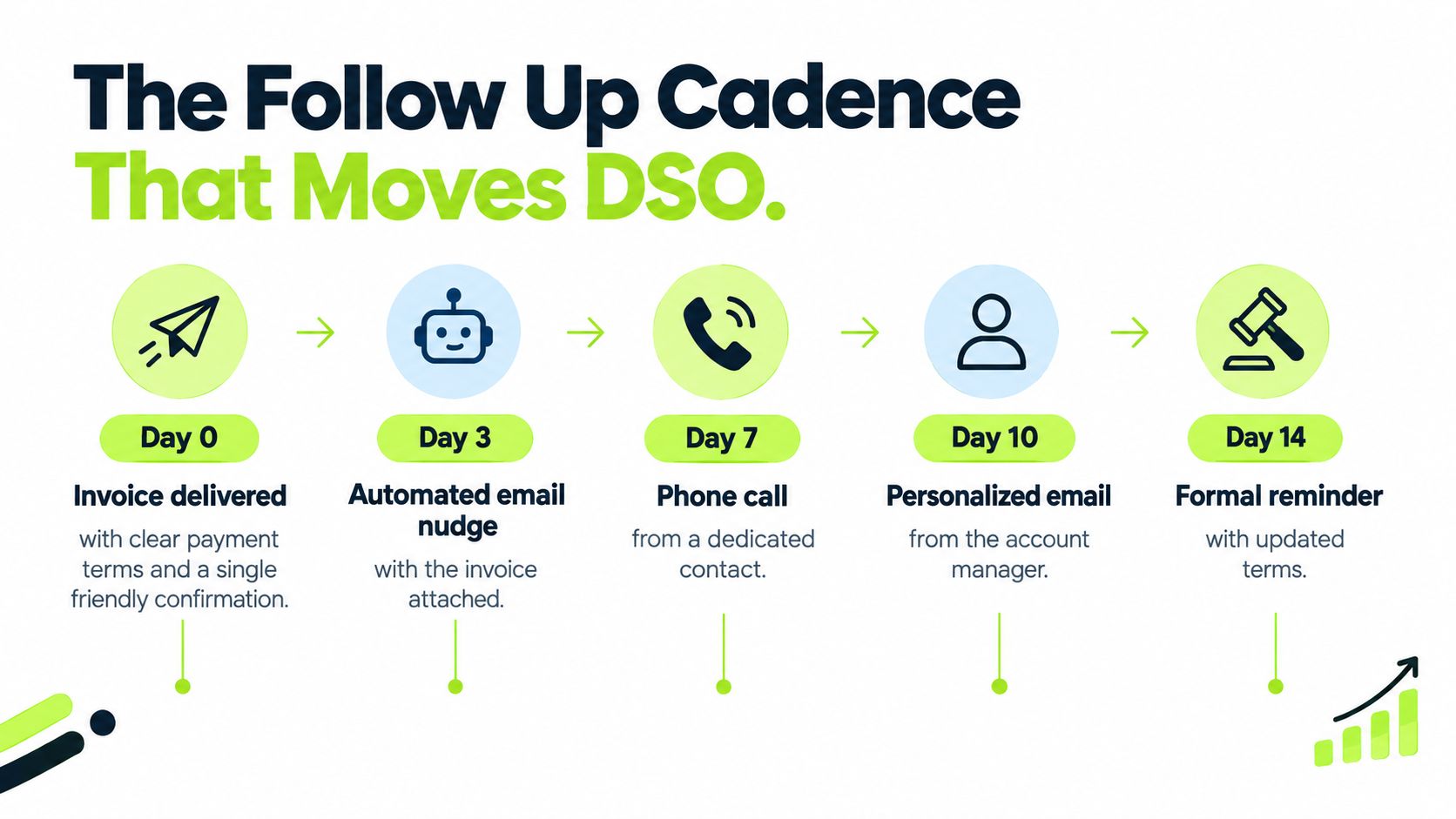
Use this as the baseline:
- Day 0, delivery and confirmation: Send the invoice with clear terms, payment instructions, supporting detail, and the correct AP contact. Add one friendly confirmation asking whether the document reached the right queue. The decision is simple, confirm receipt or correct delivery.
- Day 3, automated email: Send the invoice again as an attachment or accessible payment link. Keep the tone neutral and ask whether anything is missing for approval. The desired outcome is an identified blocker, not a vague acknowledgment.
- Day 7, channel choice: For an invoice under $5,000, use SMS or a short email when the client has opted in to that channel. For a larger balance, call the responsible contact. The objective is to secure a response and establish who owns payment internally.
- Day 14, named-contact phone call: Call the person responsible for approving or releasing payment, not a generic AP inbox. Ask, “What date should we expect payment?” Record the answer, the reason for delay, and the follow-up date.
- Day 21, partner-backed escalation: Send a concise email copying the engagement partner. State the invoice number, amount, original due date, previous contact attempts, and the specific payment date requested. The goal is executive attention without turning the message into a threat.
- Day 30, formal notice: Reference the agreed terms and any applicable late-fee provision. The tone is firm and factual. Ask for payment or a written dispute with supporting detail.
- Day 45, decision point: Decide whether the balance belongs in active collections, a service restriction process, or a documented write-off review. Don't let “we're still working on it” substitute for an owner and a decision.
A separate collections benchmark recommends automated reminders at 7 and 14 days past due, a phone call at 30 days, formal demand at 45 to 60 days, account hold at 60 to 75 days, and third-party referral at 90 to 120 days. It also reports that automated reminders at those early stages can resolve 40% to 60% of overdue invoices without human effort. The sequence is detailed in this collection email and escalation guide.
The plan should flex for strategic accounts, but it must never disappear. Use account notes to adjust tone, timing, and owner. Don't send every reminder by email just because it is easy, and don't skip the phone because it feels uncomfortable. A short, respectful call often reveals an approval issue that several emails will never uncover.
Use the payment reminder workflow as a reference when documenting your internal process. The aim is to reduce manual admin in order to cash, not to replace judgment with more activity.
Message Templates That Sound Human at Every Stage
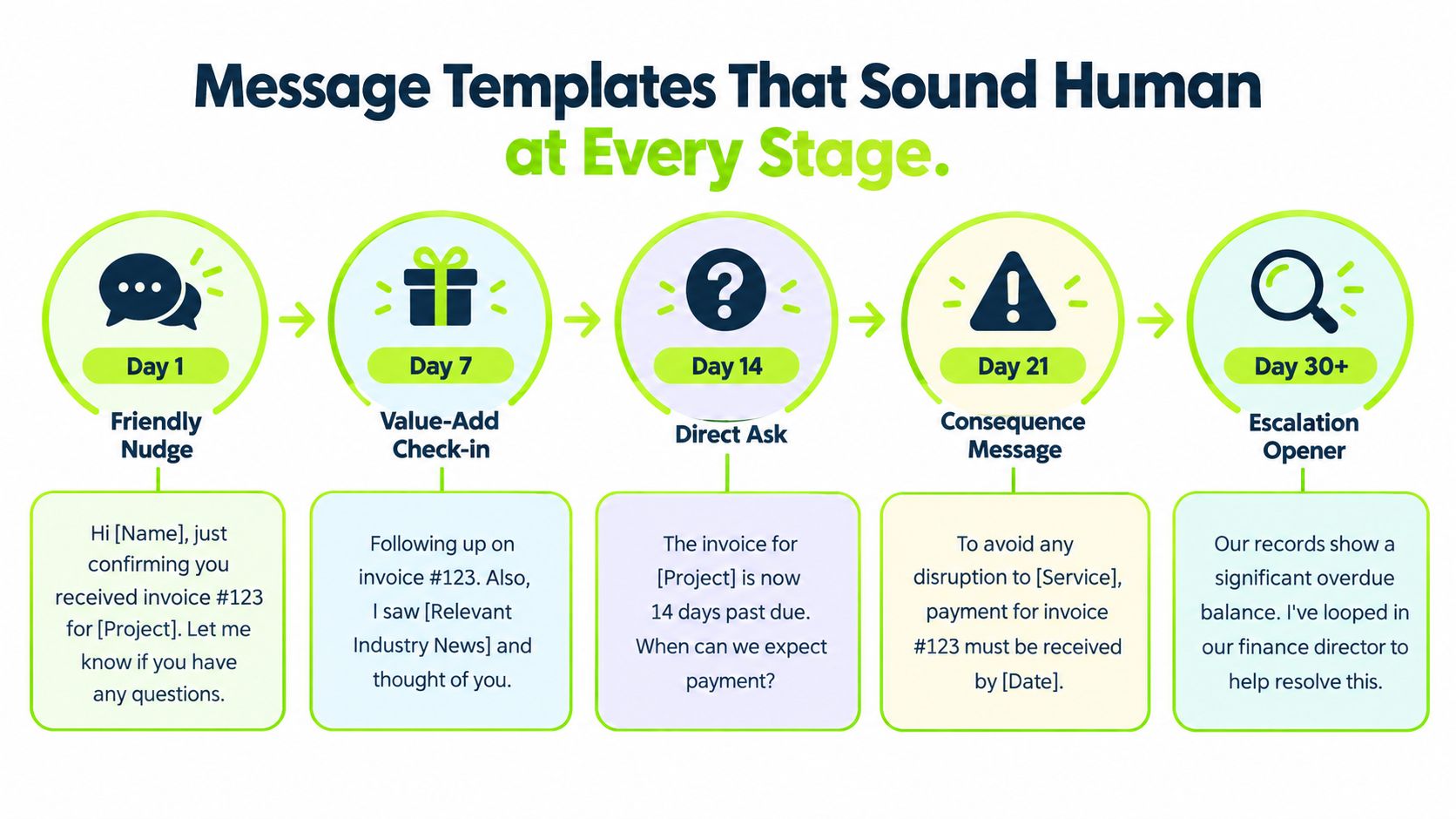
Good AR messages sound like they were written by a finance operator who knows the account. They name the invoice number, exact amount, original due date, and requested next step. They don't hide behind passive voice or apologize for asking a client to honor agreed terms.
Early reminders should remove friction
Day 1, friendly nudge
- Email: “Hi [Name], just confirming you received invoice #[Number] for [Project], for [Amount], due [Due Date]. Let me know if you need anything from us to route it for approval.”
- SMS: “Hi [Name], confirming receipt of invoice #[Number] for [Amount], due [Due Date]. Can you confirm it reached the right AP contact?”
- Phone opener: “Hi [Name], I'm calling to confirm invoice #[Number] for [Project] reached your team and to check whether the payment details are complete.”
Day 7, value-add check-in
- Email: “Following up on invoice #[Number] for [Amount], originally due [Due Date]. I also saw [Relevant Industry News] and thought of you. Is there any document or approval detail your team needs before payment?”
- SMS: “Following up on invoice #[Number] for [Amount]. Is anything holding approval on your side?”
- Phone opener: “I wanted to check whether invoice #[Number] is moving through approval and whether we can clear any issue before the payment run.”
Keep these messages short. Don't include a long account history or generic language about “urgent attention” when the need is just confirmation.
Later messages need a commitment
Day 14, direct ask
- Email: “Invoice #[Number] for [Project], amount [Amount], is now 14 days past due. When can we expect payment?”
- SMS: “Invoice #[Number] for [Amount] is 14 days past due. What payment date should we record?”
- Phone opener: “I'm calling for a payment date on invoice #[Number]. What date can your team commit to?”
Day 21, consequence message
- Email: “To avoid disruption to [Service], payment for invoice #[Number], amount [Amount], must be received by [Date]. If there's a dispute, please send the disputed line and supporting detail by [Date].”
- SMS: “Please confirm payment timing for invoice #[Number]. If there's a dispute, identify the line item so we can resolve it.”
- Phone opener: “I want to make sure the account stays on track. Is the balance delayed by a dispute, an approval issue, or payment scheduling?”
Day 30 and beyond, escalation opener
- Email: “Our records show a significant overdue balance on invoice #[Number], for [Amount], originally due [Due Date]. I've looped in [Finance Director or Partner] so we can resolve the account and confirm the next action.”
- SMS: “Invoice #[Number] remains overdue. I've escalated the account internally and need a confirmed payment date or dispute detail.”
- Phone opener: “The balance has moved beyond the agreed terms, so I'm bringing in [Name] to help resolve it. Can we agree the payment action today?”
Leave out apologies such as “sorry to bother you,” vague phrases such as “at your earliest convenience,” and threats you aren't authorized to enforce. The collection email templates provide another useful starting point, but your CRM should retain the invoice facts and account context in every message.
Escalation Triggers and When to Get Firmer
More process doesn't automatically produce better collections. A process that sends the wrong message, to the wrong person, through the wrong channel creates more noise. Escalation should follow evidence, not frustration.
Use a tone shift when one of these conditions appears:
- The invoice is past net 30 with no response.
- The client has ignored two unanswered emails.
- The client misses a promised payment date.
- A disputed line remains unresolved after seven days.
- The client stops communicating after initially engaging.
Getting firmer doesn't mean becoming hostile. It means changing the owner, adding the account leader, documenting the consequence, or moving the matter into a formal process. Every escalation should cite earlier message dates and commitments, so the client can see a clear record rather than an emotional reaction.
Escalation Trigger Matrix
Trigger | Action | Owner |
|---|---|---|
Past net 30 with no response | Call the named contact and copy the account owner | Controller |
Two unanswered emails | Switch to a phone touch and add the engagement partner | AR lead |
Missed promise-to-pay date | Request a revised date in writing and notify the account owner | Controller and account owner |
Dispute unresolved after seven days | Separate the disputed line from the undisputed balance and assign a resolver | Project lead and controller |
Client goes silent after engagement | Send a documented escalation notice and review service restrictions | Finance director |
Repeated broken commitments | Consider formal demand or external collections under company policy | CFO or authorized delegate |
A credit-hold notice should be attached only when your terms and internal policy support it. A formal demand letter should come from the authorized owner, with the invoice, due date, prior correspondence, and required remedy clearly stated. Don't make the engagement partner responsible for every reminder. Bring that person in when relationship authority can change the outcome.
Channel Orchestration Beats Channel Volume
Sending more messages across more channels usually creates worse outcomes. The right question isn't how many touches the team completed. It's whether each touch reached the person who can move the invoice.
Email remains the dominant follow-up channel at 91% adoption, while SMS, WhatsApp, and LinkedIn are used by 23%, 15%, and 10% of firms respectively, according to this AR statistics overview. That gap doesn't mean every firm should add SMS. It means channel choice deserves an explicit policy.
A practical decision tree looks like this:
- Small invoice and long-tenure client: Stay with the client's established email process if it works.
- Large invoice or new client: Add a phone touch by day 14, especially when approval responsibility is unclear.
- SMS: Use it only when the client has explicitly opted in and the invoice is under 90 days old.
- Relationship-led account: Let the account owner make the personal contact, while finance controls the facts and follow-up record.
- Portal-oriented client: Put the payment action and supporting documents in the client's preferred portal when available.
A well-sequenced three-touch plan across two appropriate channels can outperform a seven-touch spray across four channels because every interaction has a purpose. Blasting email, SMS, and calls at the same time signals desperation and can make a healthy partnership feel transactional.
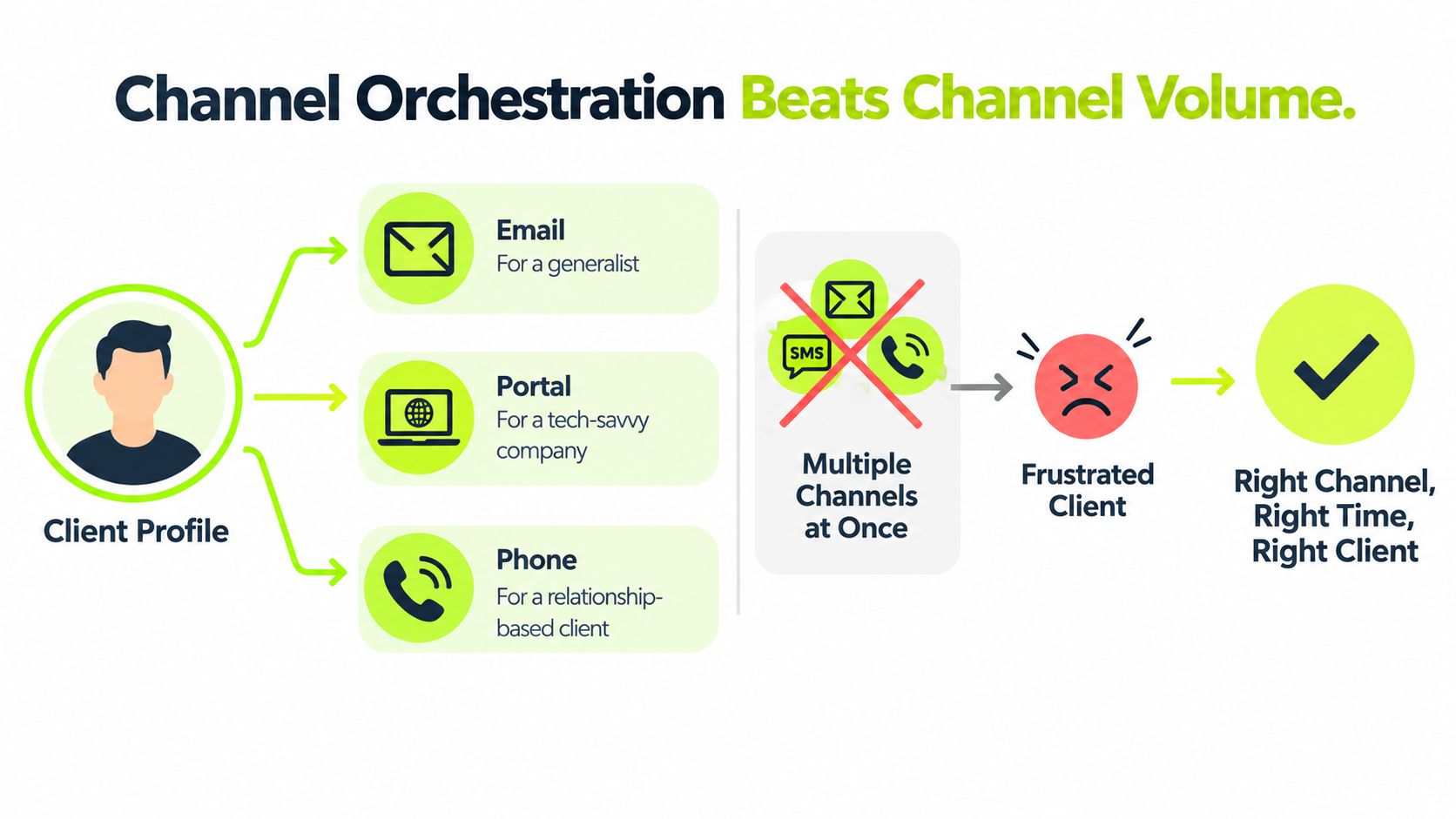
Decision test: Every additional channel must earn its place by moving payment, resolving a dispute, or identifying the real decision-maker.
The CFO should track response by channel, payment-date commitments, kept commitments, disputes opened, and invoices with no recorded next action. These measures reveal orchestration quality better than raw message volume.
KPIs to Track and What to Do With Them
A useful AR dashboard fits on one page and supports a decision. It shouldn't exist to prove that the team sent reminders. It should show whether the firm is converting billed work into cash and where the process is failing.
Start with the six measures below. Targets should reflect your contracts, client mix, and service model. For a mid-sized professional services firm, use internal targets based on the firm's stated terms and a disciplined benchmark, rather than adopting an arbitrary universal number. A 2023 professional services AR report found average DSO of 47.6 days, with 32% of firms taking 60 days or more to receive payment and 68% getting paid within 45 days or less. The report, available through this professional services invoicing analysis, also identifies 30 days as generally good or average for B2B companies and 48 days or more as a possible collection concern.
KPI | Formula | Target | What a Slip Means |
|---|---|---|---|
DSO | AR divided by average daily revenue | At or below the firm's approved benchmark | Cash conversion is slowing |
Days Delinquent | Overdue days by invoice, summarized by portfolio | Downward trend | Follow-up or approval is late |
Aging bucket distribution | AR grouped by current and overdue age | Concentrated in current and early overdue buckets | Older balances are accumulating |
Contact rate | Invoices with a documented client response divided by invoices contacted | High and stable | The channel, contact data, or message may be wrong |
Promise-to-pay kept rate | Kept payment promises divided by total promises | High and improving | The date-setting process lacks accountability |
Invoice dispute rate | Disputed invoices divided by invoices issued | Low and falling | Billing quality, scope clarity, or delivery evidence needs work |
Read the measures together. Falling DSO with a rising dispute rate isn't a clean win. It may mean the firm collected easy balances while creating more billing friction. A high contact rate with a low promise-kept rate means the team is loud but the commitment process is broken. Rising days delinquent alongside stable contact rate points toward approval, cash, or dispute problems rather than an outreach-volume problem.
The review rhythm that keeps the dashboard useful
- Weekly AR aging walk: Review every material overdue balance, confirm the next action, and remove invoices with resolved disputes or recorded payments.
- Monthly portfolio review: Examine DSO, aging distribution, channel response, dispute patterns, and client concentration by account owner.
- Quarterly policy reset: Revisit terms, escalation authority, service restrictions, credit decisions, and the cadence for strategic accounts.
The two leading indicators to watch before DSO moves are contact rate and promise-to-pay kept rate. If clients stop responding, or if they repeatedly miss agreed dates, intervene before the portfolio average reflects the deterioration. For a deeper way to evaluate collection performance, use the collection effectiveness index framework.
A disciplined follow-up system gives partners a defensible view of cash risk. It helps controllers distinguish a real dispute from a silent approval delay, gives account owners a clear role, and lets CFOs improve cash flow without turning every client conversation into a confrontation.
Resolut automates AR for professional services with consistent workflows, accurate invoice context, and human channel orchestration across email, SMS, and phone. Visit Resolut to see how your team can reduce manual follow-up, monitor commitments, and build a more predictable path from invoice to cash.