Invoice Factoring Construction: A CFO's Guide
A practical guide for CFOs on invoice factoring construction. Learn the mechanics, pricing, risks, and how it compares to AR automation alternatives.
You've probably lived this quarter already.
Payroll hits on Friday. Supplier terms are tightening. A project milestone is complete, the invoice is out, and the customer's payment clock still reads net 60 or net 90. On paper, margin looks fine. In the bank account, it doesn't.
That gap is where most conversations about invoice factoring construction start. Not with distress, but with timing. Construction firms and project-based service businesses fund labor, materials, and field activity before cash lands. If you're running a firm in the $3M–$50M range, that mismatch can force bad decisions fast. Delay hiring, stretch vendors, or pass on work you could execute profitably.
Used well, factoring is a control tool. Used casually, it becomes an expensive substitute for discipline in billing, collections, and contract review. The difference comes down to how clearly you understand the mechanics, the exclusions, and the operational trade-offs.
The Construction Cash Flow Problem
A familiar pattern shows up in growing firms. You've staffed the job, mobilized crews, bought materials, and cleared a billing milestone. The revenue is earned. Cash still isn't available.
Construction makes that timing problem worse because costs arrive early and predictably, while collections arrive later and often depend on approvals, paperwork, and pay application timing. Even strong operators get squeezed if several large invoices age at the same time.
For many firms, the strain doesn't come from a bad project. It comes from a good backlog with slow cash conversion.
Where cash gets trapped
A CFO usually sees the same friction points at once:
- Front-loaded cost structure: Labor and materials go out before owner payments come in.
- Milestone billing delays: The work may be done, but sign-off, documentation, or lien waiver issues slow billing.
- Payment terms that outrun cash needs: The client's terms don't care when payroll is due.
- Growth pressure: More awarded work often means more cash stress, not less.
A lot of owners still frame factoring as something you do only when the bank says no. That's too simplistic. In practice, it can be the cleanest way to bridge earned receivables into working capital while preserving room on other facilities.
The question isn't whether the project is profitable. The question is whether the business can carry the timing.
If you're trying to improve forecasting upstream, it also helps to tighten how draws and billing events line up with field progress. These fix and flip draw schedule tips are written for a different corner of project finance, but the discipline applies. Clear draw logic reduces avoidable cash gaps before financing even enters the conversation.
How Invoice Factoring Works in Construction
At its core, factoring is a short bridge against receivables you've already earned. You submit an invoice, the factor advances part of it, the customer eventually pays the factor, and you receive the remainder minus fees.
In construction, the economics are different from many other sectors. Advance rates typically range from 70% to 90% of invoice value, with factoring fees averaging 2.0% to 5.0% per month. Those fees are higher than the general market average of 1.5% to 4.5% because construction carries increased project risk and longer payment cycles of 60–90 days according to industry benchmarks on invoice financing adoption and pricing.
Here's the basic flow:
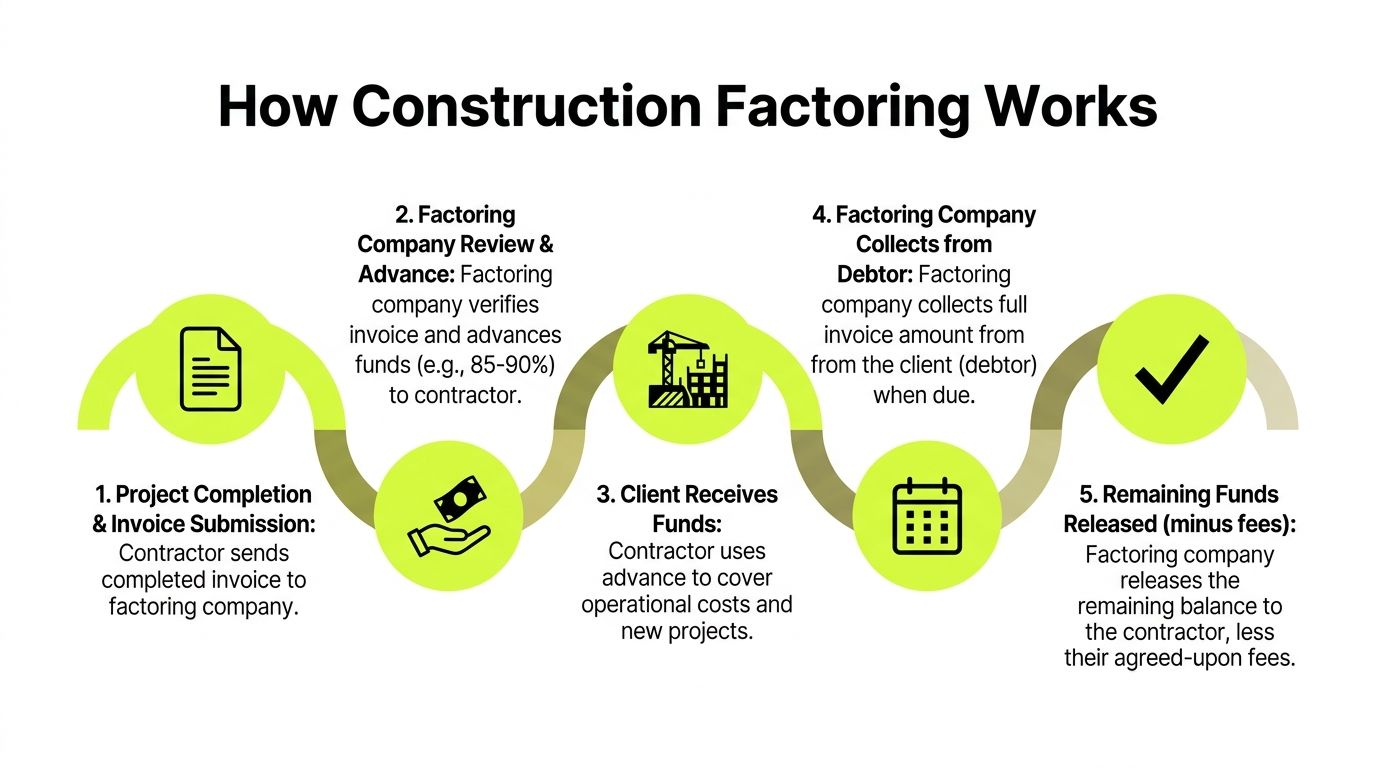
The five-step mechanics
- You complete billable work The invoice has to reflect work the customer recognizes as due. In most cases, that means completed and accepted work, not a rough internal estimate.
- You assign the invoice to the factor The factor reviews the invoice, the customer, and any contract terms that affect collectability.
- The factor advances cash You receive a large portion of the approved invoice up front. That cash usually supports payroll, vendor payments, equipment costs, and mobilization on the next phase.
- The customer pays the factor The factor handles collection based on the assigned receivable.
- You receive the reserve balance, less fees Once payment clears, the factor remits the remaining amount after deducting its charges.
A simple operating example
Take a $100,000 approved invoice. If the factor advances near the middle of the common range, you may receive most of the invoice quickly and leave a reserve balance pending customer payment. That reserve is not free cash. It's the portion held back until the factor gets paid and deducts its fee.
That distinction matters because many operators focus only on the advance rate and ignore the timing and fee accrual behind the reserve.
A useful way to think about it is this:
Item | What it means operationally |
|---|---|
Invoice value | Your earned receivable |
Advance | Immediate liquidity for operations |
Reserve | Cash held back until payment arrives |
Fee | Cost of accelerating access to cash |
A short video can help if you want the process in a visual format.
What works and what doesn't
What works is clean documentation, approved billing, and creditworthy customers. What doesn't work is treating factoring like a substitute for contract discipline or invoice accuracy.
Practical rule: If your AR file is full of disputes, missing backup, or unsigned change orders, factoring won't solve the root problem. It will just price around it, if it approves the invoice at all.
Calculating the True Cost and ROI
Most finance teams make one of two mistakes. They either look only at the fee and reject factoring outright, or they look only at speed and ignore the all-in cost.
Both are incomplete.
The right analysis compares the cost of accelerated cash against the value created by having that cash when operations need it. In a project business, timing often matters more than nominal margin. Payroll missed is more expensive than a fee line. A delayed material order can damage gross profit far beyond the financing charge.
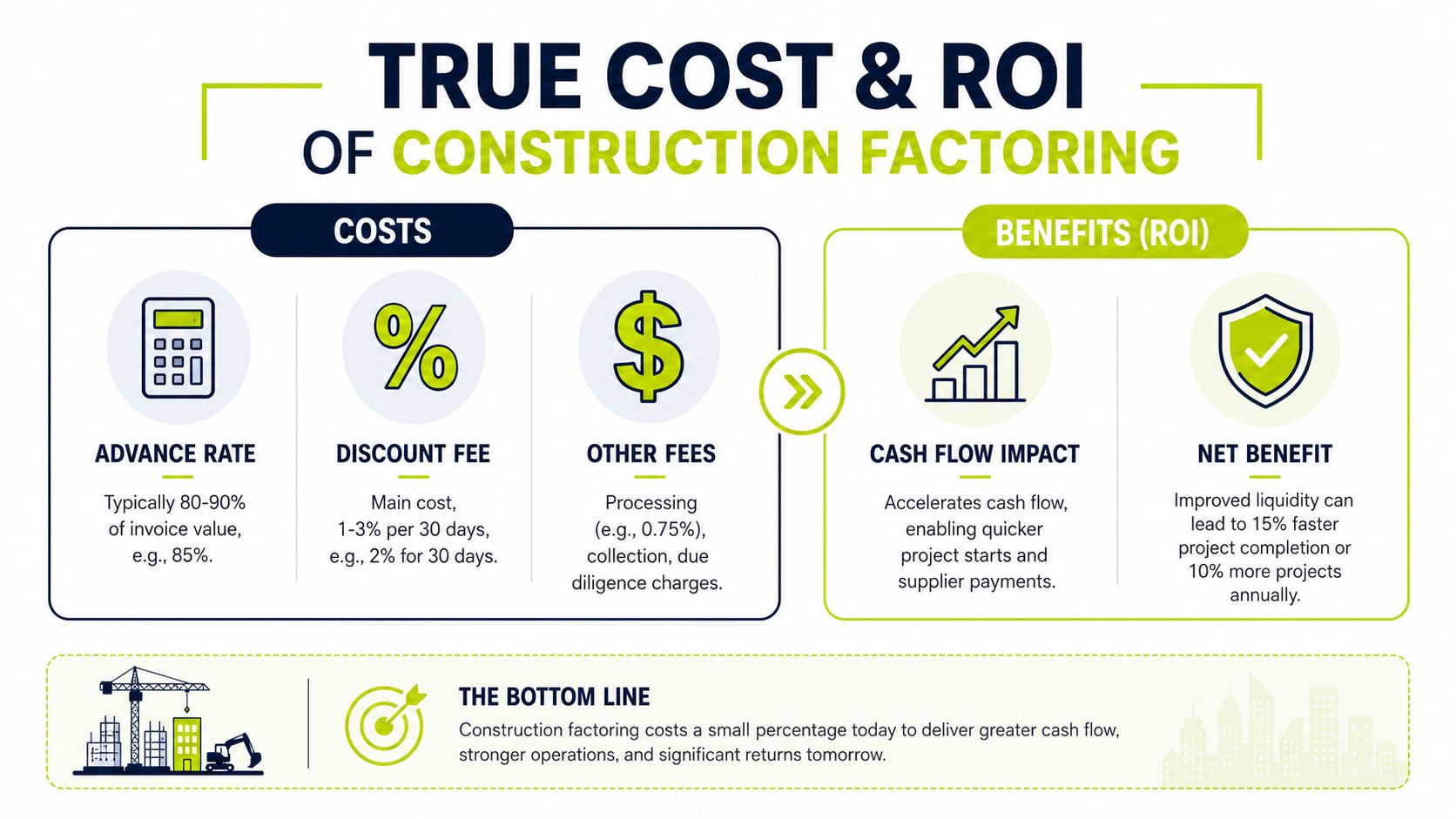
Start with the cash math
Your model should isolate four things:
- Advance timing: How quickly cash is available after invoice approval
- Fee structure: Whether the charge increases with each aging period
- Reserve release timing: When you receive the balance
- Operational use of proceeds: Payroll, vendors, tax obligations, or project mobilization
A lot of firms already have the accounting framework to model this if they're disciplined about receivables valuation. If your team needs a refresher, this guide to net realizable value in receivables analysis is a useful lens. It forces the right question: what is this invoice worth in cash terms, after timing, fees, and collectability?
Then compare it to the alternative
The benchmark usually isn't “free cash.” It's one of these:
Comparison point | Finance question |
|---|---|
Delayed payroll coverage | What does disruption cost if cash arrives late? |
Supplier relationships | Are you giving up leverage by paying late? |
New project mobilization | Does lack of liquidity prevent profitable work? |
Internal admin burden | Are collections delays adding avoidable operating cost? |
Many professional services firms can learn from broader AR operations. Organizations that fully implement AR automation, including cash application, collections intelligence, and dispute routing, achieve average annual cost savings of $4.20 per transaction compared with manual processing according to Deloitte benchmark data summarized here. That's not construction factoring data, but it matters to CFOs because it shows a separate path to liquidity improvement through process efficiency instead of receivables financing.
ROI is about optionality
If factoring lets you hold labor continuity, keep a project moving, or avoid stretching a key supplier, the return may be obvious even when the fee feels high.
If factoring is only plugging a chronic invoicing backlog, weak collections habits, or poor contract administration, the ROI usually degrades fast.
Cost of capital should be measured against the cost of interruption, not against an imaginary world where cash arrives exactly when needed.
The best operators I've seen don't ask whether factoring is cheap. They ask whether the liquidity arrives at the exact point the business can turn it into stability or revenue.
Eligibility Nuances Retention and Progress Billing
Generic factoring advice frequently falters in these situations.
Many articles stop at the headline advance rate. They don't explain what portion of the invoice is eligible for advance in construction, and that omission creates bad forecasts.

Retention changes the usable cash
Here's the hidden gap. While 70–90% advance rates are standard for completed work, retention amounts typically run 5–10% and are almost universally excluded from the initial advance, forcing contractors to fund that gap themselves as noted in this discussion of construction factoring and retention treatment.
That means your forecast can be wrong even when the stated advance rate is accurate.
If a customer withholds retention, the factor often treats that amount separately and may not advance against it until final sign-off. For subcontractors on longer-tail jobs, that creates a second liquidity problem hiding underneath the first one.
Progress billing is more nuanced than most guides admit
Construction doesn't run on one final invoice. It runs on staged billing, partial completions, inspections, and documentation. In theory, that should support financing earlier in the project. In practice, eligibility usually depends on formal acceptance and the quality of supporting records.
The common misunderstanding is binary thinking. Teams assume either everything can be factored or nothing can be factored until final completion. The truth sits in the middle and depends on contract structure, customer acceptance, and the factor's comfort with the billing package.
A useful internal review before submitting any progress invoice:
- Acceptance status: Has the customer formally approved the billed work?
- Backup quality: Can AR produce pay apps, schedules of values, and supporting documentation quickly?
- Dispute exposure: Are there unresolved punch list, change order, or quality questions?
- Retention visibility: Is the retained amount clearly separated from the collectible portion?
If your team can't explain which dollars on the invoice are collectible now versus collectible later, don't rely on the headline advance rate.
For CFOs, the takeaway is simple. Model accessible cash, not invoice face value.
Strategic Benefits and Operational Risks
Factoring can be a strong operating lever when it's used intentionally. It can also create friction if you ignore the behavioral side of collections and customer communication.
The strategic benefit is predictability. Converting approved receivables into near-term cash can help a firm stabilize labor, buy materials without delay, and bid on work without waiting for the prior project to fully liquidate.
Where it helps
There are three situations where factoring tends to earn its keep.
First, firms with uneven billing cycles use it to smooth working capital. Second, fast-growing contractors use it to avoid overloading a bank line every time backlog expands. Third, businesses with solid customers but slow payment rhythms use it to turn collection lag into a manageable cost.
That's especially relevant when internal processes are still maturing. A business may be operationally strong but administratively slower than its growth requires.
Where it can hurt
The downside usually shows up in control and relationship management.
When a third party is collecting from your customer, tone matters. Some factors handle this professionally. Others create tension fast, especially if they're rigid about documentation or aggressive on payment follow-up. That can affect how your client experiences your back office.
You also risk dependency. If a company starts underwriting each month's operations on expected advances, the organization may stop fixing the root causes behind slow cash conversion.
A final wrinkle is technology. There is still a lack of data-backed guidance on how AI-driven platforms or blockchain verification, emerging in 2025, might enable factoring of partially completed work through digital site logs that bypass traditional sign-off delays according to this review of construction factoring and emerging verification methods. That idea is promising, but it's still an emerging operating model, not a standard assumption you should build into near-term cash planning.
Strong firms use factoring as a lever inside a broader cash strategy. Weak firms use it as a cover for poor billing discipline.
Factoring vs AR Automation and Other Alternatives
This is the decision that matters more than the product choice.
Factoring finances receivables after you've created them. Accounts receivable automation improves how quickly and accurately you bill, follow up, reconcile cash, and resolve disputes so receivables don't age unnecessarily in the first place. A bank line solves a different problem again. It provides borrowing capacity, subject to underwriting and covenant constraints.
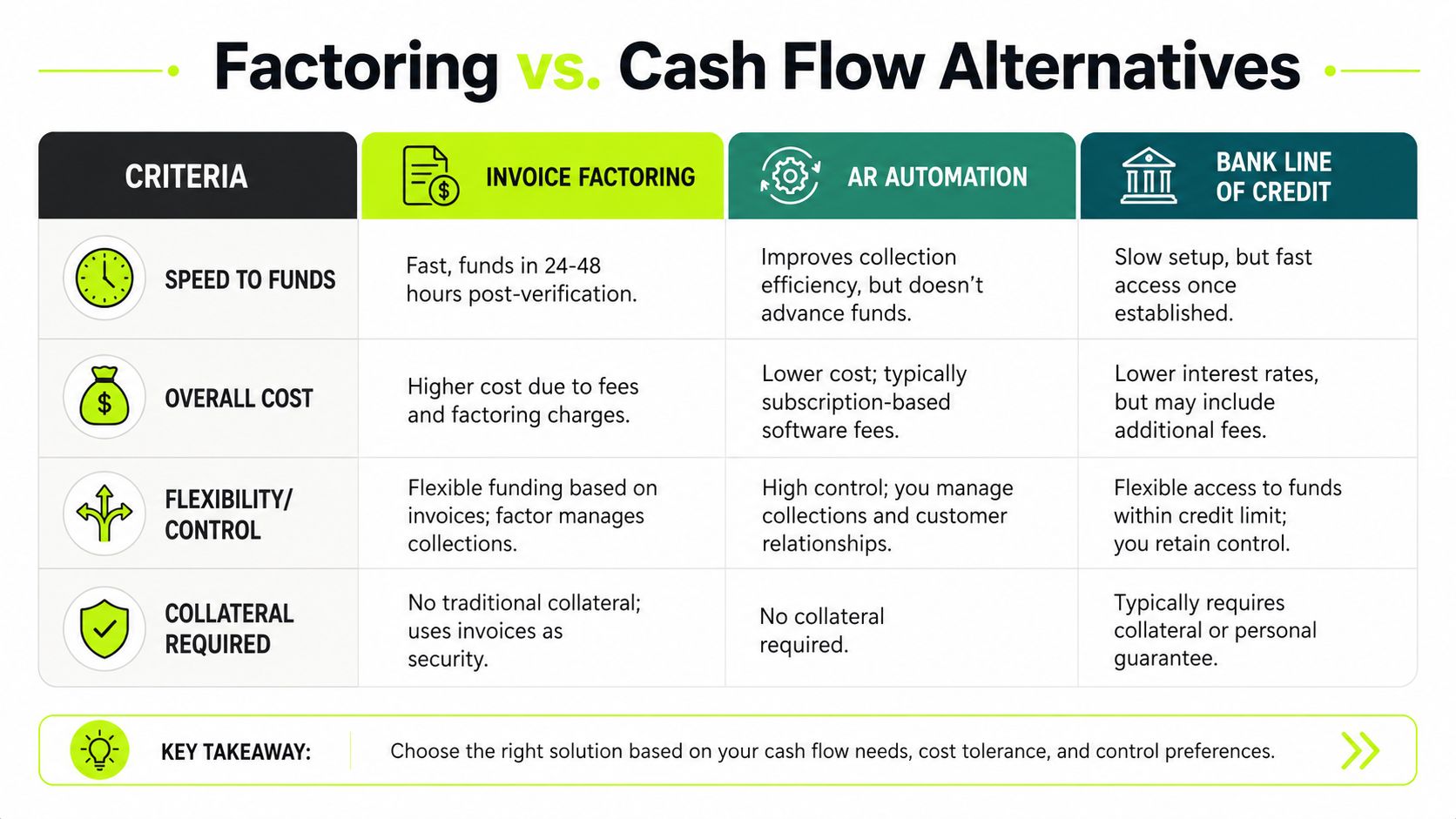
A side-by-side operating view
Option | Best use case | Main trade-off |
|---|---|---|
Invoice factoring | Need immediate liquidity against earned receivables | Ongoing fees and external collection involvement |
Accounts receivable automation | Need to reduce DSO and improve cash flow structurally | Doesn't create an instant advance against an invoice |
Bank line of credit | Need broader liquidity flexibility | Slower setup, tighter underwriting, borrowing constraints |
For many professional services firms, the better long-term answer is process improvement. That's where AR software for professional services, AI AR automation, and QuickBooks AR automation enter the picture. These tools don't buy your invoice. They improve invoice timing, collections cadence, dispute routing, and cash application so less cash gets trapped in the first place.
The measurable case is strong. 100% of respondents in a Vanson Bourne ROI study on accounts receivable automation reported measurable gains, including faster payments, reduced operational costs, and accelerated cash flows according to Billtrust's summary of the study. For a CFO, that doesn't mean every implementation performs identically. It does mean the category has clear evidence of operational upside.
There's also a practical process gain. About 34% of service providers identify faster invoice processing as one of the biggest gains from AR automation in this business services AR automation review. That matters because reducing the delay between work completion and invoice delivery is one of the cleanest ways to reduce DSO without changing customer terms.
When factoring makes sense anyway
Factoring still has a valid place.
Use it when you need cash against approved receivables now, especially during growth, seasonal strain, or customer payment lag. It's tactical. It can be exactly right for the moment.
But if your issue is recurring slowness in billing, fragmented follow-up, weak collections workflows, or manual reconciliation, financing the receivable is less attractive than fixing the AR machine.
A bank facility belongs in the comparison too. If you're evaluating whether a conventional facility is realistic, these SBA loan qualification tips give a grounded view of what lenders tend to scrutinize. It won't solve construction billing friction by itself, but it helps frame whether debt capacity is a practical alternative.
If your team wants a broader primer on the financing category itself, this overview of receivables financing options is a helpful companion. It's useful when you're deciding whether to finance the asset, automate the process, or combine both.
The clean decision framework
Use this sequence.
- Choose factoring when the receivable is solid and timing is the problem.
- Choose AR automation when the process is weak and late invoicing or late follow-up is extending cash conversion.
- Choose a bank line when you need flexible liquidity across uses, not just against specific invoices.
Most mature finance teams eventually use more than one lever. The mistake is using the expensive one to avoid fixing the durable one.
Vendor Selection and Onboarding Checklist
If you're evaluating a factor, diligence matters more than the pitch deck. Construction receivables are too contract-specific for generic underwriting claims.
Questions for the factor
Ask direct questions and make them answer in operational terms.
- Construction specialization: Do they actively handle construction receivables, including pay apps, schedules of values, and lien-sensitive documentation?
- Collections approach: How do they communicate with your customers once an invoice is assigned?
- Dispute handling: What happens if the customer short-pays, delays approval, or contests part of the invoice?
- Eligibility screen: How do they treat retention, unapproved change orders, and partially approved invoices?
- Fee clarity: Which charges accrue over time, and which charges apply up front?
- Recourse terms: Under what conditions does the invoice come back to you?
You should also review the actual agreement language, not just the term sheet. This guide on factoring contract agreement terms is a practical checklist for the clauses that tend to matter once deals are live.
Internal onboarding checklist
Your own house has to be ready too.
Team area | What to lock down |
|---|---|
AR | Clean invoice files, customer contacts, and backup documentation |
Project controls | Clear status on approved work versus pending sign-off |
Legal or contracts | Assignment language, notice requirements, and payment instructions |
Operations | Escalation path for billing disputes and documentation requests |
A factor can accelerate cash, but it can't repair weak handoffs between project managers, billing, and AR.
Once the facility is active, monitor three things closely. Customer feedback on the collection process. Actual fee yield against plan. Percentage of billed value that is eligible for advance after exclusions.
That's the discipline that keeps factoring useful instead of habitual.
Resolut automates AR for professional services, including accounts receivable automation, AI AR automation, AR software for professional services, and QuickBooks AR automation workflows that help teams reduce DSO and improve cash flow. If the long-term goal is consistent collections without adding friction for clients, Resolut offers a practical path: consistent, accurate, and human.