Invoice Payment Reminder Email: 7 Templates for 2026
Seven invoice payment reminder email templates for B2B receivables, with timing, subject lines, escalation tone, and A/B tests for finance teams.
You're reviewing receivables before the cash forecast meeting. The work is complete, the invoices went out, and the project leads say their clients are happy. Yet several balances still have no payment date, and your controller is searching email threads for an explanation.
Most overdue invoices don't begin as a refusal to pay. They begin as a missed date, a message sent to the wrong inbox, or an approval that stalled with someone outside accounts payable. Your invoice payment reminder email should identify which problem you're dealing with, not repeat that money is owed.
The operating objective is a payment, a dated commitment, or a documented exception. Anything else leaves your team guessing.
For professional services firms, that distinction matters. A retainer awaiting routine approval needs different treatment from a disputed milestone invoice. Sending both clients a stronger email won't resolve either account reliably.
- Before sending: Confirm the recipient, outstanding balance, payment route, and invoice status.
- After sending: Assign an owner to replies, promised dates, and unresolved questions.
- Before automating: Fix the underlying records. Efforts to reduce manual invoice entry should support accurate reminders, not just faster data capture.
The following sequence moves from a pre-due courtesy note to controlled escalation, with separate routes for payment plans and recurring statements.
1. Friendly Pre-Due Date Reminder
Send this before the client has missed anything. You're confirming readiness to pay, not collecting an overdue balance.
QuickBooks' invoice-tracking guidance recommends a reminder a few days before the due date and says each message should include the invoice number, amount due, due date, and clear payment instructions. Those details let the recipient act without searching another thread.
Template to confirm payment readiness
Subject: Invoice [invoice number] due [due date]
Hi [name],
You can pay invoice [invoice number] through [secure payment portal]. The outstanding amount is [amount], due on [due date], and the invoice is attached.
Please let us know if you need a purchase order reference, supporting documents, or a different billing contact before payment can be scheduled.
If payment is already scheduled, thank you. No further action is needed.
Best, [sender name]
The decision point: Does accounts payable have everything required to process the invoice? Send this to the billing contact, not just the project sponsor, and make sure the portal reference becomes a working link before sending.
Say a consulting firm bills monthly retainers. The sponsor approved the work, but procurement still needs a purchase order. This reminder gives the client an opportunity to identify that missing requirement before the invoice becomes overdue.
Practical rule: A pre-due reminder should never imply that the client has already failed to meet its terms.
The expected reply is confirmation of scheduling or a specific missing requirement. If no reply arrives, don't escalate early; retain the due-date notice unless payment posts or someone identifies a dispute.
Measure on-time payment by client segment, not just whether recipients opened the email. That's the relevant test of whether this early contact helps you reduce DSO.
2. Due-Date Notice
The due-date notice answers a narrow question: Will the client release payment today? Keep it shorter than the pre-due message and avoid introducing new terms.
For a fractional CFO firm billing recurring retainers, this is a routine transaction notice. The client shouldn't have to interpret whether today is a courtesy deadline or the actual contractual due date.
Template to request release confirmation
Subject: Invoice [invoice number] due today
Hi [name],
Invoice [invoice number] for [amount] is due today, [due date]. Please arrange payment through [secure payment portal]; the invoice is attached for reference.
Could you confirm that payment has been released or scheduled? If an approval or billing issue is preventing payment, please reply with the details so we can assign it to the right person.
Thank you, [sender name]
Send in the client's time zone, during its normal business hours. Keep the invoice reference consistent across the sequence so accounts payable can recognize the obligation.
- Payment recorded: Suppress the notice before sending.
- Payment released: Request a remittance reference if needed, then track receipt rather than continuing routine reminders.
- Approval blocked: Record the approver and next action.
- Dispute open: Route the issue to its owner instead of sending an automatic demand.
For QuickBooks AR automation, invoice delivery and status are prerequisites, not background details. QuickBooks Online's reminder documentation says reminders are sent only when the invoice has already been emailed and still shows as unpaid.
If there's no reply, let the account enter the first overdue stage rather than sending another message immediately. A due-date email followed by an impatient same-day chase adds pressure without establishing what's preventing payment.
Review the bank feed and unapplied receipts before concluding that silence means nonpayment.
3. First Past-Due Follow-Up
Once the due date passes, stop asking whether the client received a friendly reminder. Ask for a payment date.
For a first overdue contact, a week after the deadline is a reasonable starting point; QuickBooks' accounts receivable guide recommends an earlier alternative, with automated follow-ups on day 3 and day 15 after an invoice becomes overdue. Choose a policy that fits your billing relationships, then apply it consistently.
Template to obtain a dated commitment
Subject: Payment date requested for overdue invoice [invoice number]
Hi [name],
Invoice [invoice number] for [amount], due on [due date], remains outstanding in our records. A copy is attached, and payment is available through [secure payment portal].
Could you confirm the scheduled payment date by [reply deadline]?
If there's an issue with the invoice or the services billed, please describe it in your reply so we can direct it to the appropriate person.
Thank you, [sender name]
The reply should produce a date or an exception, not another vague assurance that someone is looking into it. A marketing agency, for example, might learn that its client has approved the invoice but won't release payment until its next payment run.
Record that promised date in the AR system and assign a follow-up task. Don't leave the commitment solely in a collector's inbox.
For alternate wording around disputes, delayed approvals, and unanswered requests, use this past-due invoice email template.
A promise to pay changes the next action. It doesn't close the receivable.
If there's no reply, verify the address and contact accounts payable by phone. If the client misses a promised date, follow up on that missed commitment rather than restarting the generic reminder sequence.
4. Second Notice with Statement of Account
A client with recurring retainers and project fees may recognize each invoice but still misunderstand the total outstanding balance. At this stage, reconcile the account before increasing pressure.
Prepare a statement showing invoice references, issue dates, due dates, credits, payments, and remaining balances. Match unapplied cash first, then sort open items by age so the client can see what requires attention.
Template to reconcile the full balance
Subject: Account statement and payment confirmation requested
Hi [name],
Your account has an outstanding balance of [total amount]. The attached statement lists the open invoices, including invoice [invoice number] for [amount], due on [due date].
Please review the statement and confirm the payment date for the outstanding balance by [reply deadline]. You can arrange payment through [secure payment portal].
If your records differ, please identify the relevant invoice or send the remittance reference. We can also arrange a short call to reconcile the account.
Regards, [sender name]
For example, an accounting firm may discover that a client paid its latest retainer but overlooked an older advisory invoice. A consolidated statement makes that distinction visible without implying that every item is equally late.
Use a statement of account sample to standardize the presentation, then verify the figures against your ledger before attaching it.
- Balance agreed: Obtain a payment date for the full amount or identified invoices.
- Records differ: Assign reconciliation to a named person and pause disputed items.
- No response: Call the billing contact and involve the relationship owner before considering final escalation.
Keep the language courteous even as the request becomes firmer. An observational analysis summarized by Raoura associated wording containing “thank you” with an 89.61% payment rate, compared with 78.62% for baseline wording; that association isn't proof that phrasing alone caused payment.
The practical lesson is narrower: clarity doesn't require hostility. Your strongest message is an accurate balance with a concrete request.
5. Final Notice Before Escalation
A final notice belongs after unsuccessful follow-up, verified delivery, and a review of the account. Don't automate it solely because an invoice reached an aging threshold.
Before sending, the controller should confirm the debt, review correspondence, check contractual remedies, and obtain approval for the stated consequence. For material balances, use your firm's legal-review threshold rather than letting a collector improvise.
Template to state the next action
Subject: Final notice before escalation for invoice [invoice number]
Dear [name],
Invoice [invoice number] for [amount], due on [due date], remains outstanding following our earlier reminders on [reminder dates].
Please arrange payment through [secure payment portal] by [deadline]. If payment hasn't been received by that date, we intend to [specific approved action], in accordance with [applicable contract provision].
If you dispute this balance or have already released payment, please contact [named owner] by [reply deadline] with supporting details.
Regards, [controller or CFO name]
Say an advisory client has stopped responding while requesting additional work. The finance team should align with the engagement lead before threatening a service pause, including whether the contract permits it and how the firm will handle existing obligations.
Escalation control: Never announce a consequence your firm hasn't approved and isn't prepared to carry out.
The timeline should show decision gates, not increasingly severe emails.
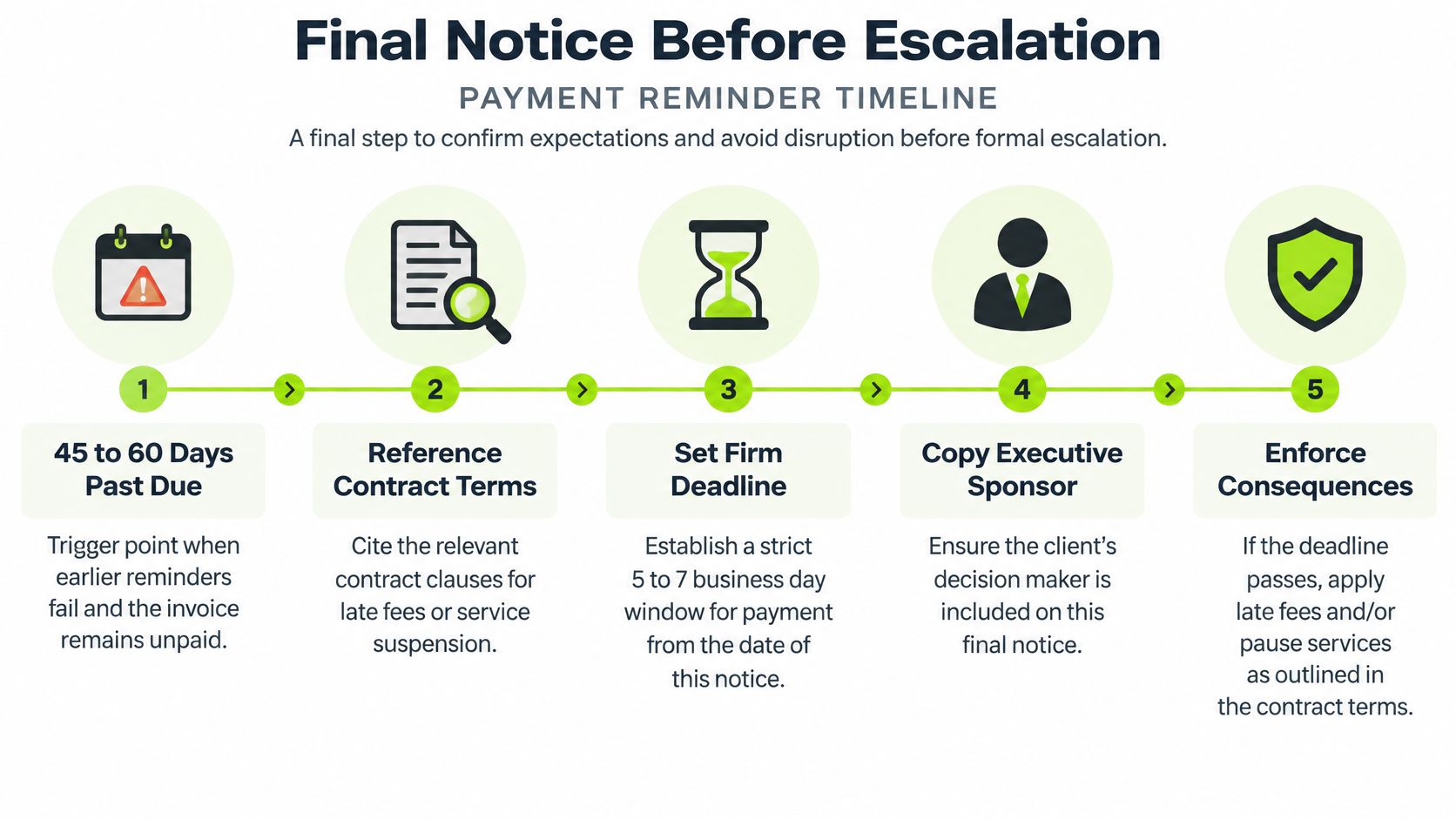
Relationship risk belongs in this review. A Digital Commerce 360 summary of an American Express survey reports that 26% of surveyed U.S. business decision-makers had stopped working with a buyer or supplier because of payment delays.
If the deadline passes without a reply, execute the approved escalation or document why management changed course. Don't issue repeated final notices, and don't introduce unexpected bank-detail changes into an urgent payment demand.
6. Payment Plan Proposal
A payment plan is a branch in the sequence, not a reward for ignoring reminders. Use it when the client acknowledges the balance, explains the constraint, and is willing to commit in writing.
The trade-off is deliberate: your firm accepts later collection in exchange for a credible recovery schedule. Don't confuse an agreed installment plan with an unresolved service dispute.
Template to turn a constraint into commitments
Subject: Proposed payment schedule for invoice [invoice number]
Hi [name],
Following our discussion, invoice [invoice number] has an outstanding balance of [amount], originally due on [due date].
We propose the following payment schedule:
[Installment amount] due [date] [Installment amount] due [date] [Final installment amount] due [date]
Please confirm your agreement by [reply deadline]. We'll send the schedule for signature, including the arrangements that apply if an installment is missed.
Payment can be made through [secure payment portal]. If this proposal isn't workable, please contact [owner] before the reply deadline.
Regards, [sender name]
For example, a professional services client may have a temporary cash shortfall while awaiting payment from its own customer. The controller can assess its communication history and proposed dates without assuming that a longstanding relationship guarantees recovery.
Use a payment plan agreement template to document the balance, schedule, authorization, and missed-payment process.
- Written acceptance received: Obtain the signed acknowledgment and create installment-specific reminders.
- Alternative proposed: Evaluate affordability and exposure before accepting revised dates.
- No acceptance: Keep the original balance overdue; an unsigned proposal isn't a commitment.
This video can support the discussion before the parties finalize the written schedule.
Once approved, suppress conflicting full-balance demands. Measure installments paid as agreed and remaining exposure, not just the number of plans accepted.
Any discount or concession should have explicit approval and documented conditions. Keep decisions about continuing new work separate from the mechanics of collecting the existing debt.
7. Statement-Based Reminder with Pay-Now Link
For clients with frequent billing, a recurring statement can replace scattered invoice-level chases. It shouldn't replace targeted action on a disputed invoice or missed commitment.
The distinction from the second notice is purpose. The second notice requests reconciliation of an overdue account; this recurring message gives an active client a consolidated payment route.
Template to simplify repeat payments
Subject: Your account statement as of [statement date]
Hi [name],
Your account's total outstanding balance is [amount], including [overdue amount] past due. The attached statement lists each open invoice, its due date, and its remaining balance.
You can review and pay the balance through [secure payment portal]. Please arrange payment for overdue items by [deadline], or confirm their scheduled payment date.
If you have a question about a specific item, reply with its invoice number and [named contact] will help.
Thank you, [sender name]
A bookkeeping firm billing recurring services and occasional cleanup projects can use this message to give accounts payable a complete view. Keep current and overdue amounts separate so the client doesn't mistake a statement for a change to agreed payment terms.
Test the payment route on mobile, confirm that credits appear correctly, and reconcile receipts before generating statements. If the portal supports partial payment, make sure the client can identify which invoices it is settling.
Paidnice's credit-control analysis reported payment within seven days for 38% of reminded overdue invoices, compared with 22% of comparable overdue invoices without reminders. Treat that observational comparison as a benchmark to test, not a promised result.
If no payment or reply arrives, move the overdue items into their appropriate follow-up stage. Don't let a routine statement reset their aging or postpone a required call.
How the seven templates differ by timing, tone, and risk
Template | Typical Timing | Tone | Best For | Main Risk |
|---|---|---|---|---|
Friendly Pre-Due Date Reminder | 3–5 days before due date | Neutral and courteous | Preventing missed payments with a low-friction reminder | May be ignored or fail to change intentional late payment |
Due-Date Notice | On the due date | Short, factual, and direct | Prompting clients to schedule or confirm payment that day | Can feel abrupt or arrive at the wrong time zone |
First Past-Due Follow-Up | 5–10 days after due date | Professional and assumes good faith | Getting payment or a specific payment-date commitment | Can create friction if the invoice is disputed |
Second Notice with Statement of Account | 15–30 days past due | Firm but courteous | Showing clients all open invoices and the total balance | Inaccurate records or an unexpected statement can strain the relationship |
Final Notice Before Escalation | 45–60 days past due | Firm, formal, and non-hostile | Setting a deadline and documenting intended consequences | Damages trust if consequences are not enforceable or were not signaled earlier |
Payment Plan Proposal | When a client has a genuine cash constraint | Collaborative and structured | Recovering a balance through agreed installments | Extends collection time and may set a precedent |
Statement-Based Reminder with Pay-Now Link | Monthly or biweekly | Efficient and service-oriented | Clients with multiple open invoices and recurring billing | Stale or inaccurate cash application can undermine trust |
Turning Reminder Templates Into a Repeatable Process
Consistent timing and clear tone do most of the work, but accurate status determines whether either is appropriate. Choose the templates your team uses most, set their cadence once, and define who owns each exception.
Accounts receivable automation should automate execution, not remove accountability. Every active invoice needs a known status, next action, and responsible person. Payment, dispute, promised date, and failed delivery should each change what happens next.
Measure collection outcomes rather than email volume
Review reply rates and promised dates monthly, alongside overdue balances and days to payment. Separate disputed invoices from routine late accounts so unresolved delivery or service problems don't distort your assessment of reminder performance.
- Payment outcomes: Track on-time payment, overdue recovery, and promises kept.
- Operational outcomes: Track unassigned replies, unapplied cash, and time spent chasing.
- Relationship outcomes: Track complaints, incorrect reminders, and unresolved billing questions.
Automation has a working-capital rationale, but don't assign all improvement to email copy. A Citizens Commercial Banking summary citing PYMNTS reports average DSO of 40 days for small and midsize businesses with moderately to highly automated AR, compared with 50 days for businesses with little or no technology implementation.
For AR software for professional services, prioritize reliable payment status, client-level statements, promise tracking, and human review of exceptions. AI AR automation is useful when it helps staff identify which account needs attention, without allowing unreviewed language to invent terms or consequences.
Keep finance ownership visible
Your reminder should come from a recognizable team and lead to someone who can answer questions. We send reminders from your own domain, signed by your team, using the template you wrote; only the sending is automatic.
With QuickBooks Online connected, invoice payment status syncs live. Those controls help prevent the avoidable mistake of chasing a client who has already paid.
Consider the client's process too. The 2026 guide for accounts payable teams offers a counterpart to receivables workflow design: your contact may need a valid purchase order, approval, and matching documentation before releasing funds.
To improve cash flow, start with accurate invoices, explicit requests, and disciplined follow-through. Then automate the repeatable parts while keeping disputes, concessions, and escalation under human control.
Resolut automates AR for professional services, keeping reminders consistent, accurate, and human. Visit Resolut to explore how your team can run these invoice payment reminder email sequences with a user-set cadence and clear oversight.