
Payment Due on Receipt: A CFO's Guide to Cash Flow
Is 'payment due on receipt' right for your firm? A guide for CFOs on its impact on cash flow, DSO, and AR policy. Learn when and how to enforce these terms.
About 60% of invoices are paid late in the United States, based on U.S. EXIM Bank data cited in this payment terms analysis. That one number explains why so many finance leaders revisit invoice terms after a few quarters of avoidable cash pressure.
For professional services firms, payment delays don't just sit on an aging report. They affect payroll timing, partner distributions, hiring decisions, and how much management attention gets pulled into collections. That's why payment due on receipt deserves a closer look.
Used well, it's not just invoice wording. It's an AR control. Used poorly, it creates friction, gets ignored by client AP teams, and gives your staff more follow-up work instead of less. The difference is rarely the phrase itself. It's the process behind it.
Why Your AR Policy Needs Immediate Attention
About 60% of invoices are paid late in the United States. For a services firm, that is not background noise. It is a direct threat to cash timing, staffing plans, and partner confidence in the forecast.
Firms tighten payment terms because standard terms stop matching operational reality. If invoices routinely age past the original due date, net 30 often functions like involuntary financing. The firm delivers work, funds payroll, and waits while the client's approval and AP process runs on its own clock.
That gap shows up fast in professional services. There is no inventory buffer to manage. The cost base is people, and labor expense keeps accruing whether the client pays in two days or forty-five. A weak AR policy usually surfaces first in small ways: billing goes out late, follow-up starts too slowly, exceptions pile up, and account managers make one-off promises that finance then has to clean up.
The primary issue is not invoice wording alone.
For many firms, "due on receipt" works as a priority signal inside the client's payment queue, not as a guarantee of same-day cash. That distinction matters. Teams that expect the phrase itself to change behavior are usually disappointed. Teams that pair stricter terms with clear client setup, card or ACH options, disciplined reminders, and fast escalation tend to see a measurable effect on DSO.
What this means for a services firm
A stronger AR policy improves control in a few specific ways:
- It sets collection expectations before a dispute starts: Clients see the payment standard early, not after the invoice has already aged.
- It gives AR staff a cleaner escalation path: The team can act on day one instead of waiting through a default grace period that no one intended.
- It improves DSO discipline without changing every client relationship at once: Firms can apply tighter terms to new engagements, rush work, small projects, or chronically slow accounts first.
There is a trade-off. Stricter terms can create friction with procurement-driven clients or larger accounts that will not change their internal payment cycle for one vendor. In those cases, the gain often comes from making the invoice easier to approve and easier to pay, then enforcing follow-up consistently. Policy gets attention. Process gets results.
If your team is still debating payment terms after the invoice goes out, the control failure started upstream. Tightening your accounts receivable procedures gives billing, collections, and client-facing teams one standard for approvals, invoice timing, exceptions, and follow-up.
The Operational Reality of Due on Receipt
Payment due on receipt sets the expectation that the invoice should be paid as soon as the client receives it, usually the same day or within the next business day, as explained in QuickBooks' guide to invoice due upon receipt terms.
In practice, professional services firms should treat that phrase as a priority signal, not a guarantee of instant cash. A client may agree to the term and still pay according to its AP queue, approval chain, or weekly payment run. That gap matters. Firms that improve DSO with due on receipt usually do it by combining clear terms with fast invoice delivery, easy payment options, and disciplined follow-up.
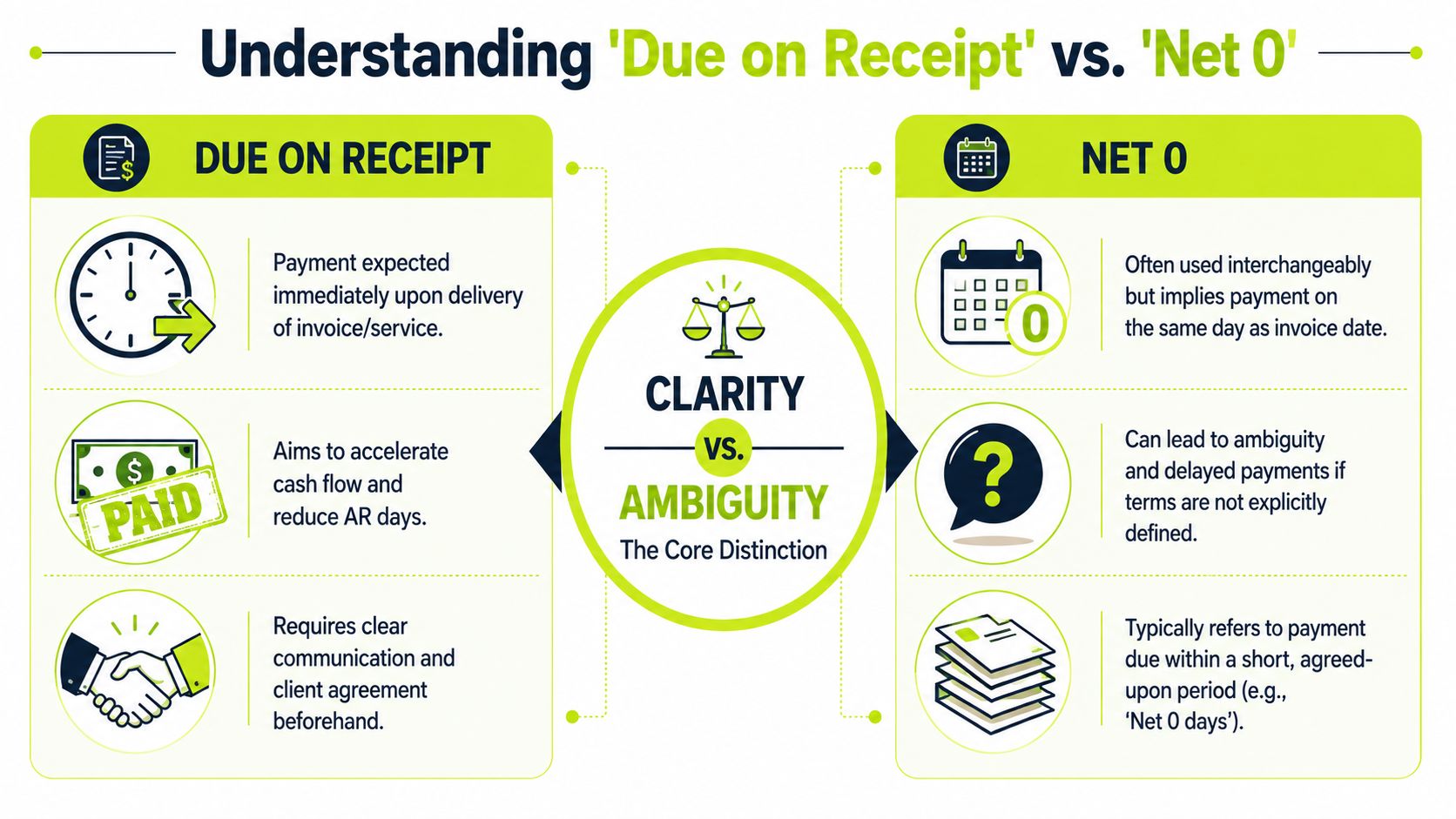
Due on receipt versus Net 0
Controllers often see these terms treated as equivalents. They are close, but I would not write them interchangeably in policy documents.
Due on receipt tells the client to prioritize payment as soon as the invoice arrives. Net 0 usually points to the invoice date itself. That difference seems small until an invoice lands after business hours, sits in a portal pending review, or reaches an admin instead of the actual approver. At that point, your team is left arguing about timing instead of collecting cash.
A short comparison makes the distinction clearer:
Term | Operational meaning | Main risk |
|---|---|---|
Due on receipt | Payment expected as soon as the invoice is received | Ambiguity if receipt is not documented |
Net 0 | Often interpreted as due on the invoice date | Higher risk of timing disputes |
Net 10 / Net 15 | Short scheduled payment window | Slower cash conversion, but easier for AP teams to process |
What “receipt” should mean in practice
Receipt needs a defined operational meaning.
Email sent is not enough. Email opened is not enough either. For many clients, the invoice is not received until it reaches the approved AP inbox or is accepted in the billing portal they require.
That is why firms using due on receipt should tighten the process around delivery:
- Use the client's approved billing channel: Send to the AP address, vendor portal, or billing contact the client has confirmed.
- Keep proof of transmission: Retain send logs, portal confirmations, and any acknowledgment from the client.
- State the timing clearly: Add language such as “Payment due upon receipt. Please remit within one business day.”
- Make payment easy: Include ACH details, card options if accepted, and any remittance instructions directly on the invoice.
If those pieces are missing, the term loses force quickly.
What changes operationally
The value of due on receipt is not that every client suddenly pays on day one. The value is that your AR team can start the clock immediately.
That changes behavior inside the finance function. Follow-up can begin earlier. Billing errors surface faster. Client excuses become easier to test against documented delivery and stated terms. In my experience, firms gain control of DSO with these steps. The wording gets attention, but the payment infrastructure and enforcement process determine whether cash arrives sooner.
For professional services firms, that trade-off is manageable if expectations are set early. Some clients will push back, especially larger accounts with fixed AP cycles. Others will accept the term if the invoice is accurate, approved, and easy to pay. Due on receipt works best as an operating discipline backed by process, not as a phrase printed at the bottom of an invoice.
Strategic Implementation for Professional Services
Blanket policies create unnecessary conflict. Segmented policies create control.
For a professional services firm, payment due on receipt works best when you apply it where the risk is real and the transaction is simple enough to support fast payment. According to Appvizer's guidance on invoice due upon receipt, this term is most effective for low-complexity transactions or customers with strong payment reliability. For larger or relationship-sensitive accounts, many businesses prefer shorter net terms because they preserve flexibility while still accelerating cash conversion.
That trade-off is familiar to any controller who has had to balance cash discipline with client retention.

Where it works well
Some client situations are good candidates from the start.
- New clients without payment history: If you don't yet know how their AP team behaves, a stricter term reduces early exposure.
- One-off projects or advisory sprints: Short engagements with a clear deliverable are easier to bill and collect quickly.
- Accounts with prior delinquency: If a client repeatedly stretches terms, due on receipt resets expectations.
- Matters with high upfront labor concentration: When staffing ramps before cash comes in, tighter terms protect liquidity.
These are usually the easiest wins because the commercial rationale is straightforward.
Where shorter net terms are smarter
Some accounts can pay quickly but still need a structured internal approval window. In those cases, insisting on payment due on receipt can create friction without producing faster settlement.
A shorter net term often works better when:
Client profile | Better fit | Why |
|---|---|---|
Long-term strategic account | Net 10 or Net 15 | Preserves goodwill while accelerating payment |
Enterprise buyer with AP workflow | Short net term | Gives internal approvers a realistic window |
Ongoing monthly retainer | Defined recurring due date | Easier for both teams to operationalize |
High-touch relationship partner | Hybrid policy | Maintains flexibility while protecting cash |
A useful risk versus relationship test
When deciding which clients get payment due on receipt, use two questions.
First, what happens if this invoice pays late? If the answer is margin compression, staffing strain, or increased write-off risk, stricter terms deserve a look.
Second, what happens if the client pushes back on the term? If the answer is minor negotiation, proceed. If the answer is commercial escalation or avoidable account damage, a short net term may be the better instrument.
Strong AR policy doesn't mean treating every client the same. It means treating each client deliberately.
For firms in the $3M to $50M range, this usually lands on a mixed model. New and higher-risk work gets payment due on receipt. Core retained clients get Net 10 or Net 15. Exception handling sits with finance, not individual account leads. That structure keeps policy from dissolving in one-off concessions.
Crafting Enforceable Invoice Language and AR Policy
A term isn't enforceable in practice if your invoice leaves room for interpretation.
Many buyers won't pay the moment an invoice arrives because it still has to move through approval and AP queues. That's the operational reality highlighted in Holded's analysis of due upon receipt. In many B2B settings, due upon receipt functions more as a priority signal than an immediate-payment guarantee.
That's not a reason to avoid the term. It's a reason to write it clearly and support it with process.
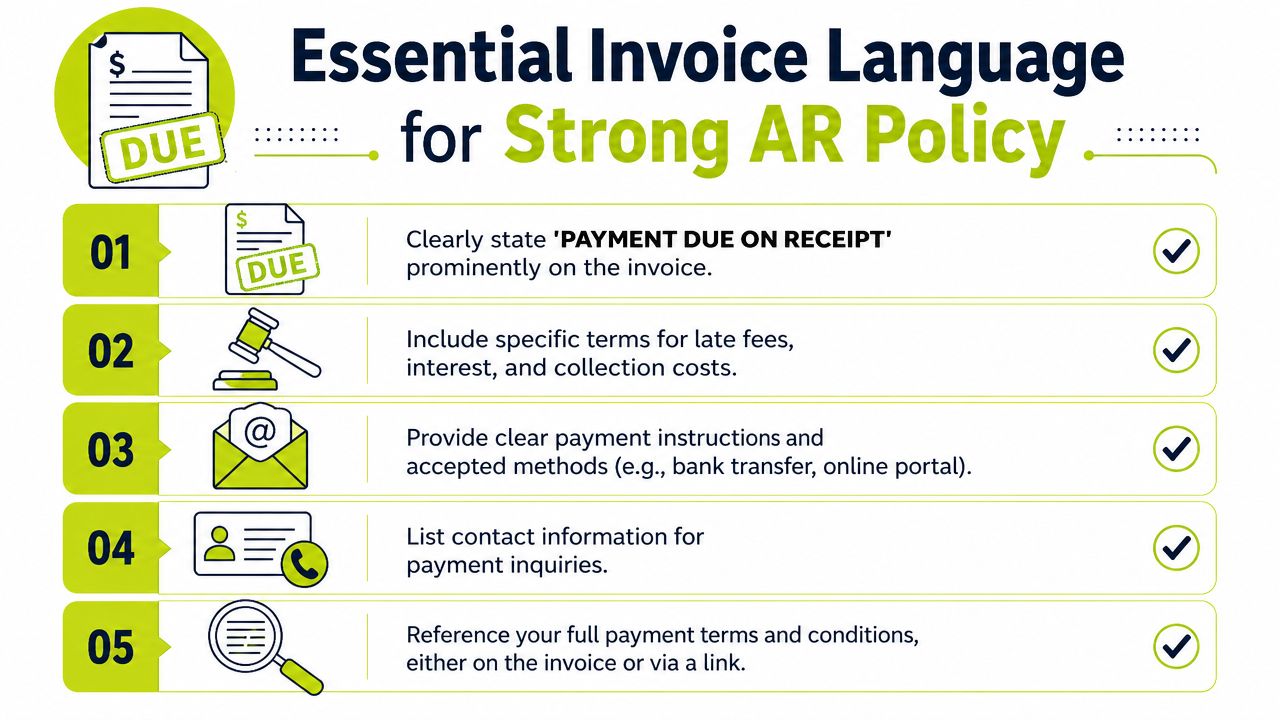
Invoice language that reduces friction
Weak wording creates debate. Strong wording creates a next action.
Use language like this on the invoice itself:
Payment due upon receipt. Please remit within one business day using the payment method listed below.
If you want a little flexibility without losing urgency, use this:
Payment due upon receipt. If your internal process requires routing, please ensure payment is completed promptly upon approval.
For relationship-sensitive accounts, this version often lands better:
Payment is due upon receipt of invoice. If there is any billing question, contact our finance team immediately so processing isn't delayed.
What to avoid
Some wording sounds firm but performs poorly.
- “Pay ASAP” leaves too much room for interpretation.
- “Net 0” can confuse clients who already use standard AP workflows.
- Dense legal copy on the invoice face makes key instructions harder to spot.
- Separate remittance instructions in an email thread increases the chance of delay or fraud concern.
If your clients are in legal, consulting, architecture, engineering, or other documentation-heavy fields, invoice clarity matters even more. Teams that support legal billing often need standardized formats and support resources. If your billing process intersects with legal operations, Hire Legal assistants can be a useful resource for firms that need administrative help with documentation and billing coordination.
The policy behind the invoice
Good invoice language fails when internal teams send mixed signals. Your AR policy should answer a few questions without debate:
- Who qualifies for payment due on receipt Define the client segments, matter types, or risk conditions that trigger the term.
- What finance does if payment doesn't arrive Spell out reminder timing, escalation ownership, and whether account holds apply.
- What sales and account managers can approve Don't let commercial teams alter terms informally after the work is delivered.
- How disputes are routed Billing questions should go to a named owner with a response clock.
A simple policy table helps:
Policy area | Minimum standard |
|---|---|
Invoice wording | State “payment due upon receipt” prominently |
Due-date clarity | Add a plain-language expectation such as one business day |
Payment path | Include secure instructions or portal link on the invoice |
Exception control | Require finance approval for term changes |
Dispute handling | Route billing issues immediately to a named contact |
Clear language speeds payment. Clear ownership prevents excuses.
If you're revising templates, tighten both structure and presentation. A clean legal invoice format is a good benchmark even outside law firms because it forces precision around dates, services, payee details, and remittance instructions.
Automating Enforcement to Improve Cash Flow
Manual enforcement breaks down fast. The team sends invoices late, reminders go out inconsistently, and follow-up depends on whoever happens to remember which client usually stalls.
That's why payment due on receipt only works at scale when the workflow is automated. The underlying issue isn't only about asking for faster payment. As explained in Moon Invoice's discussion of due upon receipt and payment workflows, success depends on having the right payment infrastructure and remittance workflow so payment can happen instantly when the buyer is ready.
That's the connection between stricter terms and accounts receivable automation.
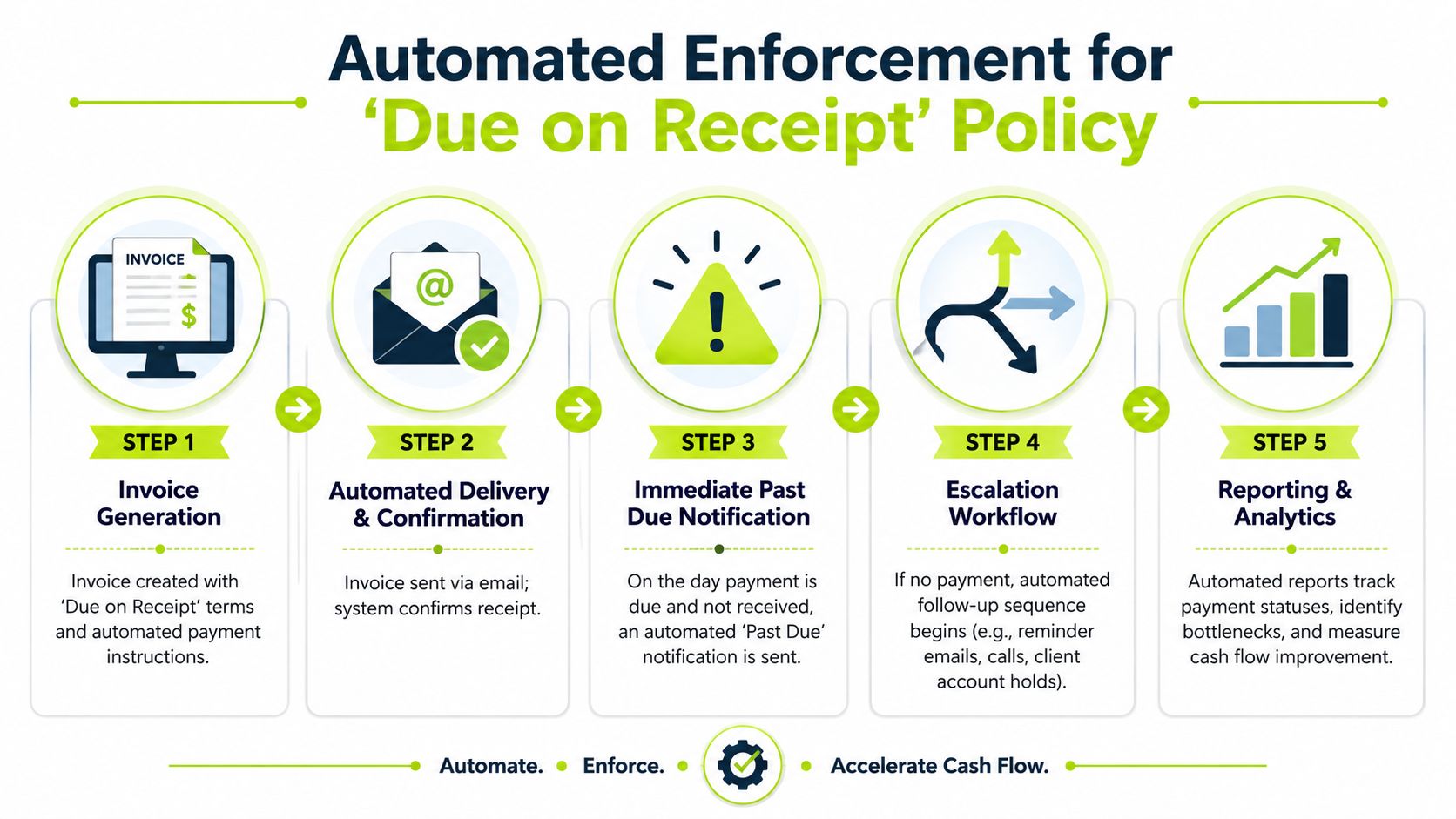
What automation changes
With manual collections, every invoice becomes a judgment call. With automation, policy becomes repeatable.
A workable setup usually includes:
- Automated delivery: The invoice goes out immediately after approval, with payment instructions embedded.
- Receipt-aware reminders: Follow-ups trigger based on send status, open status, or elapsed time.
- Integrated payment options: Clients can pay without leaving the invoice flow.
- Escalation logic: Higher-risk accounts get stronger messaging or faster follow-up.
- Visibility for finance: Controllers can see where invoices stall and why.
For many firms, QuickBooks AR automation is the first step. It helps standardize invoice generation, reminders, and status tracking. The limitation is that basic workflows often stop short of true orchestration across channels, account risk, and exception handling.
Where AI AR automation helps
AI AR automation becomes useful, especially for firms with varied client types and approval patterns. The value isn't novelty. It's consistency.
An advanced setup can:
Need | Manual process | Automated process |
|---|---|---|
Reminder timing | Depends on staff follow-up | Triggered automatically by due status |
Client treatment | One-size-fits-all | Adjusted by account behavior |
Payment experience | Separate email and portal steps | Embedded into invoice workflow |
Reporting | Spreadsheet-based | Live AR visibility |
That's how firms start to reduce DSO in a durable way. Not by sending harsher emails, but by removing lag between invoice creation, client receipt, reminder timing, and payment completion.
One option in this category is Resolut, which automates AR workflows for professional services across reminders, outreach sequencing, and payment orchestration. More broadly, if you're evaluating how to automate accounts receivable, focus on whether the tool supports your actual collection policy rather than just sending generic reminder emails.
Automation still needs a human decision path
Even strong systems need exception rules.
If a client disputes time entries, asks for a revised PO reference, or claims the invoice went to the wrong mailbox, automation should route the issue to a person quickly. Good AR software for professional services doesn't replace judgment. It removes the repetitive work so finance can apply judgment where it matters.
When invoices age despite a defined process, legal escalation may become necessary. For teams building a formal escalation ladder, this guide on how to collect unpaid invoices is a practical reference for understanding later-stage recovery options.
From Policy to Predictable Cash Flow
Payment due on receipt is useful, but only when the rest of the system supports it.
For professional services firms, the term works best as part of a controlled AR model. Client segmentation determines where to apply it. Invoice language removes ambiguity. Automation enforces follow-up without draining staff time. Finance owns exceptions instead of letting them spread across account managers and partners.
That combination does more than tighten collections. It improves forecasting quality, gives leadership earlier warning on slow-paying accounts, and reduces the amount of working capital trapped in routine delay. In other words, it helps improve cash flow without turning every client conversation into a collection call.
Some firms will still need outside help for certain account segments or legacy receivables. In those cases, resources like CallZent's AR outsourcing services can be worth reviewing if internal bandwidth is thin or follow-up discipline is inconsistent.
The important shift is this: stop treating payment due on receipt as a line item on the invoice. Treat it as an operating policy backed by systems, ownership, and measured execution. That's how it starts to move DSO in the right direction.
Resolut automates AR for professional services with workflows built for consistent follow-up, accurate execution, and a human approach to client communication. If you're tightening terms and want the process to hold, Resolut is worth a look.