Process Standardization for Finance Teams
Learn how process standardization reduces DSO, cuts errors, and scales AR operations for professional services firms. Practical frameworks and KPIs inside.
A client invoice is overdue, but your firm's response depends on who notices it first. One team member sends a courteous reminder. Another calls the client's project lead. A third waits for the partner to intervene, while nobody follows up because the invoice sits in an unfamiliar spreadsheet.
That pattern is common in professional services firms where billing depends on project milestones, partner relationships, regional terms, and multiple accounting systems. It also creates a finance problem that's larger than missed reminders. The firm can't reliably forecast collections, distinguish a difficult client from a neglected account, or know whether an exception was deliberate.
Process standardization gives finance leaders a way to create consistency without turning client communication into a script. The objective isn't to force every account into one rigid workflow. It's to establish dependable steps, clear decision rights, usable data, and controlled exceptions so the team can scale while preserving judgment.
The Hidden Cost of Inconsistent AR Workflows
At a mid-sized consulting firm, two invoices from similar clients become overdue on the same day. The first client receives a friendly email with a payment link because the assigned billing specialist has a routine. The second receives nothing because its account manager assumes the partner is handling the relationship.
A week later, the first invoice is in a documented follow-up sequence. The second is still waiting for someone to decide whether contacting the client would be too aggressive. When the controller asks for an update, the answer depends on memory, email searches, and informal conversations.
This inconsistency damages more than collections velocity. Clients experience the firm as disorganized when different people provide different payment instructions, reference different invoice details, or escalate at different times. Internal teams lose confidence in the ledger because an invoice's status may reflect a personal interpretation rather than a shared operating rule.
Where the drag appears
The operational cost usually hides inside routine work:
- Repeated investigation: Staff search for contract terms, approval history, and prior correspondence before deciding what to do.
- Unclear ownership: Sales, delivery, billing, and finance each assume another team owns the next action.
- Unreliable forecasting: Expected payment dates reflect optimistic judgment instead of consistent evidence.
- Relationship risk: A collector may escalate a sensitive client issue without knowing the commercial context.
- Manual rework: The same invoice data gets copied between QuickBooks, spreadsheets, email, and client portals.
The 2023 review in Information Systems and e-Business Management describes why organizations pursue standardization, including reducing redundancies and costs, improving quality and transparency, shortening processing time, and coordinating handoffs across organizational boundaries (the review of business process standardization). Those benefits apply directly to accounts receivable, but only when the workflow reflects how the firm operates.
Practical rule: Standardize the work that should be predictable. Govern the situations that require judgment.
A reliable accounts receivable automation program starts with that distinction. Standardization should tell the team what happens when an invoice becomes overdue, what information must be recorded, and who can change the path. It shouldn't prevent a partner from handling a strategically important client with discretion.
That's why process standardization functions as a control mechanism, not a constraint. It gives finance a common baseline for accounts receivable automation, while leaving room for documented human intervention. Without that baseline, AI AR automation accelerates inconsistent decisions.
What Process Standardization Actually Means for Finance
In finance, process standardization means defining how work should be performed, what data must be captured, which decisions belong to which role, and how deviations are recorded. For AR, that might cover invoice creation, approval, delivery, reminder timing, dispute routing, payment matching, write-off review, and escalation.
A pilot's pre-flight checklist is a useful analogy. The checklist doesn't replace the pilot's judgment about weather or mechanical conditions. It makes sure essential checks happen in a reliable order and creates a record when something is different.
Finance teams need the same balance. A collector should be able to adjust a message for a long-standing client, but the account should still contain the agreed terms, outstanding balance, dispute reason, owner, next action, and expected payment date.
Steps versus decision rights
Many firms begin by documenting every click in a workflow. That can help, but it's only one layer of standardization.
Standardizing steps means defining the normal sequence. For example, an approved invoice is issued through the agreed channel, payment terms are visible, reminders follow a controlled cadence, and unresolved disputes move to a named owner.
Standardizing decision rights means defining who may alter that sequence. A billing specialist might correct contact information. A controller might approve a credit adjustment. A partner might request a relationship-sensitive pause, but the reason and review date still belong in the system.
Standardizing metadata means ensuring the same labels and fields exist across entities and tools. Terms such as “dispute,” “promise to pay,” “billing hold,” and “commercial exception” must mean the same thing to finance, sales, and operations.
The roots of this discipline sit in industrial engineering and lean manufacturing, where standardized work made execution repeatable, measurable, and scalable. One manufacturing study found that standardizing work at a workstation reduced cycle time by 31.6 seconds per cycle and increased output from about 45–50 pieces to 58 pieces per 7-hour shift, which the authors reported as a 6.5% productivity increase (the manufacturing workstation study).
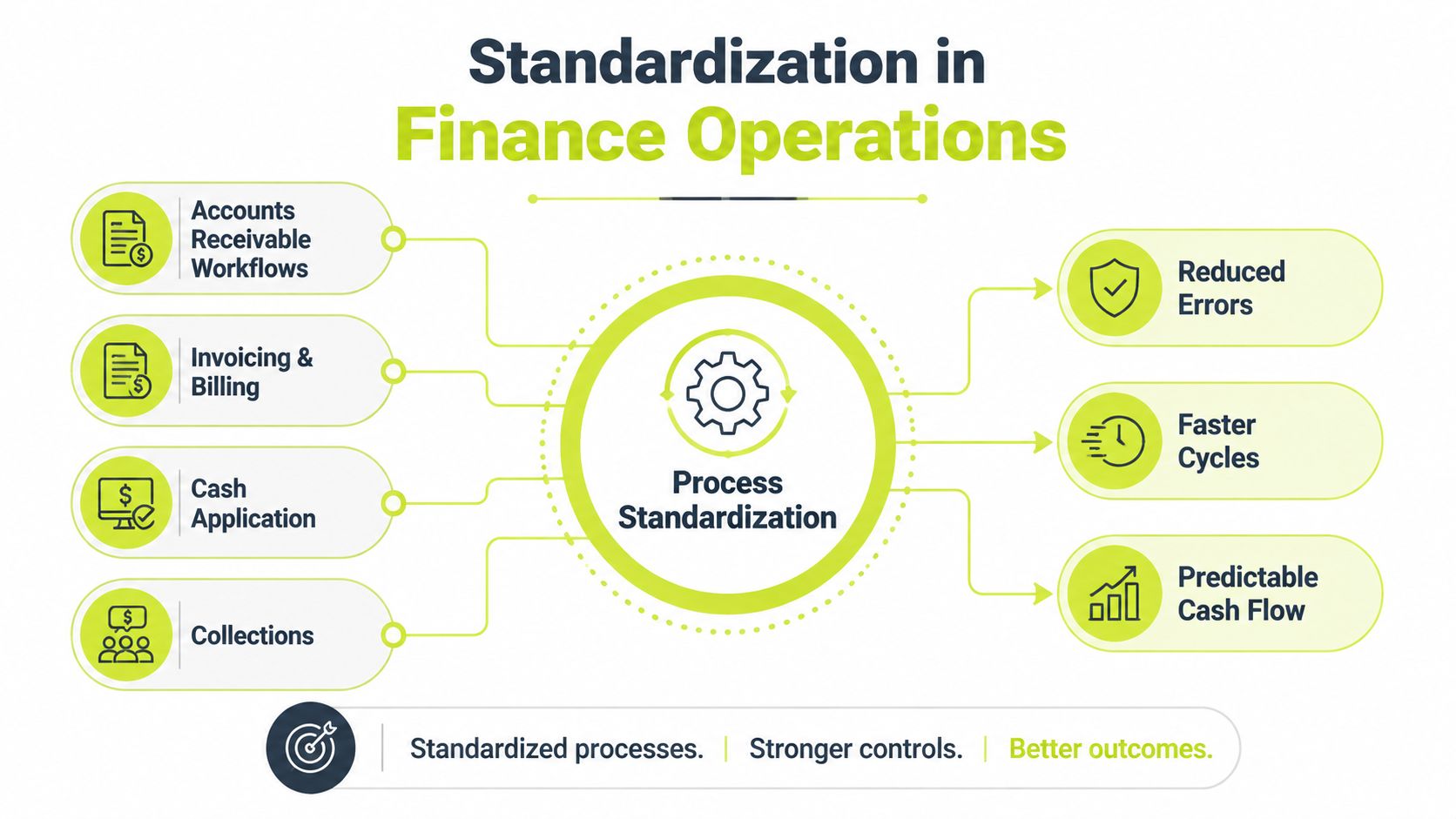
The finance equivalent is not a manufacturing script. It's a documented operating model that lets teams identify deviations early, compare cycle times consistently, and audit why an account took a particular path. Teams looking to strengthen the documentation layer can also review guidance documented by MarTech Do.
Measurable Benefits for Accounts Receivable Teams
Standardization becomes valuable when it changes the economics of the receivables function. A consistent workflow can help the team identify overdue invoices earlier, apply payments with less investigation, and separate routine follow-up from genuine commercial or legal risk.
The working-capital impact comes from removing avoidable delay. If every collector uses a different trigger, message, or escalation rule, management can't tell whether a late payment reflects client behavior or internal inconsistency. A standardized process creates a cleaner basis for forecasting and helps finance leaders decide where automation will have the greatest effect.
Published manufacturing evidence illustrates the operating principle. A later standardized-work case study reported a 66% reduction in unnecessary operator movements, a reduction in standard time from 244 seconds to 199 seconds per assembled box, and a 63.2% increase in production rate, reaching 229 units per assembly line per day with overtime reduced to zero (the standardized-work case study). AR isn't an assembly line, but the same logic applies. When staff stop recreating decisions and searching for missing context, more capacity becomes available for disputes, client conversations, and risk review.
A useful measurement model
A professional services firm should compare its own baseline before changing the workflow. The table below is a management template, not a reported case study. Replace the placeholders with figures from your ledger and collections system.
Metric | Before Standardization | After Standardization | Improvement |
|---|---|---|---|
DSO | Firm baseline | Post-implementation result | Calculate the change |
Invoice accuracy | Firm baseline | Post-implementation result | Calculate the change |
Cash application time | Firm baseline | Post-implementation result | Calculate the change |
Collection cycle time | Firm baseline | Post-implementation result | Calculate the change |
Exception volume | Firm baseline | Post-implementation result | Calculate the change |
The most important benefit is often scalability without proportional administrative growth. A firm can add clients, entities, or billing arrangements without asking every new team member to learn a private version of AR.
That doesn't mean standardization eliminates judgment. It moves judgment to the points where it matters, while routine work follows an accountable path. The result can support efforts to reduce DSO, improve cash flow, and give partners more reliable information about client payment behavior.
A Practical Framework for Standardizing AR Workflows
The sequence matters. Firms often buy AR software for professional services before documenting the workflow, then discover that automation has reproduced unclear ownership and inconsistent data. Start with operating reality, not the tool.
1. Map the current process
Follow a real invoice from scope approval through payment, dispute, reconciliation, or escalation. Include the people and systems involved, such as project managers, partners, billing specialists, QuickBooks, time-tracking tools, email, payment portals, and bank feeds.
Record handoffs, delays, duplicate entry, missing fields, and informal workarounds. Don't map only the ideal process. The shadow spreadsheet and private inbox are part of the current state.
2. Document the normal path
Define the minimum required actions for a standard invoice. That may include validating the client contact, confirming approved services, issuing a consistent invoice template, recording terms, delivering through the agreed channel, and setting the next follow-up event.
Documentation should be usable during a busy close. Teams can apply the principles in accounts receivable procedures when turning informal practices into repeatable operating instructions.
3. Assign decision rights
Write down who owns each decision, not just who performs each task. Specify authority for billing corrections, payment-plan requests, disputed time, credit notes, collection pauses, and legal review.
A decision matrix works well here. It should show the trigger, accountable role, required evidence, approval level, and system record. This prevents a partner's verbal request from becoming an invisible policy exception.
4. Define exception rules
Classify exceptions before automating them. Common categories include contract disputes, missing purchase orders, client portal failures, tax or regulatory requirements, cross-entity billing, and relationship-sensitive accounts.
For each category, define the owner, service expectation, escalation path, and closure condition. A payment hold without an owner is not an exception process. It's an overdue invoice with a better-sounding label.
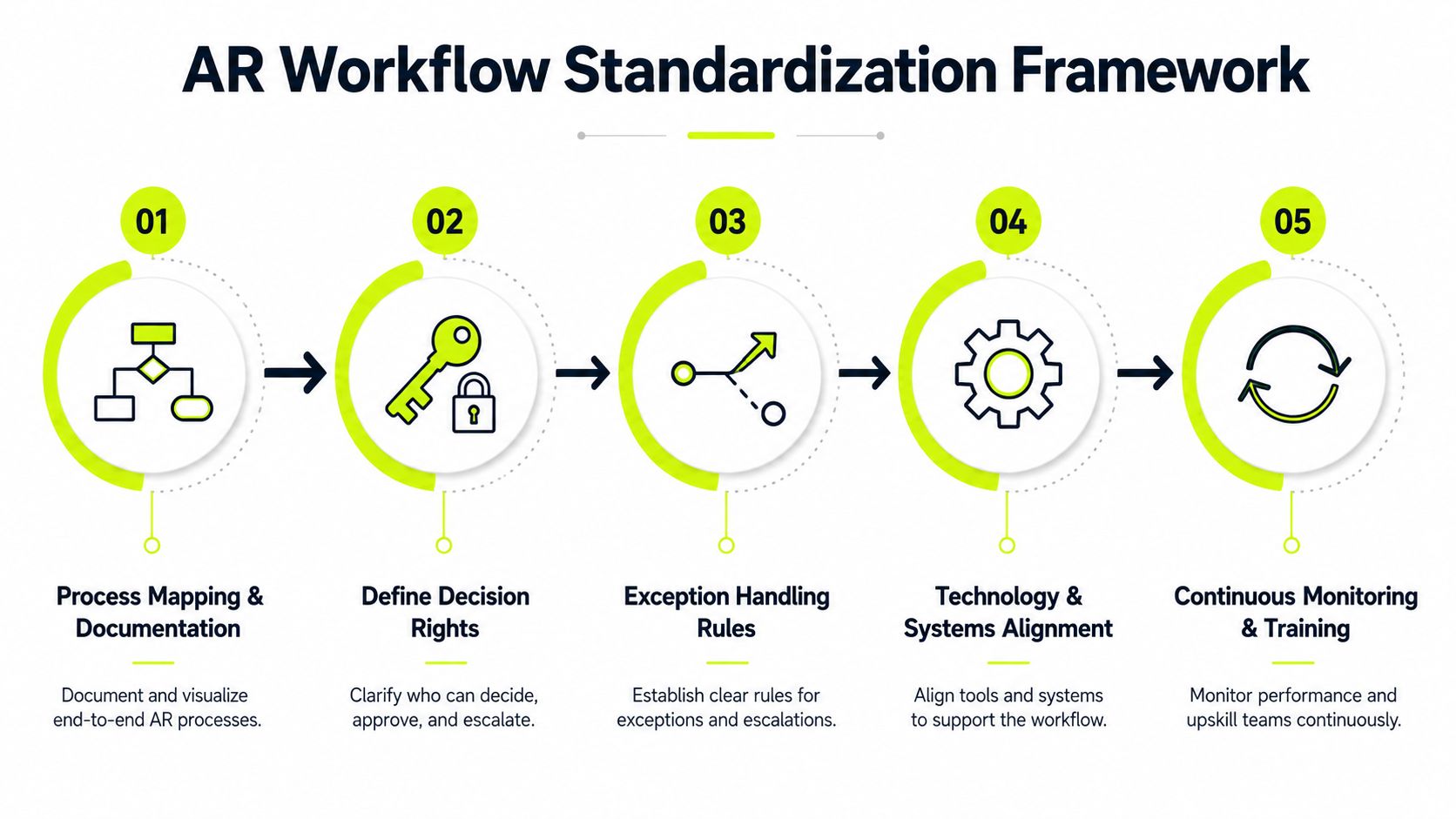
5. Align systems and train the team
Choose technology after the rules are clear. The selected platform should work with the firm's accounting system, preserve an audit trail, support human review, and expose exceptions instead of burying them.
For firms using QuickBooks, QuickBooks AR automation should reduce duplicate entry while protecting the ledger's integrity. Standardize invoice fields, customer contacts, payment references, and status definitions before connecting automated outreach or cash application.
Electronic approvals deserve the same discipline. Teams formalizing approval and signature steps can use signing flow best practices to clarify signer roles, document order, and completion evidence.
Review the workflow with finance, delivery, sales, and operations. Train against actual invoices, including difficult ones. Then monitor results, investigate drift, and revise the standard when the business changes.
The common sequencing mistakes are predictable:
- Automating first: A tool can't resolve undefined ownership.
- Documenting only the ideal: Ignored exceptions will recreate shadow processes.
- Treating training as a launch event: New hires and policy changes require ongoing reinforcement.
- Measuring activity alone: More reminders don't necessarily mean better collections.
- Ignoring data definitions: Inconsistent statuses make dashboards unreliable.
Where Standardization Should Stop and Exceptions Begin
More uniformity isn't automatically better. Professional services firms operate across legal entities, client procurement rules, regional billing norms, tax requirements, and negotiated commercial terms. A single global sequence may look efficient on a process map and fail in practice.

Consider a client that requires invoices through a procurement portal, another that accepts email only, and a third whose contract requires partner approval before any collection contact. The communication channel and approval step should vary. The underlying data and accountability should not.
Govern the boundary
A mature AR operating model standardizes the metadata around variation:
- Exception type: What kind of deviation is this?
- Business reason: Which contract, regulation, client term, or operational condition requires it?
- Decision owner: Who approved the variation?
- Expiry or review: When will the team reassess it?
- Evidence: Which document or record supports the decision?
- Financial impact: What does the exception mean for timing, risk, and reporting?
This approach avoids two bad outcomes. The first is rigid automation that creates legal, tax, or relationship risk. The second is uncontrolled flexibility, where every collector develops a private method and the firm loses the ability to compare performance.
The 2025 Global Process Excellence and AI Readiness report identifies process discovery, mapping, process design, and alignment with systems and architecture as ongoing leadership challenges. That matters for AR because fragmented systems make it difficult to impose one workflow cleanly across regions and entities.
Standardize the decision framework first. Standardize the exact action only where the facts genuinely repeat.
An exception should also have a closure condition. If a disputed invoice is waiting for project evidence, the workflow should identify who supplies that evidence and what happens after review. Otherwise the exception becomes a permanent alternative process.
Leaders looking to formalize that control layer can also reference exception handling as a distinct operating discipline, rather than treating deviations as informal favors.
The following video provides a visual reference for teams discussing process design and operational collaboration.
KPIs and Measurement for Standardized Finance Operations
Documentation doesn't prove that a process works. Measurement does. Finance leaders should establish a baseline, define the intended outcome, and review whether the workflow is producing better decisions as well as faster activity.
The core dashboard should connect operational indicators to cash and client outcomes:
- DSO: Track the firm's movement in outstanding receivables over time and segment the result by client type, entity, service line, and terms.
- Invoice accuracy: Monitor corrections, rejected invoices, missing references, and disputes caused by billing quality.
- Cash application speed: Measure the time between payment receipt and accurate matching to an invoice.
- Collection cycle time: Follow the path from due date to payment, while separating routine collections from disputes.
- Exception volume: Count how many transactions leave the standard path and identify recurring causes.
The dashboard should distinguish between a low exception count and a low recorded exception count. If staff bypass the system, the metric may look healthy while the operating model deteriorates.
Make the numbers actionable
Assign an owner to each KPI and define the response when performance moves outside the expected range. A rise in invoice corrections might point to weak intake data. Slower cash application may indicate inconsistent payment references. More collection exceptions may reflect contract changes or a broken handoff with delivery.
The accounts receivable KPI guidance can help teams organize the measurement layer, but the dashboard should remain specific to the firm's operating model. A CFO doesn't need a crowded report. The CFO needs to know which process is drifting, who owns the correction, and whether the drift affects cash forecasting or client experience.
A 2025 survey on process and performance management priorities indicates that process management, continuous improvement, and data measurement remain significant priorities. The practical implication is straightforward. If the firm can't measure execution consistently, it can't demonstrate that standardization is improving the business.
Review leading indicators frequently enough to catch drift, and use a deeper monthly or quarterly review to assess policy, exceptions, and system alignment. Measurement should trigger a management conversation, not become another administrative report.
Real-World AR Examples and Automation Considerations
A professional services firm may begin with a narrow workflow, such as overdue invoice follow-up. The team maps the current path, defines when an invoice enters collections, records the reason for any pause, and assigns commercial exceptions to the account owner. Finance then reviews whether the standard path is producing cleaner status data and fewer unexplained delays.
Another firm may start with billing quality. It standardizes client contacts, invoice templates, line-item descriptions, approval evidence, and delivery channels. That creates a stronger foundation for automated reminders because the system isn't sending accurate messages to incomplete or incorrect records.
The technology decision should follow the workflow. An AR platform may support omnichannel outreach across email, SMS, and phone, dynamic billing for varied service arrangements, automated cash application, and risk identification for invoices that need earlier attention. Those functions are useful only when the firm has defined the rules that tell the system what to do and when a person must intervene.
Keep human judgment in the loop
AI AR automation should surface context rather than conceal it. A collector needs to see the invoice, contract status, prior communications, dispute reason, payment history, and next decision before approving an escalation.
Autopilot and co-pilot modes can support different control preferences. A routine account may follow an automated path, while a sensitive client or disputed engagement remains under human review. The firm should record why the path changed, who approved it, and whether the exception remains active.
For leaders evaluating external operating support, Truespeak's managed AI operations offers a useful reference point for thinking about the people, process, and governance required around automation. The important question isn't whether a platform contains AI. It's whether finance can explain the outcome, correct the workflow, and preserve the client relationship.
Standardization works when it makes the right action easier, the wrong action visible, and the exceptional action accountable. That is how an AR software for professional services firm can help finance teams improve cash flow without reducing collections to impersonal volume.
Resolut automates AR for professional services with consistent workflows, accurate records, automated outreach and cash application, and human review where client context matters. Visit Resolut to evaluate how its AR automation and orchestration approach can help your team reduce process variation and make standardization stick.