What Is Exception Handling for CFOs: Boost AR & Cash Flow
Learn what is exception handling for CFOs. Discover how robust AR automation & error handling improve cash flow & financial control.
Your AR team runs the process on schedule. Invoices go out. Reminders are queued. Payment links are active. The dashboard looks clean.
Then cash lands late anyway.
What usually breaks cash flow isn't the headline problem. It's the unhandled one. A client email server rejects a reminder. A card update form fails. A payment comes in without enough detail to match the invoice in QuickBooks. If the system doesn't detect that break, respond correctly, and route it to the right next step, the issue sits unobserved until someone notices the aging report moved the wrong way.
For finance leaders in professional services, that's the answer to what is exception handling. It's the control layer that keeps accounts receivable automation, AI AR automation, and AR software for professional services from turning into black-box risk.
The Silent Failure That Costs You Cash
An invoice is already overdue. Your team can see that reminders were scheduled, and the activity log suggests the process ran. But the client never received the message because their mail server was temporarily unavailable. No one was alerted. No alternate outreach fired. The invoice slips further past due, and your collector now has to reconstruct what happened by hand.

That pattern shows up everywhere in receivables. A payment portal login fails. A bank transfer arrives with incomplete remittance data. A customer disputes a line item, but the dispute never changes the workflow, so the account keeps receiving the wrong reminders. The first error is manageable. The silent failure after it is what costs you time, trust, and cash.
Where automation gets risky
Most firms don't struggle because they lack workflow. They struggle because the workflow assumes everything will go right.
Most guides define exception handling as a code-level mechanism, but they miss the operational gap. Effective systems must detect errors early, route them intelligently based on severity, and use resolutions to prevent future issues, a complete orchestration CFOs need but rarely see explained.
In practice, exception handling is that orchestration. It turns an unexpected break into a controlled response instead of a missed collection opportunity. That's especially important if you're trying to improve accounts receivable performance without adding more manual review to every invoice.
What fragile processes look like
A fragile AR process usually has three characteristics:
- It assumes success: Reminder sent means reminder delivered.
- It hides ambiguity: Payment received means payment reconciled.
- It delays human action: Staff only learn about the issue after the customer complains or the invoice ages further.
A resilient process does the opposite. It expects that some transactions will fail, some data won't match, and some outreach won't land. Then it plans the response in advance.
That's exception handling in business terms. Not a technical feature for developers. A built-in contingency plan for collections, reconciliation, and client communication.
What Is Exception Handling in Plain English
Think about delivery operations, not software. The normal process is simple. Package leaves the warehouse, moves through the route, and arrives at the destination.
Exception handling starts when the normal route breaks.
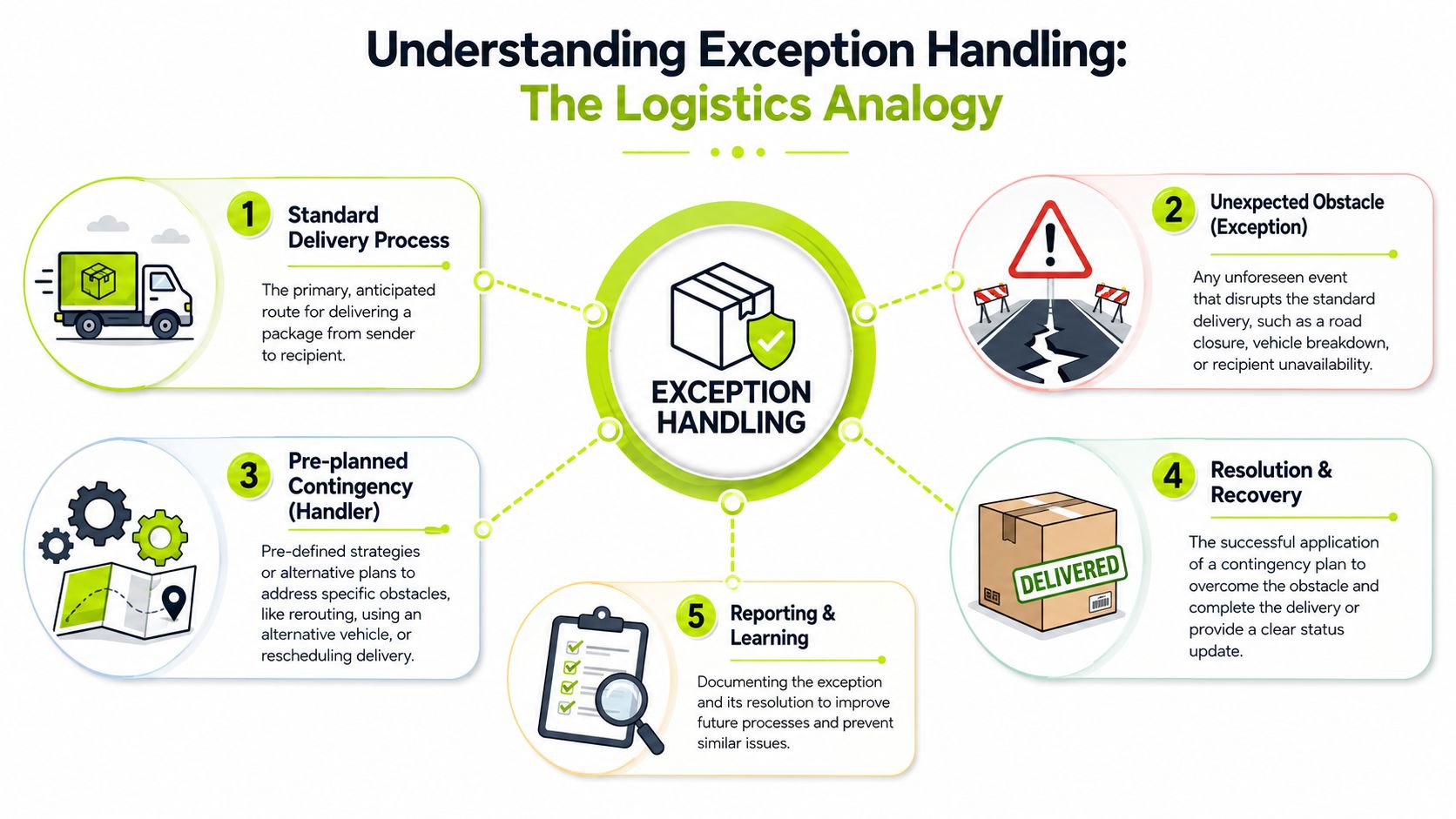
If the truck breaks down, the system needs a rule. Send another vehicle. Delay and notify the recipient. Return the package. Escalate for manual handling. The shipment shouldn't disappear just because the original plan failed.
That's what exception handling does inside finance systems. It gives the process a prewritten response when something unexpected interrupts the normal flow.
The plain-English version
A useful way to define what is exception handling is this:
- Detect the problem: Something went wrong or produced an abnormal result.
- Respond with a rule: Retry, stop, notify, reroute, or escalate.
- Recover cleanly: Keep records intact, avoid duplication, and preserve a clear status.
This matters in AR because payment operations aren't linear in real life. A customer may pay from a different entity. A reminder may bounce. A portal session may expire. A billing record may fail validation.
The business analogy holds up
In software history, exception handling became formal in the 1960s with PL/I, and later CLU helped shape patterns that modern object-oriented systems use today, including the idea that an exception interrupts normal flow and hands control to a pre-registered handler, as described in this computer science history of exception handling. Finance leaders don't need the language history to run AR, but the principle matters. The process doesn't crash. It transfers control to the right response.
A short explainer is worth watching before you evaluate any platform:
What good handling sounds like in AR
Instead of "the reminder failed," the system should say:
"Delivery failed. Reattempt queued. Alternate contact task created. Invoice status preserved."
Instead of "payment couldn't be matched," it should say:
"Variance detected. Deposit parked for review. Customer account not closed until reconciliation is confirmed."
This is the distinction. Basic automation executes tasks. Mature automation governs exceptions.
The Three Pillars of Smart Error Management
Good exception handling isn't one feature. It's a set of operating rules that keep automated workflows safe under pressure.
Plan A and Plan B
The first pillar is the logic commonly known from software, even if the terminology isn't always used. The system tries the intended action. If the action fails, it catches the specific problem and switches to a defined fallback.
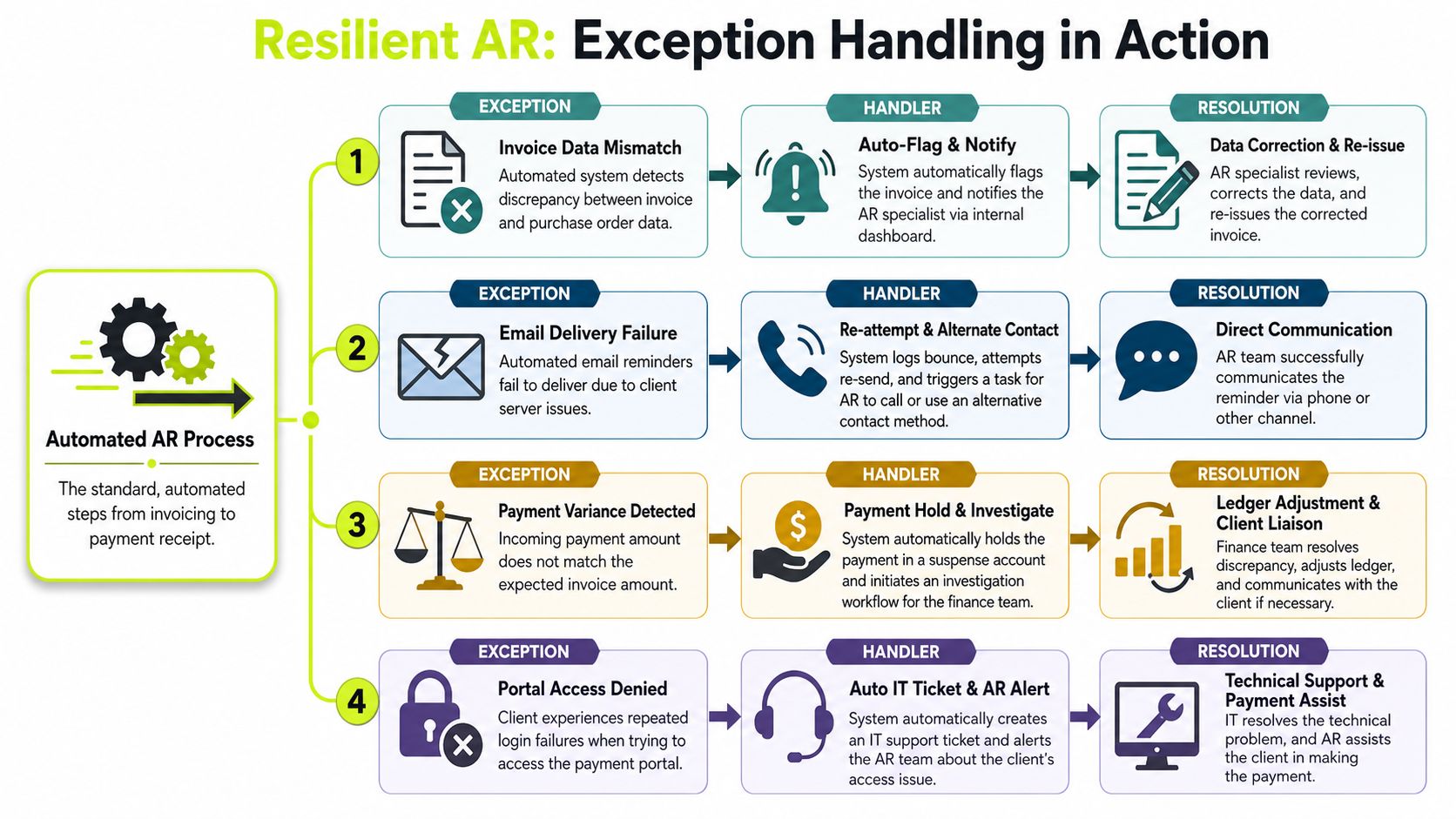
In AR, that can look like this:
- Payment attempt fails: The system doesn't mark the invoice paid. It sends a secure update request to the customer and flags the account for follow-up.
- Reminder email bounces: The system logs the bounce, retries if appropriate, and creates a call task for the account owner.
- Validation error appears: The invoice stops before delivery instead of going out with broken details.
That sounds obvious, but many workflows still have a dangerous gap. They log the issue and move on as if the business consequence were minor.
Practical rule: If a workflow can fail, the response should already be chosen before the failure occurs.
The software principle behind that is strict. In reliable systems, exception handling supports fault tolerance. A routine must either correct itself and retry, or fail with an organized panic so the calling system knows something is wrong. Ignoring the error isn't allowed because it risks corrupted data, as outlined in this fault-tolerance principle for safe exception handling.
The no-matter-what step
The second pillar is the action that must run whether the transaction succeeds or fails.
Finance teams need this for auditability. If a payment attempt starts, the system should leave a clean record no matter the outcome. If a reconciliation job opens a file, the job must close it. If a collections workflow changes account status, the change history must still be written even if the communication channel fails.
Strong systems separate operational truth from wishful status reporting. You don't want "completed" to mean "the main step ran, but we lost track of the failure after it."
Retry without making a mess
The third pillar is where many AR teams get burned. Retrying a failed task is sensible. Retrying badly creates duplicate reminders, duplicate tickets, or duplicate payment attempts.
Smart retries work only when the process is designed to avoid duplicates and preserve a single source of truth. A customer whose card update failed should receive a controlled follow-up, not three overlapping notices from disconnected systems. A bank feed timeout should restart safely, not re-post the same cash event.
A practical way to evaluate this in an AR platform is to ask:
- What happens when a process fails midstream
- What gets retried automatically
- How does the system prevent duplicate actions
- Who gets alerted when automation should stop
If the answer to the fourth question is vague, the workflow isn't under control. Mature teams usually formalize that handoff with documented escalation procedures for finance operations, so exceptions move to the right person before they become aged receivables.
Why This Matters for Financial Control and Reliability
Exception handling belongs in finance conversations because it directly affects reliability, observability, and control.
Reliability in daily collections
A collections run shouldn't collapse because one client record is malformed or one downstream service is unavailable. Strong exception handling isolates the issue so the rest of the workflow continues, while the failed item gets routed for recovery.
That matters for firms managing many invoices across projects, retainers, and milestone billing. One failure should create one controlled exception, not a chain reaction across the batch.
Observability for root cause
Finance teams need more than a red error flag. They need to know what failed, where it failed, and whether the record is still trustworthy.
Technical guidance on exception handling stresses preserving the stack trace so teams can identify the original failure point during root-cause analysis. If that context is lost, production issues take much longer to resolve, according to Microsoft's best practices for exception handling in .NET. In business terms, if your team can't trace the break, they'll spend hours reconciling symptoms instead of fixing causes.
A reliable AR operation doesn't just capture the error. It preserves the story of the error.
That is one reason finance leaders should care about architecture, not just features. Technical shortcuts accumulate. Over time they weaken controls, slow investigations, and create brittle handoffs. That's the same pattern discussed in Faberwork LLC technical debt insights, especially where risk control depends on systems behaving predictably under stress.
Control instead of firefighting
Control means the organization decides in advance how exceptions should be handled. Retry this one. Hold that one. Route another to a senior reviewer. Freeze downstream updates until reconciliation is complete.
Without that discipline, staff improvise. One collector resends the invoice. Another changes the balance manually. A third closes the issue because the client says payment is coming. Those choices create inconsistency, and inconsistency makes forecasting weaker.
For a CFO or Controller, exception handling is part of the financial operating model. It keeps process deviations visible, reviewable, and contained.
How Exception Handling Improves Accounts Receivable Automation
The business case becomes clear when you look at actual AR workflows. Good exception handling doesn't just prevent technical errors. It protects collections momentum and helps reduce DSO.
According to PYMNTS research, 62% of firms that implemented accounts receivable automation reported measurable reductions in DSO, validating the cash flow impact of automation when it works as intended, as summarized in this PYMNTS AR automation statistic. The hidden qualifier is important. Automation only works as intended when exceptions are managed well.
Failed payments that don't disappear
A failed payment should never become a quiet aging problem.
In a mature workflow, the failed attempt triggers a clear chain. The invoice remains open. The customer receives a prompt to update payment details. The account owner sees the issue. If the problem persists, the workflow escalates.
In a weak setup, the payment fails in the background. The client assumes the invoice is handled. Your team assumes the reminder cycle is active. Time passes.
AI AR automation can offer assistance, but only if it respects business controls. Automated messaging, timing, and channel selection are useful. They are not enough on their own. The system still needs rules for what happens when payment cannot be completed.
Reconciliation errors that protect the ledger
Cash application is one of the clearest examples of exception handling creating control.
If a bank deposit doesn't match the invoice amount in QuickBooks, the worst response is to force the match for the sake of a tidy dashboard. A better response is to create an exception, park the item for review, and preserve the integrity of the ledger until someone resolves the variance.
For firms evaluating automation, this is one of the most practical areas to inspect. Strong cash application automation workflows should distinguish between clean matches and exceptions that need human judgment.
Don't measure AR software by how fast it closes clean items. Measure it by how safely it handles ambiguous ones.
That standard matters for QuickBooks AR automation in particular, because many teams rely on QuickBooks as the financial source of record and can't afford silent mismatches between customer, invoice, and bank data.
Communication failures that trigger alternate routes
Reminder delivery isn't binary. Messages can bounce, land in the wrong inbox, or fail because the recipient changed roles.
Strong exception handling logs the delivery failure, avoids treating the reminder as completed, and triggers an alternate route such as a phone task, a different contact record, or a portal notification. That kind of channel-aware response is one of the practical differences between simple accounts receivable automation and systems built for collections reliability.
Escalations that happen on time
Some invoices won't resolve through normal reminders. That doesn't make them technical failures. It does create a process exception.
A smart workflow can move an account into a different path after repeated non-response. That might mean assigning a senior collector, changing communication tone, involving account leadership, or preparing more formal outreach. The point isn't aggression. It's timely control.
Here's a simple decision view:
Situation | Weak response | Strong response |
|---|---|---|
Payment fails | Wait for staff to notice | Keep invoice open, notify customer, route task |
Deposit doesn't match | Force reconciliation | Hold, investigate, resolve before posting |
Reminder bounces | Mark message sent | Log bounce, retry appropriately, change channel |
Account ignores reminders | Continue same sequence | Escalate workflow based on pre-approved rules |
The firms that get the most value from AR software for professional services usually understand this well. They don't just automate activity. They automate decision paths around failure.
From Fragile Process to Resilient System
The difference between weak automation and trustworthy automation is simple. Weak automation works when conditions are perfect. Resilient automation keeps control when they aren't.
That matters in finance because receivables are full of edge cases. Clients change approvers. Payment data arrives incomplete. A portal access issue interrupts an otherwise willing payer. If the process can't absorb those disruptions, your team goes back to inbox searches, spreadsheet notes, and manual follow-up.
AR automation replaces manual invoicing and collection tasks, and companies that move to automation see measurable improvement in DSO, the average time it takes to collect after a sale, according to this NetSuite overview of accounts receivable automation. For CFOs, Controllers, and firm owners, the deeper point is that results depend on operational discipline as much as workflow speed.
What resilient AR looks like
Operating question | Fragile process | Resilient system |
|---|---|---|
Did the action fail | Hard to tell | Clearly detected |
Who owns the next step | Unclear | Pre-assigned |
Is the ledger protected | Sometimes | Yes |
Can leadership trust status reporting | Not consistently | Yes |
This is also why operational resilience now matters beyond internal process design. If you're reviewing vendor exposure, platform continuity, or outsourced controls, it's worth understanding how resilience expectations are evolving in frameworks such as DORA third-party risk management.
Exception handling isn't an IT side note. It's a financial control mechanism. It protects cash flow, supports reliable forecasting, and helps teams improve cash flow without surrendering visibility.
Resolut automates AR for professional services, consistent, accurate, and human. If you're looking for accounts receivable automation that helps reduce DSO, supports QuickBooks AR automation, and keeps exceptions visible instead of buried, Resolut is built for that balance of control and efficiency.