Accounts Receivable Automation Market Guide for CFOs
Explore the accounts receivable automation market size, growth, AI trends and ROI on DSO to choose AR software that improves cash flow.
Your invoices go out on time. Terms are net 30. Clients are happy enough. And yet cash still lands late.
That's the daily tension in a professional services firm. You're not selling widgets. You're billing for judgment, projects, retainers, milestones, and sometimes messy scope changes. A blunt collections process can damage trust. A passive one lets DSO drift until the balance sheet starts carrying the burden.
The accounts receivable automation market matters because it isn't really about sending more reminders. It's about deciding which parts of AR deserve automation, which parts still need human judgment, and which delays are structural in your firm's billing model. If you run a $3M to $50M services business, that distinction is where cash flow either improves or stays stuck.
Why AR Automation Matters Right Now for Professional Services
Most professional services firms don't have an invoicing problem. They have a timing and follow-through problem.
Invoices often go out monthly. Terms are usually net 30. But real collection speed runs much slower in practice because billing happens in arrears, approvals sit with client managers, and disputes get buried in email threads. An industry benchmark placed law, accounting, consulting, and agency firms in a 35 to 55 day DSO range (professional services DSO benchmark).
That gap is where cash gets trapped.
The issue isn't effort
Your controller can work the aging report every Friday. Your collectors can send follow-ups. Partners can promise to “check with the client.” None of that creates control if the process depends on memory, spreadsheets, and personal escalation styles.
AR automation fixes that when it acts as an operating system for billing, collections, exceptions, and payment tracking. It doesn't just digitize the work. It standardizes it.
Practical rule: If your firm relies on partner intervention to collect routine invoices, your AR process is under-controlled.
For professional services, the value usually comes from a few specific pressure points:
- Billing discipline: Invoices go out consistently, with fewer delays between work completed and bill sent.
- Collections segmentation: Strategic clients get the right tone and cadence instead of generic dunning.
- Dispute visibility: Scope questions, PO issues, and billing corrections stop living in someone's inbox.
- Payment resolution: ACH, card, and remittance matching become less manual.
A lot of firms start this evaluation after a cash crunch. That's late. The better time is when revenue is growing, headcount is expanding, and your team still has enough capacity to redesign the workflow before it breaks.
If you want the practical baseline on where automation helps most, this guide on accounts receivable automation benefits is a useful companion. The core point is simple. Better AR doesn't start with more activity. It starts with better control over what delays payment.
How Big the Accounts Receivable Automation Market Has Become
A $12M consulting firm does not need a giant software category. It needs a faster path from approved work to cash in the bank.
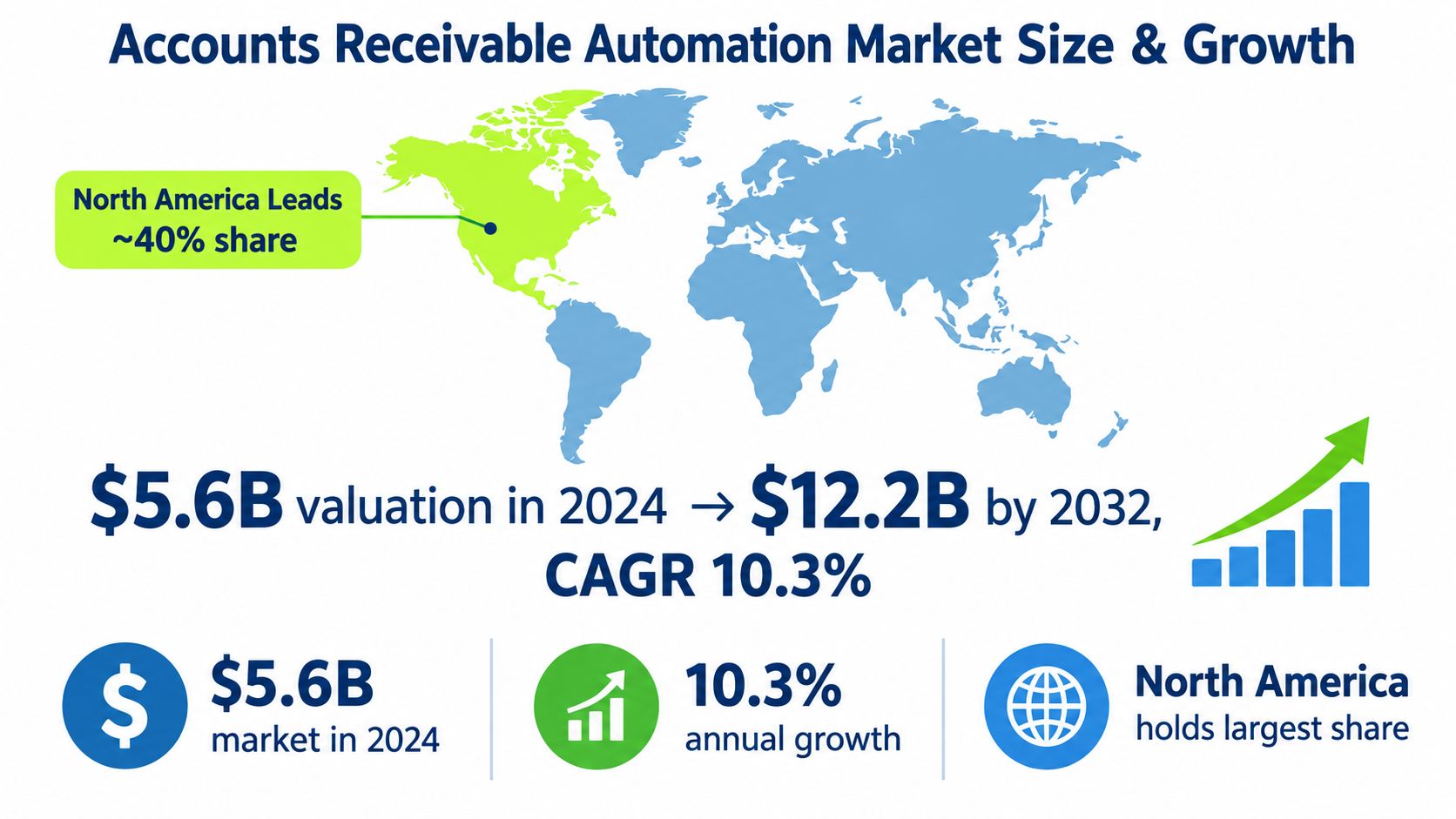
That is why market size matters less than market maturity. AR automation is now established enough that buyers can expect proven vendors, standard integrations, and repeatable implementation patterns. Analysts at IMARC valued the global market at USD 3.84 billion in 2026 and projected it to reach USD 6.66 billion by 2031, which implies 11.64% CAGR over that period. IMARC also found that North America held 38.40% of market share in 2025, while Asia-Pacific is projected to grow fastest at 12.67% CAGR from 2026 to 2031 (IMARC accounts receivable automation market forecast).
For CFOs and Controllers, the practical read is simple. This is no longer a fringe purchase. It is a real software category with enough adoption to separate solid platforms from dressed-up workflow tools.
What market maturity actually means
The top-line forecast matters. The buying pattern matters more.
IMARC reported that solutions represented 67.33% of the market in 2025, and large enterprises accounted for 58.71% of spending in that same year, as noted in the forecast above. That matters because enterprise finance teams do not keep funding categories that fail basic control tests. If they keep buying, the category has moved beyond experimentation.
That does not mean every product will improve cash performance for a professional services firm.
Some tools mainly digitize mature steps such as invoice delivery and reminder emails. Helpful, but limited. The bigger DSO gains usually come from the sub-processes that break in services firms first: billing delays after delivery, weak follow-up by client segment, approval bottlenecks, disputed time or scope, and remittance matching that sits in someone's inbox. A platform that cannot address those frictions may make AR look cleaner without making cash arrive faster.
Use this section of the market with discipline. Focus less on broad claims about efficiency and more on where a product changes timing:
- Billing issuance speed: How many days pass between work approval and invoice send?
- Collections execution: Does outreach adjust by client type, invoice age, and dispute status?
- Exception handling: Are PO gaps, scope questions, and billing corrections tracked in one workflow?
- Cash application lag: How quickly do payments and remittances match back to open invoices?
How to read competing forecasts
You will see different market estimates. That is normal.
Grand View Research describes the category as part of a broader shift toward cloud finance automation, AI-supported workflows, and tighter integration across the order-to-cash stack (Grand View Research on accounts receivable automation). The exact totals will vary by research firm because each one defines the category differently. Some include adjacent invoice-to-cash tools. Some keep the scope narrower.
Do not spend time reconciling every forecast line. Use the consensus instead. The category is growing because finance teams still have unresolved collection, reconciliation, and cash visibility problems.
For a professional services firm in the $3M to $50M range, that is good news. You can buy into a category that is mature enough to be stable, but still early enough that process design choices will determine whether automation cuts DSO or just produces cleaner activity logs. If your revenue mix includes retainers, usage-based billing, or recurring contracts alongside projects, this guide to billing automation for SaaS and recurring revenue teams helps frame where billing structure affects downstream AR control.
What Is Driving and Slowing Adoption Across Finance Teams
Monday morning. Your controller is asking why collections looks busy but cash still has not landed. One client is waiting on a corrected invoice. Another paid, but the remittance is sitting in someone's inbox. A third was never chased because the account owner did not want outreach sent yet.
That is why adoption is rising.
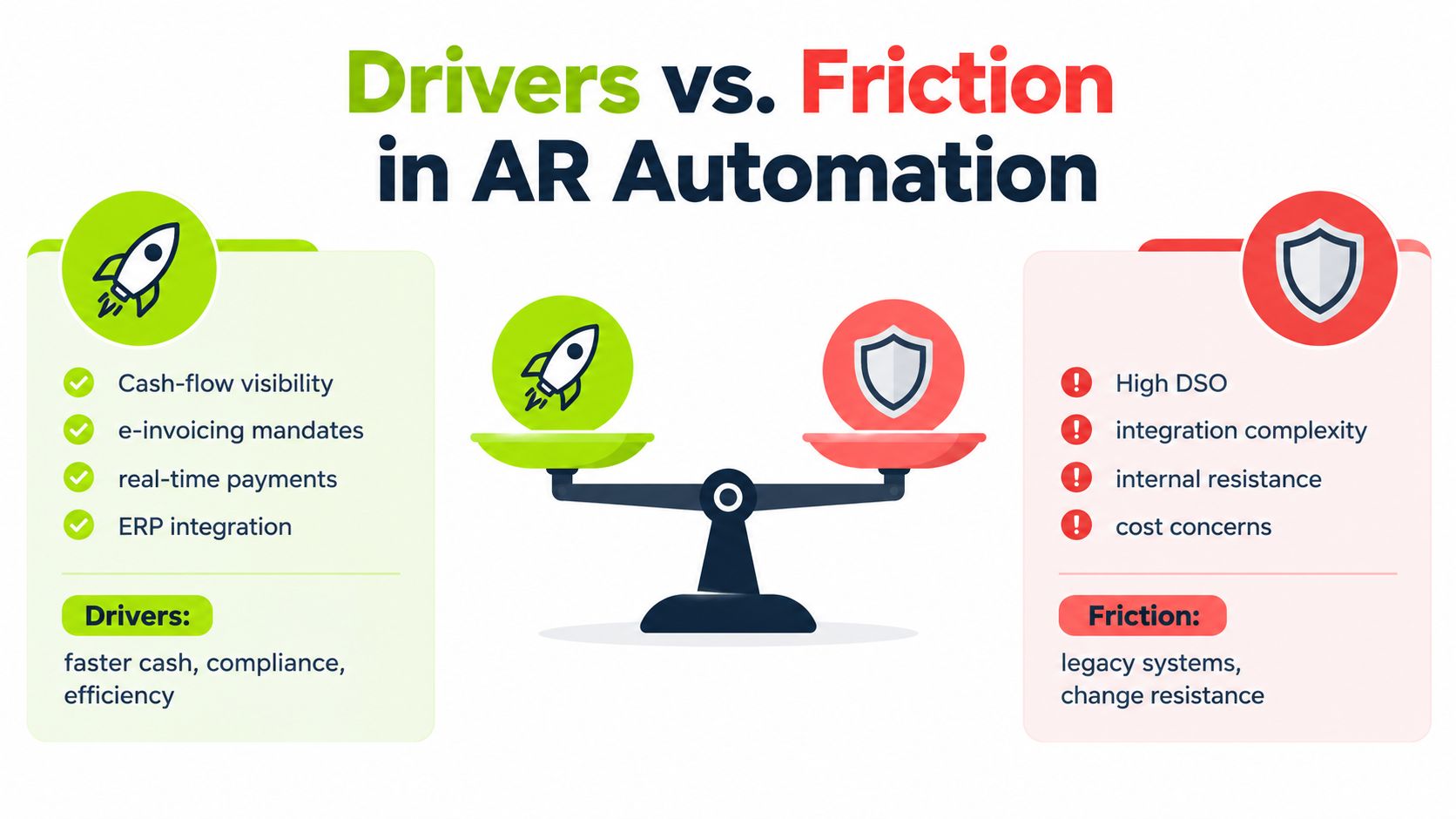
Finance teams are not buying AR automation just to save labor. They are buying it to remove specific points of DSO drag. In professional services, the biggest delays usually sit in follow-up discipline, approval bottlenecks, short-pay resolution, and payment matching. If software only digitizes invoice delivery or reminder emails, it improves recordkeeping more than cash timing.
Analysts at The Business Research Company identified agentic AI, real-time reconciliation, integrated finance platforms, compliance needs, ERP connectivity, and cash-flow visibility as current market drivers (accounts receivable automation market trends). That list is directionally right. For a CFO or Controller, the useful question is simpler. Which part of the AR workflow is delaying cash today?
Start there.
For firms in the $3M to $50M range, adoption usually accelerates when one of these problems becomes hard to ignore:
- Collections are inconsistent: Follow-up depends on the collector, partner, or project lead, so invoice aging reflects behavior gaps more than client credit quality.
- Cash application is slow: Payments arrive, but remittances are incomplete, trapped in email, or hard to match across entities and invoices.
- Billing exceptions keep aging invoices: Revised time entries, purchase order mismatches, and disputed fees stall payment before collections can even do its job.
- Client payment preferences have changed: ACH, cards, customer portals, and structured remittance are now standard expectations, not edge cases.
- Audit pressure has increased: Controllers need a clear record of who contacted whom, what changed, and why an exception stayed open.
The firms that move fastest are usually the ones that can tie automation to one sub-process with a measurable cash outcome. Faster reminder cadence can help. Faster dispute routing helps more. Faster cash application often matters most because unapplied cash hides real performance and delays clean follow-up.
What slows adoption is rarely lack of interest. It is process sprawl and unclear ownership.
HighRadius reported that 80% of AR teams were not using AI in their AR processes, which tells you the category is still early in actual operating use, not just software availability (HighRadius AR automation statistics). Many teams buy pieces of automation without assigning end-to-end control. Billing owns invoice accuracy. AR owns reminders. Accounting owns posting. Client service owns the relationship. No one owns the full path from invoice issue to cash applied.
That model does not lower DSO consistently.
Treat AR automation like finance infrastructure. Define the exception queues before you buy. Decide who owns disputed invoices, partial payments, unapplied cash, broken syncs, and client-specific outreach rules. Teams that already think in terms of observability and runbooks usually make better AR decisions because they plan for failures, not just straight-through processing.
A finance workflow is only automated if exceptions have an owner, a queue, and a resolution path.
Internal resistance is real, especially in professional services. Partners want discretion with strategic accounts. Collectors want room to negotiate. Controllers want tighter controls without damaging client experience. The answer is not to preserve a loose process. The answer is to set rules by account segment, invoice type, and risk level so humans step in where judgment changes the outcome, and software handles the rest.
How AI Omnichannel Outreach and Cash Application Work Together
Most AR software demos still break the workflow into feature boxes. Email automation. SMS reminders. AI prioritization. Cash application. That's the wrong view.
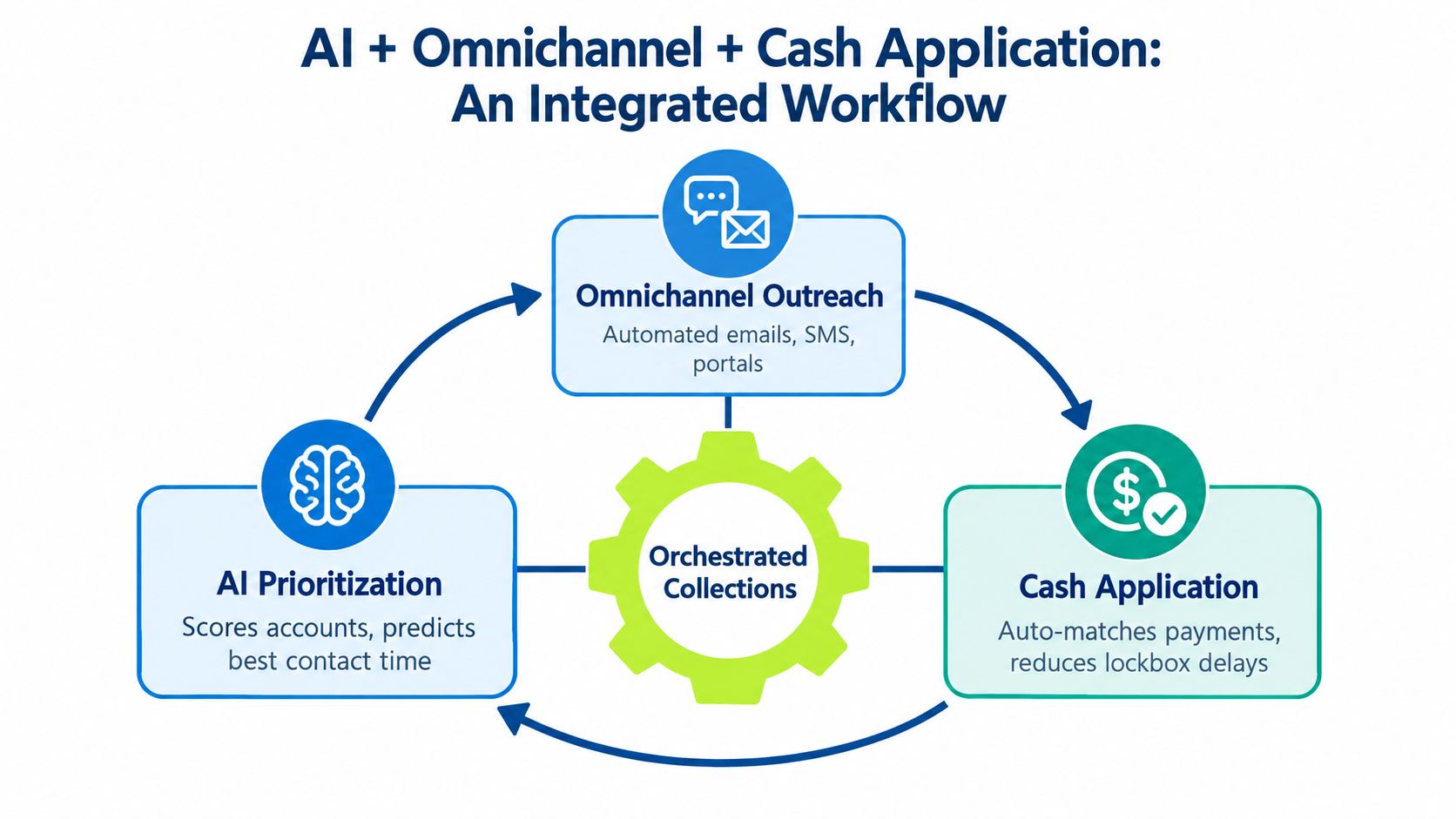
The useful model is orchestration. One system decides who needs attention, one system delivers the message through the right channel, and one system closes the loop when payment arrives. If those pieces don't work together, you don't have AI AR automation. You have a stack of disconnected tools.
AI should decide where effort goes
The benchmark data that matters most here is operational, not promotional. Peer-group AR operations average about 42.3 days DSO, while digital world-class organizations average 29.6 days, and the best-performing 10% are below 22 days (AI AR benchmark comparison).
The same benchmark set ties mature AI cash application, AI-driven collections prioritization, and automated dispute management to the lowest DSO cohort. That's the key point. Lower DSO doesn't come from sending more reminders. It comes from deciding where humans should intervene and where software should handle the queue.
For a services firm, AI prioritization should answer questions like:
- Which client is likely to pay late without intervention?
- Which invoice is stuck because of a billing exception?
- Which account deserves partner outreach versus standard collections?
- Which promise-to-pay needs follow-up today?
Outreach should be coordinated, not louder
Finance teams often overestimate email and underestimate timing, channel, and tone.
If your clients respond better to text nudges before due date and formal email after due date, the workflow should reflect that. If you need examples of what that can look like in practice, these automated payment SMS templates are useful as message design references. The point isn't to copy scripts. It's to structure outreach so your client experience stays professional while your team stays consistent.
A strong platform also needs governance. AI-generated outreach should be reviewable. Escalation rules should be visible. Strategic accounts should have controlled approval paths.
Here's a useful product walkthrough to frame what integrated execution looks like in practice:
Cash application is where most “automation” gets tested
A platform can look polished on the collections side and still fail in the back half of AR.
If payments hit the bank and your team still has to manually match remittances, clear exceptions, and chase short pays, DSO won't improve much. You'll collect promises faster than you can reconcile them.
The real test of AR software is what happens after the customer pays.
That's why I'd evaluate AI AR automation as one loop, not three tools. Prioritization should shape outreach. Outreach should drive payment. Payment should update cash application and customer status quickly enough that collectors stop working resolved accounts. If you're comparing approaches, this breakdown of AI for accounts receivable is worth reviewing with your controller and AR lead in the same room.
Who Is Buying and Who Is Selling in the AR Automation Landscape
The buyer is uneven. Large enterprises still dominate spending, but that doesn't mean the best products for a professional services firm are enterprise-heavy suites.
In practice, the right fit depends less on company size alone and more on your invoice complexity, client communication needs, and accounting stack. For a $3M to $50M firm, the main question is whether you need end-to-end orchestration or just better invoicing and follow-up discipline.
Vertical reality matters more than vendor category
Industry DSO ranges vary widely. SaaS commonly runs around 30 to 45 days, manufacturing around 45 to 60 days, and construction around 60 to 90+ days (industry DSO comparison). Professional services sits in its own middle ground because billing is often monthly, but friction comes from approvals, scope disputes, milestone timing, and fragmented client contacts.
That means AR software for professional services should handle more than reminders. It should support:
- Milestone or project-based billing
- Client-specific contacts and approval flows
- ACH and card collection options
- Dispute routing tied to billing context
- Partner visibility without partner dependency
QuickBooks AR automation is especially relevant here. Many firms in this revenue band don't need a massive global suite. They need software that plugs into QuickBooks cleanly, keeps the team inside a controlled workflow, and doesn't create another reconciliation project.
Use a fit matrix, not a feature checklist
Firm Profile | Primary Friction | Automation Priority |
|---|---|---|
Retainer-based accounting or advisory firm | Late follow-up and inconsistent reminder cadence | Automate invoicing, reminders, payment portal, and promise tracking |
Agency or consulting firm with project billing | Billing disputes and approval lag | Prioritize dispute workflows, segmented outreach, and client-level escalation |
Multi-office professional services firm | Process inconsistency across teams | Standardize workflows, reporting, and collection rules |
Founder-led services firm still using QuickBooks heavily | Owner involvement in collections | Add QuickBooks AR automation, client portal, and structured escalation |
Firm with high payment volume but manual reconciliation | Cash posting delays | Focus on automated cash application and exception queues |
Some vendors sell point solutions. Some sell broader invoice-to-cash platforms. Some aim squarely at enterprise finance. One option in the end-to-end category is Resolut, which combines credit risk, omnichannel outreach, billing, and cash application in one operating workflow. That kind of architecture makes sense when your problem is process fragmentation, not just reminder volume.
What Automation Really Does to DSO and Cash Flow
If you're buying AR automation to save staff time, you're aiming too low.
The financial test is DSO. If DSO doesn't improve, your process may be more efficient, but your cash position hasn't materially changed. Finance teams should treat DSO movement as the primary outcome and productivity gains as secondary.
Start with a control benchmark
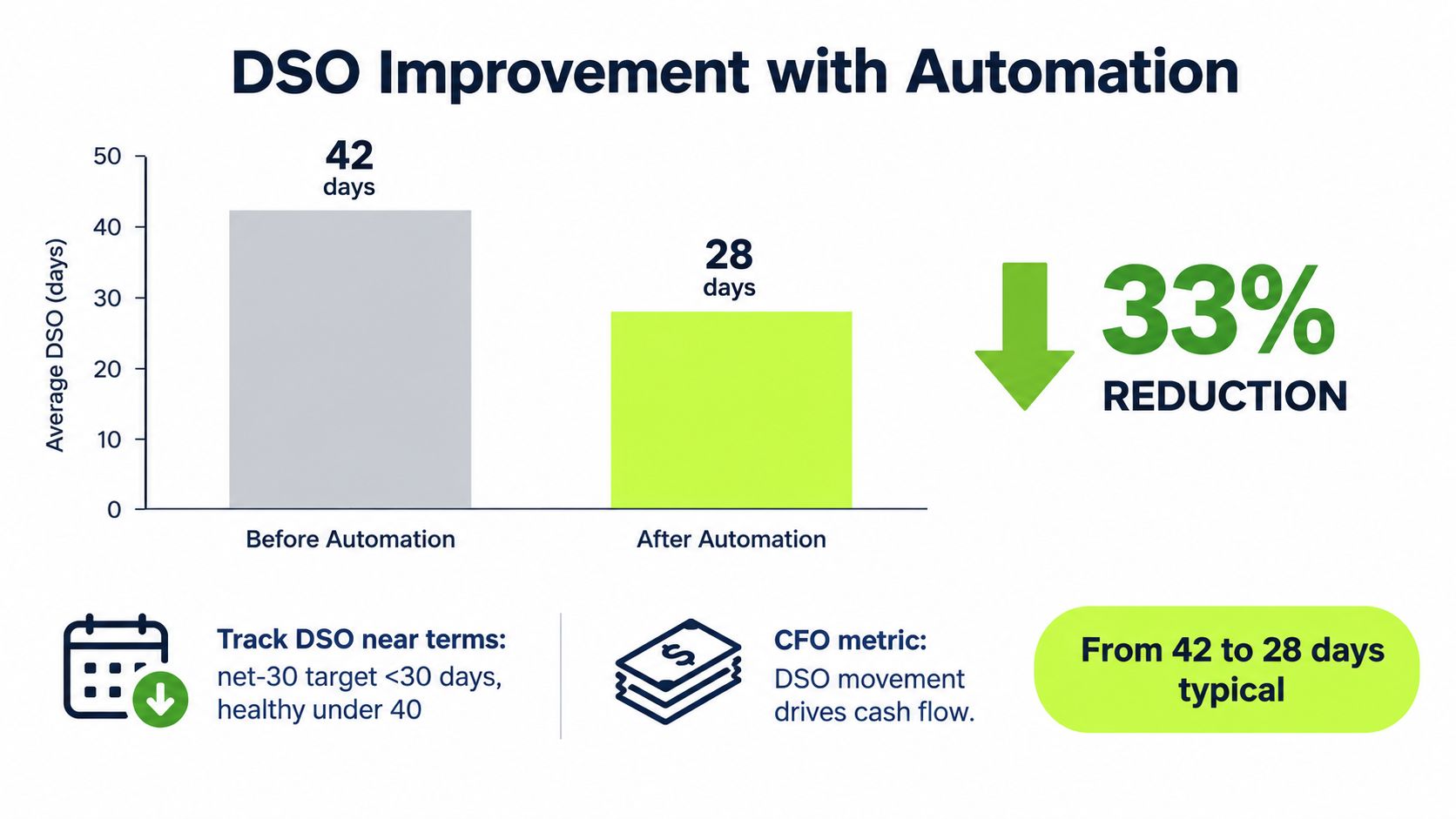
A useful benchmark is simple. DSO should stay close to payment terms. One source said a DSO around 30 matches net-30 terms, under about 40 days is healthy, and over 55 days usually signals process problems such as late invoicing, weak dunning, or billing errors (DSO control benchmark).
That's a clean operating rule for professional services firms.
If you invoice on net 30 and regularly collect in the high 40s or 50s, you don't have a theoretical optimization issue. You have a process problem.
Depth matters more than surface automation
Many finance teams get misled. They automate communication, report “efficiency gains,” and still don't move cash enough.
Recent benchmark data says 95% of finance teams report efficiency gains from AR automation, yet only 17% of organizations achieve DSO below 30 days, while 65% still sit in the 31 to 60 day range (AR automation survey results). That gap is the whole story. Activity got easier. Outcomes didn't always follow.
What tends to move DSO is automation depth across sub-processes:
- Collections prioritization Work the right invoices first. Don't let collectors spend equal time on every account.
- Dispute handling Route billing issues fast. A disputed invoice with no owner will age no matter how many reminders you send.
- Cash application Clear incoming payments quickly so your aging and follow-up lists stay accurate.
- Invoice discipline Get clean invoices out on time, every time.
The strongest evidence is on depth and AI usage
One industry summary reported that companies automating more than half of their AR processes reduced DSO by 32%, or 19 days (AR automation depth and DSO reduction). That's useful because it ties results to how much of the workflow is automated.
A separate Wakefield Research study reported that 99% of companies using AI in AR reduced their average DSO, and 75% said the reduction was six days or more (AI in AR and DSO reduction).
Don't ask vendors whether their software saves time. Ask which sub-processes they automate deeply enough to reduce DSO.
For CFOs, the implementation sequence should be disciplined:
- Baseline your current DSO against your terms
- Identify the dominant delay, such as disputes, late billing, weak prioritization, or cash posting lag
- Automate that bottleneck first
- Measure DSO monthly, not just collector activity
- Expand only after you see cash movement
That's how you improve cash flow with evidence, not software theater.
Choosing Calm Control for Your AR Future with Resolut
The accounts receivable automation market is growing because finance teams need more than cleaner reminders. They need a system that turns invoices into cash with fewer delays, fewer exceptions, and less dependence on heroics.
For professional services firms, the priority should be narrow and practical. Buy the workflow that matches your billing friction. If your challenge is monthly invoice follow-up, don't overbuy. If your challenge is dispute routing, inconsistent outreach, and manual payment matching, don't pretend a basic reminder tool will fix it.
What to prioritize
When I advise CFOs and Controllers in this range, I push for three things:
- End-to-end coverage: Collections alone won't reduce DSO if cash application and billing exceptions stay manual.
- Vertical fit: AR software for professional services should reflect project billing, client approvals, and relationship-sensitive outreach.
- Human control: AI AR automation should be auditable, adjustable, and easy to override when a client situation needs judgment.
That's where calm control comes from. Not from a flashy dashboard. From a process your team can trust on an ordinary Tuesday.
Why the operating model matters
The strongest systems don't force a choice between full automation and full manual work. They let your team run autopilot where the path is clear and step in where exceptions, relationships, or legal escalation require judgment.
That operating model fits firms that care about client retention as much as collection speed. It also fits controllers who need auditability and firm owners who want better cash flow without turning the business into a collection shop.
Resolut's shape in this market is straightforward. It unifies credit risk, omnichannel outreach, billing, payment experience, and cash application in one control layer, with both autopilot and co-pilot workflows. For a professional services firm, that structure makes sense when the issue is inconsistency across the invoice-to-cash process, not lack of effort from the team.
Resolut automates AR for professional services with structured billing, controlled outreach, payment workflows, and cash application that support real DSO improvement. If you want a calmer way to improve cash flow without losing the human side of client relationships, visit Resolut.