AR Account Reconciliation: A Practical Guide for CFOs
A practical guide to AR account reconciliation for CFOs and controllers. Learn workflows, control points, automation strategies, and KPIs that reduce DSO.
The first business day after month-end starts with a familiar question: why doesn't the cash on the balance sheet tie to the bank? The AR subledger is behind the general ledger, unapplied receipts are sitting in suspense, and collections is chasing remittance details that never arrived with the wires. Nobody has lost the cash. The business has lost the evidence needed to explain where it belongs.
For professional services firms with $3M to $50M in revenue, that gap creates more than close-week irritation. It distorts aging, slows collections, weakens cash forecasting, and forces senior finance staff to investigate transactions that should have resolved automatically. AR account reconciliation is the control point between billing and usable cash. Done continuously, it keeps the close predictable. Done only at month-end, it turns ordinary exceptions into a finance emergency.
The Monday Morning Close That Should Not Exist
A controller walks in after the close and finds a stack of unresolved items waiting on the desk. There are 47 unapplied payments, three customers disputing deductions from the prior cycle, and a CEO asking why the reported cash position doesn't agree with the bank activity.
The AR subledger is two days behind the GL. The collections team is still requesting remittance advice from customers whose wires arrived without invoice references. A missing lockbox file has stalled the posting run, so the team can't tell which customer balances are overdue and which ones are already paid but unallocated.
The accounting team starts searching email, opening bank portals, and comparing spreadsheets. One person keys payment references manually. Another checks whether a credit memo was posted. A third asks the billing team whether an invoice was replaced after a scope change. The close becomes an investigation rather than a review.
Controller's rule: If reconciliation begins only after the period ends, the team isn't controlling the process. It's reconstructing it.
This situation is common because organizations treat reconciliation as a clerical month-end task. That framing is too narrow. Reconciliation proves that the invoice, the customer account, the incoming cash, and the accounting entries all describe the same economic event.
The distinction matters for firms that bill retainers, milestone work, recurring services, reimbursable expenses, or work across entities. A payment can arrive correctly at the bank and still remain wrong in the AR ledger. A customer can have paid while the invoice remains open. A cash receipt can be posted to the wrong client and contaminate collections reporting.
The practical fix isn't to ask the team to work harder on the final day. It's to move control points earlier, assign ownership to each exception, and make unresolved items visible before they reach the close.
What AR Account Reconciliation Actually Means
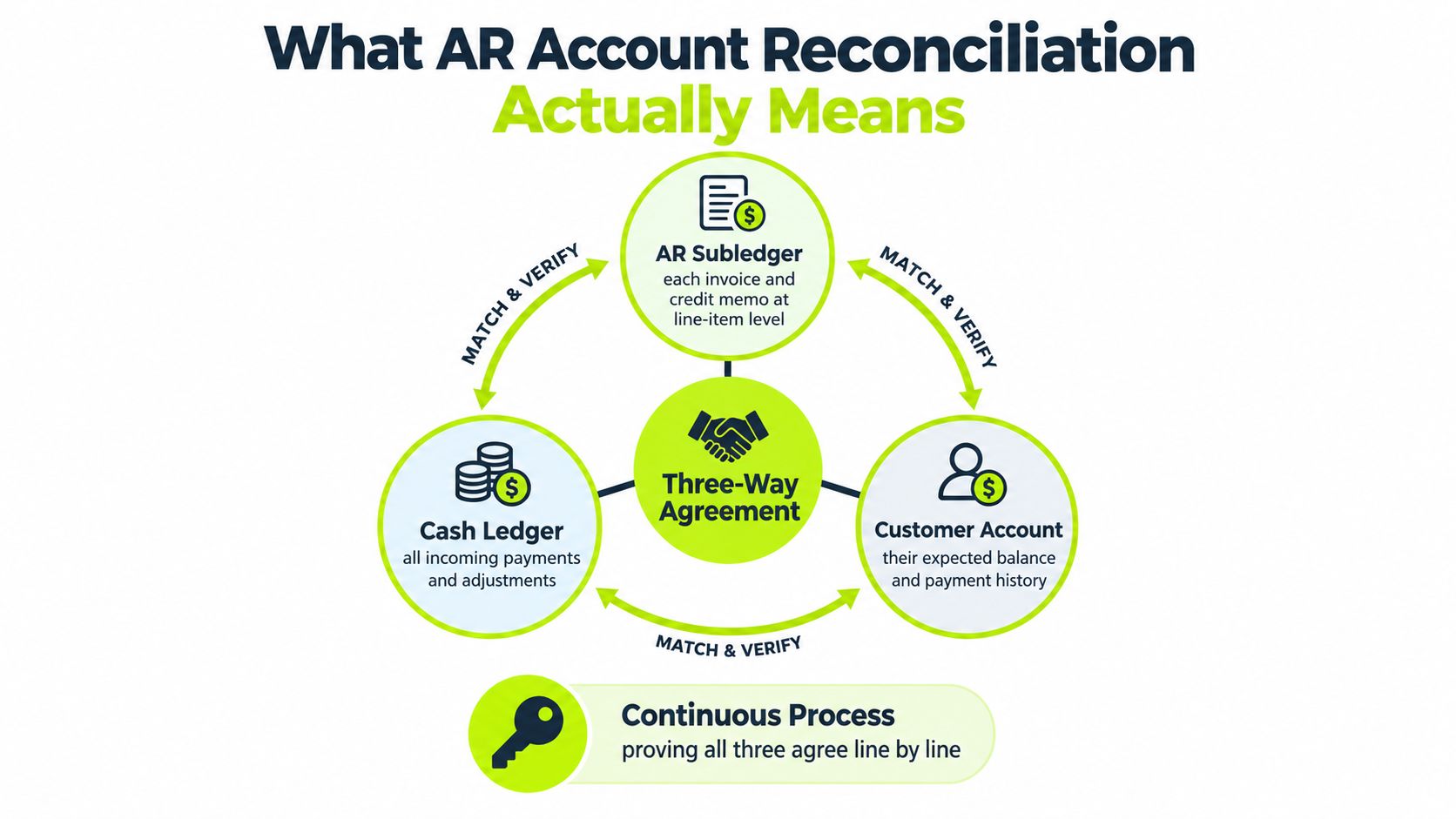
In operator terms, AR account reconciliation is the continuous process of proving that the AR subledger, cash ledger, and customer account agree at the line-item level. The general ledger provides the control total, but the detail must explain how that total is composed.
Every payment has three related questions:
- Which invoice or invoices does the payment settle?
- Where was the cash posted in the ledger?
- What balance remains, and is that balance valid?
A clean result reduces the invoice balance to zero or leaves a documented residual. An unexplained residual becomes an exception, such as unapplied cash, a short pay, a disputed deduction, a credit memo, or a timing difference.
Reconciliation is not cash application
Cash application is the act of posting a customer payment against an invoice. Reconciliation is the proof that the posting was correct, the appropriate customer account was used, the right GL treatment was applied, and the remaining receivable is accurately represented.
Bank reconciliation answers a different question. It compares bank activity with the cash accounts in the GL. AR reconciliation connects that cash activity to customer-level balances and the AR subledger. A bank account can reconcile perfectly while the customer ledger still contains misapplied or unapplied receipts.
The scope includes open invoices, credit memos, write-offs, cross-currency transactions, intercompany balances, deductions, and customer-specific adjustments. It doesn't include AP, payroll, or supplier liabilities. Those accounts require their own reconciliation controls.
For a professional services firm, the customer account is often more complex than a simple invoice balance. A client may pay several projects in one wire, deduct an approved credit, settle invoices in different currencies, or route payment through a parent entity. The reconciliation process must preserve the relationship between the commercial record and the accounting record.
The standard is not “the total looks close.” The standard is that every material difference has an owner, an explanation, supporting evidence, and a defined resolution path.
The Reconciliation Workflow and Where It Breaks
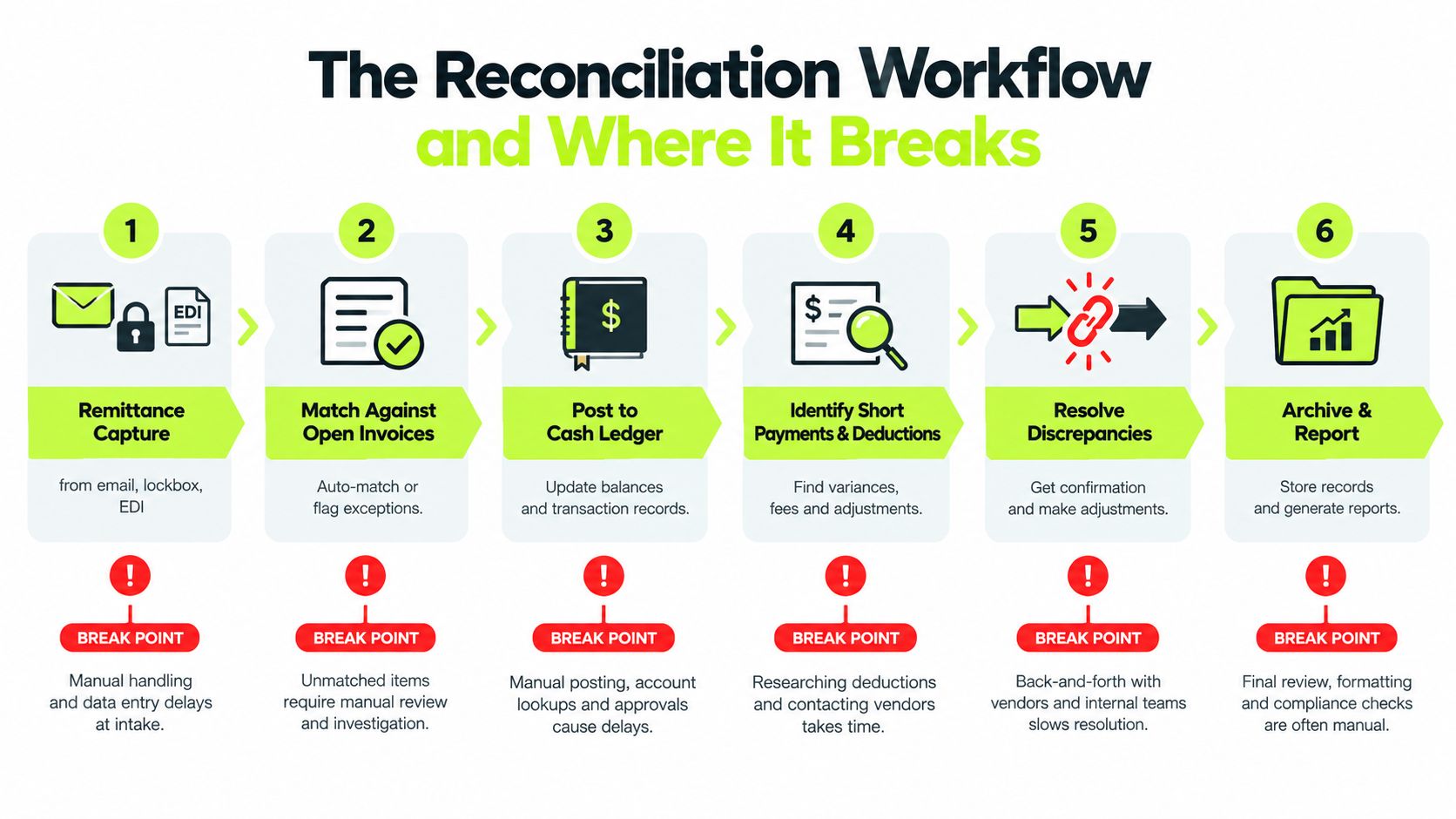
A payment can arrive, post to the bank, and still leave the AR ledger wrong. Reliable reconciliation treats the full invoice-to-cash flow as an exception-management process across email, lockbox files, EDI, customer portals, bank feeds, the AR subledger, and the GL. Each gate needs an owner, a tolerance, and a defined handoff.
Six stages with practical control points
1. Capture remittance. Collect payment details from every channel and confirm that each receipt entered the workflow. Remittance often arrives separately from the cash, so completeness must be checked before matching begins.
2. Match against open invoices. Compare customer identity, invoice references, amount, currency, date, and known payment patterns. Record match confidence. A weak match belongs in review rather than being forced to make the queue appear smaller.
3. Post to the AR subledger and GL. The receipt must update the customer account and the correct cash and AR accounts. Posting cash without reducing the corresponding receivable creates an incorrect customer balance and a misleading sense of completion.
4. Identify short pays and deductions. Classify commercial disputes separately from processing errors. A deduction tied to a service issue needs the appropriate business owner. A missing remittance reference belongs with the payment process.
5. Resolve discrepancies. Route every exception with its reason, supporting evidence, owner, and due date. An unassigned exception is an unresolved aging item, even if the cash has already reached the bank.
6. Review aging and complete the tie-out. Examine current, overdue, and long-outstanding balances, then reconcile the AR subledger total to the GL. This final review checks that applications, adjustments, and unresolved items are represented correctly for the period.
Days Sales Outstanding, or DSO, estimates collection time after a credit sale. The formula is accounts receivable divided by credit sales, multiplied by the number of days in the period. Allianz Trade reported global DSO typically sat between 59 and 68 days in 2026, with a global average of about 62 days in 2024. Its benchmarks also show variation by market and sector, including 94 days in China, 88 days in Italy, 82 days in construction, and 26 days in retail, as reported in Allianz Trade DSO benchmarks.
The comparison is useful because invoice-to-cash design affects working capital differently across markets and sectors. Time spent waiting for a remittance, clarifying an ambiguous payment, or correcting a posting makes collectible balances harder to identify and act on.
Where teams usually lose control
Missing remittances create research work. Weak matching rules push routine receipts into an analyst queue. A gap between posting and exception handling lets incorrect applications flow into aging and collections reports.
Cross-system and multi-format transactions add another failure point. A customer name may differ between the bank file, CRM, ERP, and remittance advice. One payment may cover several invoices, include a deduction, or arrive in a format the matching rule cannot read.
Track capture status, match confidence, posting status, exception reason, owner, and resolution date. These fields show where work stopped, who must act, and whether the same break is recurring.
Why Payments Do Not Match and What It Costs
Most mismatch queues contain the same five categories. The right response isn't to prioritize whichever customer complains loudest. Rank the queue by manual cost, repeatability, risk, and effect on the accuracy of aging.
The table below is a management framework rather than a benchmark. Actual minutes, rework cycles, and DSO effects depend on your systems, transaction design, customer behavior, and escalation discipline.
Mismatch | Avg minutes per item | Rework loops | DSO impact (days) |
|---|---|---|---|
Short pays and deductions | Not standardized | Often repeated | Can keep invoices partially open |
Unapplied cash | Not standardized | Often repeated | Can make paid balances appear open |
Overpayments and credits | Not standardized | Sometimes repeated | Can delay allocation of future invoices |
Dispute holds | Not standardized | Frequently repeated | Can leave collectible balances unresolved |
ERP, CRM, and bank gaps | Not standardized | Frequently repeated | Can delay reliable aging and collection action |
Because no verified source establishes average handling minutes, rework counts, or day-level DSO effects for each category, a controller shouldn't pretend these values are universal. Measure them from your own queue. Record the timestamp when an item enters review, the timestamp when it posts or closes, and the number of handoffs.
The expensive exceptions are often quiet
Short pays are visible because the invoice remains partially open. Cross-system gaps are less visible. A CRM may show an approved project credit that never reaches the ERP. A bank portal may strip the remittance identifier. A parent company may net several entities in one settlement. FX timing can leave the cash amount and invoice amount looking inconsistent even when the payment is commercially valid.
These cases consume time because the analyst has to reconstruct context across systems. The issue is not just payment matching. It's exception management across the full invoice-to-cash flow.
A useful internal rule is simple: if an analyst touches a payment more than twice, investigate the process rather than labeling the item unusual. Repeated handling usually points to poor remittance standards, missing integration, an incomplete customer master, or tolerance settings that don't reflect commercial reality.
Payment recovery also belongs in the wider control design. Failed recurring payments create a different path to unresolved AR, so finance teams evaluating ways to reduce involuntary churn with better retries should connect recovery activity to customer balances and reconciliation status.
How AR Automation Reconciles Cash in Real Time
Good accounts receivable automation doesn't eliminate judgment. It removes repetitive evidence gathering so the team can apply judgment where the risk is real.
When a payment lands, a modern AR platform should perform four actions in sequence.
Capture, match, post, and route
First, the platform extracts remittance information from email attachments, EDI 820 files, lockbox files, customer portals, and supported bank feeds. It normalizes identifiers, invoice references, amounts, dates, and currency fields into a consistent record.
Second, it compares that record with open invoices. Matching can use amount, reference, customer ID, currency, payment date, and known relationships between payer and billed entity. A match should include a confidence decision, not just a binary result.
Third, high-confidence receipts post straight through to the customer account and cash ledger. Industry benchmark material defines automatic match rate as the share of incoming payments posted to open invoices without human intervention. It notes that a good rate is typically above 70%, while best-in-class organizations can exceed 90%, as described in Emagia's automatic match rate glossary.
Fourth, exceptions go to a worklist with the reason, source documents, proposed action, and approval requirement attached. That is where the human remains essential.
Control point: Automation should make the easy items invisible and the difficult items more explainable.
Keep people in the high-risk loop
New customer accounts, unusual payer entities, credit memos, cross-currency adjustments, material short pays, and payments above a configured threshold deserve review. Tolerance bands should reflect the firm's contracts and billing practices. A system that accepts every near-match can mispost receipts, producing a worse close than a manual queue.
Process design matters as much as software. An empirical study reported that an invoice matching error rate fell from 15% to 1.5% after process improvement, showing how tighter match logic and data normalization can reduce exceptions. The result appears in the IJARCCE invoice matching study.
For teams assessing options, AR automation software for cash flow is a useful category to evaluate, but the test should be operational. Ask how the platform handles split settlements, missing remittances, disputes, audit history, reversals, and write-back to the system of record.
A practical walkthrough of the workflow is available in automated payment reconciliation.
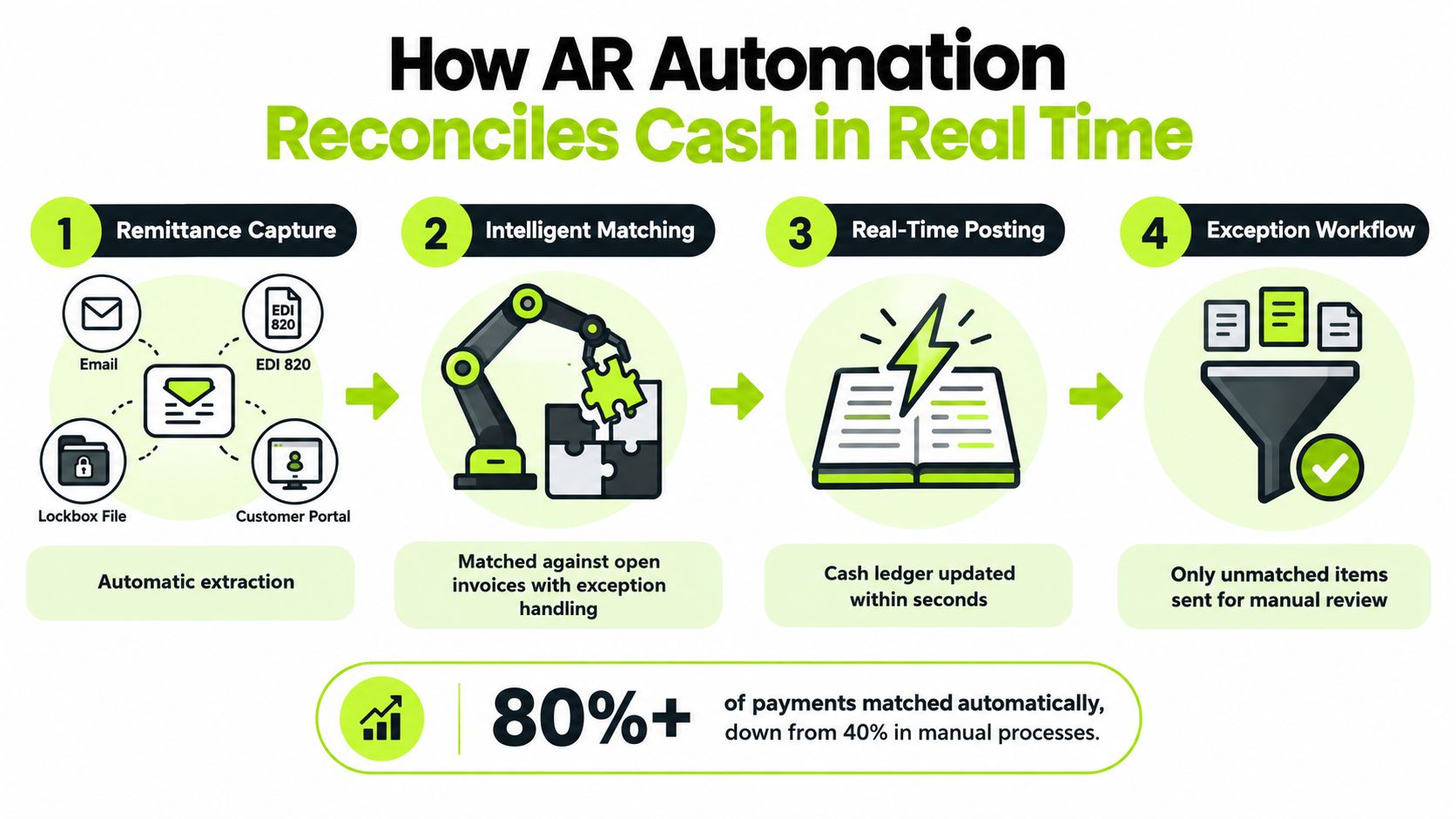
The visual callout says “80%+ of payments matched automatically, down from 40% in manual processes.” Those figures aren't part of the verified data available for this article, so they shouldn't be used as a performance promise. Match-rate targets must come from the firm's own transaction history and exception mix.
QuickBooks Mid Market ERPs and Modern AR Platforms Compared
The system of record doesn't automatically become the system of reconciliation. Each stack handles a different part of the work, and the integration seams determine how much manual effort remains.
System type | Native reconciliation | Manual work remaining | Integration gaps |
|---|---|---|---|
QuickBooks Online or Desktop | Basic bank-feed and invoice application for straightforward customer payments | Remittance research, split payments, deductions, credits, and exception follow-up | Bank feeds may lack remittance detail, while EDI, multi-entity netting, and complex customer workflows need additional tools |
Mid-market ERP, such as NetSuite, Sage Intacct, or Microsoft Dynamics | Centralized AR subledger, GL posting, customer balances, and configurable accounting rules | Remittance ingestion, exception classification, dispute coordination, and cross-system investigation | CRM orders, portals, lockbox data, and nonstandard formats may not connect cleanly |
Dedicated AR platform, such as Versapay, Billtrust, or HighRadius | Payment ingestion, matching, exception worklists, customer communication, and write-back to the system of record | Policy decisions, unusual commercial disputes, approvals, and master-data governance | ERP configuration, data ownership, permissions, and unsupported formats still require deliberate integration work |
QuickBooks can serve a single entity with simple remittance behavior well. It becomes less comfortable when payments arrive through EDI, one settlement covers multiple entities, or the team needs structured exception routing rather than a bank-feed screen.
Mid-market ERPs centralize the ledger, which is valuable for financial control. They don't always solve the front end of reconciliation, where remittance data arrives in inconsistent formats and analysts need context from CRM, project management, customer portals, and bank systems.
Dedicated AR platforms own more of the ingestion and matching layer. Their value depends on clean customer master data, reliable write-back, and disciplined exception ownership. A platform that matches quickly but cannot explain the decision or preserve an audit trail creates a new control problem.
Professional services firms comparing accounting stacks may also benefit from reviewing Xero versus QuickBooks. The choice is less important than recognizing the boundary of the accounting system. The practical architecture is usually ERP plus a focused AR layer, not one tool forced to manage billing, collections, cash application, dispute handling, and reporting without specialist support.
KPIs and Weekly Rituals That Keep Reconciliation Honest
A useful dashboard shows where reconciliation is drifting before month-end close. Each measure should lead to a management action, not describe the queue.
KPI | Healthy Threshold | Action When Breached |
|---|---|---|
Automatic match rate | Above 85% is a management target, not a universal benchmark | Review remittance formats, payer identifiers, and matching rules |
Unapplied cash aging | Under 5% of open AR is a management target, not a universal benchmark | Assign customer follow-up and review missing remittance sources |
Exception aging | Cleared within 5 business days is a management target, not a universal benchmark | Escalate tickets without owners or evidence |
DSO | Compare with your sector, geography, contract terms, and trend | Separate collection delay from posting and reconciliation delay |
Collections Effectiveness Index | Stable or improving against your own baseline | Review collector coverage, promise-to-pay follow-up, and disputes |
Write-off ratio | Stable against approved policy and forecast | Review credit controls, dispute causes, and recovery decisions |
These thresholds are operating targets for this process, not universal external benchmarks. Calibrate them to transaction volume, contract structure, customer concentration, and risk tolerance. A multi-entity business may need separate baselines for different payment channels or customer groups rather than one blended target.
DSO requires the same discipline. Allianz Trade reported global DSO between 59 and 68 days in 2026, a global average of about 62 days in 2024, with wide variation across countries and sectors. A rising trend can indicate weaker collections, but it can also reflect unapplied cash, delayed posting, or an aging report that no longer represents the customer account accurately.
The weekly operating meeting
Keep the AR standup short and evidence-based. Bring the exception queue, aging movement, and unresolved decisions from the previous week. Review the full invoice-to-cash flow, including bank files, remittance formats, ERP postings, and customer-account context. A payment that appears unmatched in one system may be fully explained by a separate remittance file or settlement report.
- Assign an owner: Every exception gets one accountable person, not a shared team label.
- Review the oldest items: Discuss why each remains open and what evidence is missing.
- Choose one decision: Approve, reclassify, contact the customer, escalate the dispute, or change the matching rule.
- Look for patterns: A cluster of missing remittances may require a customer instruction, not more collector effort.
- Record the process fix: Close the ticket and document what should prevent recurrence.
Review exceptions by cause, not only by age. A low match rate should prompt a remittance-format review. Rising unapplied cash should prompt customer outreach and bank-file investigation. A growing dispute queue should involve billing or delivery owners, while repeated cross-entity or multi-invoice exceptions may require a rule or data correction.
For firms working to lower days in AR to 35, begin with clear definitions and a reconciled baseline. Otherwise, the team can claim progress by moving receipts between statuses instead of collecting more cash. Track posting delay separately from customer payment delay so the KPI points to the right owner.
The accounts receivable KPI guide can help structure the dashboard. The operating rule is simple: every KPI needs a named response, an owner, and a review cadence. A metric with no trigger action is reporting, not control.
Turning Reconciliation Into a System You Can Trust
Trustworthy reconciliation rests on three operating principles.
First, maintain one customer master. Payer names, legal entities, invoice references, currencies, project codes, and payment instructions must resolve to a consistent customer identity. If the ERP, CRM, bank portal, and billing system each recognize the customer differently, matching will remain fragile.
Second, make automated matching the default and exception routing the fallback. The system should handle repeatable receipts with documented rules and confidence thresholds. Analysts should spend their time on disputes, credits, unusual settlements, and data defects.
Third, turn weekly metrics into process changes. If unapplied cash repeatedly comes from one payment channel, fix the remittance requirement. If short pays cluster around one service line, involve the billing owner. If the same exception returns every close, treat it as a design defect.
The maturity path usually moves from spreadsheets, to rules-based ERP matching, to a modern AR platform with intelligent matching and structured workflows, and eventually toward a continuous close. Each stage reduces dependence on memory and individual heroics.
The underlying problem is structural. Fragmented systems, inconsistent remittance formats, unclear ownership, and weak audit trails won't disappear because the team adds another analyst. More staffing can absorb the queue, but it rarely removes the reason the queue exists.
For firms ready to move beyond rules-based limits, Resolut fits as an AR automation and orchestration layer that supports collections, payment workflows, and automated cash application. The right evaluation is practical: test whether it captures the firm's payment formats, matches against open invoices, routes exceptions with context, and writes accurate results back to the accounting system.
Reconciliation belongs in the control framework presented to senior leadership and the board. It determines whether cash forecasts, aging reports, working-capital decisions, and close results are built on evidence. Either trust the system, or keep staffing the fire.
Resolut automates AR for professional services with payment matching, cash application, collections workflows, and exception visibility built around the invoice-to-cash process. If you want to replace spreadsheet-driven reconciliation with a consistent, accurate, and human-controlled workflow, visit Resolut to see how it fits your finance stack.