
Past Due Invoices and How to Fix Cash Flow Fast
Learn what past due invoices cost, why they age, and how to collect faster, reduce DSO, and prevent overdue invoices with smarter AR controls.
A client payment that slips by a few days rarely looks dangerous on the day it happens. At a professional services firm, the invoice is already issued, the work is complete, and the team expects cash to arrive. Then one large account misses its date, two smaller balances remain unresolved, and the next payroll or supplier run suddenly requires more attention than it should.
For CFOs, Controllers, and owners at firms between $3M and $50M, past due invoices are a control problem before they become a collections problem. They make cash forecasts less reliable, force avoidable borrowing decisions, and pull senior people into account-by-account chasing. Client relationships also suffer when follow-up is inconsistent, overly soft, or unexpectedly aggressive.
The practical answer isn't to send more reminders at random. It's to connect invoice aging with clear intervention thresholds, assign ownership for disputes, and use automation for the repetitive work while keeping human judgment where the relationship requires it.
Introduction Why Past Due Invoices Quietly Drain Control
A services firm can report strong sales, healthy margins, and a full project pipeline while still facing cash pressure. The warning often appears in the aging report: invoices have passed their terms, yet no one has established whether the cause is a missing purchase order, an approval hold, a billing dispute, or client inattention.
The outstanding balance is visible. The expected resolution is not. Finance must distinguish invoices likely to clear through routine processing from those requiring direct contact, internal escalation, or a documented recovery decision. Until that distinction is made, cash forecasts remain less reliable and operating risk stays hidden.
Practical rule: Treat the aging report as a forward-looking risk register, not a historical list of unpaid bills.
Professional services firms face this exposure because they deliver employee time before collecting the related cash. Payroll and project costs are already incurred while the client's approval process continues. If follow-up depends on one person remembering an email, cash conversion rests on personal effort instead of a repeatable control.
Why inconsistency becomes expensive
A courteous reminder can preserve goodwill when an invoice is slightly late and the client usually pays reliably. Repeating that same approach after the balance has aged materially can signal that silence carries no consequence. Finance then has to choose between creating relationship friction through escalation and accepting a greater chance that recovery will become difficult.
The portfolio-level pressure is visible across Europe. A European payment and collection report reports that roughly 1 in 4 invoices is either paid late, at 19%, or never collected, at 5%. Customers across Europe pay invoices about 21 days after the due date on average, so overdue balances represent a recurring working-capital issue rather than an isolated exception.
Intervention timing should follow the aging bucket. Early-stage balances need verification and a clear owner. Older balances need a defined next action, documented dispute status, and a threshold for changing the contact method or escalation level.
A controlled process gives each invoice four fields: an owner, its current aging bucket, the next action, and the point at which intervention changes. That visibility protects the client relationship while preventing courtesy from turning into inaction.
What Past Due Invoices Mean and How Aging Works
An invoice becomes past due when it remains unpaid after the agreed payment date. It may have been outstanding before that date, but the risk profile changes once the deadline passes. For UK businesses, the Small Business Commissioner's payment guidance says trade-credit terms are often set at up to 60 days from the invoice date, and where no terms are agreed, payment is late after 30 days from invoice acceptance.
Think of cash conversion as a journey with checkpoints. The invoice starts in the current bucket, then moves through progressively older stages if the client doesn't pay. Each move gives finance a stronger signal that the original process, payment route, or customer relationship needs attention.
The standard buckets create shared language:
- Current: The invoice is within agreed terms. Confirm delivery, billing details, and payment instructions.
- 1–30 days past due: Start with a factual, low-friction reminder and check whether the client received the invoice.
- 31–60 days past due: Confirm the payment status directly, investigate disputes, and involve the account owner where appropriate.
- 61–90 days past due: Use more direct outreach and set a documented resolution deadline.
- 90+ days past due: Escalate based on balance, relationship, contractual rights, and the likelihood of recovery.
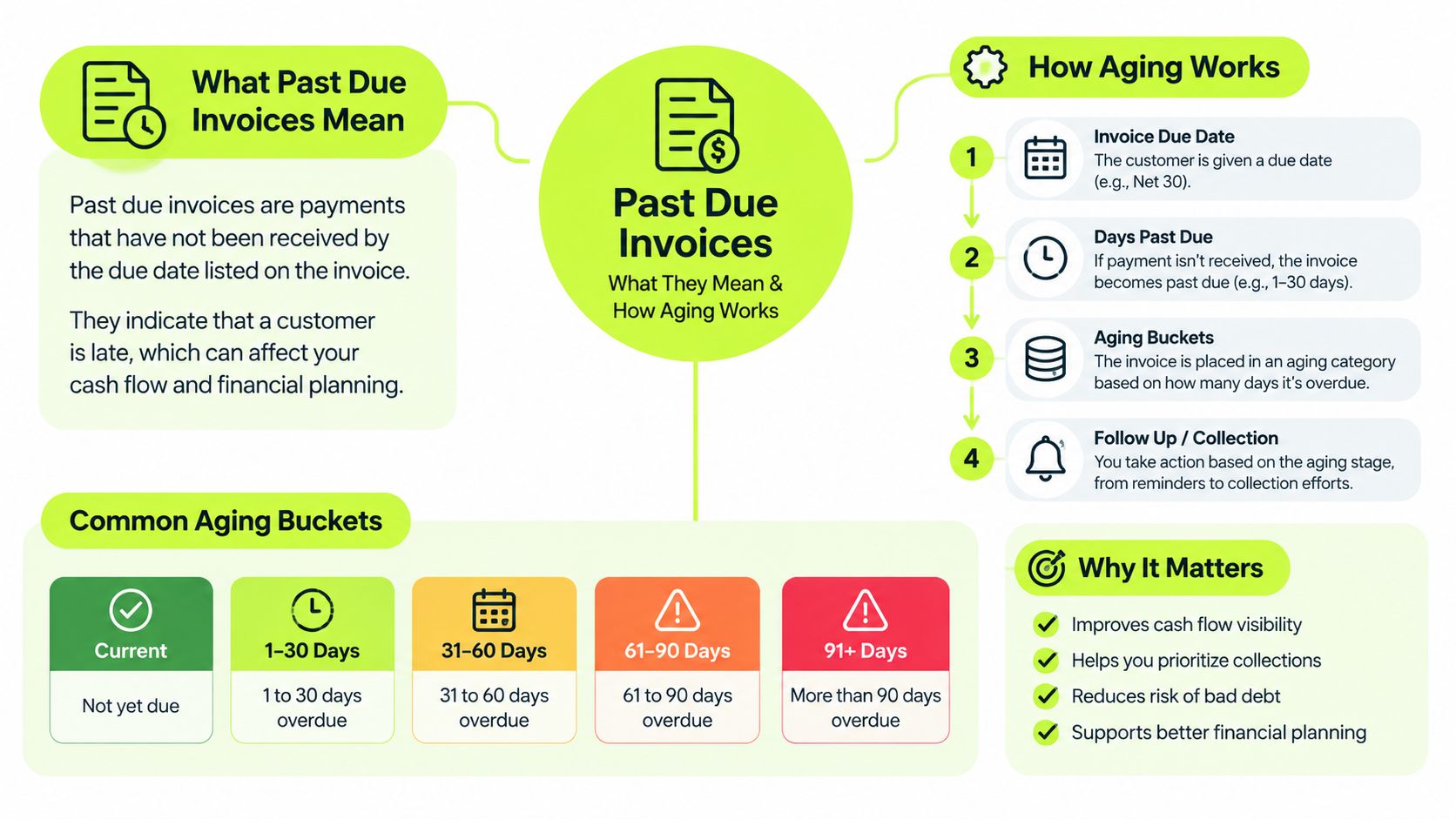
Why the 90-day threshold matters
Age often predicts recoverability more reliably than invoice size alone. A large invoice with a confirmed payment date may be less concerning than a smaller balance that has passed through several unanswered follow-ups.
A widely cited analysis of 250,000 invoices found that an invoice still unpaid after 90 days had only an 18% chance of being paid, as reported in this receivables collectability analysis. That finding explains why the 90-day bucket deserves more than another automatic email. By then, the issue may involve a dispute, a broken approval path, a deteriorating client position, or a failure to maintain contact.
Read the aging report as a queue for decisions. Sort by days past due, outstanding value, dispute status, and prior payment behavior. Then ask what action would change the outcome today. A report that only shows totals describes the problem. A report connected to owners and next steps helps control it.
Why Invoices Go Past Due in Professional Services
Late payment usually has a cause that existed before the due date. Blaming the client may feel satisfying for a moment, but it doesn't identify the control that failed. A better diagnosis separates billing quality, client processing, commercial disputes, and follow-up discipline.

Billing starts too late or arrives incomplete
Professional services billing often depends on time records, milestones, approvals, or project-manager signoff. If the firm waits until every detail is perfect, invoicing can drift. If it sends an invoice without the purchase order, acceptance record, or agreed billing reference, the client's AP team may place it on hold.
The control is simple in principle. Define who approves billable work, when invoices are issued, and which documents must travel with them. A clean invoice delivered promptly gives the client fewer reasons to delay.
Terms aren't clear enough
A due date buried in a contract may not be visible to the project team or the client's billing contact. Payment instructions can also create friction when the invoice supports only one method and the client's AP process uses another.
Finance should make terms visible on the invoice, confirm the correct billing contact, and ensure the engagement team understands any special requirements. Clear terms don't guarantee prompt payment, but unclear terms create avoidable disputes.
Approval and dispute bottlenecks
A client may accept the work but still lack an approved purchase order, receiving confirmation, or internal signoff. A disputed line item can sit while automated reminders continue to arrive. That approach wastes time and may damage trust because the finance team is asking for payment without addressing the reason for the hold.
Separate disputed invoices from ordinary reminders. Assign the dispute to someone who can resolve the underlying issue, while collections tracks the promised action and date.
Follow-up lacks ownership
The final cause is usually operational. One person sends a reminder, another assumes the account manager is handling it, and nobody calls when the email receives no response. The invoice ages without a deliberate decision.
A reliable process defines the handoff. Finance can manage routine outreach, account managers can add relationship context, and leadership can approve credit holds or formal escalation. The important point is that ownership changes by condition, not by memory.
The Real Financial Impact Beyond Late Payment
Past due invoices reduce more than the bank balance. They consume working capital that the firm expected to use for payroll, suppliers, tax obligations, hiring, and investment. When the aging report grows, management loses flexibility before the income statement visibly deteriorates.
Independent UK research found that 44% of invoices were paid late, £112 billion was locked up in late payments, and the smallest businesses were owed an average of £42,000 in overdue invoices, according to Sage's late-payment research. The exact portfolio will differ by firm, but the operating mechanism is familiar: delayed receipts lengthen the cash-conversion cycle and reduce the funds available for normal commitments.

The borrowing effect
When expected customer cash doesn't arrive, firms often bridge the gap with credit cards, overdrafts, or other short-term facilities. That may preserve continuity, but it transfers a receivables problem into a financing decision. The firm pays for liquidity while it waits for money it has already earned.
The 2025 UK QuickBooks research found that small businesses with the most invoices overdue by 30 or more days were more than 1.5 times more likely to report cash-flow problems, more than 3 times more likely to rely on credit cards, and nearly 6 times more likely to report a credit-card denial in the second half of 2024. The same research found they were 1.4 times more likely to have difficulty hiring and retaining skilled workers, as described in QuickBooks' UK late-payments report.
These are not merely collections metrics. They affect how a firm accepts new work, commits to hiring, negotiates supplier terms, and evaluates growth. A business can appear profitable while its operating choices become increasingly constrained by slow receipts.
What CFOs should monitor
DSO remains useful, but it shouldn't stand alone. Pair it with measures that expose concentration and deterioration:
- Aging dollars: Track the value in each bucket, not only the total receivables balance.
- Migration: Watch invoices moving from current into older buckets without a documented dispute or payment commitment.
- Concentration: Identify whether a small number of clients account for most aged balances.
- Resolution time: Measure how long disputes remain open before an owner closes them.
- Forecast variance: Compare promised payment dates with cleared cash.
A portfolio view matters because many modest delays can create more strain than one visible late payer. The financial objective isn't to collect aggressively. It's to make cash availability predictable enough that the firm can plan without repeatedly reaching for emergency liquidity.
How Collection Probability Changes by Aging Bucket
The right collection action depends on timing. Early in the cycle, the firm's job is to remove friction. Later, it must determine whether the balance needs escalation, negotiation, or a formal recovery path.
Benchmark data places collectability at approximately 93–95% for invoices 1–30 days past due, declining to 85–90% at 31–60 days, 70–80% at 61–90 days, and 45–55% by six months past due, according to accounts receivable collection benchmarks.
Aging Bucket | Collectability Range | Recommended Action |
|---|---|---|
1–30 days past due | ~93–95% | Send a helpful reminder, confirm receipt, attach the invoice, and ask whether any documentation is missing. |
31–60 days past due | ~85–90% | Contact the billing owner directly, investigate disputes, and secure a payment date. |
61–90 days past due | ~70–80% | Use phone outreach, involve the account manager, and set a firm resolution path. |
Six months past due | ~45–55% | Evaluate formal demand, third-party collections, legal advice, or a structured payment plan. |
Match tone to the evidence
At 1–30 days, a reminder should assume an administrative oversight. Include the invoice number, due date, balance, payment instructions, and a direct question about receipt. The objective is to make payment easy and surface a hidden issue.
At 31–60 days, email alone becomes less dependable. A phone call can reveal an approval hold, missing documentation, or a commercial concern that a template won't uncover. Keep the discussion factual and record the agreed next step immediately afterward.
Past 60 days, waiting has a measurable cost. Formal demand letters, account-manager involvement, service restrictions where contractually appropriate, third-party collections, or legal review may become more efficient than another cycle of identical reminders.
Collection discipline: Escalation should reflect age and cause. A disputed invoice needs resolution, while a silent and nonresponsive account needs pressure and ownership.
The process becomes easier to maintain when teams run collections as a workflow instead of treating every balance as a separate project. A current aging report should show the next action, responsible person, and last customer response, not just the invoice total.
Building Controls That Prevent and Remediate Overdue Invoices
A past due invoice is usually the result of a control failure before it becomes a collections issue. Billing accuracy, clear terms, payment access, ownership, and timely intervention determine whether an account remains current or enters a higher-risk aging bucket.
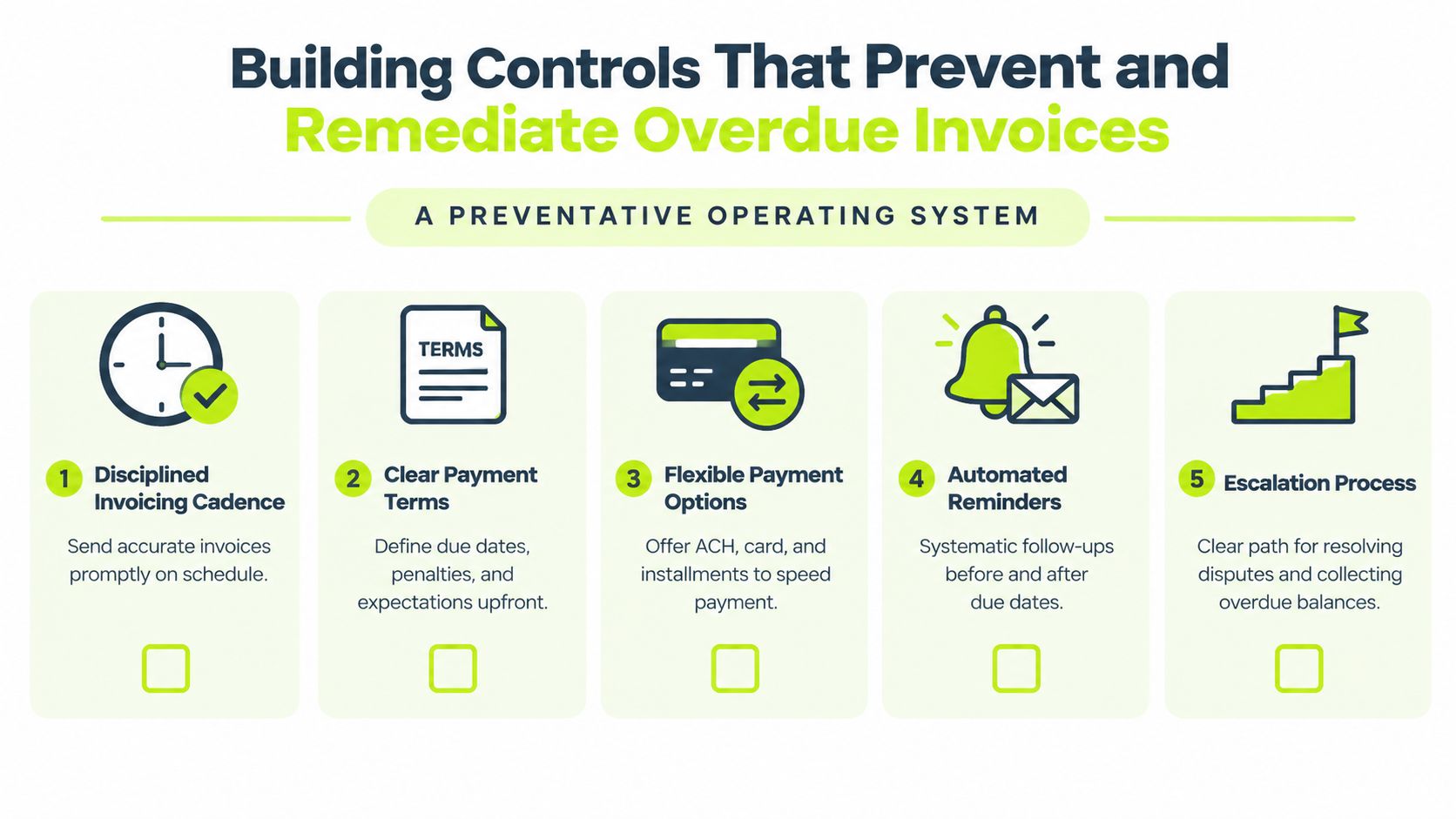
Five controls worth implementing
1. Invoice on a disciplined cadence. Issue accurate invoices as soon as the contract or project milestone permits. Delayed billing reduces the client's processing time and shifts part of the cash delay back to the firm.
2. Make terms operational. Display the due date, required references, applicable late-fee provisions, and payment instructions clearly. Confirm the client's submission route before sending the first invoice. A valid invoice sent through the wrong portal can age just like an inaccurate one.
3. Remove payment friction. Offer practical methods such as bank transfer or card where appropriate. Fewer steps reduce the chances that an approval, form, or payment setup issue will stall settlement.
4. Automate routine actions, not judgment. Accounts receivable automation can schedule reminders before and after the due date, record replies, and identify invoices requiring human attention. AI AR automation can help prioritize risk and adjust workflows, while finance staff retain control over disputes, strategic accounts, and relationship-sensitive decisions.
5. Assign escalation ownership. Set the point at which finance calls, the account manager joins, service restrictions are reviewed, or leadership and counsel assess recovery options. Every threshold should create a named task with a due date.
Controls work best when the timing matches the aging bucket. Early reminders should make payment easy and expose administrative problems. Older balances require clearer ownership and a documented decision on whether to resolve, restrict, restructure, or pursue recovery.
Automation with human oversight
For a professional services firm using QuickBooks, QuickBooks AR automation can connect invoice status, reminders, and payment activity into a consistent operating rhythm. The software matters less than the rules behind it. It should stop reminders when a dispute is logged, route strategic accounts for approval, and preserve a complete outreach record.
Finance teams also need reliable records across customer balances, supplier records, and payment activity. Guidance on auditing accounts payable with OneSafe offers a useful framework for checking document completeness, approval evidence, and exception handling.
Customer outreach should be factual and easy to act on. A past due invoice email template can standardize the invoice number, due date, balance, and payment instructions without forcing every client into the same tone.
The operating model should combine automated reminders with human review. That balance preserves consistency for routine accounts while giving finance a clear intervention point when an invoice is disputed, aging materially, or attached to a key commercial relationship.
Bringing Calm Back to Cash Flow With Smarter AR
Past due invoices become manageable when the firm stops treating them as isolated annoyances. Aging tells you where the balance sits. Root-cause analysis tells you why it is late. Intervention thresholds determine what should happen next, and automation makes sure the action occurs consistently.
That combination helps finance leaders reduce DSO without turning every client conversation into a confrontation. Early reminders can remain courteous, while older or unresponsive balances receive direct attention from the right person. The firm protects both cash flow and commercial trust because the message reflects the situation rather than a generic sequence.
The operating dashboard should answer a few practical questions quickly:
- Which invoices moved into a higher-risk bucket this week?
- Which promised payments have not cleared?
- Which disputes lack an owner?
- Which clients repeatedly require manual intervention?
- How much cash is expected, and how much is at risk?
Teams evaluating what AR automation means should focus on those control outcomes rather than on message volume. A useful platform gives the finance team accurate aging, structured workflows, payment visibility, and escalation support. It should also make it easy to step in when judgment matters.
For professional services firms, the result is not aggressive collections. It's a more dependable cash engine. The firm bills promptly, follows up predictably, resolves exceptions early, and reserves senior attention for balances where it can change the outcome.
Resolut automates AR for professional services with consistent workflows, accurate invoice follow-up, payment visibility, and human oversight for sensitive accounts. If past due invoices are making cash flow less predictable, visit Resolut to see how a calmer AR process can support your finance team.