Automated Utility Billing: A CFO's Guide to Cash Flow
Learn how automated utility billing reduces DSO, cuts errors, and improves cash flow. A guide for finance leaders on implementation, vendor selection, and ROI.
Month-end billing often looks controlled from the outside and fragile from the inside.
A partner approves fees late. A project manager changes a scope line in one system but not another. Someone in finance exports time, checks contract terms, updates a spreadsheet, issues invoices, and then spends the next two weeks answering avoidable payment questions. Cash comes in, but not on a timetable you can trust.
That's why automated utility billing matters beyond utilities. The term comes from sectors like energy and water, but the operating model applies directly to firms with recurring retainers, usage-based charges, milestone billing, and mixed fee arrangements. For a CFO or controller, it's less about invoice production and more about building a billing system that turns contractual value into predictable cash.
Beyond Invoices Reclaiming Control with Automated Billing
Automated utility billing is best understood as a financial operating system. It takes recurring billing rules, source data, client communication, payment collection, and exception handling, then runs them through a controlled process instead of a monthly scramble.
That distinction matters. Many firms think they need better invoicing software when what they need is tighter billing governance. Software alone won't fix a process where terms live in email, approvals sit with partners, and finance staff manually reconcile client-specific exceptions.
What changes when billing becomes a system
In utility environments, automation matured when teams moved from manual invoice handling to data-driven workflows built on smart meters, consolidated billing files, and billing software. The U.S. Department of Energy notes that consolidated billing aggregates data for all meters into a single spreadsheet, eliminating repeated manual entry and standardizing the process in commercial utility billing through consolidated billing guidance from the U.S. Department of Energy.
Professional services firms can apply the same logic even if they don't bill for kilowatt hours or water usage.
A practical translation looks like this:
- Retainer firms map contract terms to recurring schedules and approval thresholds.
- Project-based firms turn milestones, change orders, and pass-throughs into rule-based billing events.
- Hybrid firms connect time, deliverables, and fixed fees into one accounts receivable automation workflow.
Practical rule: If finance has to reinterpret the contract every month, billing isn't automated yet.
That's also why the best operating model usually isn't full autopilot. Even advocates of automation acknowledge that errors can slip through for months without structured human review, which is why a hybrid model of automation plus expert oversight works better than blind trust in the system as discussed in this review of manual versus automated utility billing.
Control beats speed alone
Most firms start this project because they want to reduce DSO or improve cash flow. Fair enough. But the stronger reason is control.
When billing is systematized, you can forecast invoice release dates with more confidence. You can see which exceptions are operational and which are commercial. You can separate routine processing from judgment calls. That changes team structure as much as it changes tooling.
If you want a parallel example outside professional services, the same principle shows up in property operations where owners use software to automate landlord rent payments and reduce recurring collection friction through standardized workflows rather than ad hoc follow-up.
The finance win is simple. Less improvisation. More predictability. Better cash conversion.
How Automated Billing Systems Actually Work
A partner asks on the third business day why one client's invoice is out, another is still pending approval, and a third posted cash to the wrong matter. That is the moment the billing process gets exposed. The issue usually is not fee logic. It is the operating model behind the bill: where source data enters, who approves exceptions, how invoices get routed, and how cash gets matched back to the ledger.
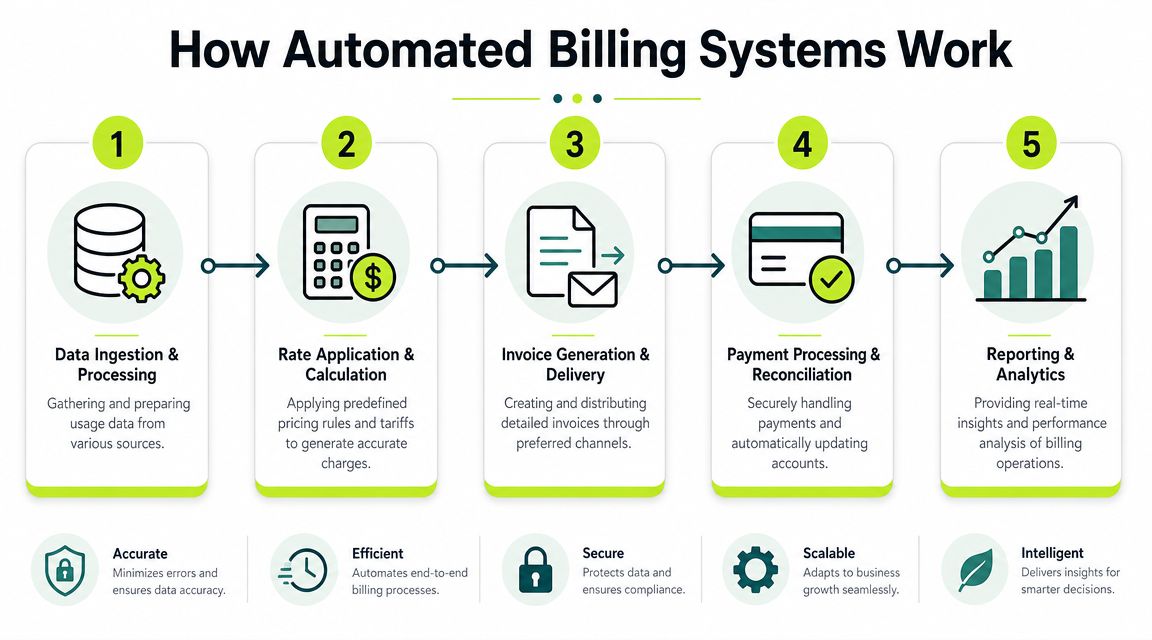
Data ingestion and validation
Recurring billing starts with source data pulled from the systems that create the charge. In utilities, that may be meter reads. In a firm, it is more often time entries, matter budgets, usage volumes, seat counts, milestones, retainers, or contract schedules.
The first control point is validation before billing runs. If time is unapproved, a rate table is outdated, a milestone is incomplete, or a client-specific rule is missing, the system should stop the invoice from advancing. Good automation does not push bad inputs through faster. It quarantines them, assigns ownership, and leaves an audit trail.
Many firms misread the problem. They focus on invoice templates when the larger risk sits upstream in data governance. If finance still has to clean source records by hand at month-end, billing remains dependent on individual effort rather than process discipline.
The rating engine
Once data clears validation, the billing engine applies contract logic. That can include fixed monthly fees, hourly components, discounts, minimums, overages, taxes, pass-through costs, and phased schedules tied to delivery or time.
In utility billing, teams often call this tariff logic. In a firm, it is the same idea translated into commercial terms. The system needs to calculate charges consistently and explain them line by line. Partners should be able to ask a simple question and get a clear answer: why did this client receive this invoice amount this month?
That standard matters for more than accuracy. It determines how dependent your process is on one billing manager who knows the exceptions from memory.
Invoice generation and delivery
After charges are calculated, the system builds the invoice package and sends it through the right channel. Formatting is part of it. Routing is the bigger issue.
Late cash often starts with basic delivery failures. The invoice goes to the engagement lead instead of accounts payable. Backup detail is missing. A client that expects one consolidated monthly package receives four separate emails from different teams. The billing engine may have done its job, but the operating process still broke collections.
Three controls make a difference:
- Maintain billing contacts by role. Billing approver, AP contact, and commercial owner are often different people.
- Match supporting detail to the client's review process. Some clients want a summary invoice with attachments. Others need line-level backup in a specific file format.
- Set invoice release dates and hold to them. Predictable billing calendars improve client readiness and make internal forecasting more reliable.
If payment posting is still handled manually after invoices go out, the process remains incomplete. A tighter close-to-cash workflow usually includes automated payment reconciliation so remittances, short pays, and unapplied cash do not sit unresolved.
Payment processing and automated reconciliation
Once the invoice is delivered, the next layer handles payment intake and cash application. That includes portals, ACH and card processing, remittance capture, exception handling, and posting entries back to the ledger or ERP.
The importance of trade-offs becomes apparent. More payment options can reduce friction for clients, but they also increase reconciliation complexity and fee exposure. Straight-through cash application improves close speed, but only if remittance data is clean and customer IDs are governed tightly across systems.
A billing workflow is complete when cash is applied correctly and exceptions are visible to the people who can resolve them.
Reporting and analytics
The final layer is reporting built for control. Finance needs visibility into invoice release timing, exceptions by cause, manual touches by client, unapplied cash, credit memo trends, and disputes that slow collections.
Used well, billing analytics change team structure. Routine work moves into scheduled workflows. Analysts spend less time assembling invoices and more time reviewing exceptions, monitoring contract compliance, and finding the accounts that create avoidable billing friction. That is the point of automation in a recurring revenue model. Better process control, clearer accountability, and a billing cadence the firm can forecast with confidence.
The Financial Impact of Billing Automation
Month-end closes. Billing is still waiting on usage files, approval emails, and rate exceptions buried in spreadsheets. In a utility or recurring-service business, that delay does more than slow invoices. It distorts cash forecasts, ties up finance staff in avoidable rework, and leaves partners making decisions from incomplete numbers.
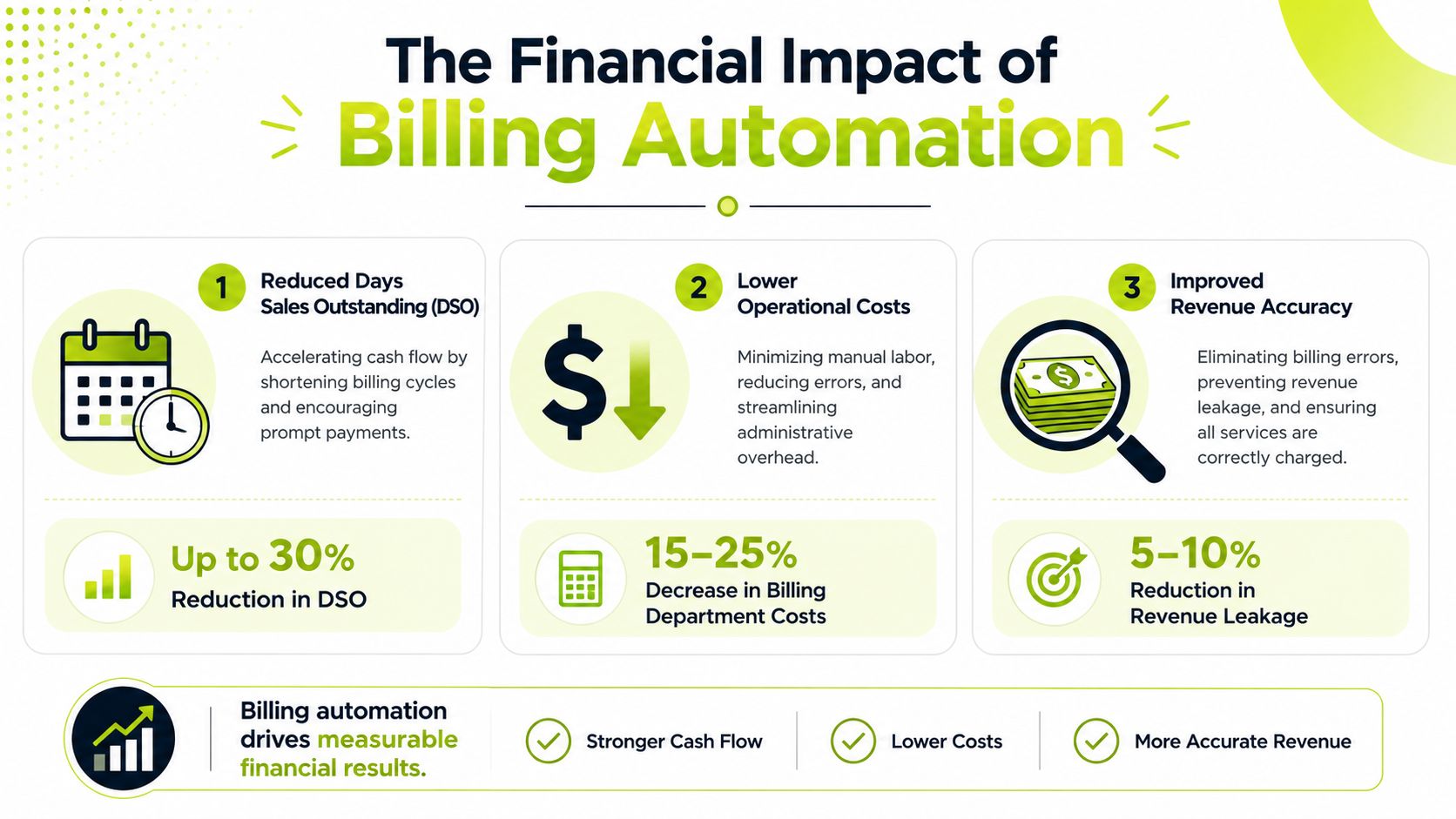
That is the financial case for automation. Better software matters, but the bigger gain comes from a tighter operating model. Billing moves from a manual relay race to a controlled process with defined inputs, release rules, exception owners, and a predictable cash pattern.
Cash flow improves when billing becomes a controlled cadence
The first financial gain is timing. If invoices go out on schedule, with the right backup and the right approvals already captured, the payment clock starts earlier and forecast accuracy improves.
That does not mean DSO falls overnight. It means finance finally controls the variables that usually push cash out: late invoice release, disputed charges, missing documentation, and inconsistent follow-up. For firms with recurring revenue, that control matters more than headline efficiency. Predictable billing creates predictable collections.
Teams evaluating accounts receivables automation often start with collections. I usually advise the opposite. Fix billing discipline first, because collections performance is often a downstream result of invoice quality, timing, and contract compliance.
Margin improves when billing rules are standardized
Manual billing creates small losses that rarely appear as a single line item. A missed late fee here. An outdated rate table there. A usage exception that never gets reviewed before the invoice goes out. Over a year, those errors turn into lower realized revenue and more write-offs than many firms expect.
Automation reduces that exposure by moving billing logic out of individual habits and into controlled rules. That changes how finance manages margin. Instead of reviewing output after the fact, the team controls inputs before revenue is posted.
For utility and other recurring billing environments, the common leakage points are familiar:
Leakage source | Manual symptom | Better automated control |
|---|---|---|
Unbilled usage or time | Source data arrives late or is missed entirely | Required data validation before bill run |
Contract drift | Legacy rates or terms remain in use | Centralized pricing and effective-date controls |
Pass-through omissions | Charges live in separate systems | Automated source feeds tied to billing rules |
Client-specific exceptions | One employee remembers the workaround | Documented workflows with approval ownership |
The same principle applies whether the stack includes ERP workflows, utility CIS platforms, or automated invoice processing solutions. The financial return comes from fewer judgment calls at the point of invoicing and fewer corrections after the invoice is sent.
A short explainer is useful here if your team wants a visual walk-through of the finance case for automation.
Team capacity shifts from invoice assembly to financial control
Automation does not eliminate billing work. It changes the work.
Clerical effort drops. Review discipline rises. Staff spend less time compiling invoices and more time handling exceptions, checking contract adherence, reviewing disputed items, and monitoring accounts that create recurring friction. That is a better use of finance talent, especially in firms where experienced staff are too expensive to spend week after week formatting bills and correcting preventable mistakes.
There is a trade-off. Standardization exposes weak source data and inconsistent commercial terms. Some firms experience more visible exceptions at first, not fewer. That is not a failure of automation. It is the system surfacing control gaps that were already costing money.
Client response improves when invoices are easier to approve and pay
Collections depend on client behavior as much as internal effort. Clear invoices, consistent formats, accurate usage detail, and straightforward payment options reduce the reasons clients delay approval.
From a CFO's seat, that affects two metrics at once. Cash comes in faster, and collection effort per account drops. The best automated billing environments improve both, because they remove avoidable disputes before the invoice reaches the client.
Billing quality is not measured only by whether the math is right. It is measured by whether the invoice can move through the client's approval process without friction.
Your Implementation Roadmap and Checklist
Most billing automation projects fail before go-live. Not because the software can't bill, but because the firm never translated its commercial rules into operational rules.
A clean rollout starts with structure. Treat it like a finance transformation project, not an app install.
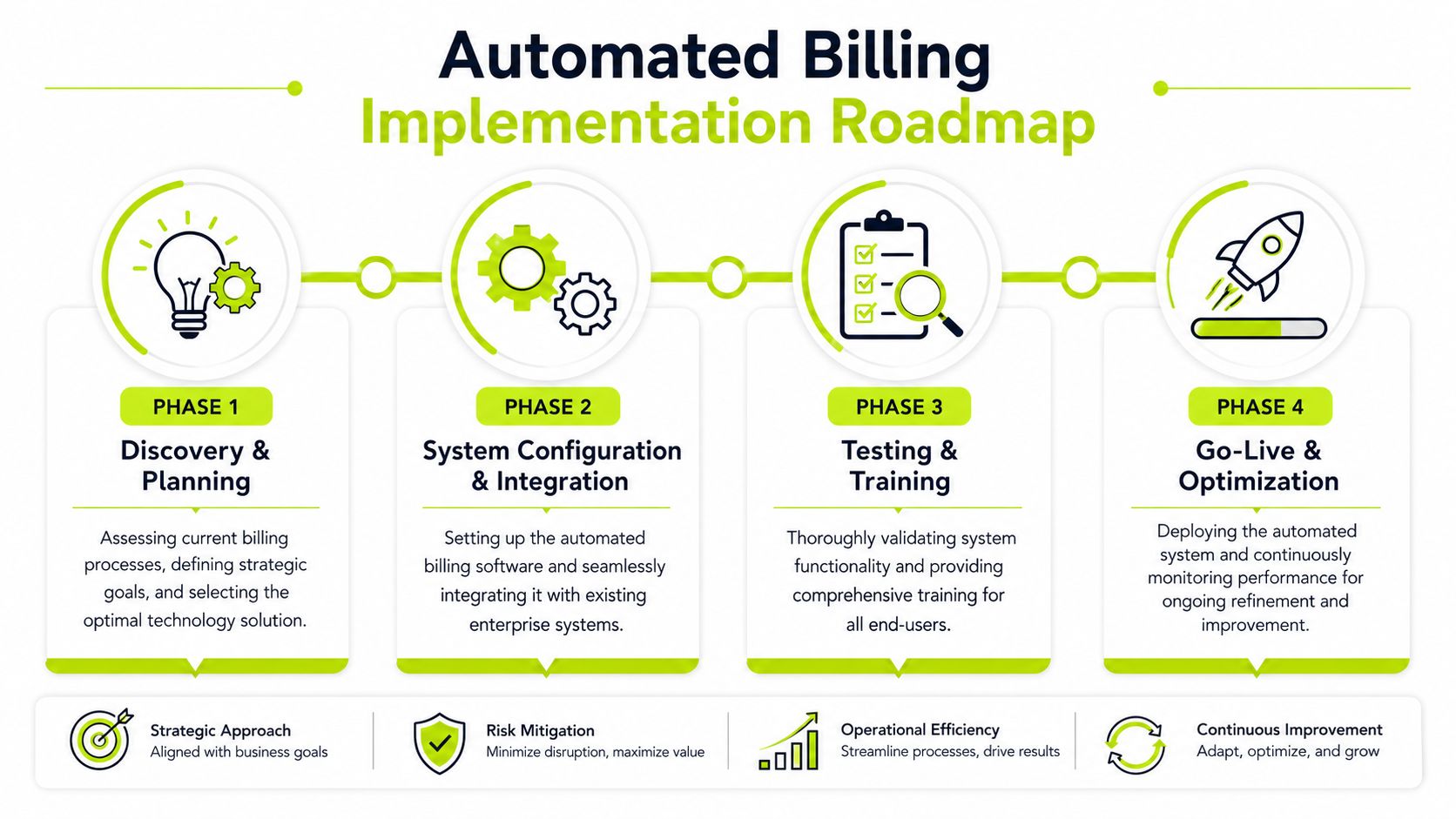
Phase 1 discovery and data
Start with the truth, not the aspiration. Pull a sample of recent invoices and trace each one back to contract terms, source records, approvals, and payment outcome.
You're looking for where billing logic currently lives. Sometimes it's in QuickBooks. Sometimes it's in PSA software. Often it's in partner habits and spreadsheet notes.
In high-volume environments, data quality is usually the constraint. Modern billing pipelines validate source data before billing and estimate missing reads under predefined rules because downstream accuracy depends on complete, validated inputs, not raw data alone as explained in this analysis of billing data validation.
Use that as your implementation standard.
Checklist for Phase 1
- Inventory source systems such as QuickBooks, CRM, PSA, payment gateways, and contract repositories.
- Identify required fields for every invoice type, including billing contact, fee basis, approval owner, and supporting detail.
- Find exception patterns like manual credits, off-cycle invoices, disputed time, and stale rates.
- Set governance rules for who owns rate changes, client setup, and billing overrides.
Phase 2 logic and configuration
Now turn contract terms into machine-readable rules. This step often makes many teams uncomfortable because it exposes inconsistency.
If two clients with the same pricing structure are billed differently because “that's how we've always done it,” the system will force a choice. Good. That's the point.
A simple way to frame the work:
Billing scenario | Rule to configure |
|---|---|
Monthly retainer | Bill on schedule unless account is on hold |
Usage overage | Add approved units above base threshold |
Milestone billing | Release invoice only after milestone status changes |
Pass-through expenses | Include only coded, approved reimbursables |
If your AP team is improving the intake side of finance at the same time, this overview of automated invoice processing solutions is a useful complement because billing automation works best when payables and receivables both run on cleaner data and fewer manual touches.
Phase 3 payments and reconciliation
Don't stop at invoice issuance. Set up the payment and posting logic before launch.
That includes payment methods, remittance handling, portal access, partial-payment rules, and write-off thresholds. It also includes escalation paths when payment arrives without usable remittance data.
Operating principle: If cash application still depends on inbox triage, your billing automation project is only half done.
Checklist for Phase 3
- Choose payment rails your clients will use.
- Map remittance matching rules by customer, invoice number, amount, and payment reference.
- Define exception queues for short pays, unapplied cash, and disputed invoices.
- Confirm ledger posting logic so AR, bank, and revenue records stay aligned.
Phase 4 launch and optimization
Pilot first. Pick a manageable client segment with recurring billing and cooperative internal stakeholders.
Run the new workflow in parallel long enough to compare outputs, exception rates, and payment behavior. Then expand in waves. After launch, review exception queues weekly. That's where the operating model shows its strengths and weaknesses.
Focus your post-launch review on qualitative questions:
- Where are humans still reworking invoices?
- Which clients need special communication handling?
- What data defects keep stopping invoice release?
- Are partners following the approval cadence the system assumes?
This is also where reduce DSO stops being a slogan and becomes a managed outcome. The system gives you process discipline. Finance still has to enforce it.
Choosing the Right Automation Partner
Vendor selection gets framed as a feature comparison. That's usually the wrong lens.
A billing platform should fit your commercial model, your finance stack, and your client experience. If it can't do all three, it will create new work faster than it removes old work.

Five criteria that matter in practice
Integration depth
A shallow integration exports invoices. A deeper one shares customer data, contract changes, payment status, and reconciliation detail across systems. Ask what happens when a client contact changes, a rate changes mid-cycle, or a payment lands without remittance.
Billing flexibility
Professional services firms rarely have one pricing model. You may need fixed fees, usage add-ons, staged billing, and exceptions for legacy clients. If the vendor handles only simple recurring invoices, finance will end up back in spreadsheets.
Scope across AR
Some tools stop at invoice creation. Others extend into collections, payment orchestration, and cash application. If your objective is to improve cash flow, not just send invoices faster, broader AR coverage matters.
One option in this category is automated billing software. Resolut, for example, combines billing, collections workflows, payment options, and cash application in one AR automation environment. That matters if you want fewer handoffs across systems rather than a point solution.
Trust and client-facing design
Many finance teams underweight the payment experience because they focus on internal controls. Clients don't.
Utility Dive reports that 80% of consumers distrust platforms that appear outdated, 55% abandon transactions that feel unclear or insecure, and one in four consumers is less likely to engage with payment-related messages from third-party platforms in this Utility Dive report on trust and utility payment programs.
That has a direct implication for AR software for professional services. If the portal looks dated, the sender identity feels unfamiliar, or the payment page creates doubt, clients delay action. Finance experiences that as slower collections. The root issue is trust.
Questions worth asking in a demo
Use pointed questions, not generic ones.
- Show me the exception workflow when source data is incomplete.
- Show me a hybrid invoice with fixed fees, overages, and reimbursables.
- Show me how unapplied cash is resolved without manual searching.
- Show me the client payment journey from invoice email to payment confirmation.
- Show me the audit trail for edits, approvals, and rebills.
A strong demo doesn't prove the happy path. It proves the platform can survive the messy path.
That's the standard partners should use.
Common Pitfalls and How to Mitigate Them
The biggest mistake in automated utility billing is assuming automation removes the need for discipline. It doesn't. It exposes whether discipline exists.
Three failure patterns come up repeatedly.
Dirty inputs dressed up as automation
Bad contract data, inconsistent client masters, unapproved time, and informal pricing exceptions don't disappear when you automate. They get processed faster.
Mitigation starts before go-live. Clean the client record. Standardize billing terms. Lock ownership of rate tables and billing contacts. If a field matters to the invoice, it needs a system owner.
The set-it-and-forget-it myth
A reliable operating model still needs oversight. Automated workflows can process errors at scale if nobody reviews exceptions or trend lines.
The fix is to define human checkpoints. Finance should review exception queues, unusual invoice variances, and customer-specific edge cases on a set cadence. Automation should handle routine processing. People should handle judgment.
Change management gets ignored
Billing automation changes jobs. Coordinators stop rekeying data and start managing exceptions. Controllers shift from invoice review to process control. Partners lose some informal flexibility because the system enforces timing and rules.
That transition needs active management.
A practical checklist helps:
- Train by role so project managers, partners, and AR staff each know their part.
- Document override rules so exceptions don't become backdoor habits.
- Review audit trails regularly to see where workarounds are appearing.
- Measure process adherence alongside billing output.
Automated utility billing systems reduce revenue leakage when they enforce a meter-to-cash workflow in one platform, avoiding manual entry errors and preserving a complete transaction trail for audit and review as described in this overview of utility billing software workflows.
That's the point. Automation isn't about replacing finance judgment. It's about giving finance a system where judgment is used deliberately, not constantly.
Resolut automates AR for professional services with a model that stays consistent, accurate, and human. If your firm wants tighter billing control, cleaner accounts receivable automation, and a more predictable path from invoice to cash, you can learn more at Resolut.