
Average DSO by Industry: 2026 Benchmarks for CFOs
Explore average DSO by industry benchmarks for 2026. Guide for professional services CFOs to interpret, target, & reduce DSO for better cash flow.
Revenue is up. Utilization looks solid. The pipeline is healthy. Then you open the aging report and see too much cash sitting in receivables.
That gap is where many professional services firms feel the most pressure. On paper, the business performs. In the bank account, timing tells a different story. Payroll, partner draws, hiring plans, and tax payments don't wait for a client's internal approval chain.
For CFOs, Controllers, and firm owners, average DSO by industry is useful context. But context alone doesn't help you make payroll with confidence. What matters is knowing whether your number reflects a normal billing pattern for your model, or avoidable friction in contracts, invoicing, follow-up, and collections discipline.
More Than a Metric Why DSO Defines Firm Health
A high receivables balance rarely comes as a surprise. Most finance leaders can feel it weeks before the report confirms it. Cash gets tighter than it should. Forecasts require more caveats. A profitable month still ends with awkward conversations about timing.

That's why DSO matters. It condenses several realities into one operational signal: how fast the firm turns completed work into cash, how clients behave once invoices land, and how much drag the billing process creates between delivery and payment. If you need a quick refresher on the core definition, Resolut's guide on what DSO means in practice is a helpful primer.
What finance leaders are really looking at
In a professional services firm, DSO isn't just an AR metric. It shapes decisions far outside finance.
- Hiring confidence: Slow collections make headcount plans feel riskier than the income statement suggests.
- Partner and owner distributions: Cash timing can force conservative decisions even in profitable periods.
- Client mix quality: Two clients with the same revenue contribution can create very different working-capital pressure.
- Operational load: Every delayed invoice usually pulls project managers, account leads, and finance staff into rework.
Practical rule: If revenue quality looks strong but cash predictability feels weak, DSO is often the first place to look.
Why benchmarks only help when you interpret them correctly
A benchmark can reassure you, or mislead you. A firm with a moderate DSO may still have a collections problem if delays come from preventable disputes. Another firm may carry a higher DSO because project approvals, milestone billing, and procurement reviews are built into how the work gets bought.
That's the distinction experienced operators care about. The number matters. The drivers matter more.
For professional services, every collection touchpoint also affects the client relationship. A retailer can rely on immediate settlement at checkout. A consulting, legal, accounting, engineering, or agency firm has to collect from organizations with AP queues, budget owners, engagement leads, and sometimes procurement. That turns DSO into a measure of both cash discipline and commercial maturity.
Decoding DSO What the Standard Formula Hides
The standard formula is simple:
DSO = (Accounts Receivable / Total Credit Sales) × Number of Days in Period
It's clean, fast, and useful. It also hides a lot. If you want to sharpen the numerator before calculating anything, this explanation of the average accounts receivable formula is worth revisiting.
The formula is accurate. The interpretation can still be wrong
On paper, DSO treats receivables as a single pool. In operations, that pool is never uniform.
A firm might have one set of invoices tied to monthly retainers, another tied to time-and-materials billing, and another tied to project milestones that can't be billed until a client signs off on deliverables. The formula averages all of that into one number. Useful for trend tracking, yes. Incomplete for diagnosis, absolutely.
Think of DSO like an average office temperature. If one room is freezing and another is overheating, the average may look comfortable while people in both rooms are miserable. AR works the same way.
What a professional services firm should separate
Before acting on DSO, break the number into operational categories:
Billing pattern | What it can hide |
|---|---|
Retainer billing | Predictable invoices that still get delayed by weak reminder cadence |
Time-and-materials | Approval friction around timesheets, scope questions, or invoice detail |
Milestone billing | Revenue recognized before billing readiness or client acceptance |
Fixed-fee projects | Margin pressure when teams hesitate to invoice awkward change orders |
A single blended DSO can mask where the true delay sits.
DSO tells you that cash is slow. It doesn't tell you whether the issue started in contracting, project delivery, invoice creation, or collections.
The distortions that matter most
Three distortions come up repeatedly in service firms.
- Project timing distortion: Work may be complete internally, but billing waits on documentation, approvals, or milestone acceptance.
- Client workflow distortion: The invoice reaches the buyer, but not the AP process that releases funds.
- Internal behavior distortion: Partners or account leads delay follow-up because they don't want collections to feel too aggressive.
None of those problems show up directly in the formula.
That's why experienced teams don't stop at headline DSO. They look at invoice cycle time, dispute patterns, and who owns each step between work completed and cash received. The formula gives the score. Operations explains the result.
Average DSO by Industry The 2026 Benchmarks
Industry benchmarks are only useful if you read them in the right category. Fast-settling sectors operate under very different rules than firms selling complex services on credit.
One widely cited 2024 industry survey shows how sharply average DSO by industry can vary, with Finance & Real Estate at 11 days, Energy & Utilities at 19 days, Manufacturing & Construction at 21 days, Healthcare, Nonprofit & Government at 22 days, Retail, Food & Entertainment at 26 days, Technology & Professional Services at 34 days, and Distribution & Transportation at 41 days according to the Financial Professionals DSO industry breakdown.
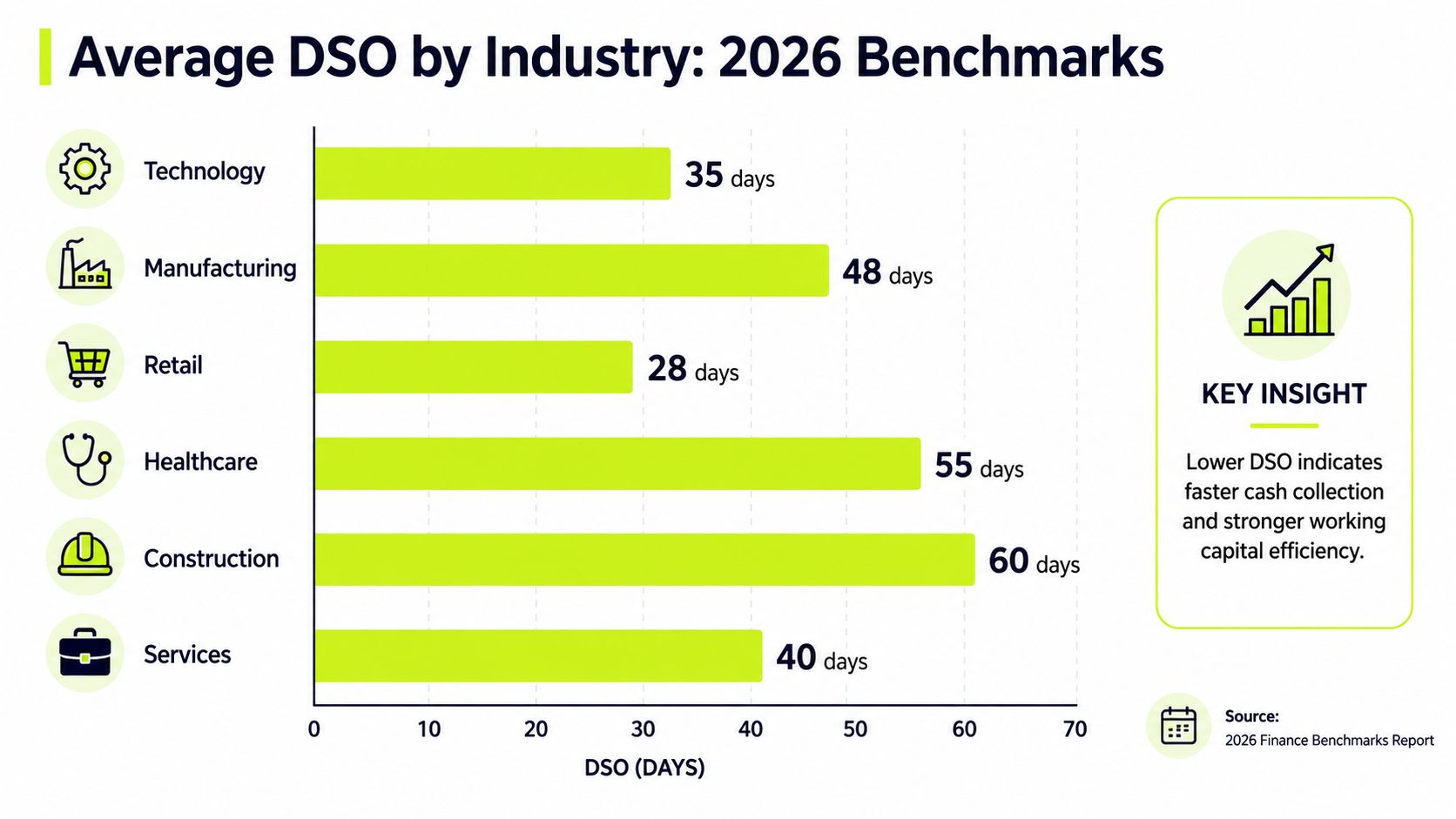
What those benchmarks say at a glance
The first pattern is obvious. Industries with standardized billing and faster payment rails tend to collect sooner. Sectors with more approvals, more customization, and more B2B complexity stretch out.
Here's a simple way to read the spread:
Broad group | Reported average DSO |
|---|---|
Finance & Real Estate | 11 days |
Energy & Utilities | 19 days |
Manufacturing & Construction | 21 days |
Healthcare, Nonprofit & Government | 22 days |
Retail, Food & Entertainment | 26 days |
Technology & Professional Services | 34 days |
Distribution & Transportation | 41 days |
That makes professional services a middle category in the broad survey. Not as fast as standardized sectors, not automatically as slow as the most complex operational environments.
Why broad averages still need caution
A CFO at a services firm shouldn't stop at the 34-day grouping. That number rolls multiple business models together. It can include recurring service arrangements, lighter project work, and firms with cleaner monthly billing habits than a bespoke consulting or engineering practice.
If your firm sells advisory work through statements of work, milestone schedules, approvals, and change orders, the broad category helps with orientation, not diagnosis.
A useful next step is segmenting your own DSO by engagement type, client size, and partner. That's where issues become visible. One office or practice group may run disciplined billing. Another may let draft invoices sit for days because partners want “one more review.”
Benchmarks are context, not permission
I've seen firms use industry averages defensively. “We're in services, so longer collections are normal.” Sometimes that's true. Often it's a polite way to avoid looking at invoicing lag, weak terms, or inconsistent follow-up.
Benchmarking rule: Compare yourself to your industry, but manage yourself against your own process.
If you want to sharpen your view beyond DSO alone, tools used for credit risk assessment in AR operations can help separate structurally slow accounts from preventable collection issues. That distinction matters because “normal for the industry” and “healthy for your firm” are not always the same thing.
Why Professional Services DSO Is a Different Beast
Professional services firms collect under constraints that many other sectors don't face. The product is often intangible, the invoice may depend on partial deliverables, and the person who approves the work is not always the person who releases payment.
That changes the job. AR isn't just chasing invoices. It's coordinating proof of value, internal documentation, client communication, and relationship management.
The structural reasons DSO runs longer
Some service categories sit far above the broad averages. IntelliChief's industry table, based on SageWorks data, reports management consulting at 125.07 days and architectural and engineering services at 74.36 days, as shown in IntelliChief's DSO KPI industry table. That spread tells you something important. Project-based work and longer approval cycles push collections into a different operating model.
The reasons are familiar:
- Billing starts late: Teams finish the work, but invoices wait for narrative cleanup, timesheet review, or partner sign-off.
- Approval chains are layered: A project sponsor may approve the work while AP waits on a purchase order, coding update, or intake form.
- Collections are relationship-sensitive: Finance sees a past-due balance. The account lead sees a strategic client and hesitates to escalate.
- Scope drift creates disputes: Small changes in work effort become invoice questions when contracts and change orders don't stay aligned.
Why the same DSO means different things in different firms
A retail business with slow collections often has a process failure. A consulting or engineering firm may have a process issue, a contract issue, and a client-side workflow issue all at once.
That's why peer comparison needs judgment. A higher DSO in services doesn't automatically mean poor discipline. But it also shouldn't become an excuse for loose billing habits.
Here's the practical difference:
Situation | What it usually points to |
|---|---|
Slow payment on clean recurring invoices | Follow-up and payment workflow issue |
Slow payment on milestone invoices | Approval and documentation issue |
Slow payment tied to scope questions | Contracting and delivery alignment issue |
Slow payment on strategic accounts only | Commercial behavior issue inside the firm |
If partners can override billing discipline informally, DSO becomes a cultural issue, not just a finance issue.
Relationship management changes the collections playbook
In professional services, tone matters. A blunt collections sequence can create more damage than the aging report justifies. But vague, overly deferential follow-up creates a different problem. Clients learn there's no urgency.
That balance is why adjacent sectors have started using automation carefully rather than aggressively. In customer-facing sales environments, for example, teams use AI to increase speed without losing consistency. The same lesson shows up in resources on how AI helps insurance agents. The takeaway isn't about copying another industry's workflow. It's about using systems to make outreach timely, structured, and dependable while keeping the human relationship intact.
For service firms, that's the heart of the problem. You're not collecting from strangers. You're collecting from clients your delivery team still needs to serve next week.
A Practical Framework to Reduce DSO
When a professional services firm wants to reduce DSO without creating client friction, the work usually falls into three buckets: policy, process, and automation. Firms that skip straight to software rarely fix the root issue. Firms that rely only on policy documents rarely sustain change.
The operating model has to hold under pressure, especially when the economy turns. A 2025 benchmark analysis found that recessions can raise DSO by 15% to 25% across industries and 20% to 35% in B2B sectors, with recovery often taking 12 to 18 months after the downturn, according to Credit Pulse's 2025 DSO benchmark analysis. That's why AR discipline can't depend on heroic effort.
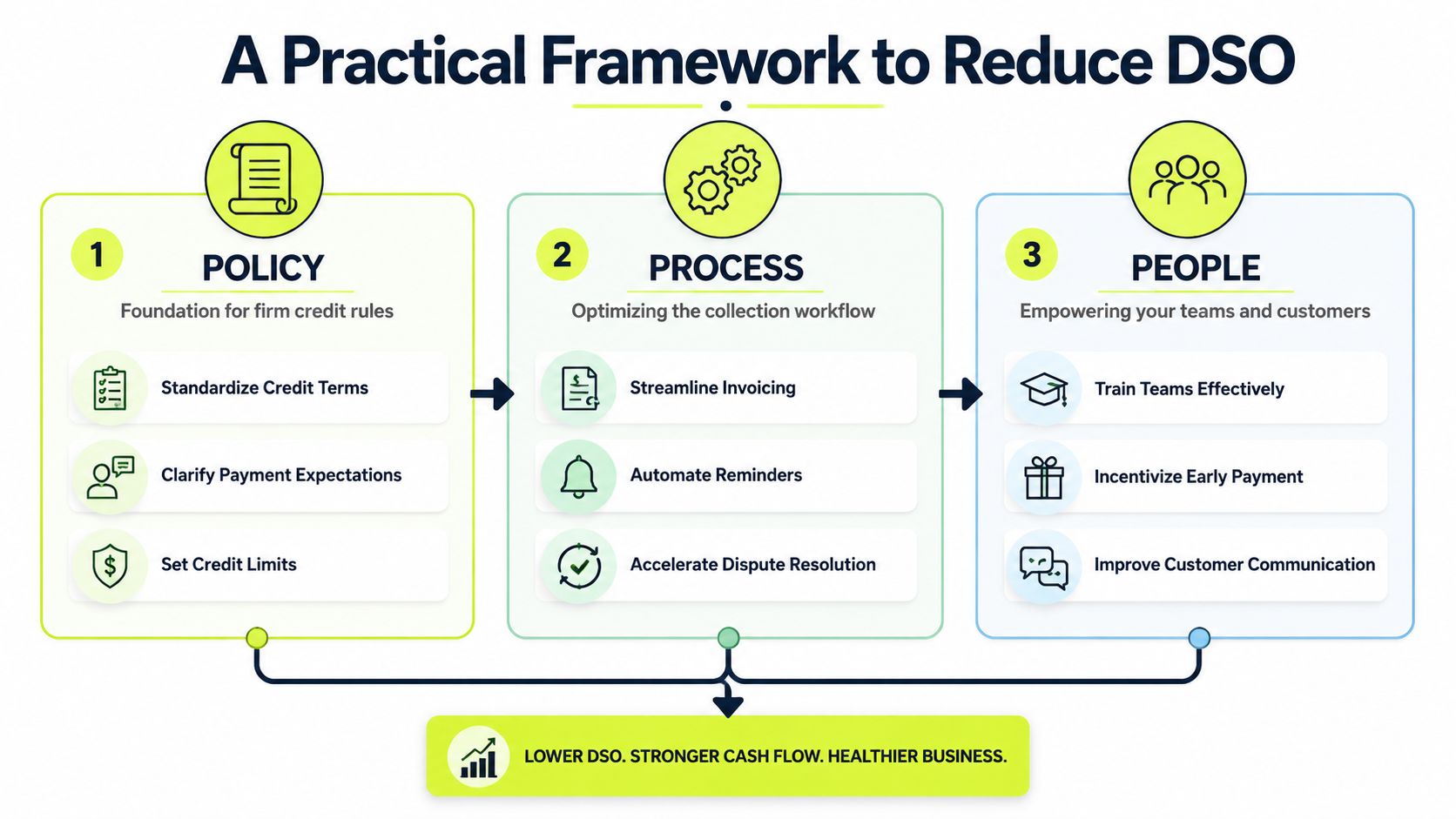
Start with policy
If terms are ambiguous, collections gets harder with every email.
Some firms still treat payment language as legal boilerplate. That's expensive. In services, contract wording directly affects cash timing.
- Define billing triggers clearly: Spell out what allows invoicing. Completed hours, milestone acceptance, monthly retainer date, or another event.
- Set payment expectations before kickoff: Clients should know terms, payment methods, invoice contacts, and dispute process before work starts.
- Create escalation rules: Decide when finance owns follow-up, when account leads step in, and when senior leadership gets involved.
Many firms lose control. Sales promises flexibility. Delivery adapts informally. Finance inherits ambiguity.
Tighten the process before adding tools
Most DSO improvement comes from doing ordinary things on time, every time.
A strong collections process in a services firm usually includes:
- Invoice immediately after the billing trigger Not at month-end if the milestone was approved earlier. Not after someone polishes descriptions for a week.
- Validate invoice routing before sending Confirm the AP contact, required PO details, and client submission method.
- Use a consistent reminder cadence Friendly before due. Clear on due date. Escalate calmly after due date based on account importance and risk.
- Resolve disputes fast The fastest way to age receivables is to let an invoice question sit between finance and delivery.
- Review exceptions weekly Not every account needs executive attention. A small group of slow, high-friction invoices usually drives the pain.
Clean invoicing beats aggressive collections. Most firms would rather prevent a delay than recover from one.
For teams looking to compare operating habits, the NineArchs LLC AR insights collection is a useful outside reference on receivables best practices and collection discipline.
Then use accounts receivable automation where it actually helps
This is the point where accounts receivable automation becomes valuable. Not as a substitute for judgment, but as a way to enforce consistency.
Good AR software for professional services should support the realities of project billing and relationship-sensitive collections. That includes scheduled invoice follow-up, payment links, visibility into client responses, and a clear audit trail showing what happened and when. If your firm runs on QuickBooks, QuickBooks AR automation matters because finance teams don't need another disconnected workflow.
The most practical automation use cases are straightforward:
Automation area | What it should do |
|---|---|
Invoice follow-up | Send reminders on schedule with client-specific tone and timing |
Payment experience | Make it easy for clients to pay without back-and-forth |
Workflow visibility | Show which invoices are waiting on action, dispute, or escalation |
Cash application support | Reduce manual reconciliation work after payment arrives |
AI AR automation can help further when it assists prioritization and timing. The best use isn't flashy. It's deciding which invoices need a softer nudge, which accounts need faster escalation, and where the collections team should spend human attention first.
One option in this category is Resolut, which combines outreach workflows, payment portal support, credit visibility, and cash application in one system for firms managing B2B receivables. Used well, that kind of platform helps finance teams execute the process consistently without making collections feel robotic.
What usually doesn't work
A few approaches tend to disappoint:
- Relying on partner memory: Important invoices don't get collected because follow-up depends on whoever feels urgency that day.
- Sending every client the same message: Strategic accounts, routine payers, and chronic slow payers need different handling.
- Treating AR as finance-only: Delivery teams often control the information needed to clear disputes and approve billing.
- Buying software before fixing invoice discipline: Automation amplifies a bad workflow just as efficiently as a good one.
The firms that improve cash flow sustainably usually do something less dramatic. They make billing rules explicit, reduce handoff friction, and let automation handle repetition with a human override where relationships matter.
From Tracking Metrics to Controlling Outcomes
Knowing the average DSO by industry helps you orient. It tells you whether your firm is operating in a naturally fast or naturally slow collection environment. That's useful, but it's not the point.
The point is control.
A services firm doesn't lower DSO by staring at the metric harder. It lowers DSO by tightening engagement terms, billing on time, routing invoices correctly, handling disputes quickly, and following up with consistency that clients can respect. When those pieces work together, cash flow improves without turning collections into a source of tension.
That's the shift experienced operators make. They stop treating DSO as a passive scoreboard and start treating it as an output of system design. Better AR management doesn't just improve liquidity. It reduces noise across finance, delivery, and client service.
If your firm wants more predictable cash without losing the human side of collections, that's where automation earns its place.
Resolut automates AR for professional services with workflows that support consistent follow-up, accurate execution, and human judgment where client relationships matter. Learn more at Resolut.