
Billing Software for Service Providers: A CFO's Guide
Choosing billing software for service providers? This guide helps CFOs reduce DSO, improve cash flow, and automate AR with a practical evaluation checklist.
If you run a professional services firm, you probably know your aging report by memory. A handful of invoices are current. Some are drifting. A few need careful follow-up because the client matters and no one wants collections to undo a good relationship.
That's where billing software for service providers stops being an admin tool and starts becoming a control system. For CFOs, Controllers, and firm owners, the issue isn't invoice generation alone. It's whether your billing process helps reduce DSO, protect cash flow, and keep client communication disciplined when work, scope, and payment terms keep changing.
The Hidden Costs of Manual Accounts Receivable
Manual AR usually looks manageable until you trace the handoffs. Project managers confirm billable work late. Finance rebuilds invoice detail from email threads. Someone sends a reminder, then waits because the account owner wants to avoid friction. The result is a slower cash cycle than the P&L suggests.
For firms in the $3M to $50M range, that drag shows up in familiar places. Month-end closes get tighter. Forecasting turns tentative. Controllers spend time chasing exceptions instead of reviewing trends. Client-facing teams end up making collections decisions without a consistent process.
A manual process also creates uneven treatment across accounts. One client gets a polished reminder sequence. Another gets silence for two weeks because the team is busy. A third receives a note that's technically correct but poorly timed. None of that looks serious on its own. Together, it makes receivables less predictable.
Practical rule: If payment follow-up depends on who remembers to send the next email, you don't have a process. You have good intentions.
The strongest reason firms move to accounts receivable automation isn't convenience. It's control. Service providers using AR software achieve an average 14-day reduction in DSO, because faster, error-free invoice processing accelerates payment receipt, as noted in Billtrust's review of AR automation for business services.
That kind of improvement matters because it changes operating posture. A shorter DSO cycle gives finance more room to plan payroll, vendor payments, partner distributions, and growth investments without leaning so hard on timing assumptions.
Where manual AR actually costs you
- Team time gets consumed: Finance staff spend hours reconciling remittances, rewriting invoice explanations, and coordinating internal approvals.
- Client trust erodes indirectly: Late or inconsistent billing makes firms look less organized than they are.
- Cash forecasting weakens: Collections become personality-driven instead of workflow-driven.
- Escalation happens too late: By the time a payment issue is visible, the invoice is already aged.
A more detailed breakdown of that operational drag appears in this look at the true cost of AR inefficiency in professional services.
Core Capabilities of Modern Billing Platforms
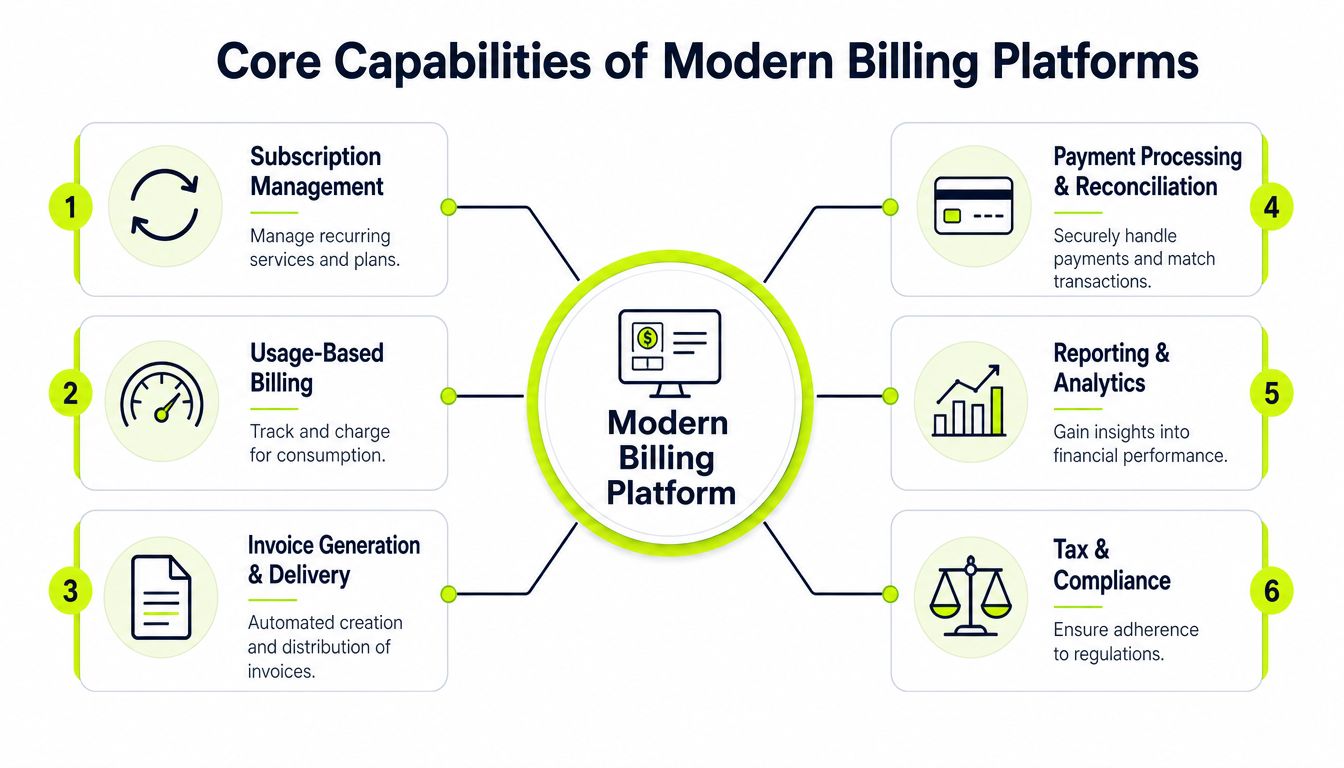
A modern billing platform should close the gap between delivered work and collected cash. That sounds simple, but most finance teams know where it breaks. Contract terms vary. Retainers don't line up neatly with actual usage. Mid-cycle changes create confusion. Payments arrive with incomplete remittance data.
The right platform handles those realities directly.
Dynamic billing that matches real work
Professional services billing rarely fits one template. Some firms bill by milestone. Others mix fixed fees, retainers, expenses, and overages. Hybrid firms add recurring software revenue or support tiers on top.
This is where architecture matters. Advanced billing systems need proration logic with sub-second latency to handle mid-cycle changes accurately. Systems that process billing dynamically instead of in batches help reduce DSO by aligning invoice generation with actual consumption events, as discussed in this analysis of managed services billing software.
That matters for firms with changing project scope. If a client upgrades service mid-month or adds usage after approval, the invoice should reflect that within the same billing cycle. If it doesn't, finance either delays invoicing or writes manual adjustments. Both create leakage.
Recurring revenue and usage in one model
A lot of firms now operate in mixed models. They may have monthly advisory retainers, implementation fees, one-off projects, and variable charges. Basic invoicing tools struggle here because they assume billing is static.
A stronger platform manages:
- Retainers with true-up logic: Monthly fees can coexist with add-on work.
- Usage-based components: Metered support, transaction-based fees, or variable service consumption can flow into the same account structure.
- Contract changes without rework: Finance can update plans and terms without rebuilding invoices manually.
If your firm is blending subscriptions with services, this guide for subscription and DTC brands is useful because it frames recurring billing design in operational terms, not just product terms.
Collections workflows that act on risk
Good billing software doesn't stop at invoice creation. It should support the collections sequence after the invoice is sent. That includes reminder logic, account segmentation, payment retries, and escalation based on aging or customer behavior.
The practical question is whether the system sends reminders, or whether it can route the right action to the right account at the right time. That's the difference between automation and noise.
A clean invoice helps. A timed follow-up sequence is what usually gets cash in the bank.
Cash application and orchestration
For most finance teams, reconciliation is where efficiency gets lost. A payment comes in. The remittance is incomplete. The invoice reference is wrong. Someone from AR has to match the payment manually and clear the account.
That's why integration matters as much as billing logic. A billing platform should connect cleanly to payment gateways, accounting systems, and operational tools. If you're evaluating how these connections work in practice, this explainer on payment orchestration is a useful frame. It shows why payment routing and reconciliation design directly affect AR speed.
Some firms evaluate tools like Maxio, Chargebee, Stripe Billing, QuickBooks AR automation add-ons, and end-to-end options such as Resolut when they want billing, collections, and cash application working in one operating flow.
Quantifying the Financial and Operational Benefits
Finance leaders don't buy billing systems for prettier invoices. They buy them to improve timing, accuracy, and predictability.
When the platform is configured well, the benefit shows up first in cash conversion. Faster invoice creation, cleaner delivery, and fewer manual errors shorten the interval between service delivery and payment. That is the practical path to improve cash flow.
Better timing creates better liquidity
The most immediate gain is usually not headcount reduction. It's fewer delays between work completed, invoice approved, invoice delivered, and payment applied.
That timing discipline makes forecasting more credible. A CFO can look at expected inflows with more confidence when reminders, retries, and reconciliation follow a system instead of relying on inbox management.
Revenue leakage becomes visible
Billing leakage in services usually comes from edge cases. Scope changes mid-cycle. A retainer shifts. A usage threshold is crossed but not captured until the next invoice. Manual processes miss these events because they depend on someone noticing.
One useful benchmark comes from billing architecture guidance that stresses dynamic rating and proration. It argues that real-time handling of billing events prevents revenue leakage and shortens the time from usage to invoice, which supports lower DSO. That's one of the clearest operational links between billing design and cash performance.
The invoice is not the output that matters most. The output is a cleaner path from earned revenue to collected cash.
Recovery improves when follow-up is systematic
Collections performance also changes when outreach is sequenced and payment matching is automated. Billing platforms with automated dunning and reconciliation logic are built to reduce the lag between “customer paid” and “finance confirmed.”
That shortens the admin loop. It also reduces avoidable back-and-forth with clients who believe they've already settled the invoice.
Scale without adding friction
As a firm grows, billing complexity usually expands faster than finance headcount. More service lines, more exceptions, more contract variations, more client-specific terms. Manual AR doesn't scale well under that load.
A well-designed billing process offers significant advantage. That's especially relevant for firms reviewing debt obligations, liquidity needs, and timing pressure across the full working capital cycle. For a finance lens on those downstream implications, this explanation of the cash flow to creditors formula is a useful companion.
An Evaluation Checklist for Finance Leaders
Most billing software demos look polished. That isn't the problem. The problem is that many tools perform well in a standard workflow and break under real service complexity.
A finance-led evaluation should start with exceptions, not the happy path. Ask the vendor to show how the system handles revised scopes, split billing, client-specific payment terms, partial remittances, and disputed invoices. If they can't demonstrate that cleanly, the rest of the feature list doesn't matter much.
What to test in the buying process
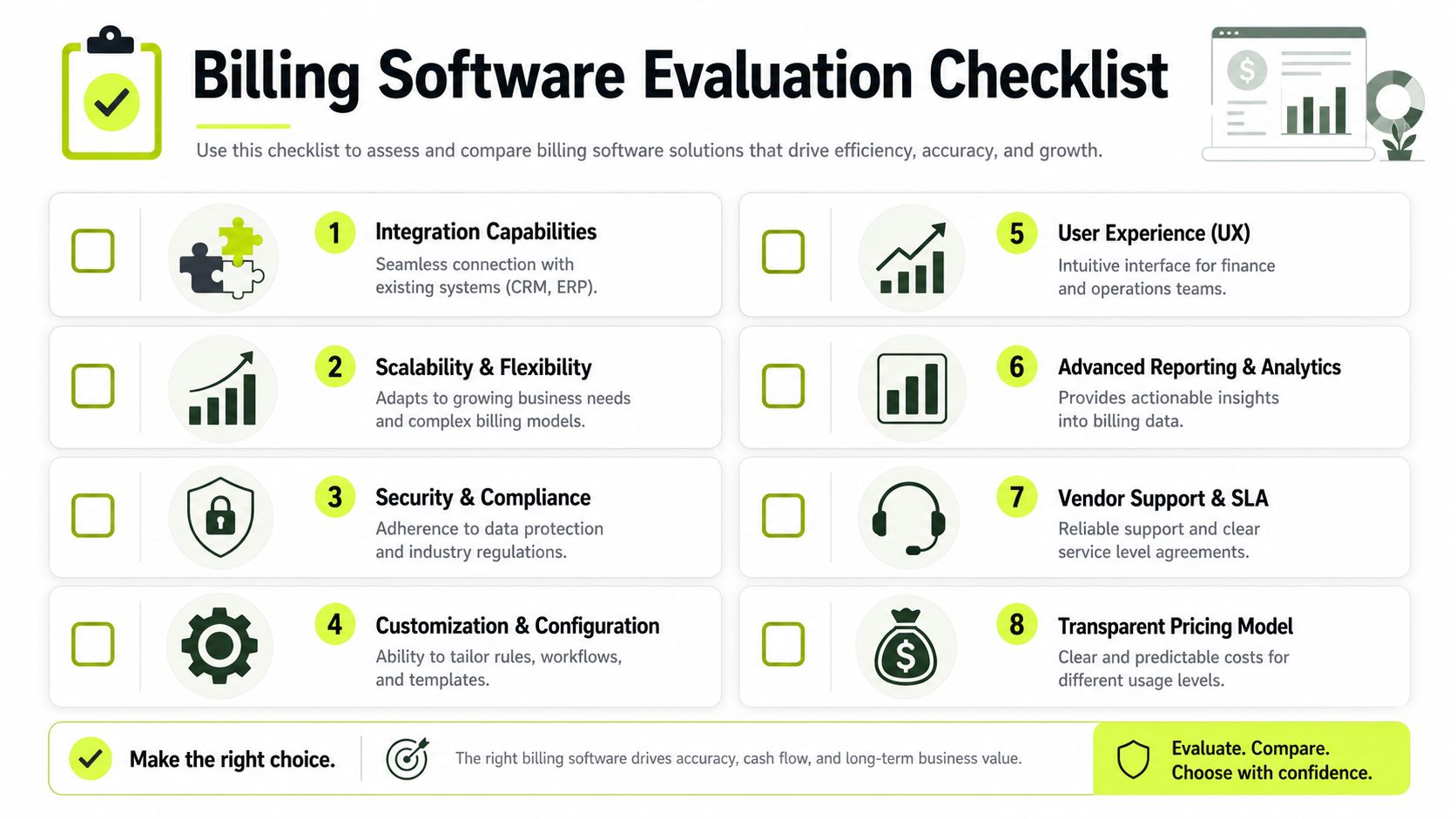
Use a working checklist, not a scorecard built from brochure language.
- Billing model fit: Can the platform handle retainers, recurring fees, milestone billing, and usage-based charges without custom workarounds?
- Workflow depth: Does automation extend beyond reminders into approval logic, retries, reconciliation, and exception handling?
- Integration quality: Will it connect cleanly to your ERP, CRM, payment stack, and reporting environment?
- Client payment experience: Is the portal simple, branded, and easy to use when a client wants to pay quickly?
- Auditability: Can your team see who changed what, when, and why?
The deeper issue is operational fit. A tool can have impressive features and still create more work if every nonstandard invoice requires manual intervention.
Pricing can punish growth
Many firms get caught by per-user pricing. It often looks manageable at the start and becomes expensive as the team expands. Some guides still ignore the impact of seat-based models, even though pricing can range from $178 to over $700 per user monthly, creating a scalability trap for growing firms. The same discussion notes that firms waste $200B annually on AR inefficiencies, which expensive software alone does not solve, according to this review of hidden software cost structures.
That should change how you assess ROI. The question isn't just subscription cost. It's whether the platform removes enough friction from billing, collections, and cash application to justify the operating model around it.
Don't confuse automation with judgment
Some vendors position AI AR automation as if it eliminates oversight. In practice, finance teams still need review controls, policy discipline, and human judgment on disputed balances, contract interpretation, and escalation timing.
That's especially true in services businesses where invoices often reflect negotiated scope and relationship history, not just fixed rules.
A practical shortlist should include these questions:
Evaluation area | What a finance leader should ask |
|---|---|
Contract flexibility | Can we support the contracts we already sell, or will sales have to change behavior for the software? |
Exception handling | How are credits, disputes, short pays, and off-cycle adjustments managed? |
Collections logic | Can outreach adapt by account risk, aging, and client type? |
Reporting | Will I get usable visibility into aging, recovery progress, and cash forecasting? |
“If the tool works only when the client behaves perfectly, it doesn't fit professional services.”
A Practical Implementation Roadmap
Implementation goes better when finance owns the process design and IT supports the integration work. If the project is treated as a software install, teams end up automating broken handoffs. If it's treated as an operating redesign, the platform has a much better chance of improving cash outcomes.
Cloud deployment has become the practical default for that reason. Cloud-native billing software captured 58.4% of market revenue in 2025, and one driver is speed. Typical deployment runs 2 to 8 weeks for cloud platforms versus 6 to 18 months for on-premises implementations, according to this market analysis of billing and invoicing software.

Phase one through two
Start with process mapping. Document how an invoice is created today, who approves it, how disputes are handled, and where payment data lands. Most firms find the underlying issue isn't one broken step. It's six small handoffs that nobody owns end to end.
Then configure the future state. That means billing rules, approval routing, payment methods, reminder cadence, and integration points into accounting and CRM systems. Keep the design grounded in actual exceptions, not only the standard invoice flow.
- Discovery and workflow mapping: Identify delays, duplicate effort, and approval bottlenecks.
- System configuration and integration: Build rules around your contracts, client communication style, and ledger structure.
Phase three through four
Data migration is where projects either become trustworthy or fragile. Open invoices, payment history, customer records, and contract terms need to migrate cleanly enough for the AR team to trust the output from day one.
User acceptance testing should include edge cases. Test partial payments, disputed invoices, changed scopes, and accounts with special terms. If the system only passes standard scenarios, go-live will expose the gaps immediately.
A short walkthrough can help align finance and operations on what good implementation sequencing looks like.
- Data migration and UAT: Validate invoice accuracy, customer history, and exception handling.
- Training and go-live: Train AR, finance, and client-facing teams on both workflow and escalation rules.
The firms that implement well usually do one thing right. They define decision rights early. Who can release an invoice, pause a dunning sequence, approve a credit, or escalate a delinquent account? Software supports those decisions. It doesn't replace them.
Practical Case Scenarios for Service Businesses
A management consulting firm usually feels the pain first in milestone billing. A project changes shape mid-engagement. The team agrees to an extra workstream, but that change lives in email and calls for two weeks before finance sees it. By the time the invoice goes out, the client's internal approver no longer remembers the detail.
A better billing setup captures the change when it happens, routes approval, and updates the invoice logic without waiting for month-end cleanup. That reduces billing lag and removes avoidable disputes before they start.
Hybrid service and SaaS models
A growing advisory firm with a software component has a different problem. It may bill a monthly retainer, add implementation fees, and charge variable usage on top. Basic invoicing tools can create the invoice, but they don't always manage the transitions well when a client changes plan or adds consumption during the cycle.
That's where structured billing logic matters. The firm needs one account view, one collections workflow, and one reconciliation process even when the revenue streams behave differently.
Law and accounting practices
Law firms and accounting practices often deal with client-specific payment terms, partner sensitivities, and a need for measured escalation. Finance can't use the same reminder sequence for every account. A long-standing client with a temporary AP delay should be treated differently from a habitually late payer.
Billing platforms with automated dunning management, triggered by invoice age and customer risk scores, increase payment recovery rates by 15–20% compared with manual follow-ups, particularly when paired with modern retries and SCA flows, according to this review of billing software development practices.
That matters in practice because it lets the firm standardize discipline without sounding robotic.
What these scenarios have in common
- They need flexibility: Service firms don't bill from one simple template.
- They need timing control: Delayed invoicing creates delayed collections.
- They need relationship-sensitive collections: Process has to be consistent without being blunt.
- They need reconciliation discipline: Cash has to be matched and cleared quickly so aging reports stay trustworthy.
Regaining Control Over Your Cash Cycle
Billing software for service providers works when it becomes part of financial control, not just invoice administration. The main benefit is a tighter link between delivered work, issued invoices, collections activity, and applied cash.
That's why the strongest finance teams evaluate billing through an AR lens. They want cleaner approvals, better outreach timing, stronger payment experience, and fewer manual reconciliations. They also know upstream agreement quality matters. If contracts are vague or approvals are slow, billing friction starts before the invoice exists. This guide to electronic signatures for sales agreements is a useful reminder that cash discipline often begins at contract execution.
The firms that improve cash flow don't chase more reminders. They build a system that makes payment easier, follow-up more consistent, and exceptions easier to resolve.
Resolut automates AR for professional services, bringing billing, collections, and cash application into one workflow so teams can reduce DSO, improve cash flow, and keep follow-up consistent, accurate, and human. Learn more at Resolut.